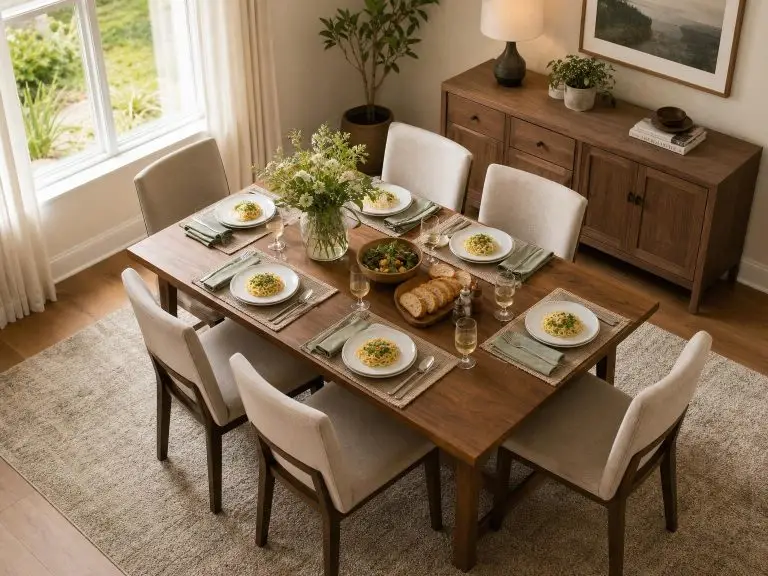
A dining room earns its place in daily life far beyond holiday dinners. It’s where homework gets done, laptops open for a quick email, and families gather for ordinary weeknight meals. Because this room serves so many purposes, its layout, lighting, and furniture need to work together rather than simply look good in a photograph. The right table size, sensible lighting, and supportive dining chairs all shape whether a room actually gets used—or becomes a place people avoid lingering in. This article offers practical, neutral guidance for creating a dining space that holds up to real life, not a sales pitch for any particular style or product.
Understanding How You Use Your Dining Room
Before rearranging any furniture, it helps to get honest about how the space actually functions. Is it the site of quick weeknight dinners, or does it double as a homework station and occasional gathering spot for twelve? Try listing your primary activities (daily meals) separately from secondary ones (holiday hosting, game nights). This list should directly inform table size, seat count, and how much storage you need nearby.
Equally important is understanding the room’s physical constraints. Measure the space and think about clearance—there should be enough room for chairs to slide back and for people to walk behind seated guests without squeezing past. Also map out traffic routes to the kitchen and other rooms; a table placed in the wrong spot can turn every meal into an obstacle course.
Key Takeaway: Start with how you live: your activities and traffic flow should dictate the dining room layout, not the other way around.
Planning a Functional Dining Room Layout
The dining table anchors the room both visually and functionally. Ideally, it should align with the room’s shape and any adjacent features, such as a kitchen island in a kitchen dining room combo. Don’t feel obligated to center it perfectly if doing so blocks a doorway or walkway—flow matters more than symmetry.
I once worked with a narrow dining space where centering the table left almost no room to open a nearby closet door. Shifting the table just a foot toward one wall freed up that path entirely and made the room feel far less cramped.
Storage pieces like sideboards or shelving should sit close enough to be convenient but far enough that they don’t crowd the seating area. Before finalizing any layout, check:
- Can every seat be reached without sidestepping around furniture?
- Is there a clear path from the kitchen to the table?
- Do doors and drawers open fully without hitting a chair?
Tip: Sit in each chair and simulate standing up to check for collisions—this simple test reveals problems no tape measure will catch.
Comfort and Ergonomics: Making the Room Pleasant to Sit In
Comfort at the table comes down to the relationship between seat height and tabletop height. When this differential is off, elbows sit too high or too low, and posture suffers over a long meal. A quick test: sit down, rest your forearms on the table, and notice whether your shoulders relax and your feet sit flat on the floor with knees comfortably bent.
Seat depth and cushioning matter too. A seat that’s too deep can press uncomfortably behind the knees, while too little padding turns an hour-long dinner into a test of endurance. Backrest height and angle also play a role in supporting a natural, upright posture.
At one gathering, half the guests sat in minimalist wooden chairs and the other half in cushioned, higher-backed seats. By dessert, it was clear which group was more relaxed and inclined to linger at the table.
Comfort Checklist:
- Can you sit comfortably for at least an hour?
- Is your lower back supported?
- Are your feet flat and shoulders relaxed?
Choosing Seating Types to Match Your Space and Lifestyle
Seating choices should reflect both your room’s dimensions and who uses it. Benches can work well in smaller or awkwardly shaped rooms, such as a living room dining room combo, offering flexible seating without the bulk of individual chairs. Rounded tables and chairs with softened backs can also make tight layouts feel more open.
Think about who typically sits down—young children, older relatives—and how easily each person can get in and out of their seat without disturbing others.
When mixing materials like wood, metal, or upholstery, aim for a cohesive look inspired by current dining room trends, but prioritize comfort and ergonomics before aesthetics. A stunning chair that no one wants to sit in defeats its own purpose.
Key Takeaway: Choose seating with comfort first, style second; the most inviting modern dining rooms are the ones people enjoy sitting in.
Lighting, Acoustics, and Atmosphere that Support Use
Good lighting layers several sources: a fixture over the table for focused light, ambient lighting for the room, and optional task lighting for reading or working. Dimmers allow the space to shift from bright everyday use to a softer mood for gatherings. Make sure fixtures hang high enough that seated diners don’t feel boxed in.
Soft materials—rugs, curtains, upholstered seats—absorb sound and make conversation easier in a room that might otherwise echo. Combine this with surfaces that are easy to clean but not uncomfortably hard or cold for extended sitting.
Atmosphere Adjustments: Add a rug or plants to soften echo, and adjust lighting temperature to suit the mood of the meal.
Bringing It All Together: Creating a Dining Room That Works for You
A functional dining room starts with understanding your daily habits, follows through with a layout that respects clearance and flow, and finishes with seating and lighting that support comfort over long periods. A successful dining room is one you can comfortably use every day, not just one that looks good in photos.
Test your current setup: sit in each chair, walk around the table, and notice where friction occurs. Consider one small adjustment—shifting the table, removing an obstruction, or reassessing your seating—that could immediately make the space more livable. Treat the room as adaptable, ready to evolve alongside your household’s changing needs.