Small Footprint, Massive Character: How to Design a Mini Home Library
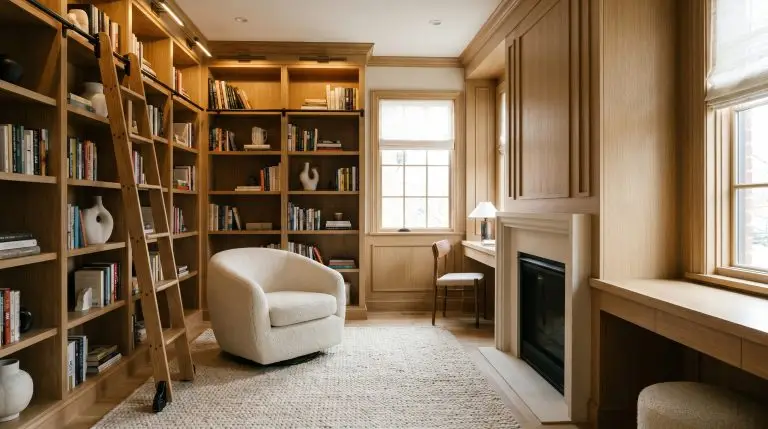
Running out of wall space but your book collection keeps growing? Implementing a highly functional mini library design transforms underutilized residential square footage into a fiercely intentional architectural feature.
We believe that you do not need a sprawling, wood-paneled Victorian study to house your literary collection; you simply need rigorous spatial planning, exact load-bearing calculations, and curated localized lighting.
We are breaking down exactly how to execute this micro-application with absolute precision.
Spatial Alchemy: Where to Carve Out a Mini Library
Mini libraries thrive in the transitional, often-ignored dead zones of a floor plan. Identifying the right physical footprint is the critical first step in seamlessly integrating heavy physical storage without suffocating your existing layout.
The Under-Stair Apothecary Configuration
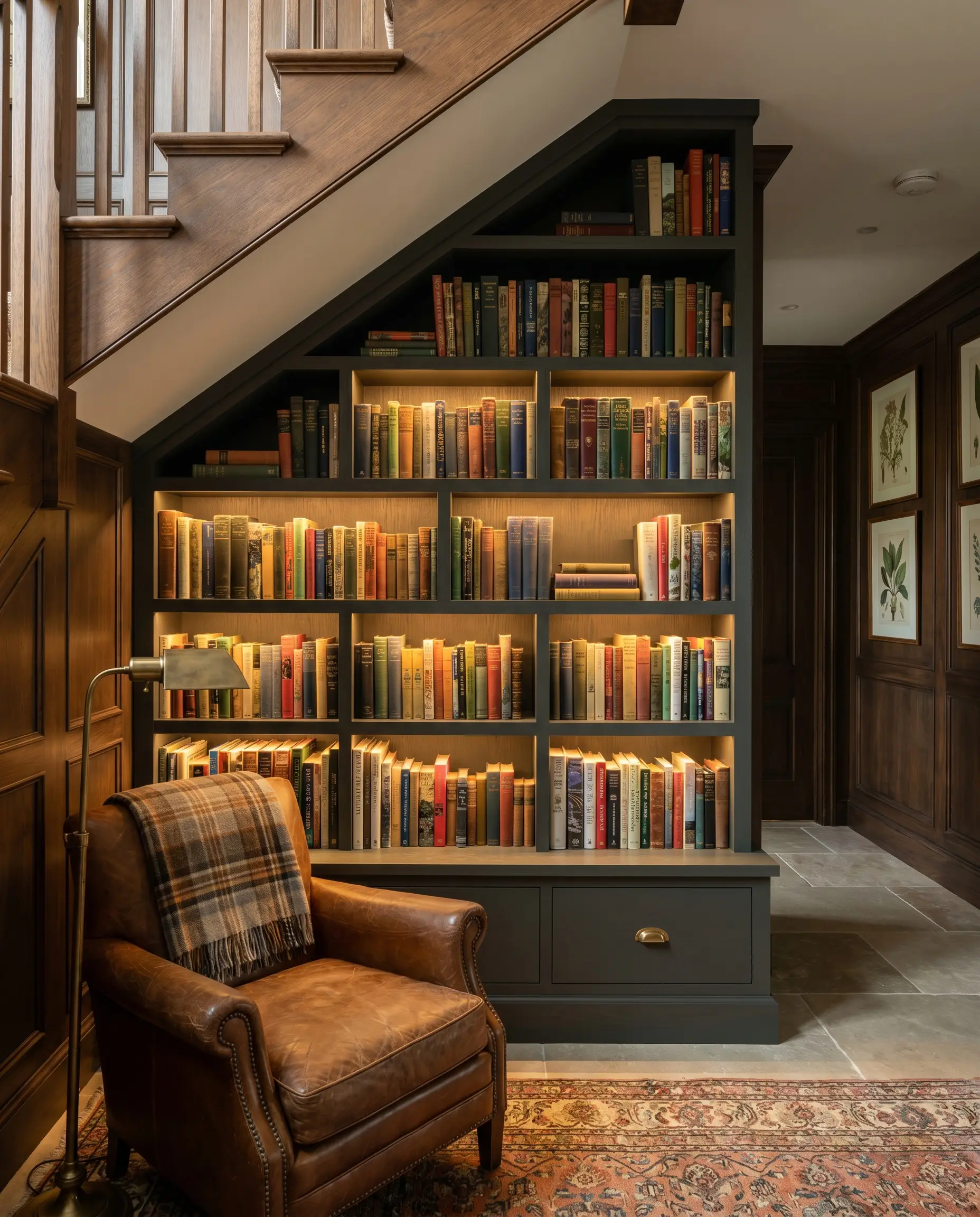
The acute angle beneath a staircase naturally begs for custom joinery, turning a notoriously awkward void into a stunning focal point. By staggering the shelving depths to match the stair risers, you create an apothecary-style visual rhythm that draws the eye upward while maximizing storage capacity.
- Vibe: Dark Academia meets spatial ingenuity.
- Key Materials: Rift-sawn white oak millwork, unlacquered brass hardware.
- Paint Match: Farrow & Ball Studio Green.
- Architectural Insight: Ensure a minimum shelf depth of 10 inches for standard hardcovers, reinforcing spans wider than 32 inches with hidden steel brackets to prevent bowing under the weight of the books.
The Transitional Hallway Gallery
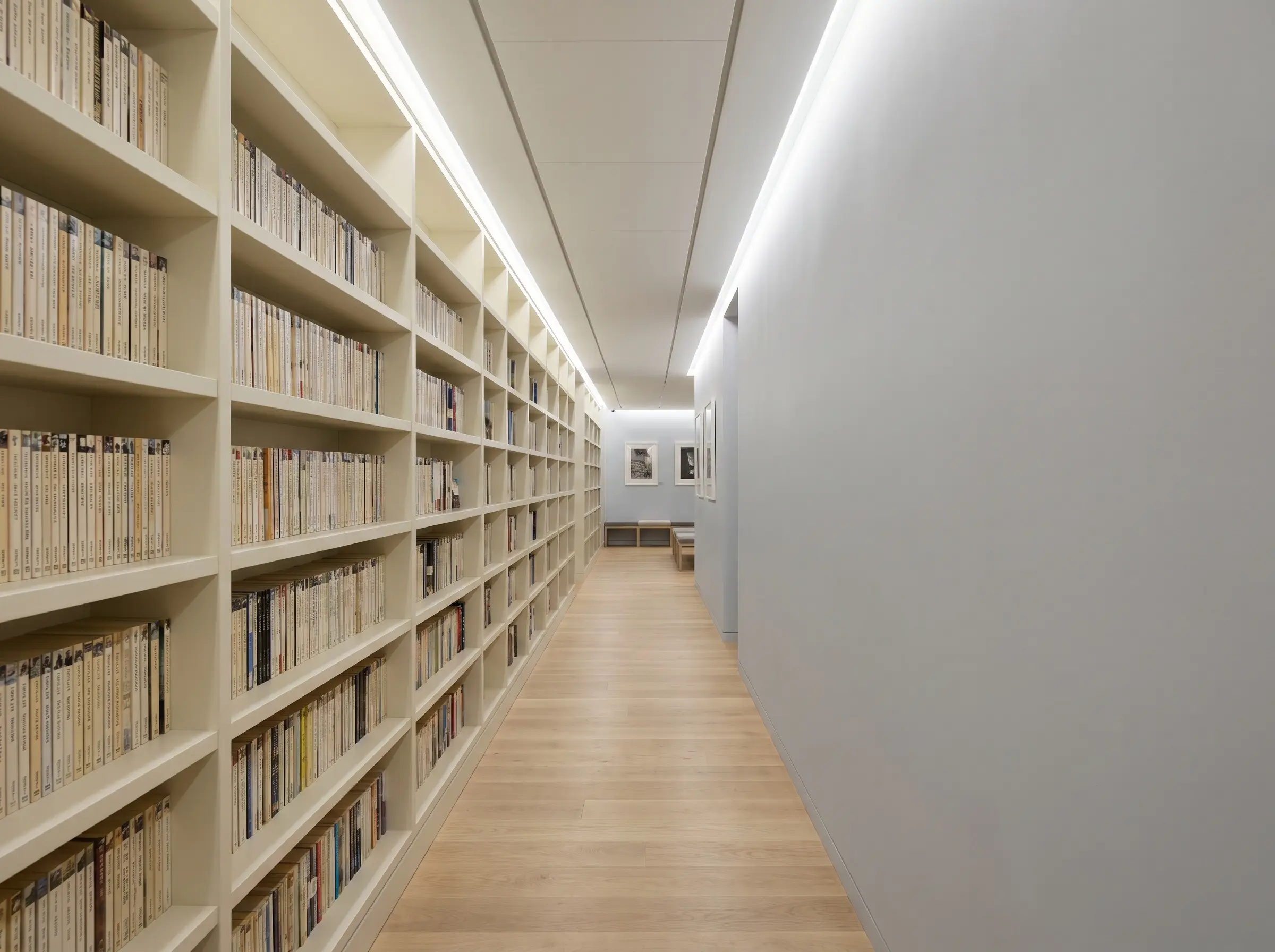
Hallways are notoriously underutilized, serving merely as transit corridors rather than functional rooms. Lining one side with floor-to-ceiling, ultra-shallow shelving converts the thoroughfare into an immersive, gallery-like reading corridor.
- Vibe: Tailored, museum-curator precision.
- Key Materials: Primed MDF painted to match the walls for a built-in illusion.
- Color Match: Sherwin-Williams Alabaster.
- Architectural Insight: Mandate a maximum shelf depth of 8 inches (sufficient for standard paperbacks) to preserve a strict 36-inch walking clearance in the hallway.
The Bedroom Corner Alcove Integration
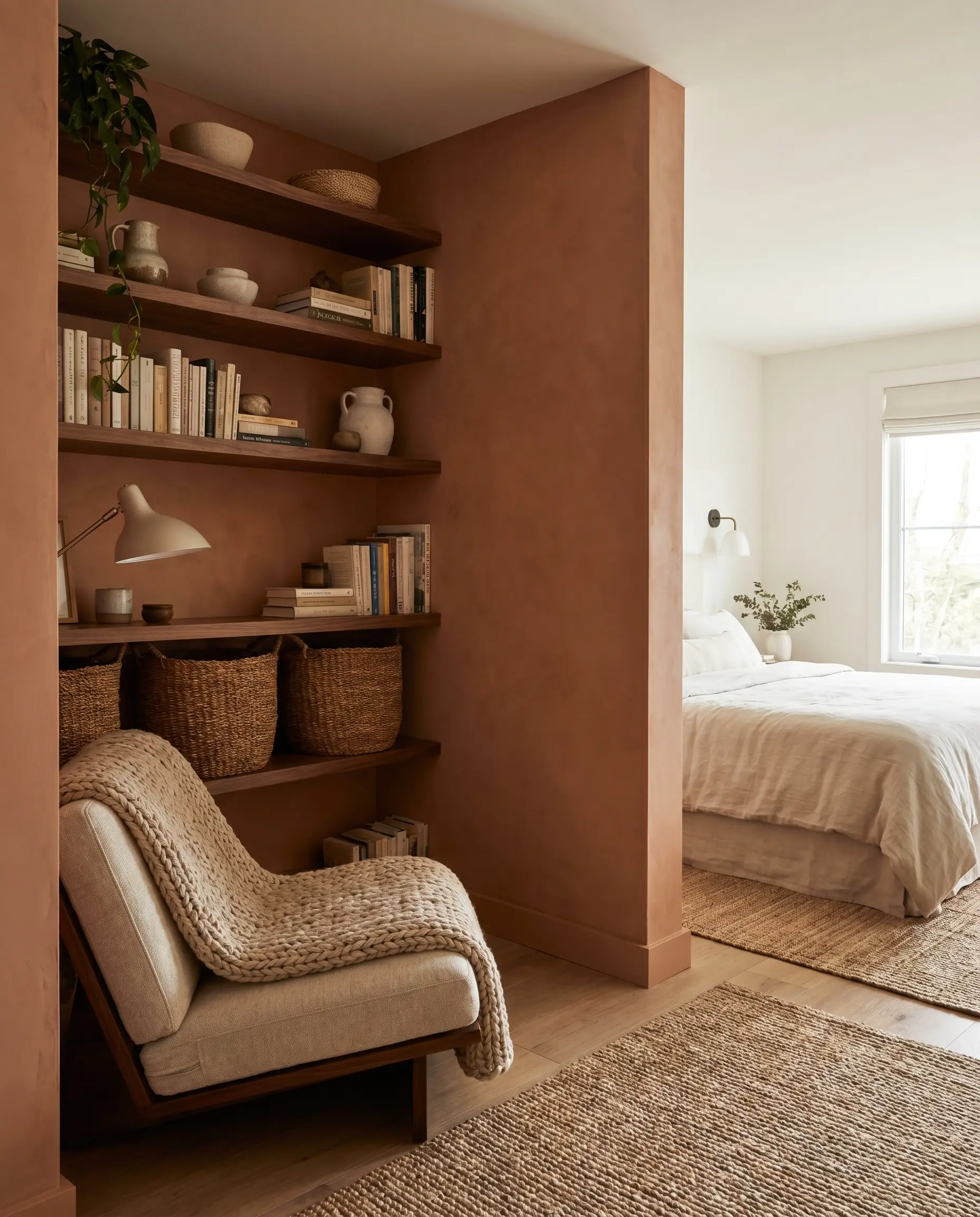
Transforming a bedroom corner into a dedicated reading alcove establishes a distinct psychological boundary between resting and reading. Wrapping the shelves around the 90-degree angle softens the room’s geometry and creates a cocooning, texturally rich focal point.
- Vibe: Organic Modern tranquility.
- Key Materials: Roman clay wall treatments, floating walnut ledges.
- Styling Pro-Tip: Anchor the bottom shelf with woven baskets to conceal unsightly charging cables and bedtime reading glasses.
- Architectural Insight: Install the lowest shelf at least 30 inches off the floor to accommodate a low-profile lounge chair directly beneath the corner joint.
The Dining Room Dual-Purpose Wall
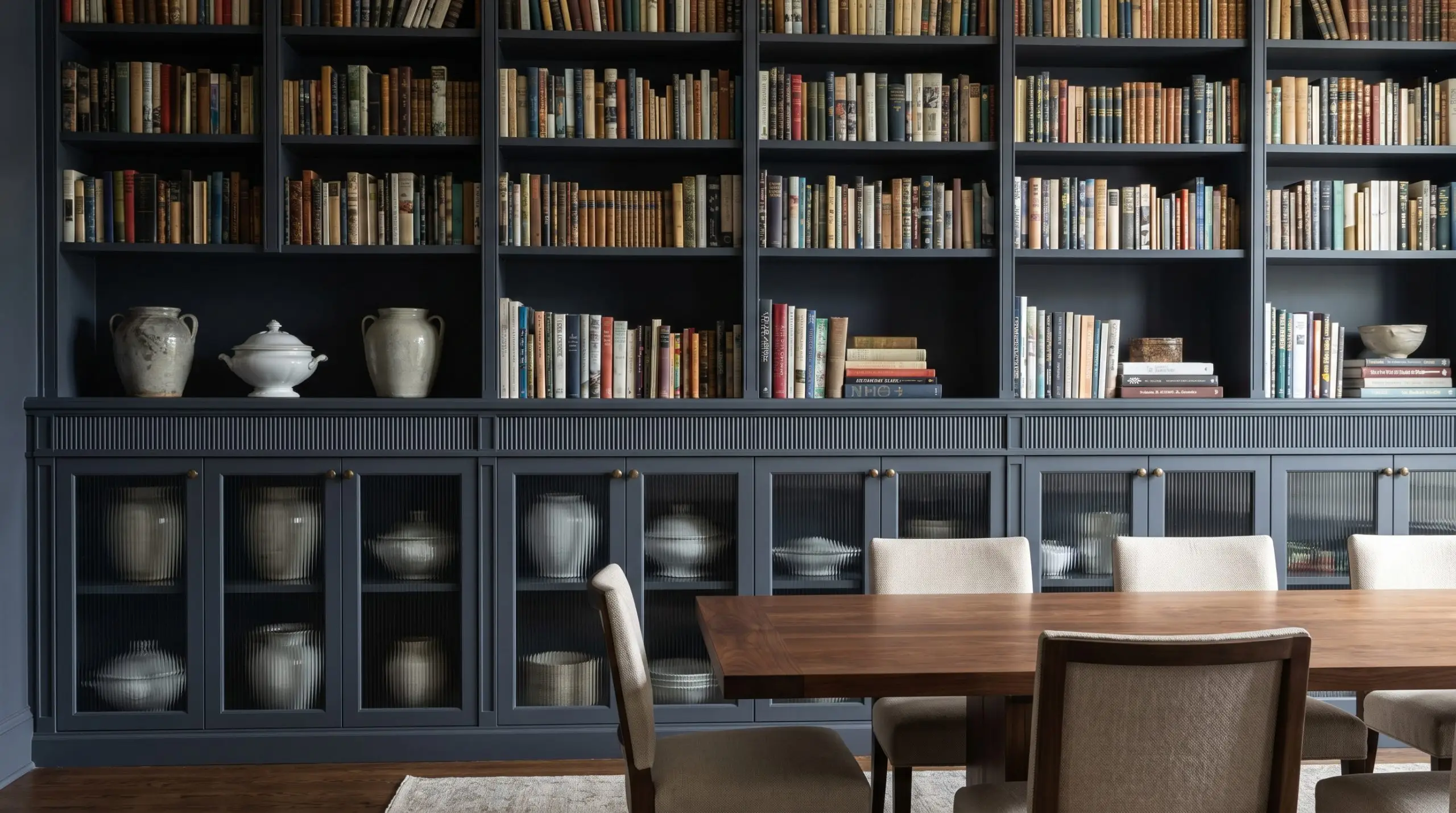
Integrating a library into the dining room introduces an immediate layer of intellectual warmth to a space typically reserved for formal entertaining. By mixing heavy dinnerware and serving platters on the lower tiers with your literary collection above, the wall becomes a striking study in contrasting materials.
- Vibe: European salon sophistication.
- Key Materials: Fluted fascia trim, reeded glass base cabinet doors.
- Paint Match: Benjamin Moore Hale Navy.
- Architectural Insight: Dedicate the bottom 36 inches to closed base cabinetry for heavy ceramics, reserving the upper open shelving strictly for books to maintain top-light visual balance.
The Closet-to-Library Conversion
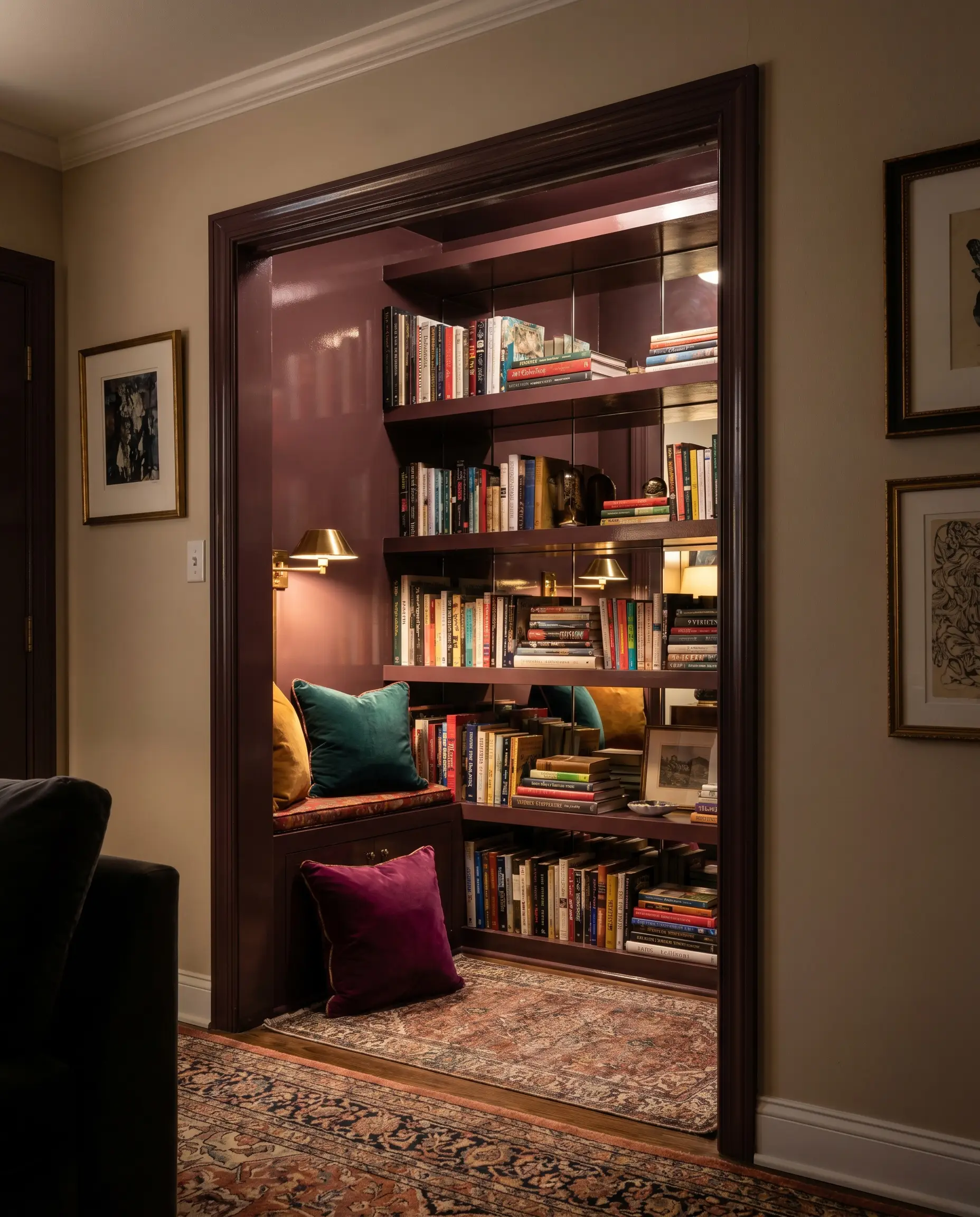
Sacrificing a secondary coat closet is a brilliant trade-off for a hyper-concentrated, jewel-box reading nook. Removing the doors and wrapping the interior entirely in a dark, saturated tone creates profound visual depth, framing the books as an illuminated art installation.
- Vibe: High-contrast Maximalist jewel box.
- Key Materials: High-gloss lacquer, mirrored back panels.
- Color Match: Farrow & Ball Brinjal.
- Architectural Insight: Reinforce the existing closet drywall with half-inch plywood backing before installing shelves; standard closet drywall anchors cannot support the dense load of a full book collection.
Architectural Execution: Shelving and Structural Integrity
Books are deceptive; their physical weight accumulates rapidly, easily overwhelming standard residential hardware. A successful small-space library requires an industrial-grade structural approach masked by refined, high-end finishing.
Floor-to-Ceiling Verticality for Scale
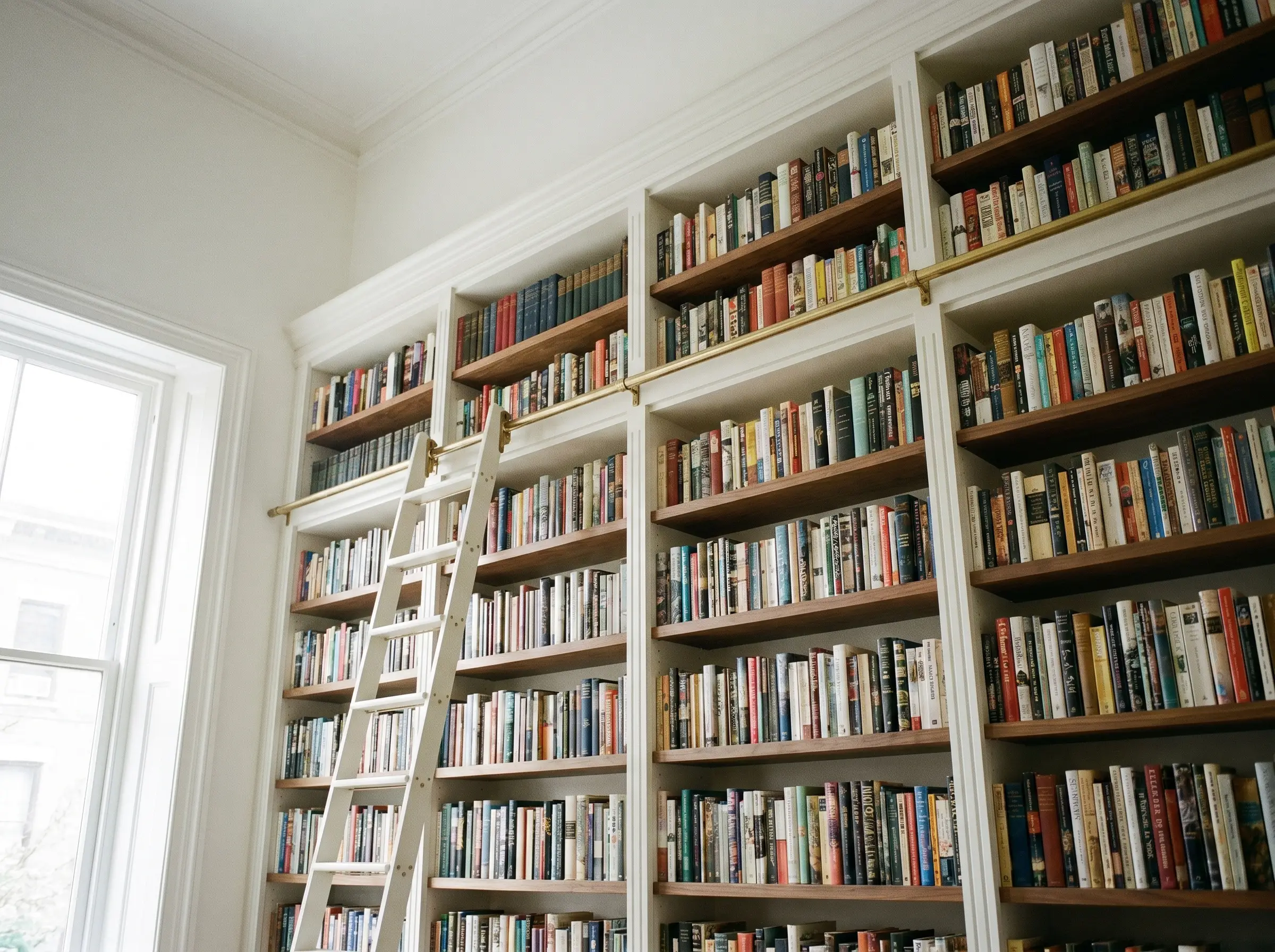
Pushing shelving entirely to the ceiling forces the eye upward, instantly making a cramped room feel taller and more expansive. This uninterrupted verticality creates a commanding architectural presence, turning simple storage into a structural monolith.
- Vibe: Bespoke architectural grandeur.
- Key Materials: Custom plywood core with premium wood veneer, crown molding integration.
- Color Match: Benjamin Moore Chantilly Lace to blend seamlessly with white ceilings.
- Architectural Insight: For ceilings taller than 9 feet, incorporate a rolling library ladder on a solid brass track, ensuring the track is bolted directly into the structural header.
Floating Steel Profiles for a Minimalist Footprint
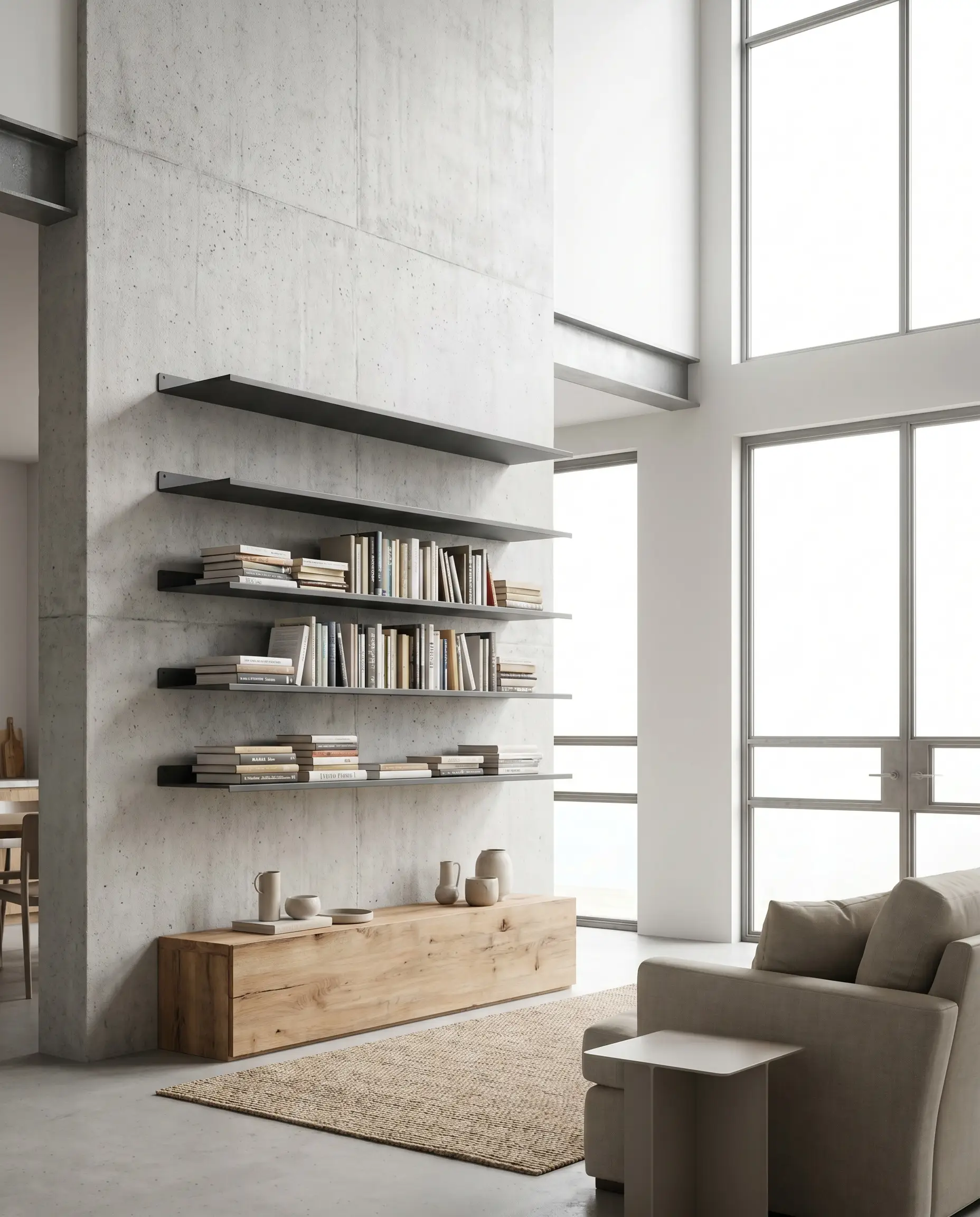
Traditional wooden bookcases carry heavy visual weight, which can suffocate a micro-footprint. Swapping chunky timber for ultra-thin, powder-coated steel profiles provides immense load-bearing capacity while maintaining a light, bracketless, and airy aesthetic.
- Vibe: Brutalist-leaning Minimalism.
- Key Materials: 1/4-inch powder-coated cold-rolled steel.
- Styling Pro-Tip: Use hidden spine-bookends to make stacks appear as if they are defying gravity on the thin metal ledges.
- Architectural Insight: Steel profiles must be anchored directly into wall studs using heavy-duty lag screws; hollow-wall anchors will fail instantly under library loads.
The Wrap-Around Door Frame Library
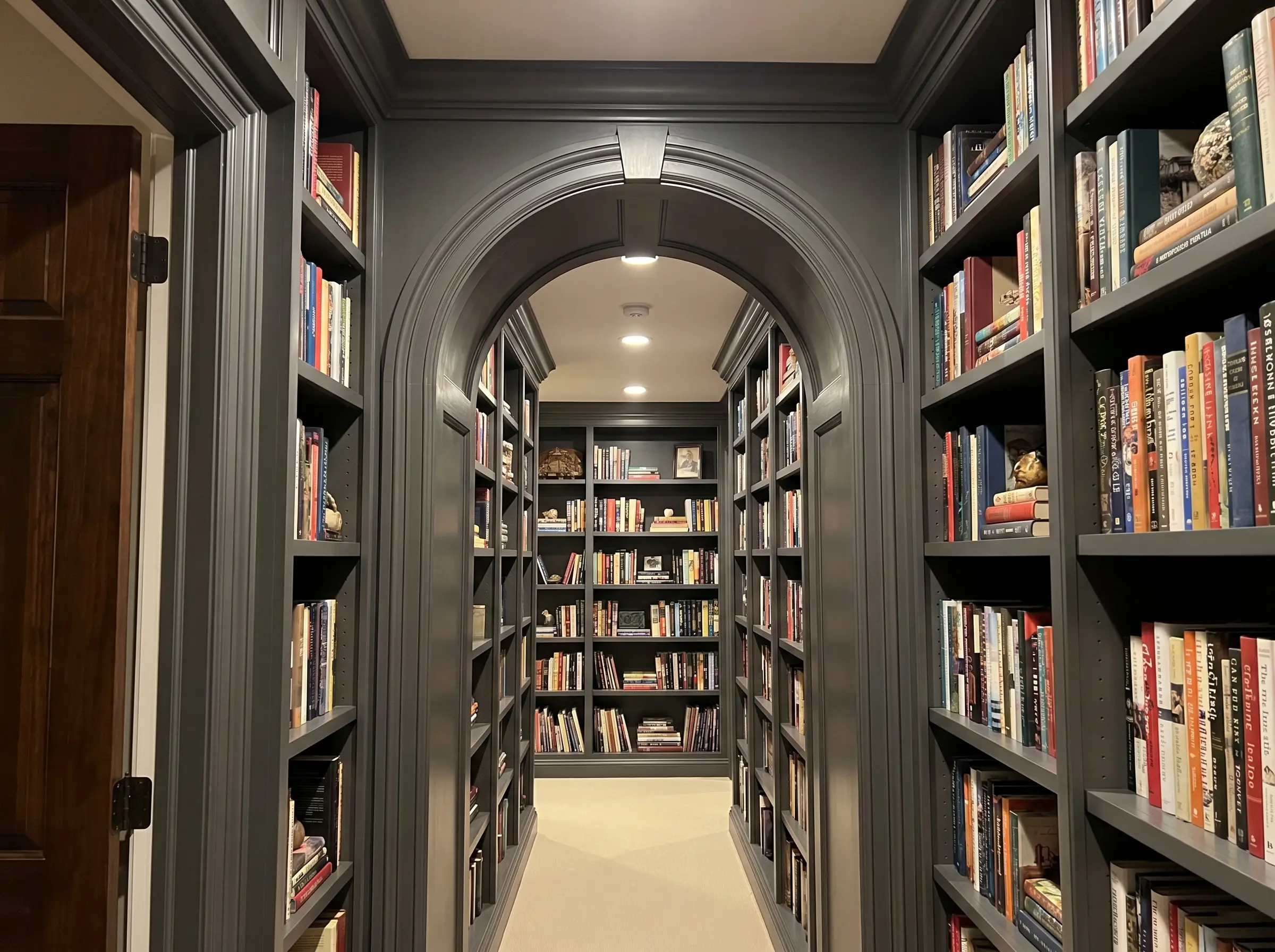
The 12 to 18 inches of drywall surrounding a standard doorway is typically wasted space. Framing the door with custom shelving utilizes this dead zone, creating a deeply immersive, tunnel-like entry into the room that screams high-end bespoke joinery.
- Vibe: English manor resourcefulness.
- Key Materials: Solid maple face frames, integrated architraves.
- Paint Match: Sherwin-Williams Peppercorn.
- Architectural Insight: Leave a strict 2-inch clearance between the door casing and the start of the vertical shelf support to allow for standard door hinge swing and future hardware updates.
Concealed Push-to-Open Base Cabinetry
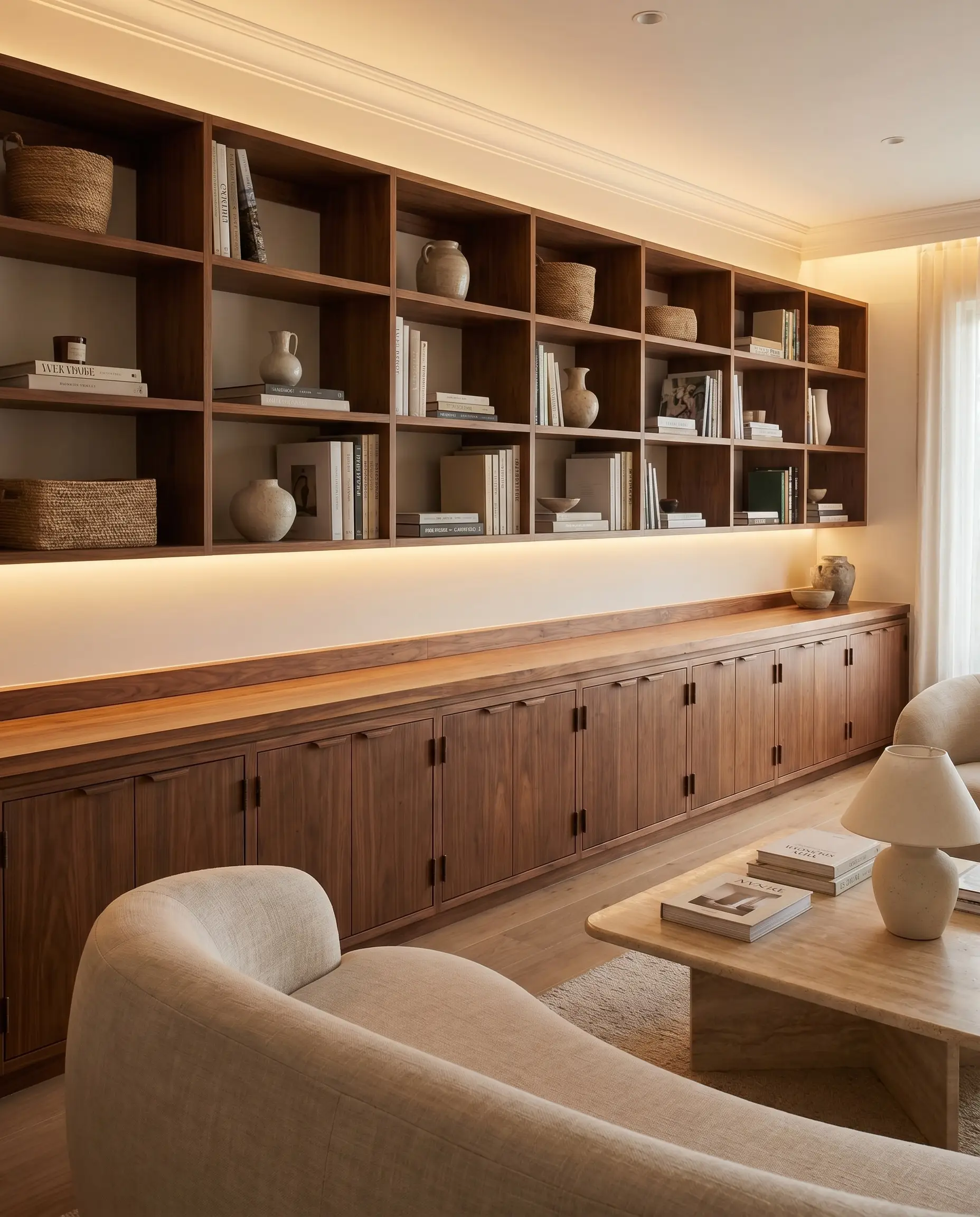
Not everything in a library deserves to be on display. Anchoring your open shelving with a row of sleek, hardware-free base cabinets grounds the design while hiding visually chaotic items like routers, dog-eared paperbacks, and board games.
- Vibe: Streamlined Organic Modernism.
- Key Materials: Flat-panel walnut doors, heavy-duty concealed hinges.
- Styling Pro-Tip: Continue the baseboard molding across the bottom of the cabinets to make them look like permanent architectural fixtures.
- Architectural Insight: Specify a standard base cabinet depth of 15 to 18 inches, stepping back to a 10-inch depth for the open shelving above to create a functional counter ledge.
Angled Mansard Roof Shelving
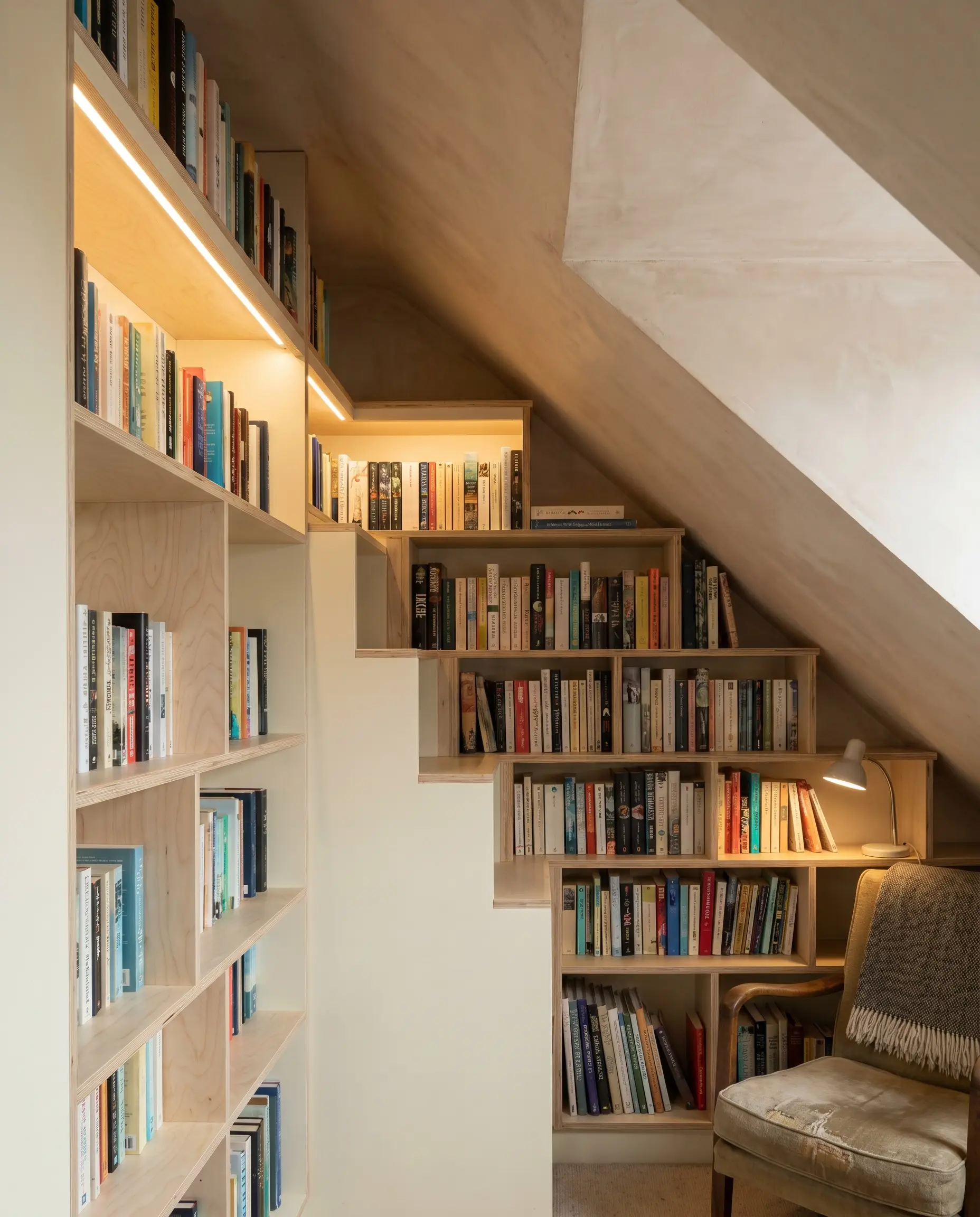
Attic conversions and sloped ceilings present notoriously difficult geometry for standard furniture. Custom-cutting shelving profiles to step down in tandem with the roofline pitch turns an awkward architectural hurdle into a brilliant, custom-fitted display.
- Vibe: Cozy, architectural problem-solving.
- Key Materials: Paint-grade birch plywood, seamless caulk finishing.
- Color Match: Farrow & Ball Pointing.
- Architectural Insight: Utilize a scribe tool during installation to perfectly match the shelving returns to the uneven plaster variations of a sloped ceiling.
The Reading Ritual: Seating and Ergonomics in Tight Spaces
A library without dedicated seating is merely a storage wall, lacking the invitation to pause and consume the material. Executing comfortable ergonomics within a micro-footprint demands specific, highly calculated furniture selections.
The Integrated Window Seat with Plinth Drawer Storage
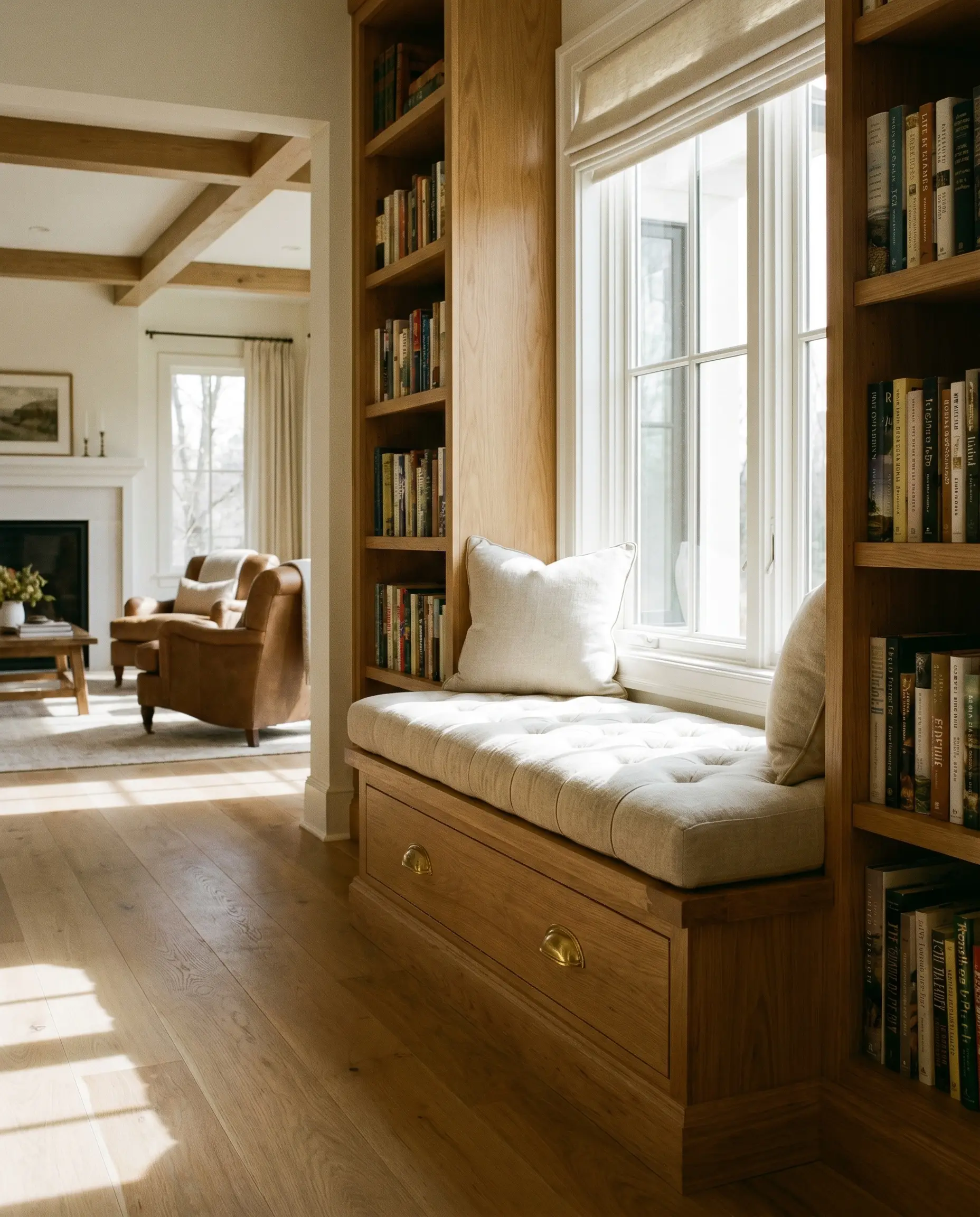
Capturing the recess of a window creates an immediate, light-filled reading zone without consuming central floor space. Building a structural plinth beneath the seat provides a deep, concealed drawer for heavy blankets or oversized folios.
- Vibe: Classic, sun-drenched comfort.
- Key Materials: Heavyweight linen upholstery, solid brass cup pulls.
- Styling Pro-Tip: Use a French-tufted bench cushion to add a layer of tailored sophistication to the millwork.
- Comfort Metric: Specify high-resilience, multi-density foam for the cushion, maintaining a minimum seat depth of 24 inches to allow for pulling your knees up comfortably.
Low-Profile Bouclé Swivel Chairs
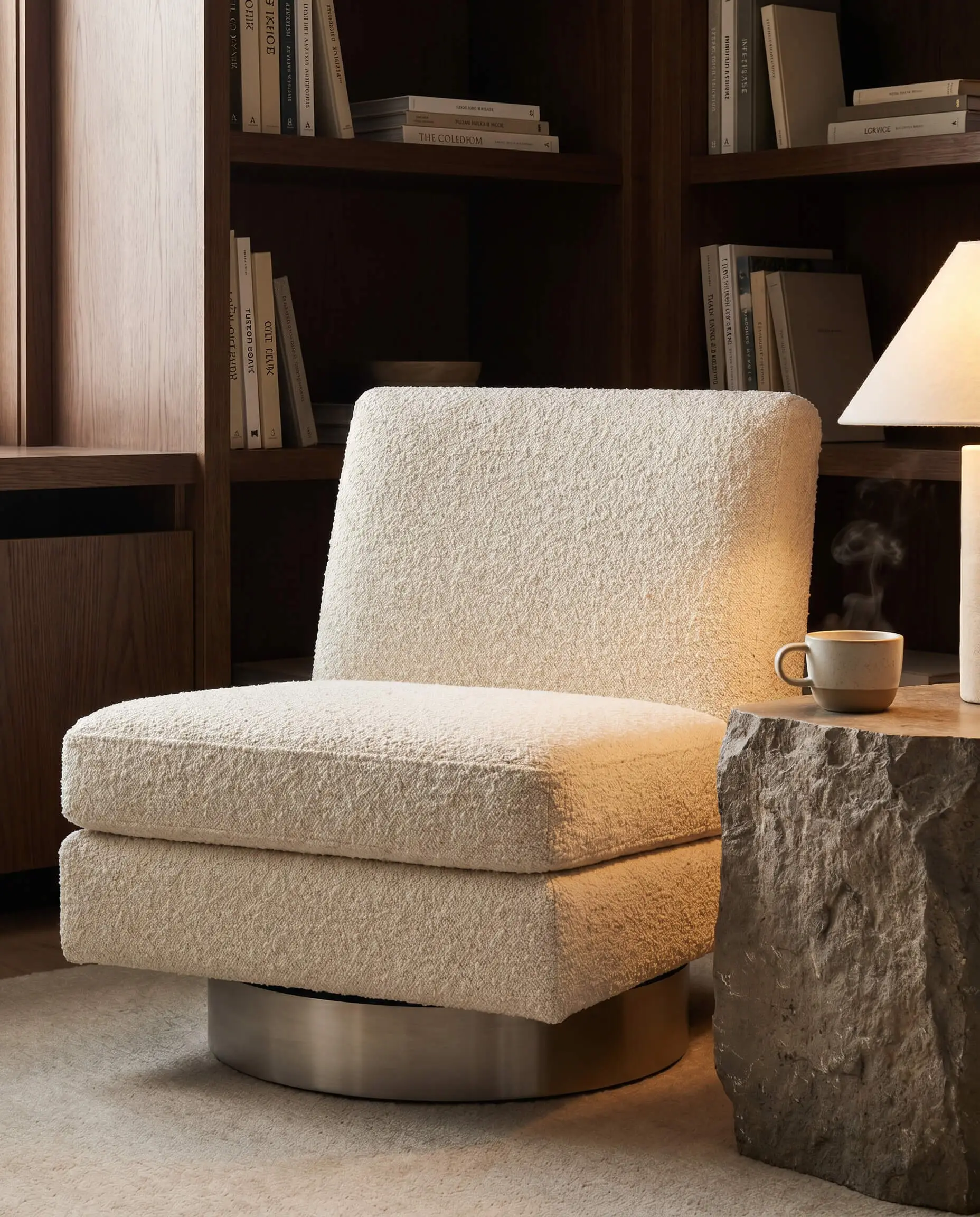
In a tight alcove, a stationary armchair traps the user, making ingress and egress incredibly clumsy. A low-profile swivel chair allows the reader to seamlessly pivot from reaching for a book to facing the room, clad in nubby textiles that absorb sound.
- Vibe: Mid-century tactile luxury.
- Key Materials: Heavyweight bouclé, brushed steel swivel base.
- Styling Pro-Tip: Pair with a monolithic stone side table just large enough for a single coffee cup.
- Comfort Metric: Look for a back-pitch angle of 105 to 110 degrees, which provides optimal lumbar support for prolonged reading without forcing a slumped posture.
Floor Cushions and Layered Textures for Micro-Nooks
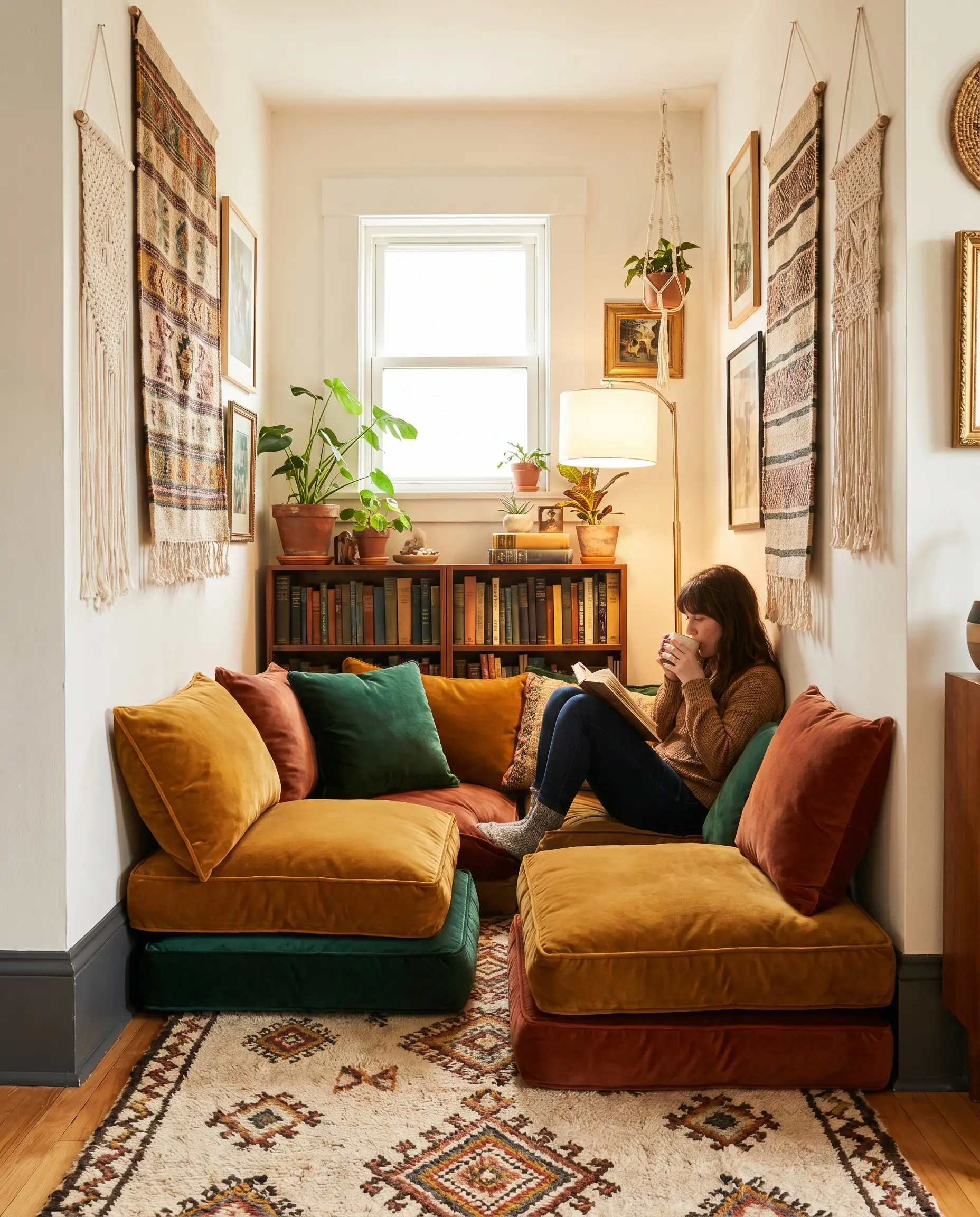
When square footage absolutely forbids a framed chair, the floor itself must become the furniture. Layering dense, high-quality floor cushions over a thick wool rug transforms a tiny corner into a deeply grounding, bohemian retreat.
- Vibe: Grounded, relaxed Maximalism.
- Key Materials: Vintage Moroccan rugs, velvet box cushions.
- Color Match: Benjamin Moore Wrought Iron for the surrounding baseboards to ground the space.
- Comfort Metric: Ensure floor cushions have a minimum thickness of 6 inches and utilize a firm foam core wrapped in down to prevent bottoming out against the hardwood.
Wall-Mounted Drop-Leaf Desks for Journaling
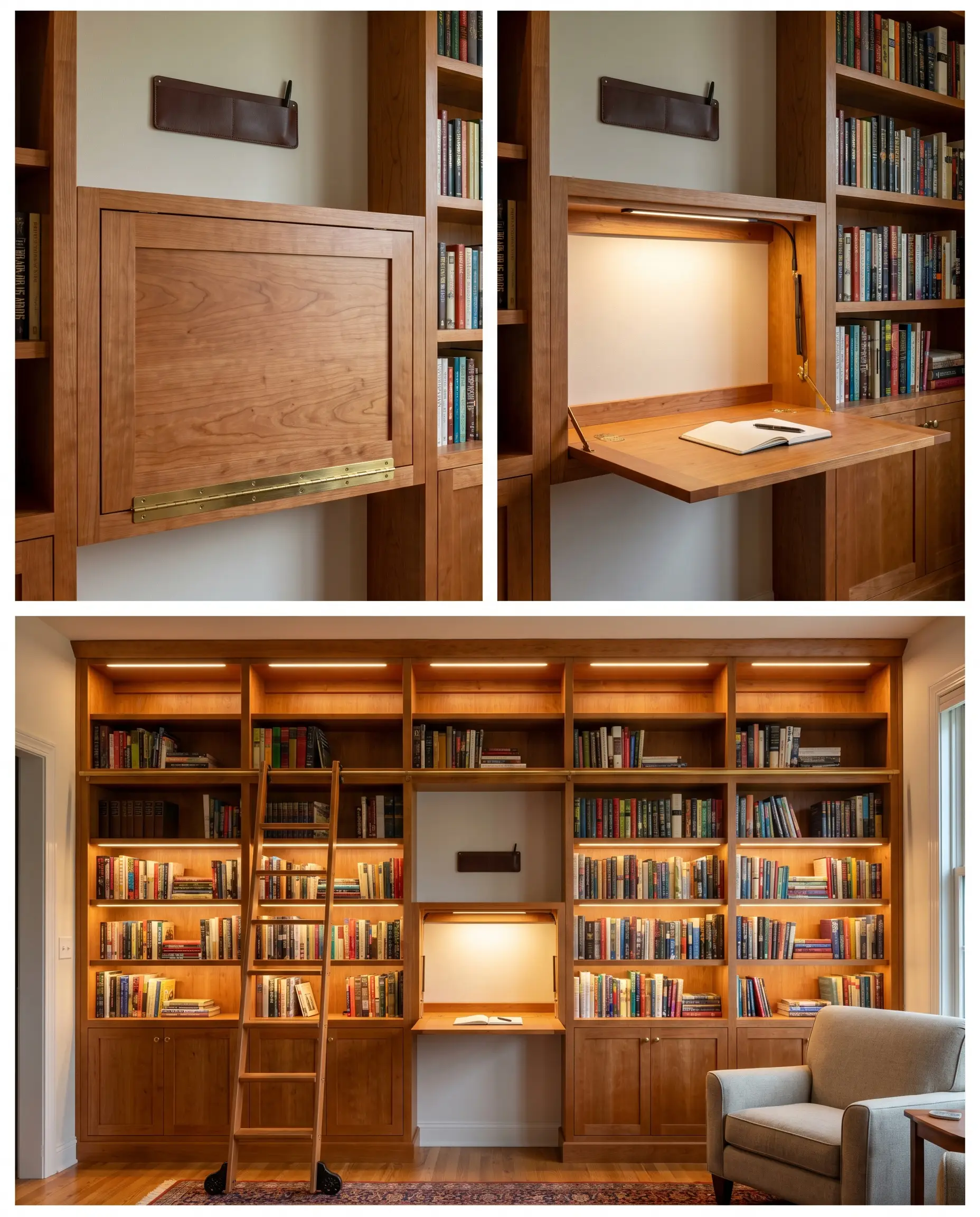
Integrating a drop-leaf desk directly into the bookshelf framework offers a momentary study experience that vanishes when not in use. This fold-away architecture accommodates journaling or laptop work without permanently claiming precious floor space.
- Vibe: Utilitarian, Shaker-inspired intelligence.
- Key Materials: Solid cherry wood, heavy-duty piano hinges.
- Styling Pro-Tip: Mount a slim, magnetic leather pen holder on the wall directly above the fold-out surface.
- Comfort Metric: Mount the drop-leaf surface precisely 29 to 30 inches from the floor to align with standard ergonomic desk heights.
Lighting and Ambience: The Technical Elements
Proper illumination is the precise variable that separates a dark, uninviting storage closet from a curated reading retreat. You must balance the ambient glow that highlights the architecture with the directional clarity required to read a page without eye strain.
Hardwired Brass Art Sconces Over Top Shelves
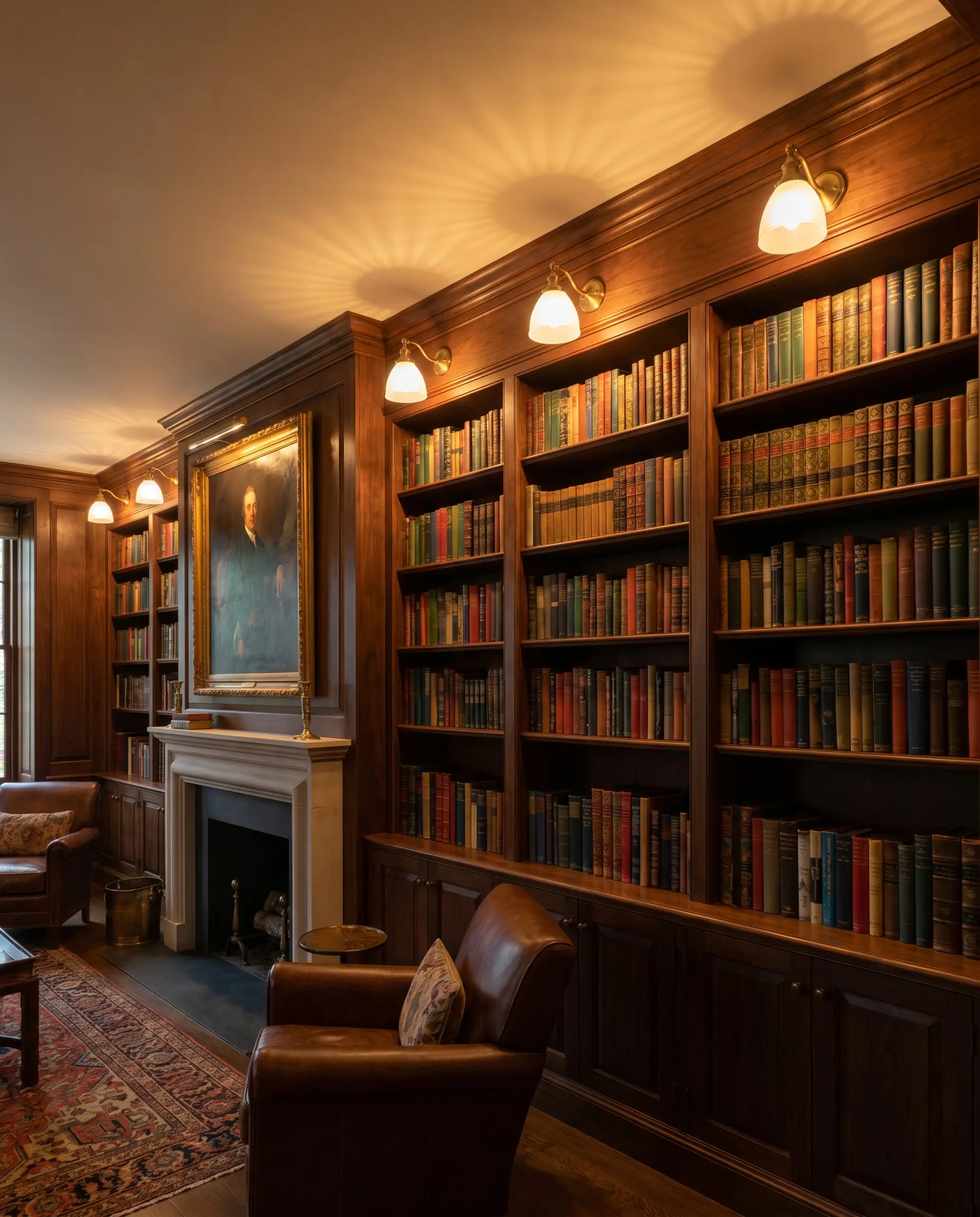
Mounting classic art sconces on the fascia board above your top shelf casts a dramatic, sweeping wash of light down the spines of your books. This technique mimics high-end retail and gallery lighting, establishing the library as the room’s primary focal point.
- Vibe: Traditional, library-club opulence.
- Key Materials: Unlacquered brass, frosted glass diffusers.
- Styling Pro-Tip: Space sconces every 36 to 48 inches along the top run to ensure an even scallop of light without harsh shadowing.
- Lighting Spec: Specify a Color Rendering Index (CRI) of 90+ to ensure the colorful jackets of your books render accurately under the artificial wash.
Rechargeable Magnetic Task Lighting for Renters
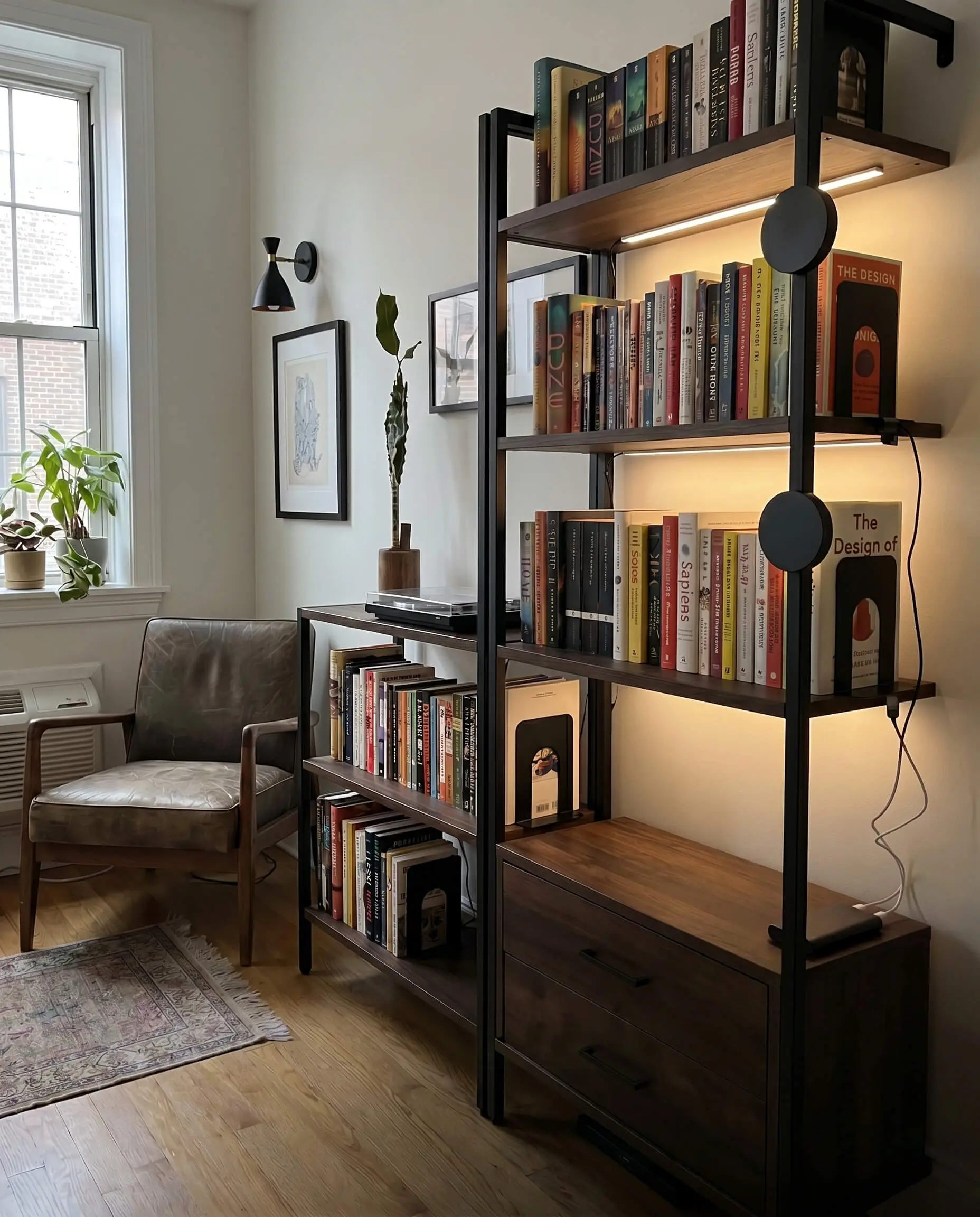
Renters and budget-conscious decorators often cannot rip open drywall to hardwire dedicated lighting. The current market offers incredibly sophisticated, USB-C rechargeable magnetic pucks and sconces that adhere directly to shelving, delivering bespoke illumination without the electrician’s invoice.
- Vibe: High-tech, accessible modernism.
- Key Materials: Matte black aluminum housings, magnetic mounting plates.
- Styling Pro-Tip: Hide the magnetic mounting strip directly behind the front lip of the shelf so the light source remains entirely invisible to the room.
- Lighting Spec: Select fixtures that output between 300 and 400 Lumens per shelf—enough to read spines clearly without turning the alcove into a glaring interrogatory space.
Warm Dimming Technology for Day-to-Night Transitions
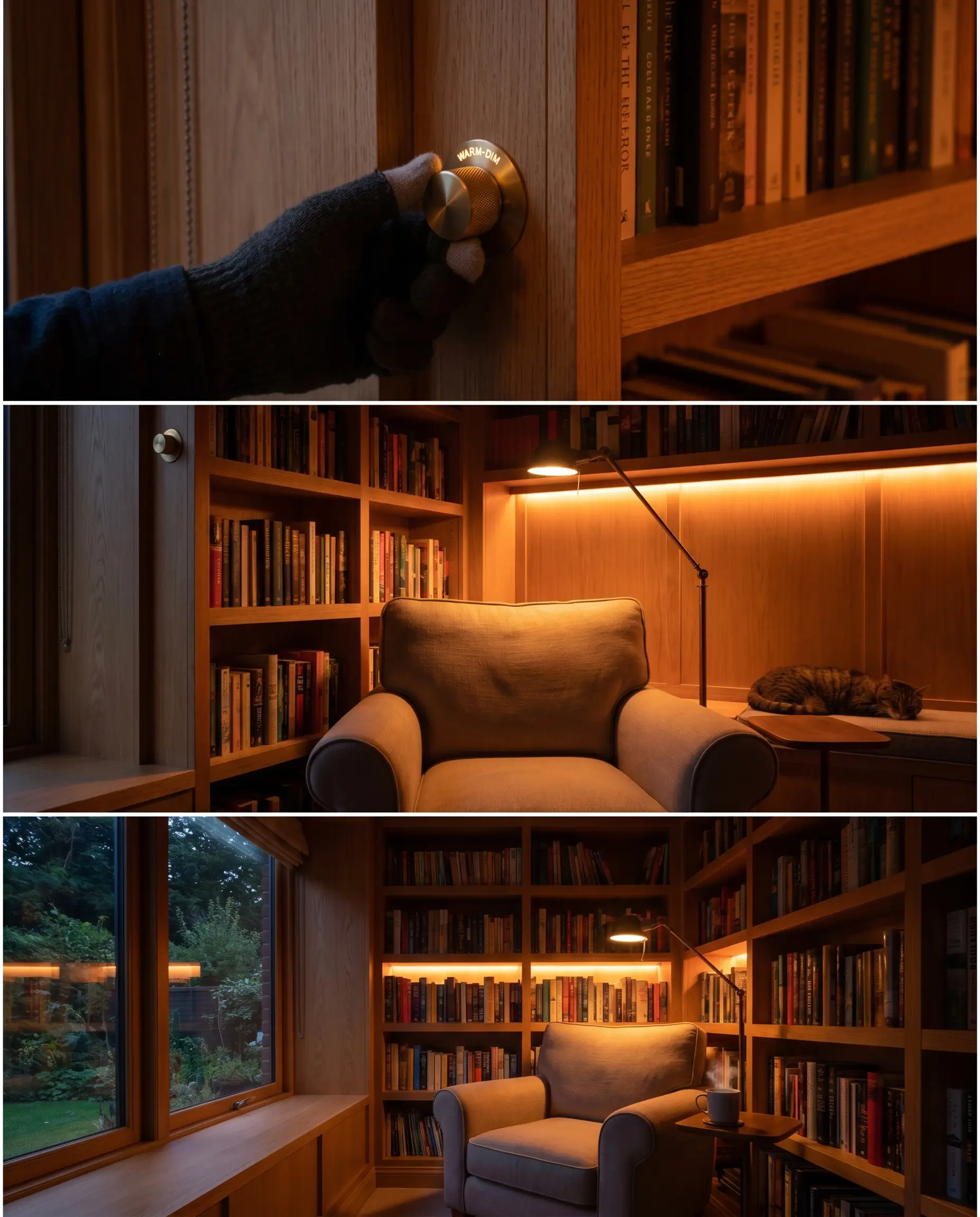
A reading nook must adapt to the shifting circadian rhythms of the home. Implementing warm-dim technology ensures that as you lower the brightness in the evening, the light physically shifts from a crisp afternoon white to a deep, firelight amber.
- Vibe: Sensory, biologically aligned comfort.
- Key Materials: Smart LED drivers, tactile rotary dimmer switches.
- Styling Pro-Tip: Install a knurled brass rotary dimmer switch directly into the side of the bookcase for a tactile, high-end mechanical feel.
- Lighting Spec: Program the warm-dim bulbs to shift from a crisp 3000K during midday reading down to a deeply relaxing 2200K for evening use.
Backlit LED Shelf Extrusions for Depth
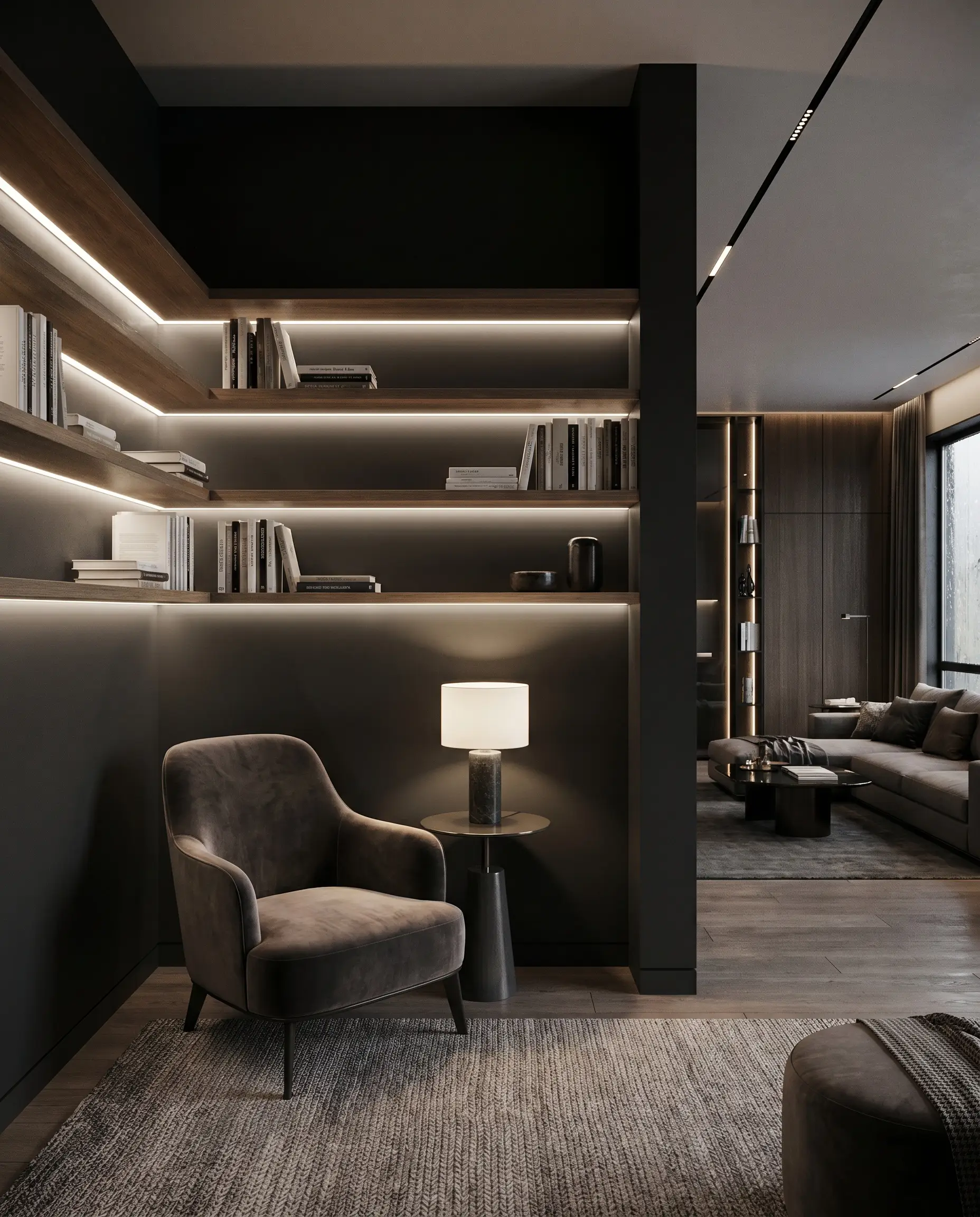
Routing a shallow channel into the back edge of your shelves to house LED tape creates a stunning silhouette effect, making the books appear as if they are floating in front of a glowing wall. This technique adds profound visual depth to incredibly shallow alcoves.
- Vibe: Moody, contemporary boutique.
- Key Materials: Aluminum LED extrusions, frosted polycarbonate diffusers.
- Color Match: Sherwin-Williams Tricorn Black on the back wall to maximize the glowing silhouette contrast.
- Lighting Spec: Mandate the use of frosted diffusers over the raw LED tape; exposed diodes will reflect harshly off glossy book covers and ruin the seamless ambient glow.
Curation and Styling: Managing the Visual Weight of Books
A dense collection of literature inherently carries a chaotic visual weight that can easily overwhelm a restricted footprint. Professional curation requires balancing negative space, grouping forms, and introducing grounding materials to let the eye rest.
The 60/40 Ratio for Books and Objects
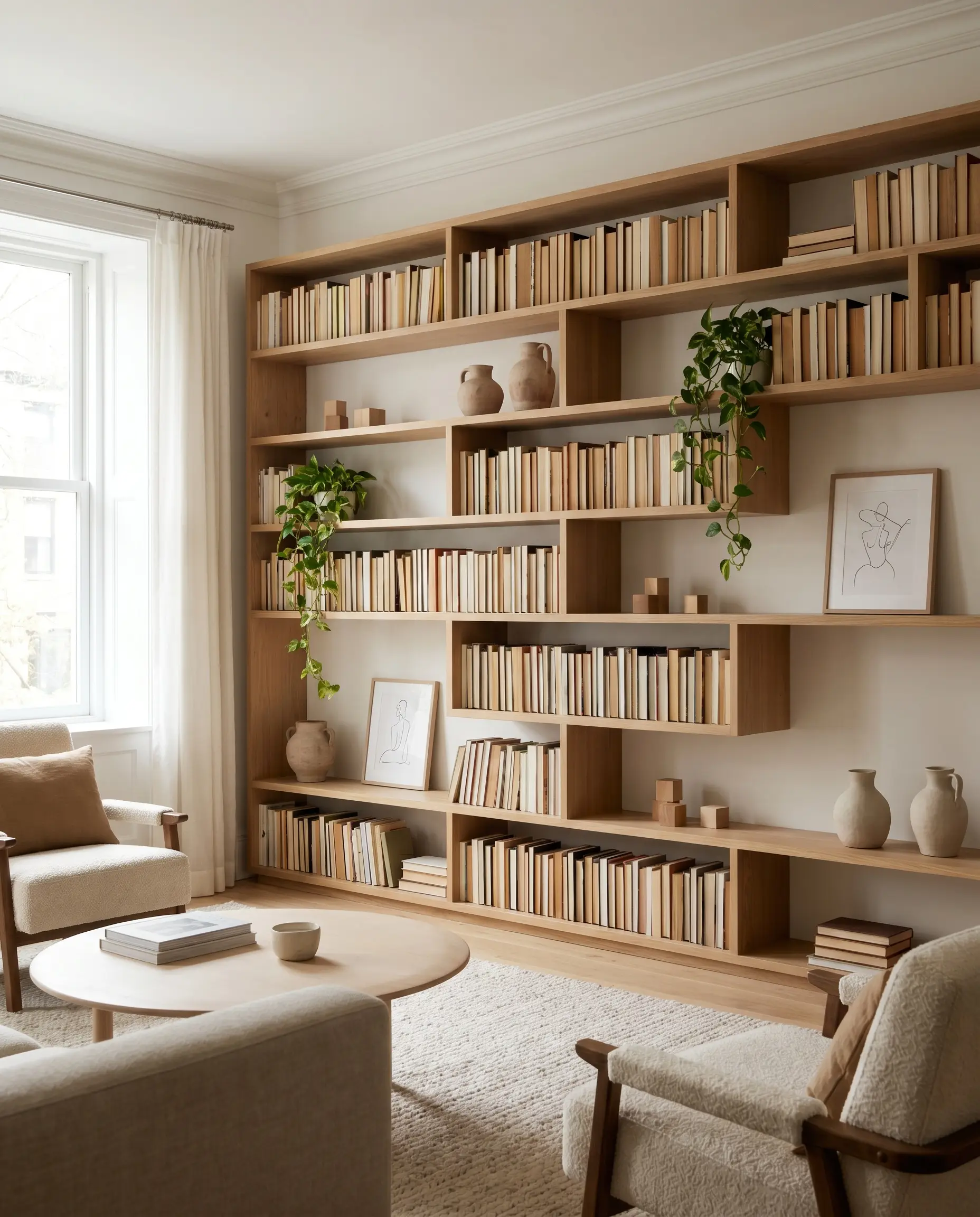
Packing every inch of shelving with vertical spines creates a monolithic wall of visual noise. Adhering to a strict ratio of books to negative space and sculptural objects introduces necessary breathing room, transforming a storage unit into a curated display.
- Vibe: Balanced, intentional curation.
- Sculptural raw clay ceramics.
- Trailing organic greenery (e.g., Pothos or Philodendron).
- Small architectural models or geometric wood blocks.
- Framed line-art leaning against the back panel.
- Styling Pro-Tip: Treat negative space as an object itself; leaving a 10-inch gap completely empty is a powerful design choice.
When applying the 60/40 rule, stagger the dense book groupings in a zig-zag pattern across the shelves (e.g., left-aligned on shelf one, right-aligned on shelf two) to keep the visual weight perfectly balanced.
Hackrea Styling Tip
Color-Muted Jackets vs. Eclectic Spine Groupings
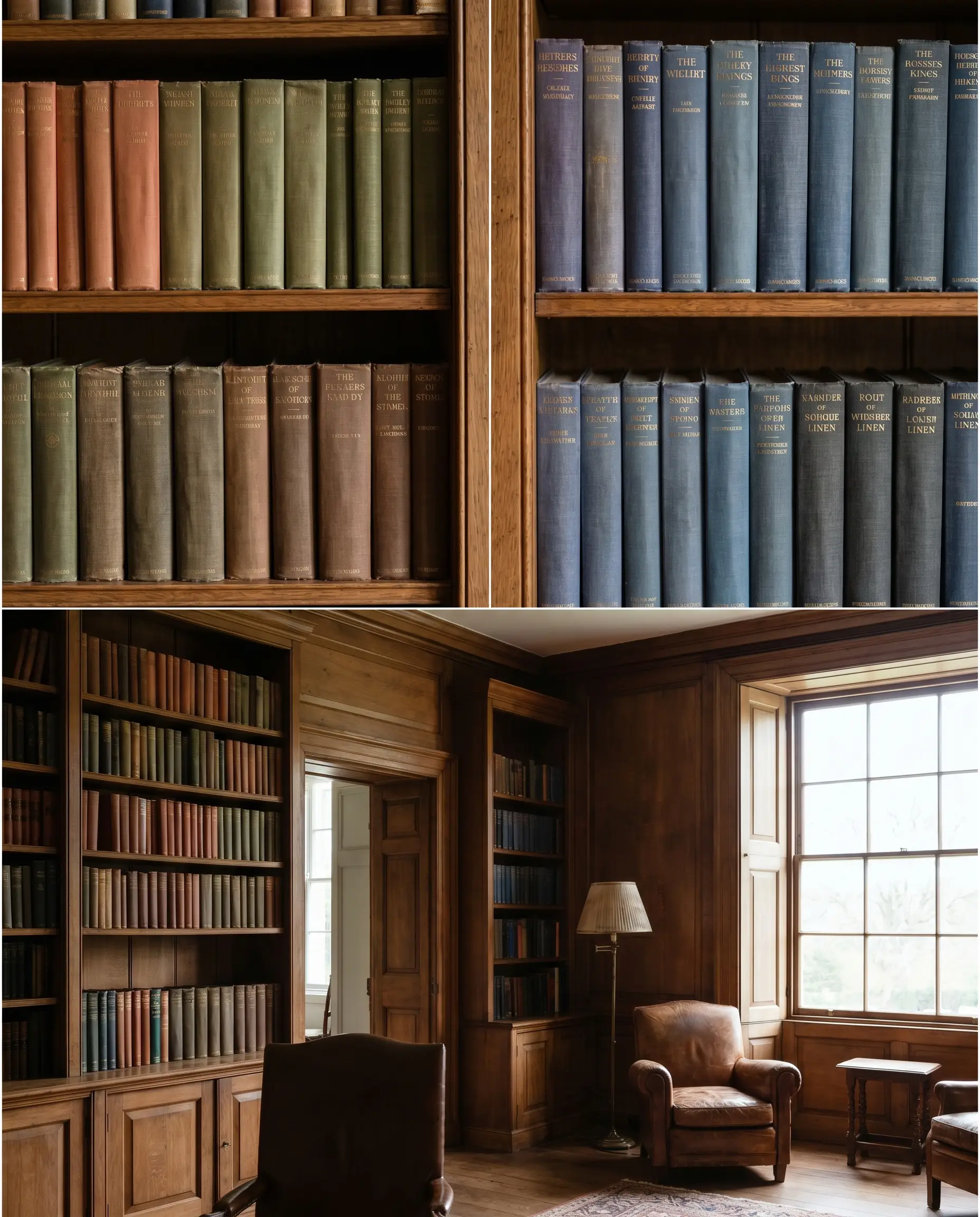
The debate between strict color-blocking and organic spine arrangement is fierce, but small spaces require a nuanced middle ground. Removing visually aggressive, high-gloss dust jackets to reveal the muted, textured cloth bindings underneath instantly unifies a disparate collection without resorting to rigid rainbow sorting.
- Vibe: Restrained, scholarly elegance.
- Key Materials: Cloth-bound hardcovers, linen textures.
- Styling Pro-Tip: Group books by general tonal families (warm earth tones together, cool blues/greens together) rather than exact color matching for a more sophisticated, lived-in feel.
Incorporating Heavy Stone and Brass Bookends
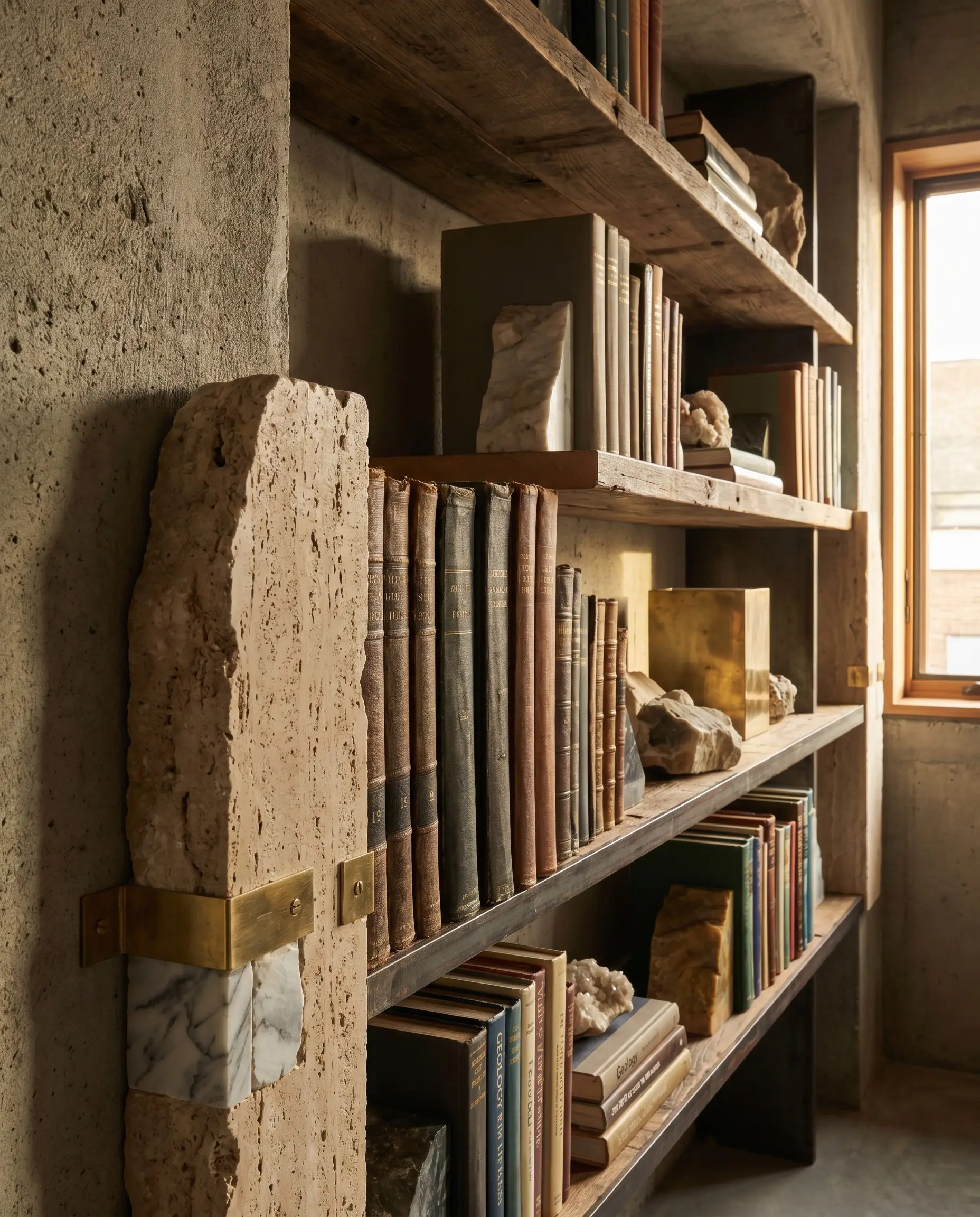
Lightweight, flimsy bookends slide under the pressure of heavy volumes and look cheap. Investing in massive, geologically heavy bookends not only provides structural integrity to your stacks but introduces a critical contrast of raw materials against the paper.
- Vibe: Grounded, earthy brutalism.
- Key Materials: Honed travertine, unlacquered solid brass, raw marble offcuts.
- Styling Pro-Tip: Use a single, massive bookend to pin a row of books tightly against the side wall of the alcove, rather than flanking them on both sides.
Forward-Facing Gallery Ledges for Art Books
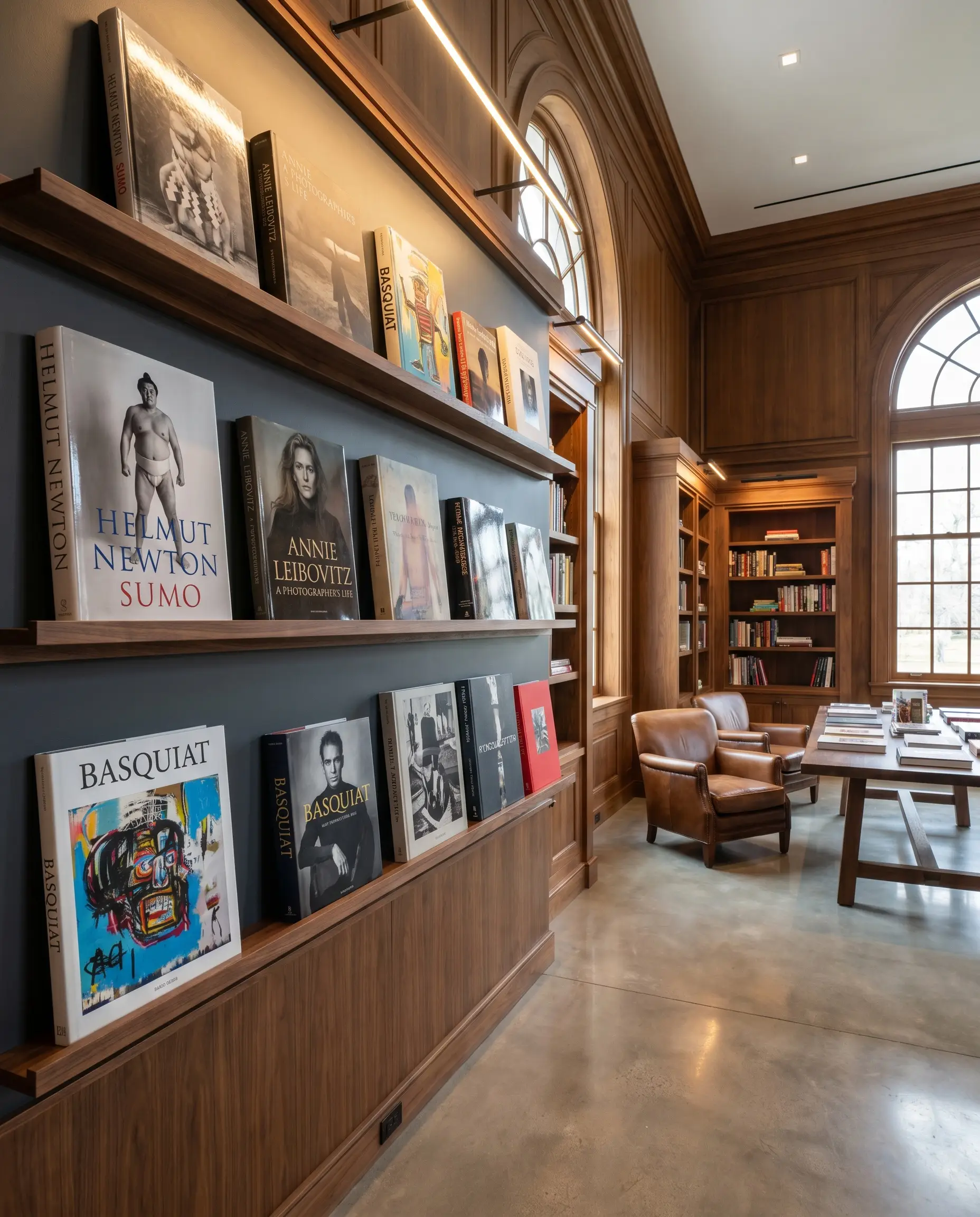
Massive, oversized art and photography books are too beautiful—and often too deep—to be filed spine-out. Integrating a shallow, forward-facing gallery ledge breaks up the monotony of spines and treats your most visually striking covers as rotating artwork.
- Vibe: Dynamic, gallery-inspired exhibition.
- Key Materials: 2-inch deep picture ledge trim, subtle front lip.
- Styling Pro-Tip: Rotate the forward-facing books seasonally to completely shift the color palette of the room without spending a dime.
Establishing a Dedicated “To-Read” VIP Shelf
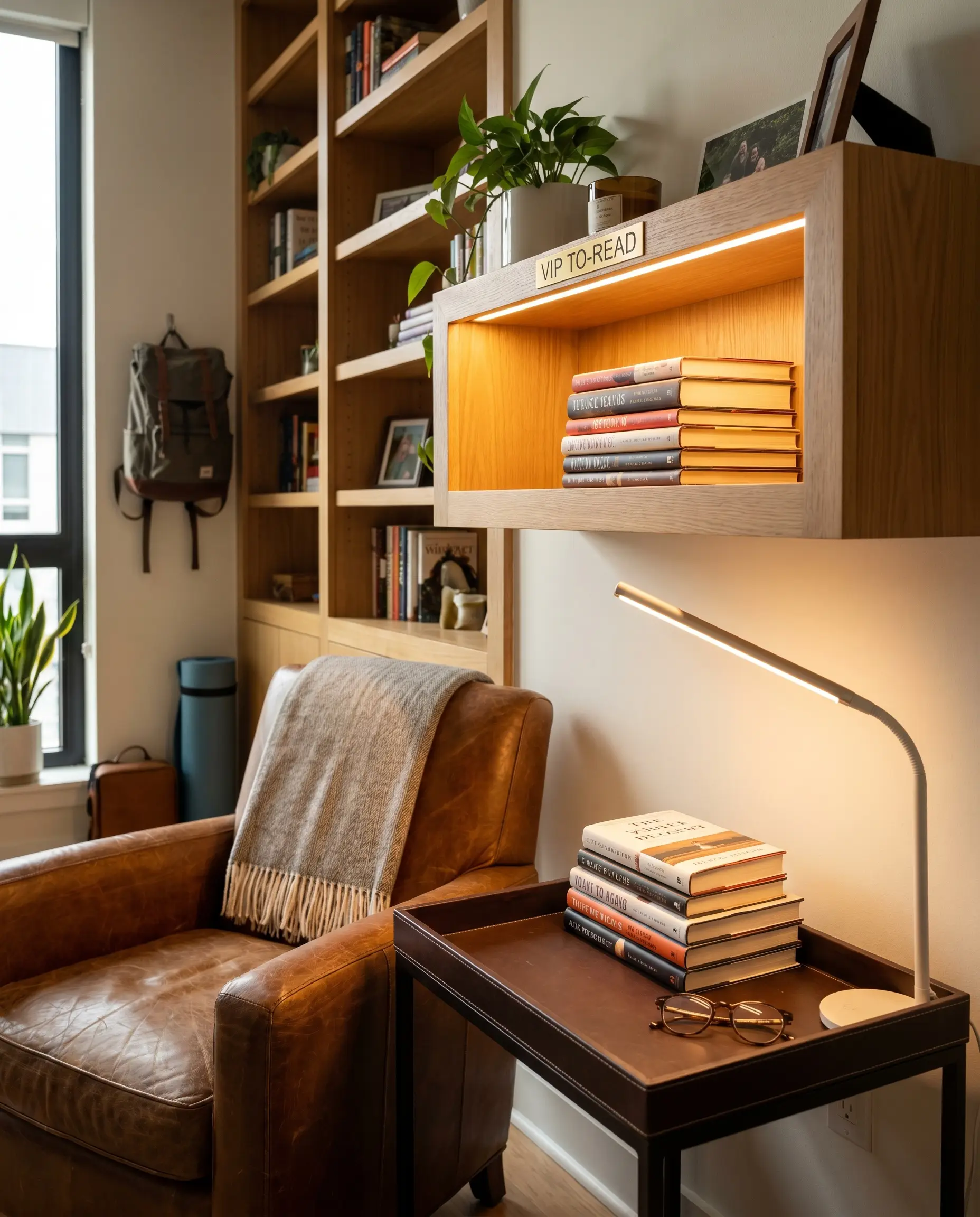
A library is a living, functional system, not just a static museum display. Designating a specific, easily accessible shelf exclusively for your current reads and immediate queue prevents stacks from accumulating on the floor and side tables.
- Vibe: Functional, active lifestyle design.
- Key Materials: A distinct material tray (e.g., a leather desk pad) placed on the shelf to demarcate the zone.
- Styling Pro-Tip: Place this shelf precisely at eye level or arm’s reach from your primary seating position for effortless access.
Budget and Build Breakdown: Deciding Your Approach
Executing a mini library requires a realistic assessment of your financial and labor parameters. Whether you are commissioning a master carpenter or modifying flat-pack furniture with trim, understanding the exact trade-offs ensures your structural integrity matches your aesthetic goals.
| Approach | Estimated Cost Tier | Structural Integrity | Visual Impact |
|---|---|---|---|
| Bespoke Custom Millwork | High-End ($5,000 – $15,000+) | Absolute maximum. Built directly into studs, supporting massive weight with zero bowing. | Flawless architectural integration. Seamless transitions, custom profiles, and exact paint matching. |
| Semi-Custom Cabinetry | Accessible Luxury ($1,500 – $4,500) | Excellent. Utilizes robust pre-fabricated boxes secured to walls. | Highly tailored. Looks built-in when finished with custom crown molding and baseboards. |
| Elevated Modular Hacks (e.g., IKEA Billy/Pax) | Budget-Conscious ($300 – $1,000) | Moderate. Requires strict adherence to weight limits and aftermarket wall anchoring. | Impressive if finished correctly. Trimming out the edges and painting the units masks the flat-pack origins. |
| Floating Steel Profiles | Mixed Tier ($200 – $1,200) | High, provided heavy-duty lag bolts hit the wall studs precisely. | Strikingly minimalist. Makes heavy books appear weightless and preserves visual space. |
The Final Chapter: Cultivating Your Personal Retreat
Carving out a mini library is profoundly more than an exercise in storage; it is an investment in your mental space and a commitment to intentional living within your existing footprint. By treating your books with architectural respect, mastering the clearances, and curating your lighting, you prove that luxury is found in proportion and execution, not just sheer square footage. Grab a tape measure, audit the dead zones in your floor plan today, and tell us below exactly where you plan to build your new reading retreat.
The Aesthetics Desk curates the visual direction for Hackrea. Specializing in design history, global architectural movements, and interior styling, this desk focuses on the psychology of space and how to translate high-end, magazine-quality aesthetics into approachable residential design without falling into fleeting micro-trends.