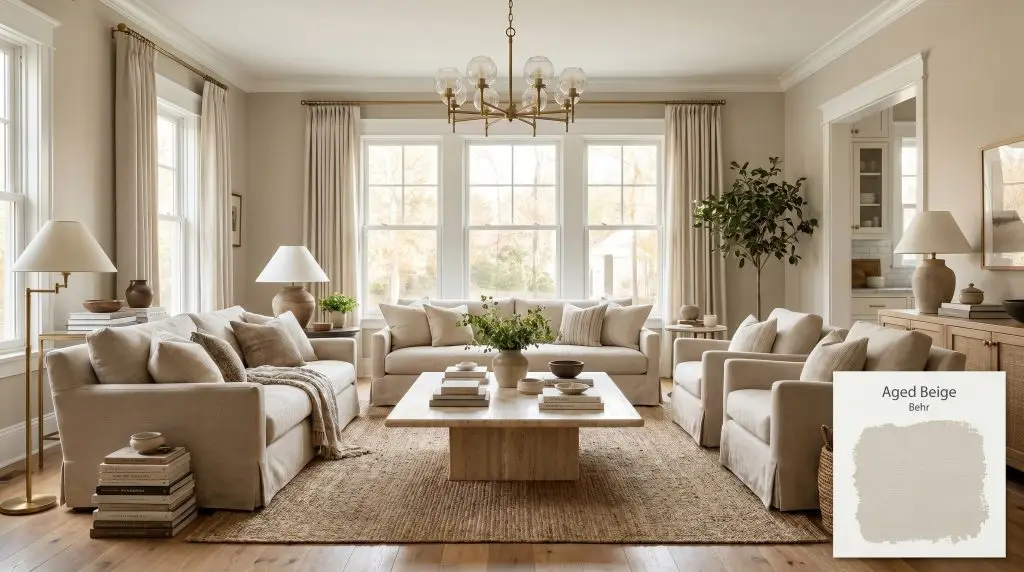
Behr Aged Beige (PPU7-09) is a warm, luminous off-white that leans toward a muted greige. With an LRV of 63, it reflects ample light while adding gentle depth, making it an incredibly versatile neutral for both cozy interiors and classic exterior facades.
Will Aged Beige clash with your room?
Paint Technical Profile
| Color ID / SKU | PPU7-09 |
| HEX Code | #D7CFC0 |
| Light Reflectance (LRV) | 63 |
| Temperature | Warm |
| Primary Undertone | Warm Greige |
| Hidden Undertones | Subtle Gray And Faint Orange |
| Use | Interior, Exterior |
| Best Exposures | North, East |
| Best For | Living rooms, cozy bedrooms, home offices, heritage exteriors, kitchen cabinets |
Aged Beige Digital Design Concept Boards
Living Rooms
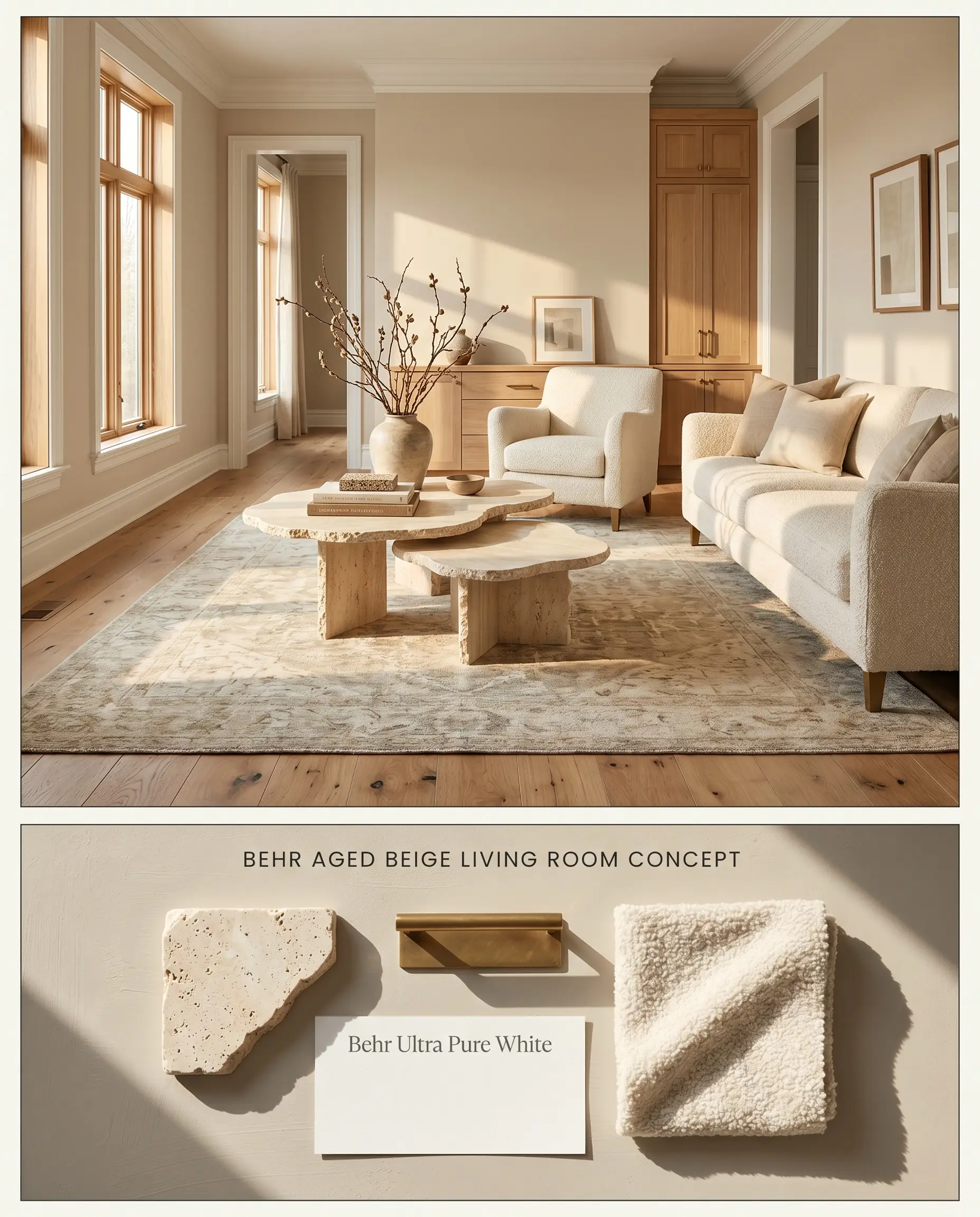
At an LRV of 63, this warm neutral establishes a grounded foundation that absorbs stark natural light without washing out. The subtle orange undertone interacts with natural linen and raw oak, amplifying the warmth of organic textures while avoiding a yellow cast. The resulting color structure visually anchors the room’s perimeter, allowing large-scale furniture pieces to feel integrated rather than floating.
Cozy Bedrooms
Will Aged Beige work with your specific lighting, floor, or furniture?
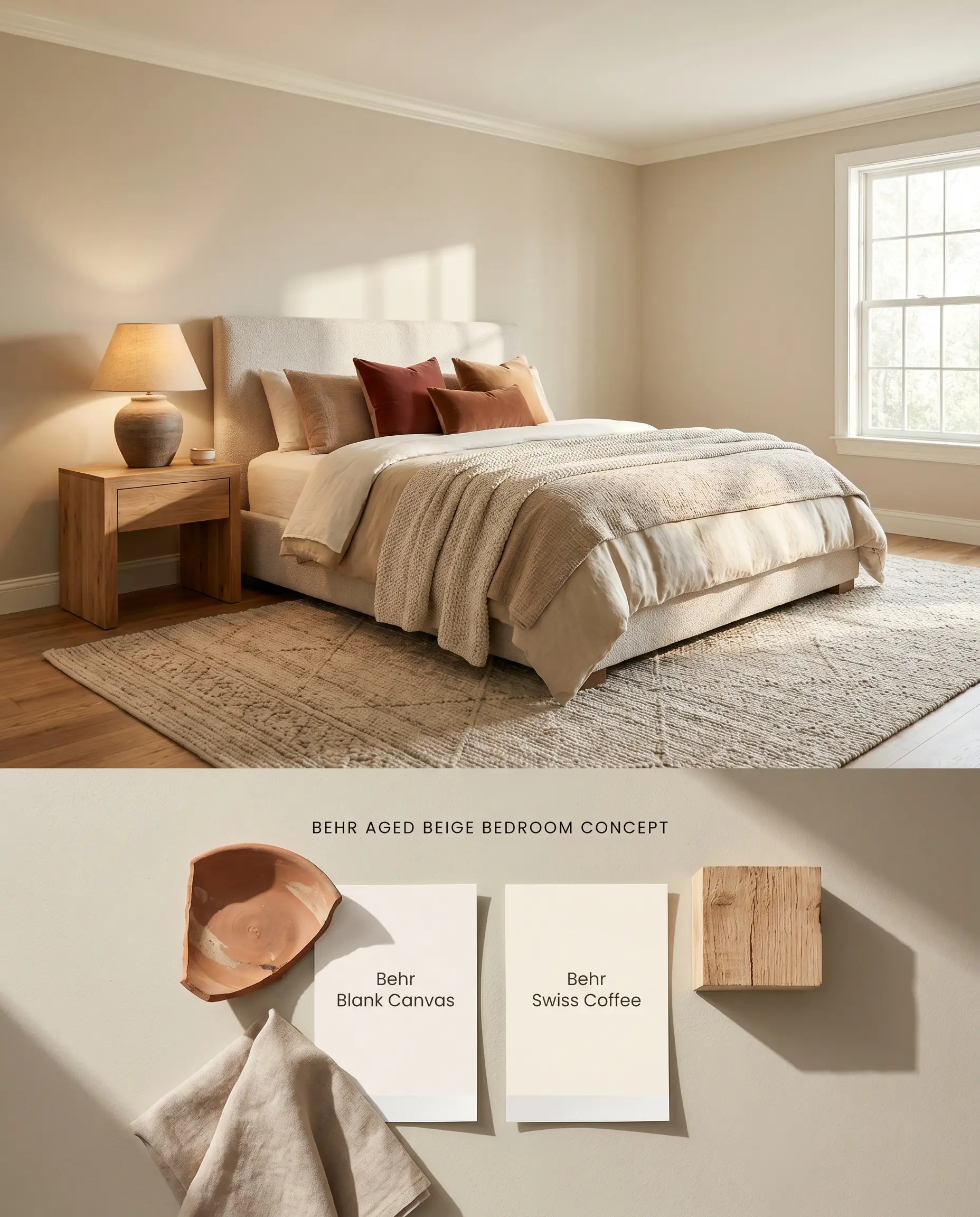
The muted greige qualities of Behr Aged Beige lower the visual temperature just enough to promote rest while avoiding the sterile chill of a true gray. Layering tonal textiles against this backdrop softens the room’s hard architectural edges and absorbs acoustic reflections. Morning sunlight pulls forward the golden warmth of the pigment, while evening shadows emphasize its heavier, stone-like qualities.
Home Offices
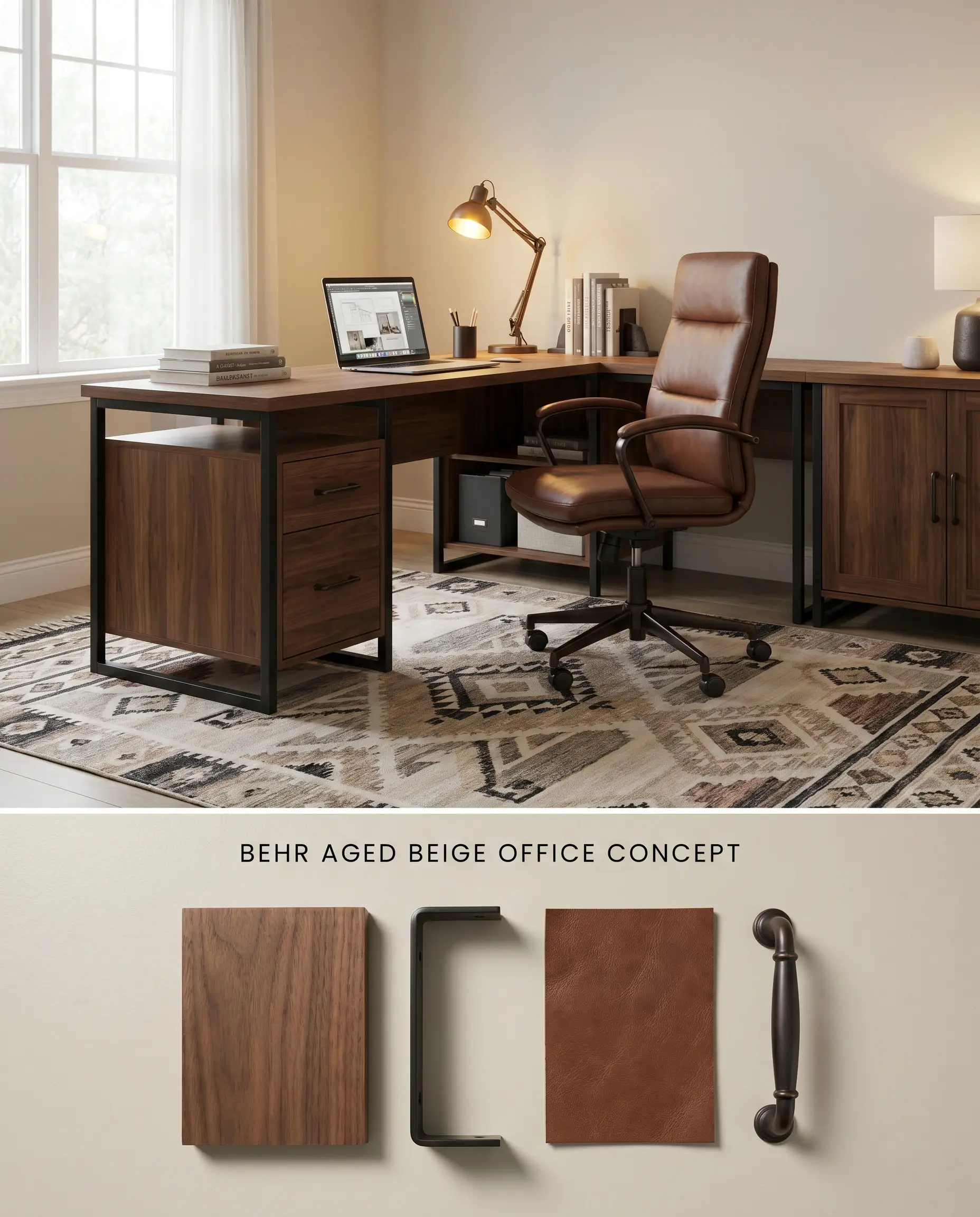
This traditional beige anchors the visual field, reducing eye strain caused by high-contrast white walls and glaring monitors. The earthy base pairs seamlessly with rich, dark wood tones, creating a grounded environment that absorbs excess light. The muted pigmentation prevents the walls from competing with task lighting or computer screens.
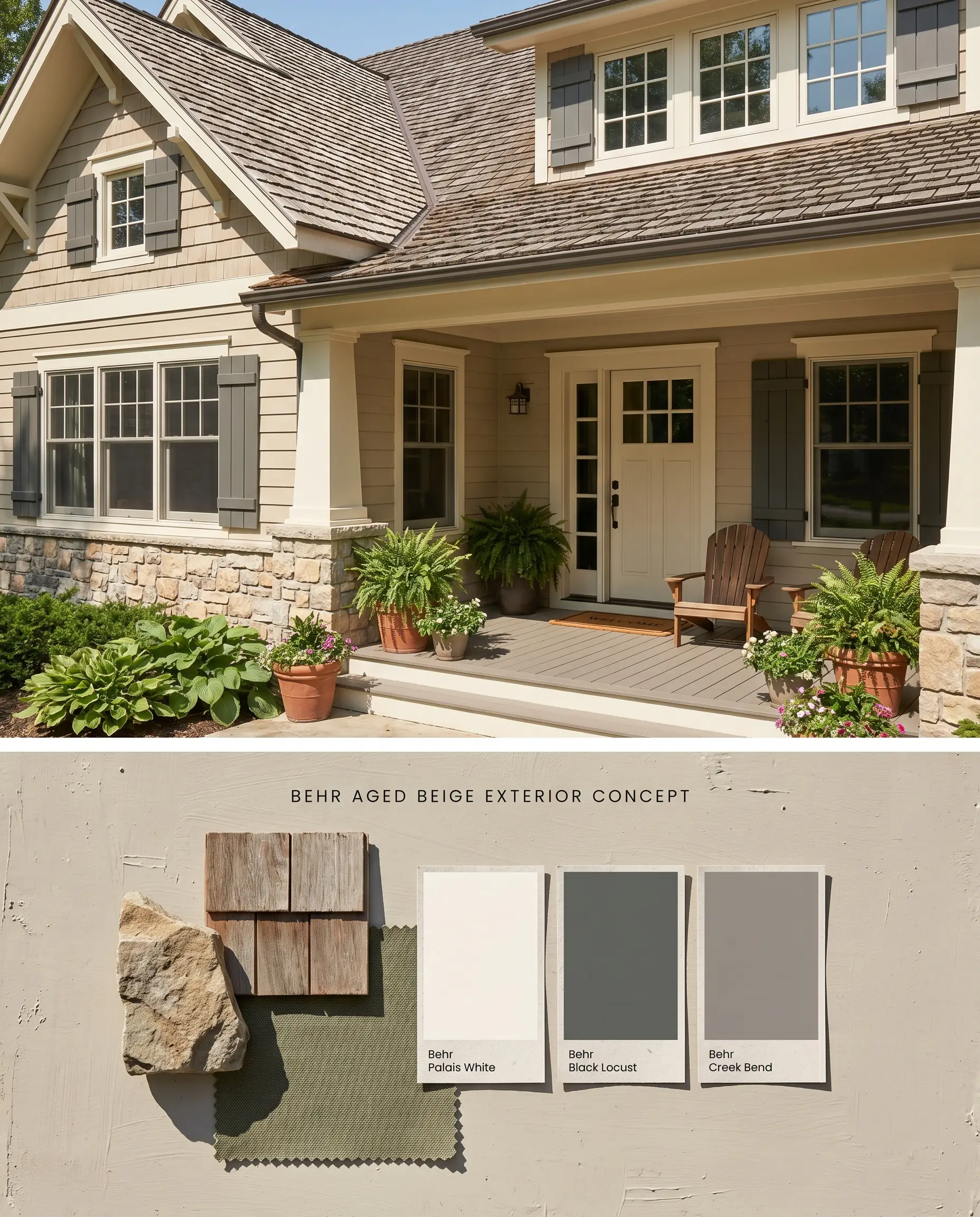
Heritage Craftsman Exteriors
Will Aged Beige work with your specific lighting, floor, or furniture?
On a heritage craftsman exterior, the light reflectance value of 63 prevents the facade from appearing blindingly bright under direct sun. The earthy base harmonizes with natural stone plinths and cedar shake roofing, embedding the architecture directly into its landscape. This specific chromatic profile bridges the gap between raw masonry and painted trim, unifying mixed-material facades.
Kitchen Cabinets
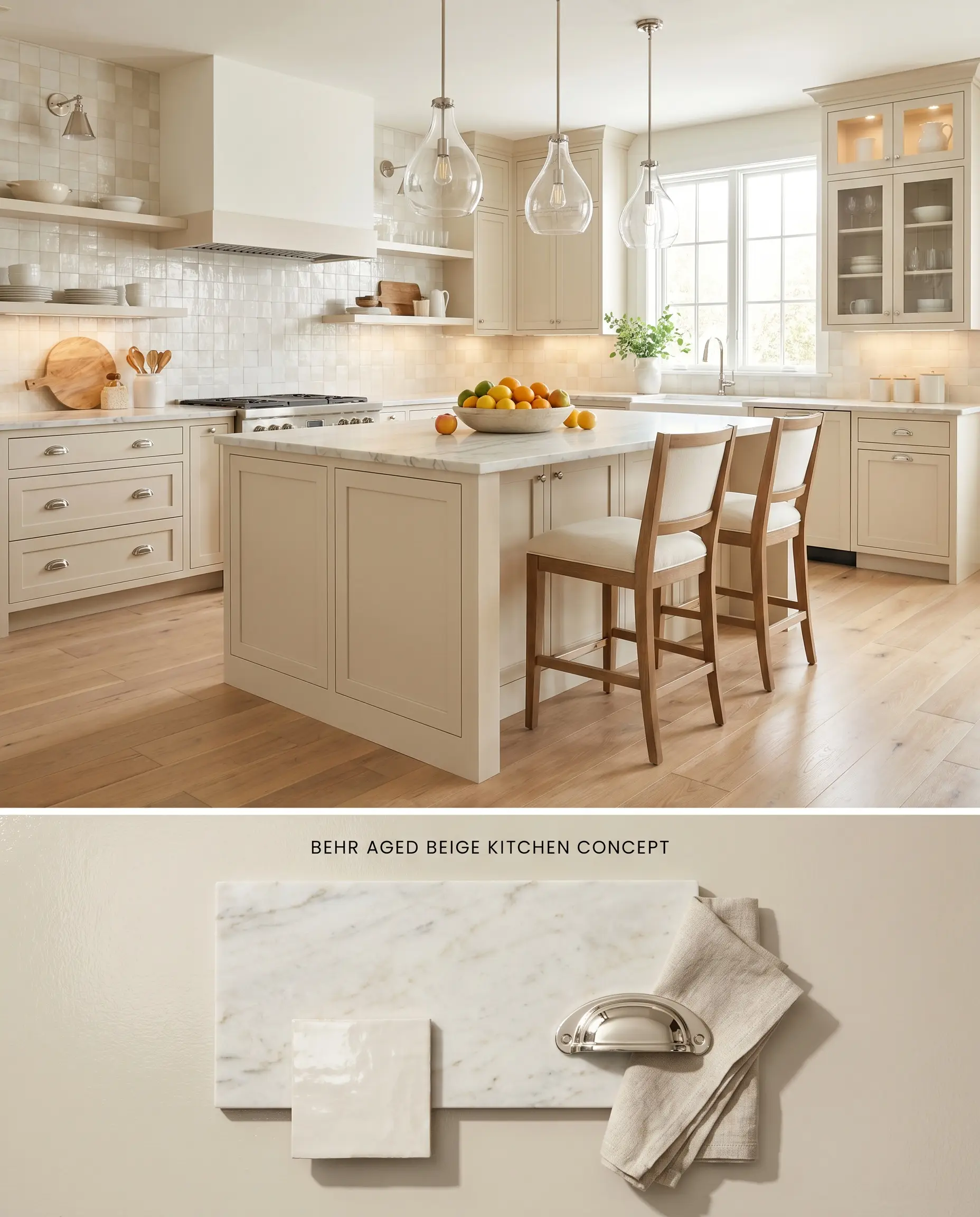
Applying Behr Aged Beige to millwork shifts a kitchen away from stark, clinical white toward a lived-in, custom aesthetic. The pigment carries enough visual weight to ground lower cabinets against light flooring while bouncing sufficient ambient light to keep the space feeling expansive. The warm neutral base acts as a transitional element between cool stone countertops and warm hardwood floors.
Chromatic Profile Comparisons
Behr Aged Beige PPU7-09 vs. Sherwin-Williams Accessible Beige SW 7036
Accessible Beige (LRV 58) sits slightly darker and leans distinctly further into the gray spectrum than Behr Aged Beige. Under northern light, Accessible Beige will read as a true greige, whereas Behr’s PPU7-09 retains its traditional beige warmth due to its stronger yellow-orange base. Specify SW 7036 for spaces requiring a cooler, more modern stone-like finish, and Behr PPU7-09 when you need to actively warm up a chilly, low-light room.
Behr Aged Beige PPU7-09 vs. Benjamin Moore Manchester Tan HC-81
Manchester Tan (LRV 63.24) shares an almost identical light reflectance value but features a pronounced green-khaki undertone. When paired with red oak floors, Manchester Tan’s green base creates a complementary contrast that neutralizes the wood’s redness, whereas the orange undertone of Behr Aged Beige blends tonally with the wood. Use Manchester Tan to cool down overly warm wood tones, and reserve Behr Aged Beige for seamless, monochromatic layering with neutral white oak or walnut.
Behr Aged Beige PPU7-09 vs. Benjamin Moore Cedar Key 982
Will Aged Beige work with your specific lighting, floor, or furniture?
Cedar Key (LRV 61.4) carries a distinct taupe-pink undertone that fundamentally shifts its chromatic profile away from traditional beige. In southern exposure, Cedar Key will flash pinkish-purple, while Behr Aged Beige maintains a steady, creamy warmth. Opt for Cedar Key when designing around cherry or mahogany furniture to harmonize with the red tones, but rely on Behr Aged Beige for a more predictable, neutral backdrop alongside yellow-based or neutral woods.
Color Structure & Lighting FAQs
In cool, blue-tinted North-facing light, the subtle orange undertone in Behr Aged Beige gets neutralized, often causing it to read as a flat, muted greige rather than yellow or pink. To prevent it from looking muddy in these spaces, pair it with crisp white trim and utilize 3000K to 3500K artificial lighting to reintroduce warmth.
Yes, the warm, orange-leaning base of Behr Aged Beige often creates an uncomfortable visual friction when placed directly against blue-based or stark cool gray hard finishes. If your hard finishes are definitively cool, you must bridge the gap with transitional textiles or opt for a cooler greige paint.
With an LRV of 63, intense direct sunlight will wash out the subtle greige characteristics, making Behr Aged Beige appear significantly lighter and closer to an off-white cream. It performs exceptionally well on a heritage craftsman exterior, provided you anchor it with darker, high-contrast trim and roofing materials to maintain structural definition.
Room Compatibility & Clashes Diagnoses
Hackrea's reports evaluating the compatibility of Aged Beige in real rooms.No compatibility tests for Aged Beige yet.
Be the first to see how this color reacts to your space. Run a free architectural diagnostic now.
Paint Aesthetic & Practical Analysis
| Profile | Analysis | |
|---|---|---|
| Aesthetic | Aged Beige by Behr is an unsung hero in the neutral category. It strikes a beautiful balance between traditional beige and modern greige, avoiding the dreaded yellow or pink traps. It is a highly reliable choice for creating a warm, sophisticated backdrop without feeling dated. |
Closest Cross-Brand Equivalents
The absolute closest scientific color matches for Aged Beige across top paint brands.