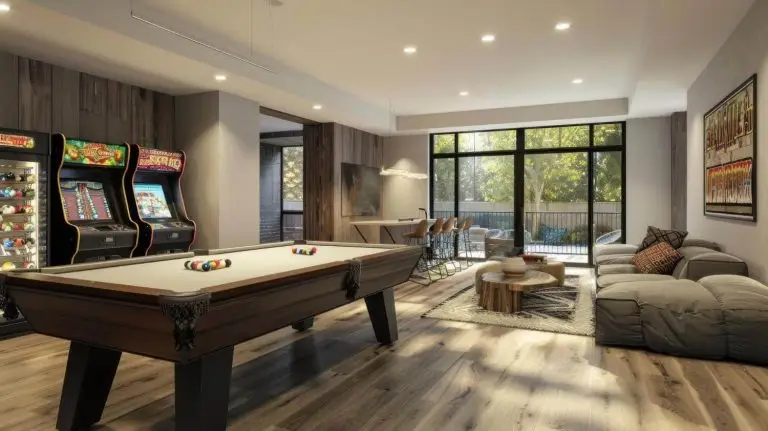
A pool table is one of the few pieces of furniture that decides a room’s layout on your behalf. It is heavy, it is difficult to move once assembled, and it needs clear space on every side. Most homeowners who inherit one, or who bought one years ago in a burst of enthusiasm, eventually reach the same question: can this room do anything else, or has it become a single-purpose space dedicated to a game the household plays twice a month?
The answer is almost always yes, provided the planning starts with the table rather than working around it as an afterthought. What follows is a practical approach to building a genuinely multipurpose recreation room around a pool table you already own and have no intention of moving.
Evaluate the Available Recreation-Room Space
Begin with an honest assessment of the room itself rather than with a wish list. Note the ceiling height, since anything below roughly eight feet will constrain both lighting placement and overhead clearance. Identify the fixed obstacles: support columns, low ducting, radiators, window positions and the swing of every door. Mark where the electrical outlets are, because that determines where lamps, screens and audio equipment can realistically live without cables crossing walkways.
Then decide what else you actually want the room to do. A space serving as a games room, a television area and occasional overflow seating for guests has three sets of requirements. A space that also needs to accommodate a desk or a home gym has four, and at some point the honest answer is that the room cannot take them all. Deciding this early prevents the common outcome where every function is squeezed in and none of them works properly.
Measure the Complete Outside Dimensions of the Pool Table
This is the measurement that governs everything, and it is not the playing surface. Measure the complete outside dimensions of the table including the rails and any decorative trim, since that is the footprint the table actually occupies. Record the height from the floor to the top of the rails as well.
Write these numbers down and keep them, because they will be needed repeatedly: when planning clearances, when considering any accessory that sits on the table, and when working out whether a piece of furniture can pass the table on its way to the other side of the room.
Preserve Walking Paths and Billiards Cue Clearance
The most common planning error in home games rooms is underestimating cue clearance. A standard cue is around 58 inches long, and a player needs enough room behind the ball to draw the cue back and follow through. The general guidance is to allow clearance on all four sides equal to the cue length plus a small margin, which means a nine-foot table needs a considerably larger room than its own footprint suggests.
Where that clearance is genuinely unavailable on one side, shorter cues can be kept for those shots, and it is better to plan for that deliberately than to discover it during a game. Separately from cue clearance, keep at least one clear circulation route through the room that does not cross the playing area, so people can reach the seating or the door without walking through a shot.
Plan Lighting for Both Billiards and Table Tennis
Billiards lighting is directional by design. A pendant or bar fixture hung over the table throws light down onto the playing surface and keeps glare out of players’ eyes, and it is usually positioned around 32 to 36 inches above the rails. That is excellent for pool and poorly suited to almost everything else the room might do, because it leaves the perimeter dim.
The solution is layering. Keep the table light as the task layer, then add ambient lighting around the room’s edges through wall fixtures, floor lamps or recessed ceiling lights, ideally on a separate switch so the two layers can be used independently. In basement conversions where ducting and pipework sit below the joists, a suspended ceiling is often what makes proper lighting possible at all, and Hackrea’s guide to modern drop ceiling designs covers how to conceal utilities while retaining access to them.
For table tennis specifically, even and diffuse light matters more than directional light, since players track a fast-moving ball across the whole table rather than focusing on one spot. A room with good ambient lighting handles both games. A room with only a pool pendant handles one.
Use Flexible Furniture and Movable Seating
Fixed, heavy seating is the enemy of a multipurpose room. Choose pieces that can be repositioned by one person without a struggle: armchairs rather than a large sectional, ottomans and stools that tuck away, side tables that lift rather than slide. Bar-height stools along a wall are particularly useful in games rooms, since they raise spectators above the action and occupy little floor area.
Media furniture deserves the same thinking. A console positioned on the shortest wall keeps the screen out of the cue clearance zone, and Hackrea’s overview of modern TV stand trends is a useful starting point for pieces that combine storage with a smaller footprint. If the room needs to feel like two separate zones at times, a folding screen is a genuinely practical device rather than a purely decorative one, and there are contemporary approaches to folding screens that work as mobile architecture rather than flimsy dividers.
Add Table Tennis With a Removable Pool-Table Conversion Top
Here is where the multipurpose ambition usually collides with reality. A standalone ping pong table needs its own floor space, and in a room already dominated by a pool table there is rarely anywhere sensible to put one. Folding models exist and still need somewhere to live when folded.
A conversion top solves the problem differently, by using the pool table as the support structure so that the second game occupies no additional floor area at all. Flip&Play’s full-size pool-table conversion top is one example of this approach: a playing surface of approximately 108 by 60 inches built on a roughly 12 mm MDF playfield, arranged as four panels in two hinged halves, with a clamp-on net and post set included. It is designed for indoor recreational use and for most compatible 8 ft and 9 ft pool tables, and compatibility is not universal, so measuring the complete outside rail dimensions of your own table before purchase is essential rather than optional. Fit also depends on rail shape, levelness, stability and whether the table provides even support across the panels. The unit weighs approximately 80 lb and two-person handling is recommended for setup and removal. Paddles and balls are not included, so budget for those separately.
Reduce Direct Contact With the Pool-Table Felt and Rails
Any accessory placed on a pool table raises a reasonable concern about the surface underneath. The Flip&Play top has pre-attached EVA pads, which help reduce direct contact with the felt and rails. That is a meaningful design feature and not a guarantee that no damage will occur, so ordinary care still applies.
That means keeping both the rails and the underside of the panels clean and free of grit before fitting, handling the panels with two people so they are placed rather than dragged, and inspecting the surface periodically. Follow the manufacturer’s own guidance on fitting and removal rather than devising your own arrangement, and do not introduce additional materials underneath the product.
Create Storage for Paddles, Balls, Cues and Accessories
Multipurpose rooms fail on storage more often than on layout. Every game brings accessories, and without dedicated homes they migrate onto the pool table, which is the one surface that must stay clear.
Wall-mounted cue racks are the standard solution and take no floor space. A closed cabinet or a bench with internal storage handles paddles, balls, chalk, the triangle and the bridge, and closed storage keeps the room from reading as cluttered. For the conversion top itself, store the panels flat in a dry indoor space where they are properly supported, such as a shelf, a purpose-made rack or beneath a bed or sofa if the clearance allows. Plan that storage location before buying, because 80 lb of panelling needs a designated home rather than an improvised one.
Compare a Conversion Top With a Permanent Standalone Ping Pong Table
Both options are legitimate and they suit different households. A standalone table is always ready, needs no setup, and gives you a purpose-built surface for regular or more serious play. It also permanently occupies floor space, needs its own clearance on all sides, and in most homes with a pool table there simply is not room for both.
A conversion top costs less than most standalone tables, occupies no additional floor area during use, and stores away when the room is needed for something else. The trade-offs are real: it requires setup and removal each time, it needs two people to handle safely, it requires storage space, and it depends entirely on having a compatible pool table underneath. It is also recreational equipment rather than regulation, tournament-grade or professional competition equipment, which matters if someone in the household plays competitively.
For most families wanting occasional table tennis in a room built around billiards, the conversion approach fits the actual pattern of use. For a household where table tennis is the primary game, a dedicated table is the better answer.
A Final Planning Checklist for a Functional Multipurpose Game Room
Before committing to any purchase or layout, work through the following. Confirm the complete outside dimensions of your pool table, including rails, and check them against anything intended to sit on top. Verify cue clearance on all four sides and identify where shorter cues will be needed. Confirm your lighting works for both directional play and general room use, on separate switches. Choose seating and media furniture that can be moved by one person. Identify a specific, supported, indoor storage location for any conversion top before you buy it. And confirm you have somewhere sensible for every accessory the room will accumulate.
Get those six things right and a pool table stops being the reason the room can only do one thing, and becomes the anchor around which a genuinely flexible space is arranged.