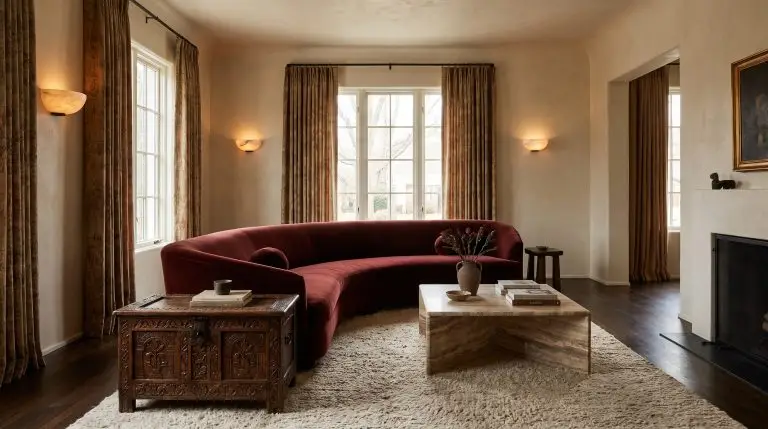
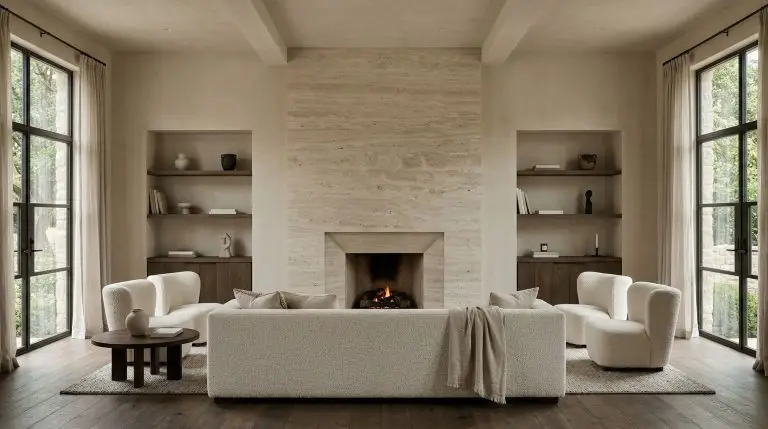
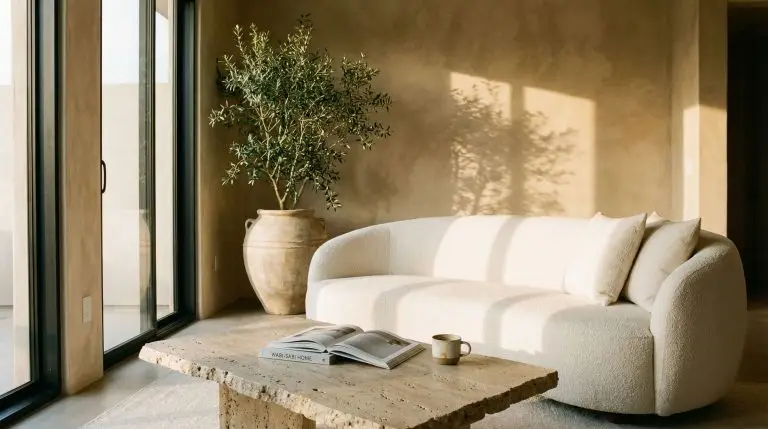
Precision Meets Patina: Defining European Organic Modern Design
The modern world operates at a relentless, deafening frequency. To counteract this exhaustion, our private sanctuaries must offer something profoundly grounding, which explains the meteoric rise of European organic modern design.
This is not the pedestrian aesthetic of tossing a mass-produced bouclé pillow onto a beige sofa. Instead, it is the ultimate architectural expression of quiet luxury.
It is a rigorous, highly disciplined dialogue between the exacting precision of contemporary European modernism and the rugged, imperfect soul of ancient materials. When you step into a masterfully executed space—perhaps an Axel Vervoordt gallery in Antwerp or a stark, minimalist villa in Puglia—the psychological shift is immediate. The air feels heavier, the acoustics soften, and the eye rests.
By studying the rise of Quiet Luxury in home design, we begin to understand that true sophistication is whispered, never shouted. To master this aesthetic, you must embrace the profound tension where flawless architectural geometry collides with the raw, unyielding beauty of the earth.
The Philosophy: What Separates “European” Organic Modern?
Geographical context dictates the soul of any design movement. The European iteration of this aesthetic is deeply informed by centuries of architectural history, prioritizing rigorous preservation, natural patina, and absolute restraint over the relentless obsession with “newness” found in other regions. To understand its profound visual weight, we must examine its origins:
Belgian Roots vs. California Casual (The Axel Vervoordt Effect)
The foundation of this aesthetic rests heavily on the shoulders of Belgian minimalism. The legendary Axel Vervoordt pioneered this exact spatial philosophy, masterfully blending the Japanese concept of wabi-sabi with heavy European antiquities and stark, minimalist architecture. Vervoordt understood that a room requires soul, and soul is born from history.
A common query we see in the Hackrea community forums asks why a newly styled room feels flat despite using natural materials. The answer lies in the stark contrast between European sensibilities and the ubiquitous “California Casual” style. The Californian approach leans heavily on light woods, bright whites, and breezy, beach-inspired textures. It is fundamentally light and airy.
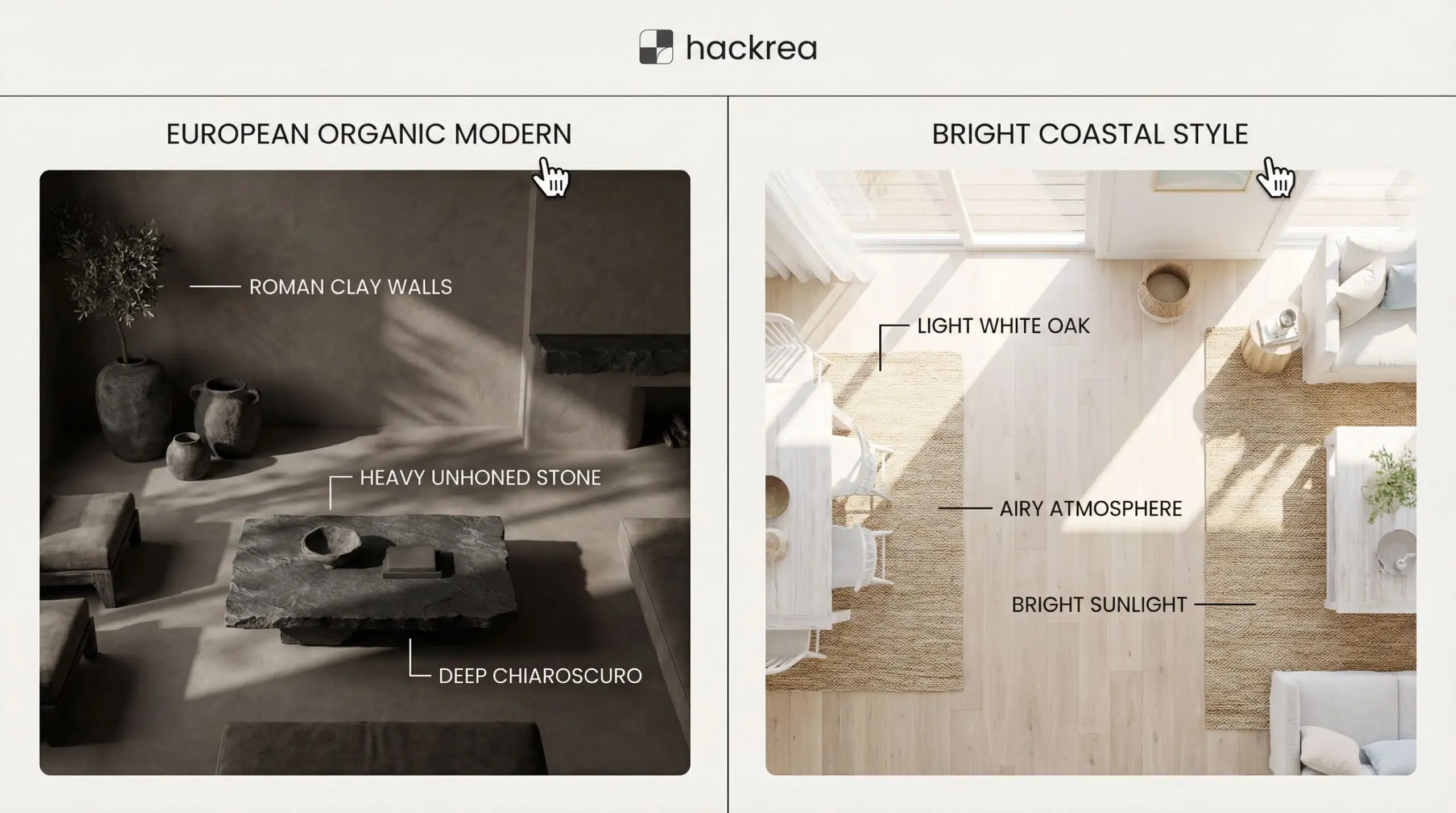
European Organic Modernism, conversely, embraces the shadows. It utilizes chiaroscuro—the interplay of light and dark—to create depth. It demands moody undertones, heavier, unhoned stones, and a distinct historical weight that grounds the occupant.
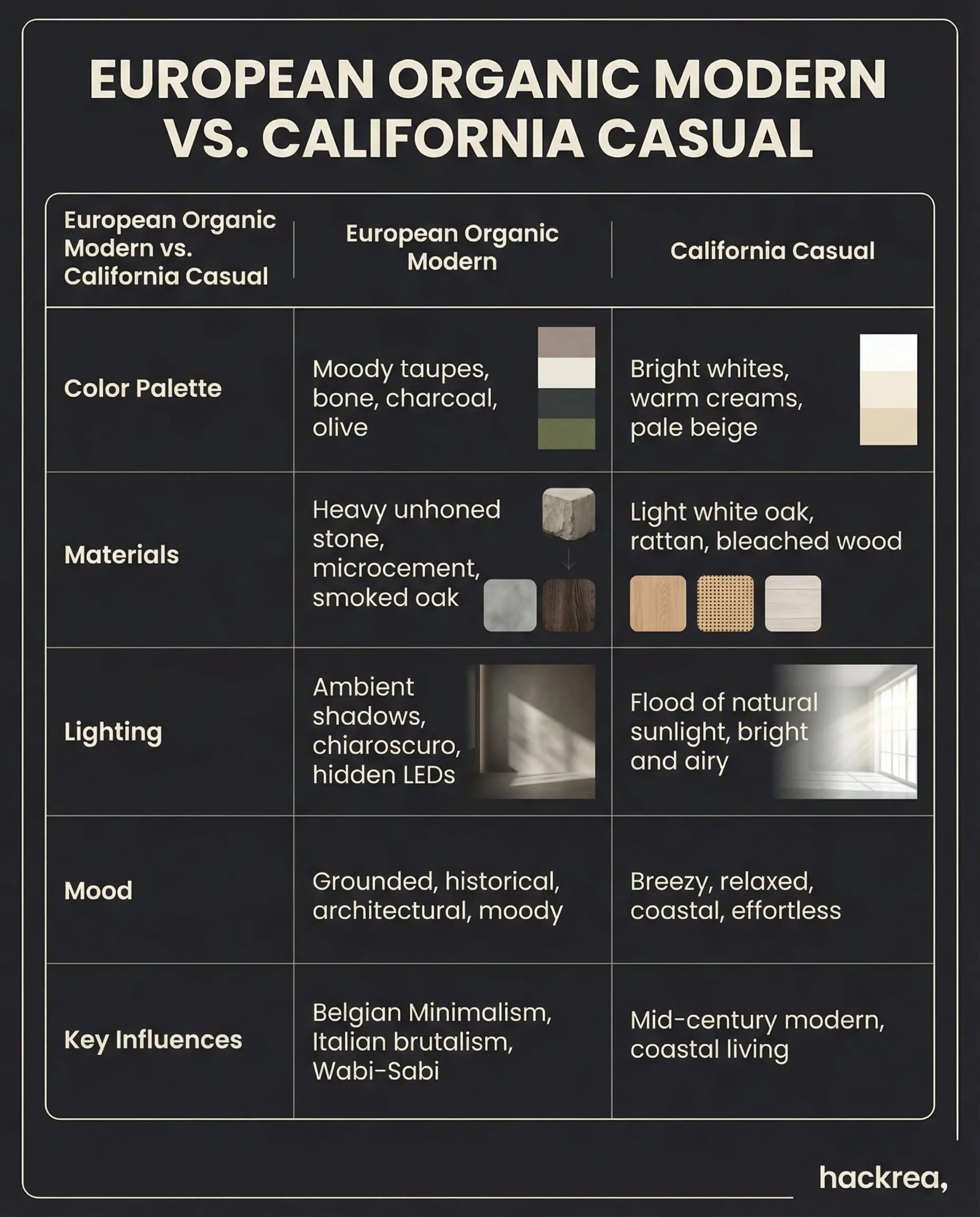
| European Organic Modern vs. California Casual | European Organic Modern | California Casual |
|---|---|---|
| Color Palette | Moody taupes, bone, charcoal, olive | Bright whites, warm creams, pale beige |
| Materials | Heavy unhoned stone, microcement, smoked oak | Light white oak, rattan, bleached wood |
| Lighting | Ambient shadows, chiaroscuro, hidden LEDs | Flood of natural sunlight, bright and airy |
| Mood | Grounded, historical, architectural, moody | Breezy, relaxed, coastal, effortless |
| Key Influences | Belgian Minimalism, Italian brutalism, Wabi-Sabi | Mid-century modern, coastal living |
The Tension of Precision and Patina
The entire aesthetic hinges on a singular, non-negotiable design theory: tension. A room filled exclusively with raw, rustic items devolves into a farmhouse. Conversely, a room defined entirely by sharp, modern lines feels like a sterile, unwelcoming clinic.
European Organic Modernism thrives in the dangerous, beautiful space between these two extremes. It is the breathtaking juxtaposition of a brutally sharp, 90-degree steel window frame looking out over an ancient, uneven stone floor. It is a perfectly smooth microcement wall acting as the silent backdrop for an eroded, 18th-century wooden bench.
Precision and Patina: The deliberate architectural collision of flawless, contemporary geometric lines (precision) with the naturally degraded, historically rich textures of organic materials (patina).
This tension forces the eye to appreciate both extremes. To execute this in your own styling, rely on these rapid-fire contrasts:
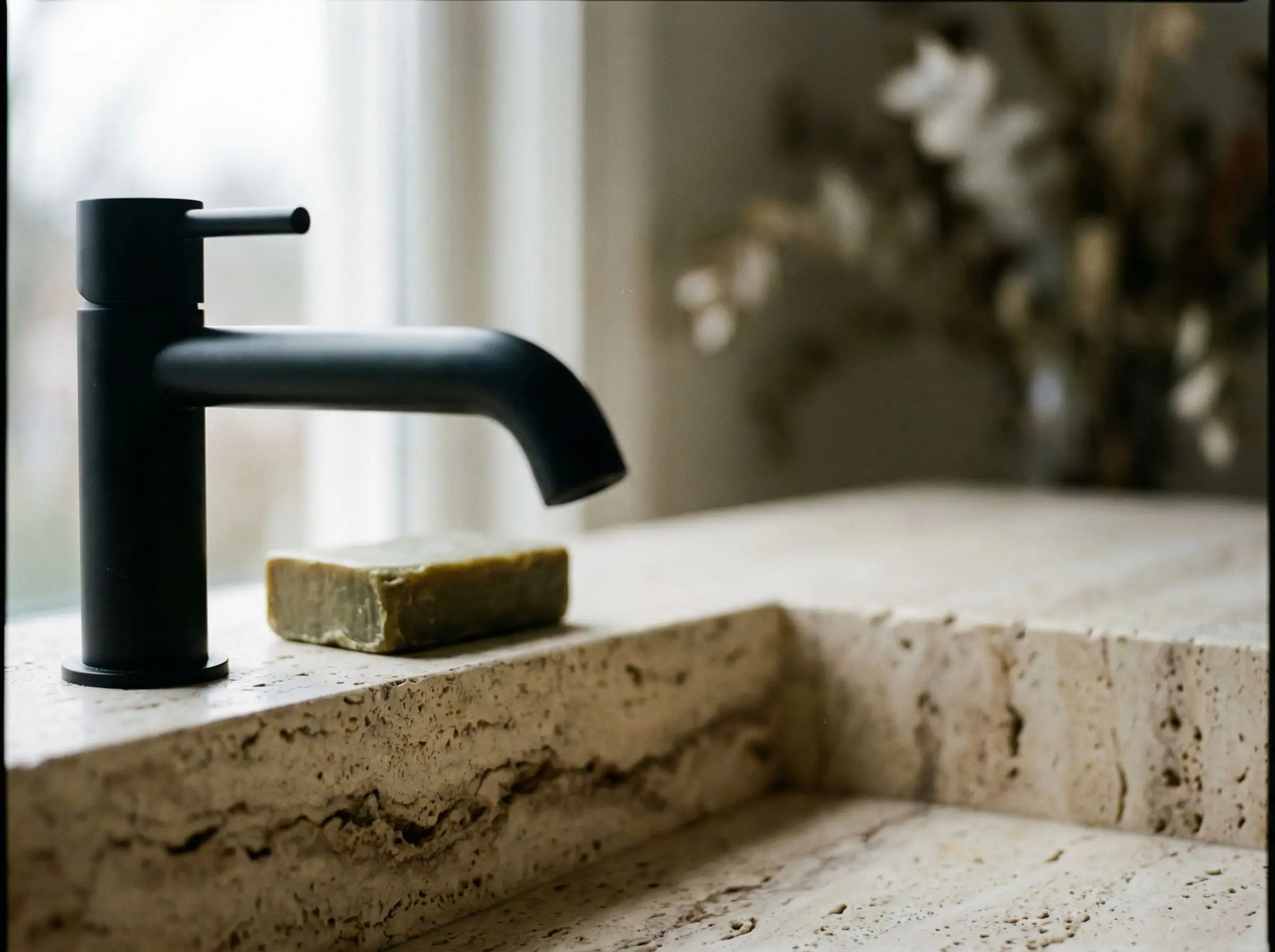
This calculated friction is what elevates a mere room into an emotional experience. Without this architectural friction, the space loses its tectonic weight and becomes entirely forgettable.
The Core Architectural Foundation (The Bones)
Before furniture is even considered, the envelope of the room must be completely transformed. You cannot successfully achieve this elite look with standard drywall and glossy white baseboards. The foundational architecture requires continuous, sweeping surfaces and an absolute rejection of fussy, applied trim. The bones of the space must stand alone as a work of art.
Continuous Surfaces: Plaster, Tadelakt, and Microcement
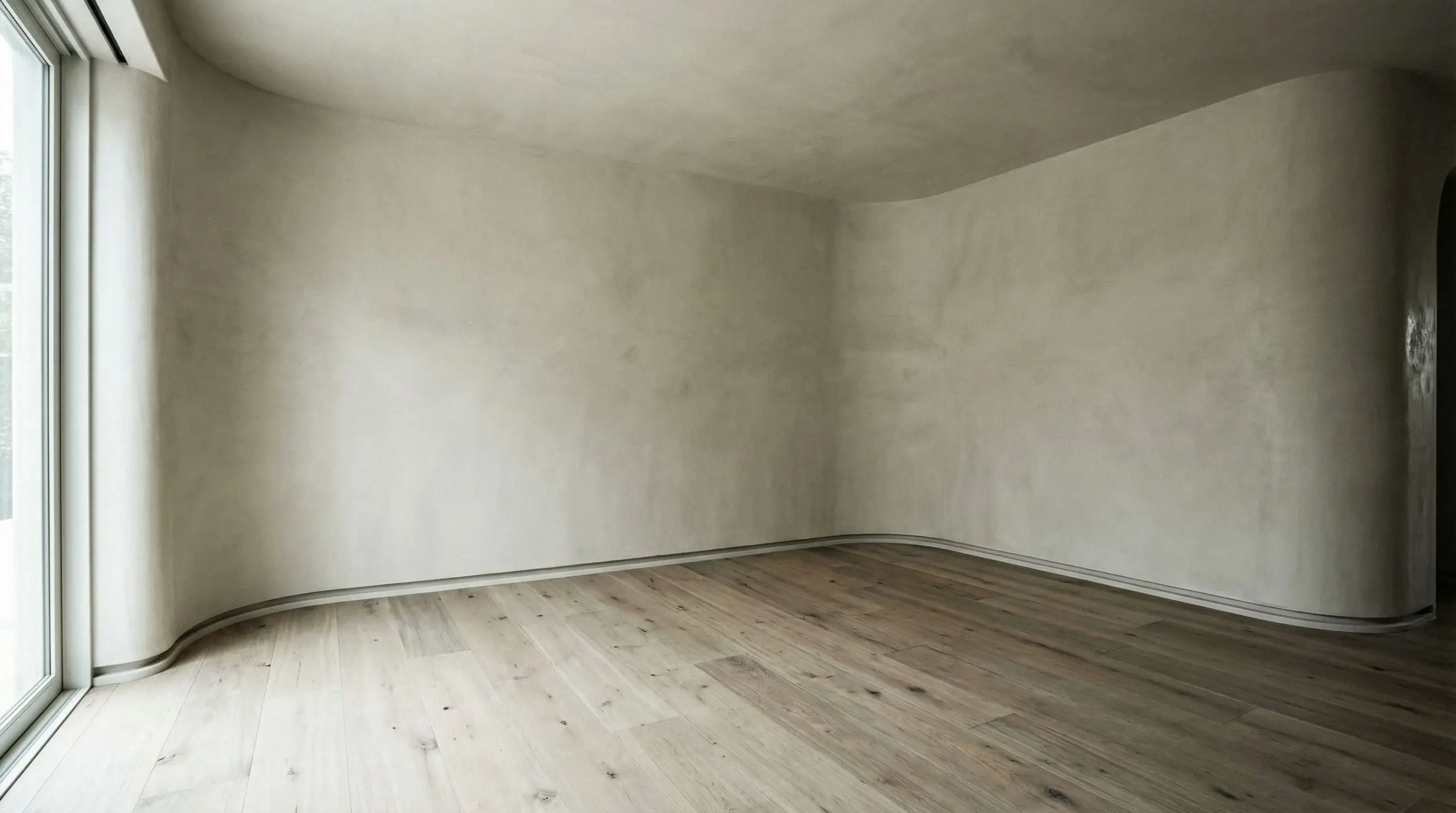
Standard flat paint fundamentally fails this aesthetic. It reflects light in a dead, uniform manner that strips a room of its soul. To build the required tectonic weight, the application of Roman clay, limewash, or specialized plasters is mandatory.
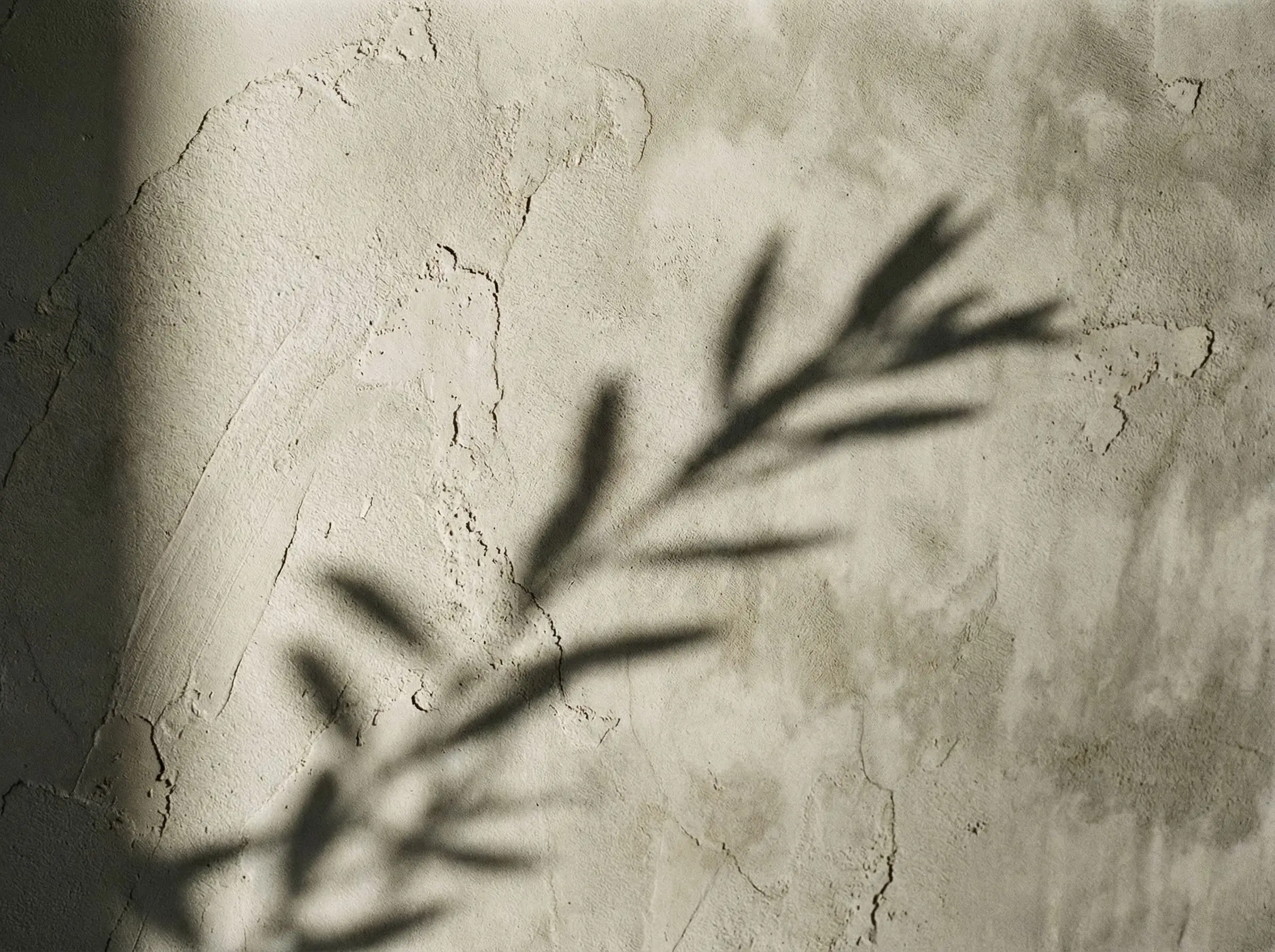
These treatments create continuous, seamless surfaces that wrap around walls, ceilings, and floors without interruption. By eliminating the visual breaks of standard baseboards and crown molding, you blur the rigid boundaries of the room, resulting in a profoundly cocooning effect. As the sun moves across the sky, the subtle, cloudy texture of these materials catches the light, creating a slow, mesmerizing movement on the walls.
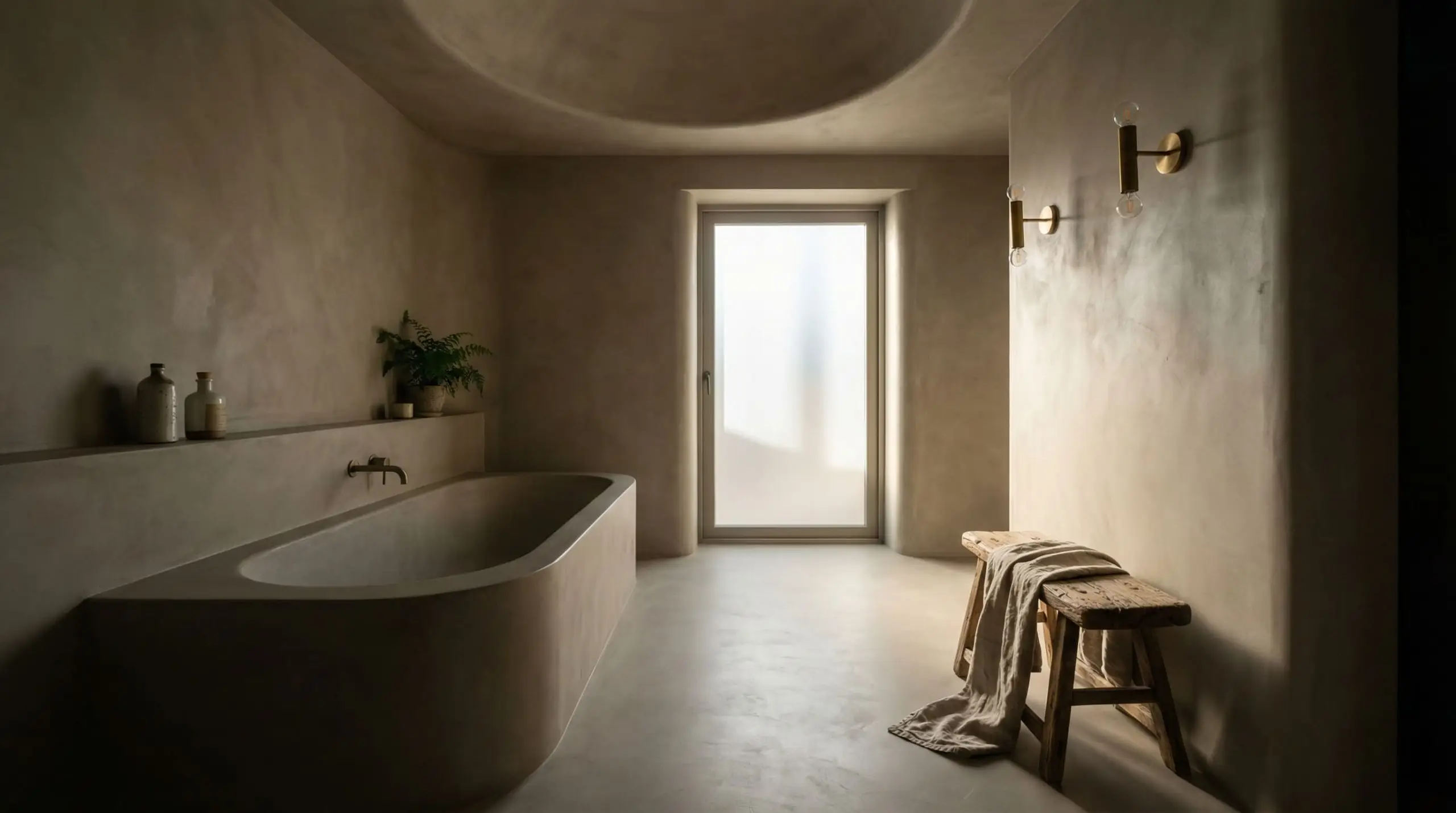
For those studying textured walls, understanding the distinction between high-end finishes is critical.
Tadelakt vs. Microcement:
A collaborating architectural salvage expert recently told us that the true luxury of European interiors lies in how the walls themselves feel like skin. They are highly tactile, demanding to be touched. By utilizing Tadelakt or Microcement, you transform a basic drywall box into a sculpted, breathing environment.
Monolithic Forms and Soft Geometry
To capture the essence of Belgian minimalism, we must move away from sharp, aggressive 90-degree interior angles wherever structurally possible. The architecture itself should feel as though it were carved directly from a single, massive piece of stone or earth, rather than assembled from separate, disparate parts.
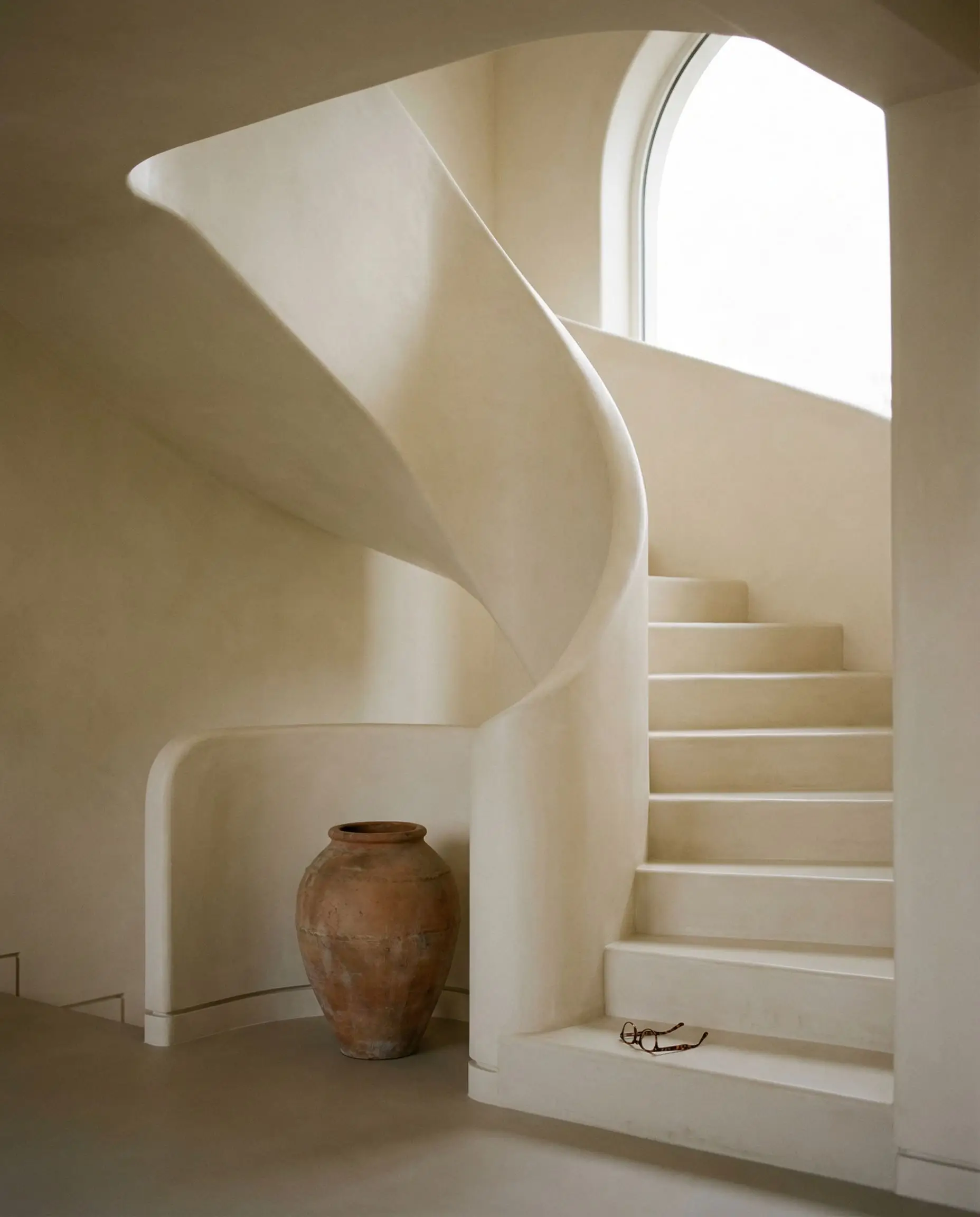
This requires the integration of soft geometry. We achieve this through sweeping, hand-plastered curved staircases, deeply recessed niches, and arched doorways devoid of traditional wood casing.
In European Organic Modernism, the architecture is the furniture.
This principle is known as tectonic design. Built-in, structural furniture is a defining hallmark of this aesthetic. A monolithic masonry bench poured seamlessly into the living room wall, or a microcement vanity floating in a bathroom, eliminates visual clutter.
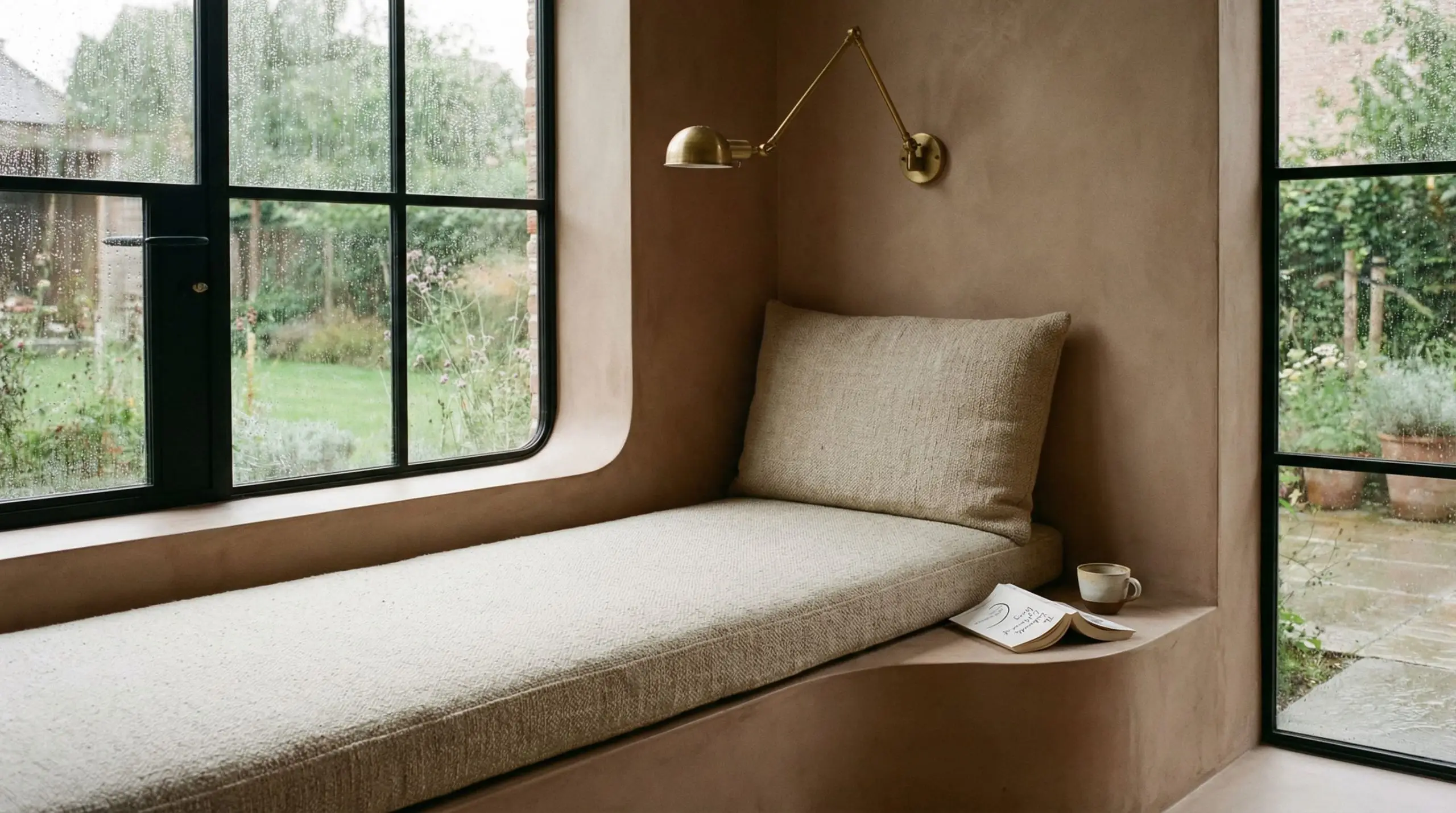
These monolithic forms anchor the space, providing a heavy, grounded permanence that freestanding furniture simply cannot replicate. When your shelving and seating emerge organically from the architecture itself, the spatial flow remains entirely uninterrupted. The room feels inevitable, as if it has existed in this exact, quiet form for centuries, waiting to be discovered.
The Material Palette (Sourcing the Earth)
Executing this look requires a highly disciplined palette. The material selection is severely restricted and entirely drawn from the earth. European design relies on the inherent, raw beauty of the material itself rather than relying on applied color, artificial stains, or high-gloss sealants. Every element must possess profound tactile integrity.
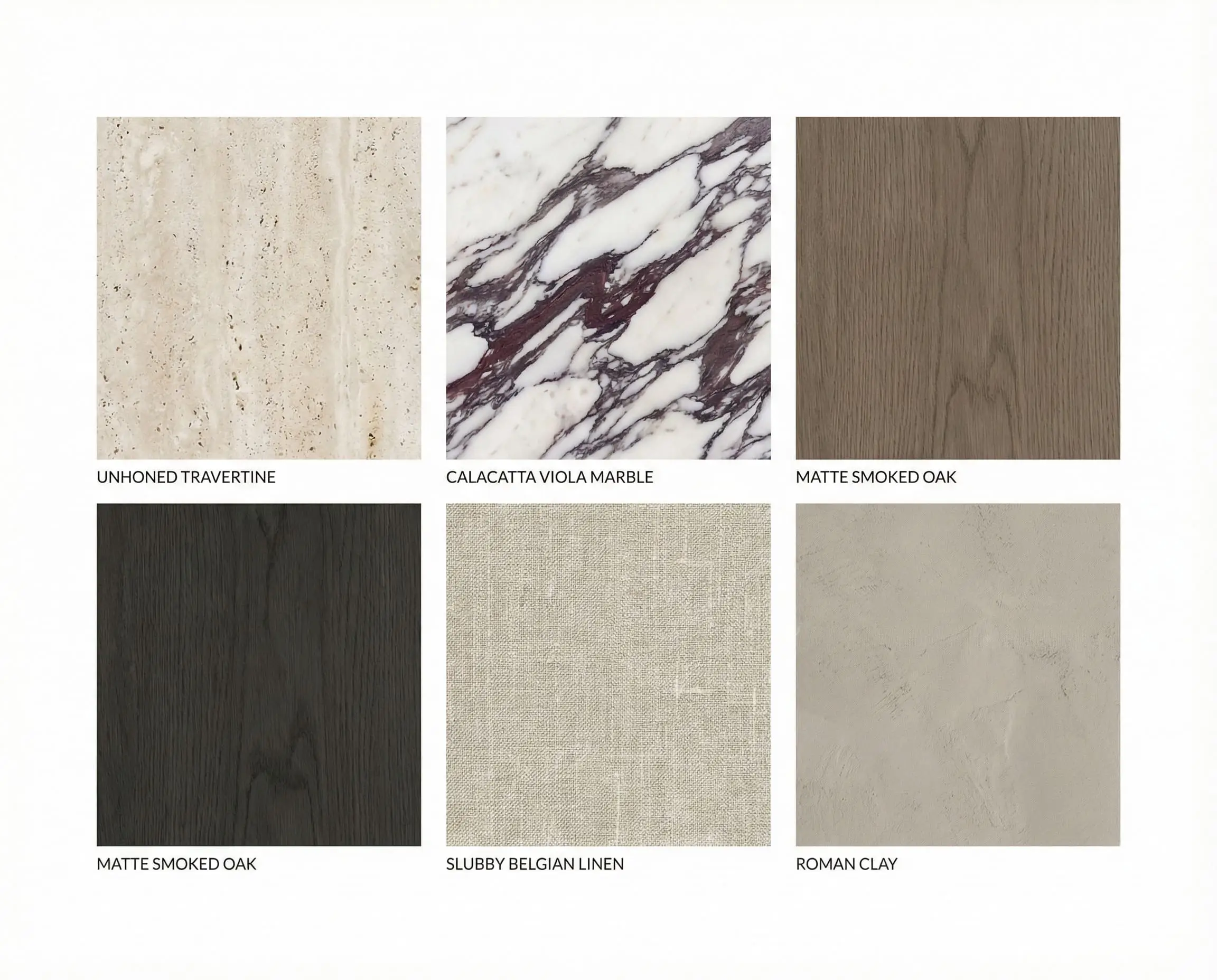
Veined Stones: Travertine, Calacatta, and Viola
The use of polished, synthetic quartz is strictly banned in this design lexicon. To achieve true European luxury, you must advocate for unhoned, matte, and heavily veined natural stones.
Italian Travertine is a foundational element, specifically when left unfilled so the natural, porous pitting is exposed to the eye. For a more dramatic tension, Calacatta marble, and the highly coveted, deeply burgundy-veined Calacatta Viola, provide an aggressive visual anchor against quiet plaster walls.
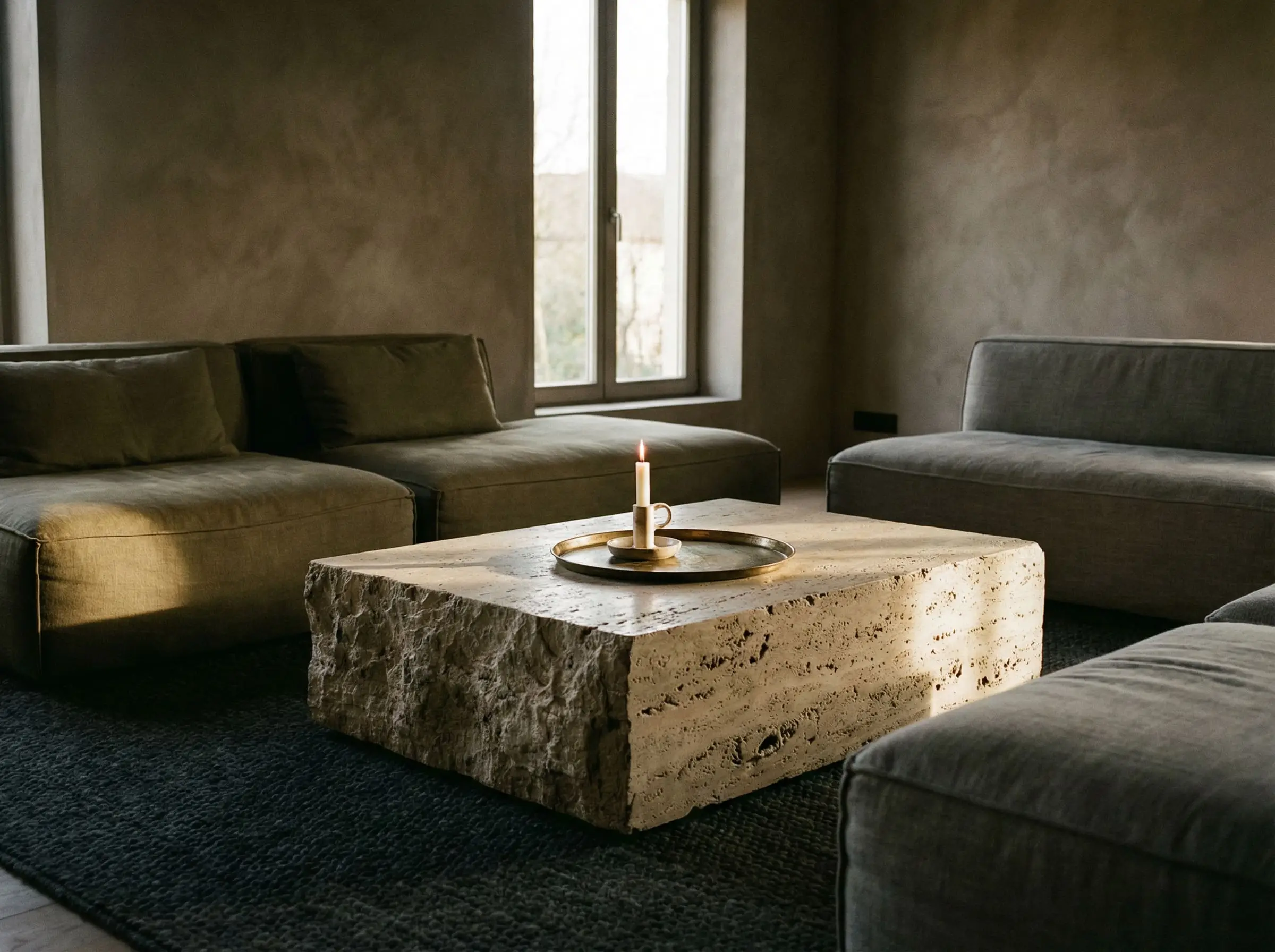
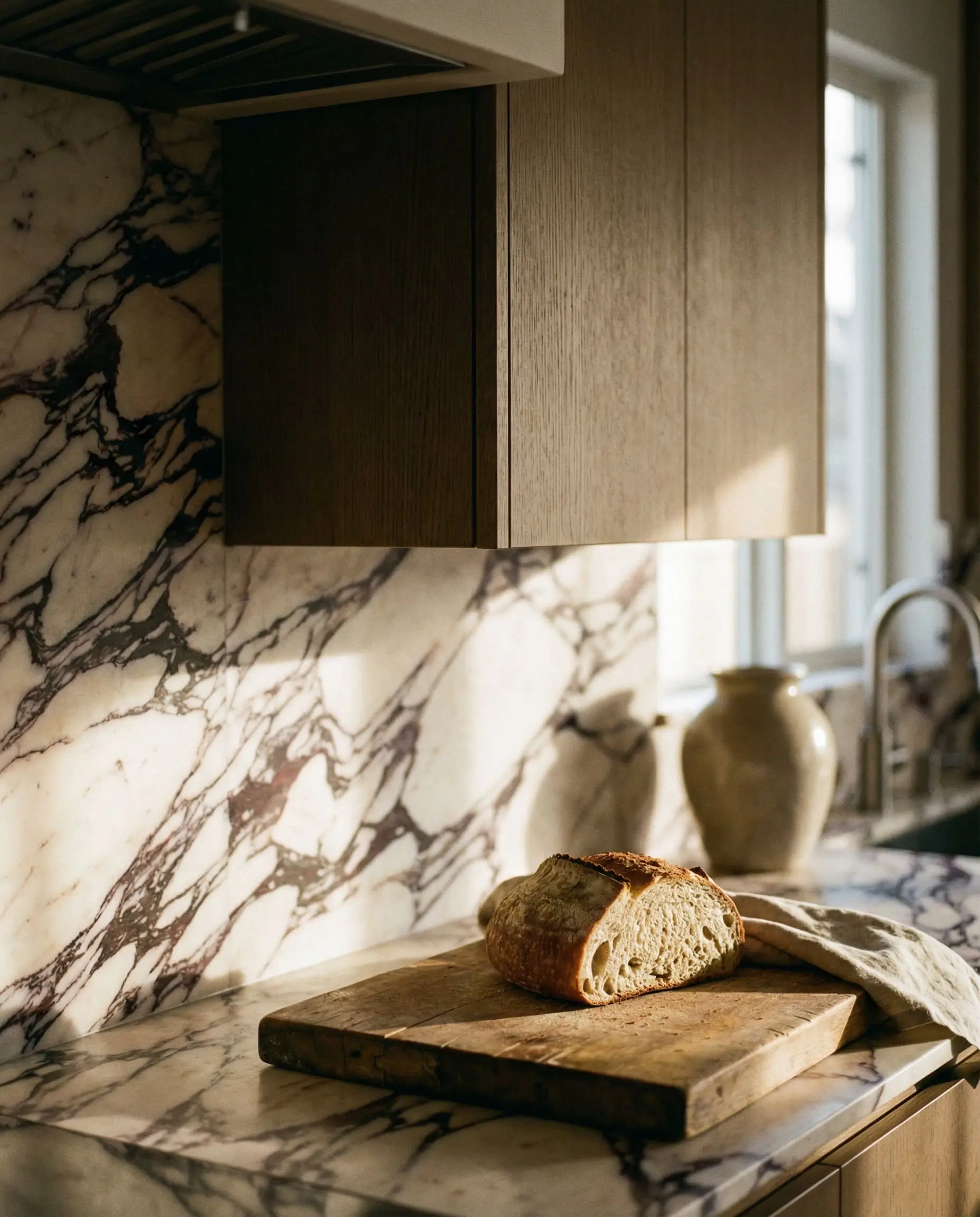
Always specify a “honed” or “leathered” finish for your stone slabs. Polished finishes reflect light sharply, ruining the soft chiaroscuro effect of the room. A matte finish absorbs light, allowing the stone to feel ancient and grounded.
💡 Hackrea Pro-Tip
You must remember that the imperfections, the inevitable etching from a spilled glass of wine, and the gradual staining of real stone over time are celebrated, not feared. This is the very definition of patina. When you learn how to style travertine and natural stone, you realize that a pristine, untouched slab lacks history. We want the stone to document the life lived around it.
Raw Timbers and Tactile Textiles
We must aggressively move away from the glossy walnuts or overly warm, orange-toned oaks of the mid-century revival. European organic modernism demands woods that look and feel as though they were just milled from a damp forest.
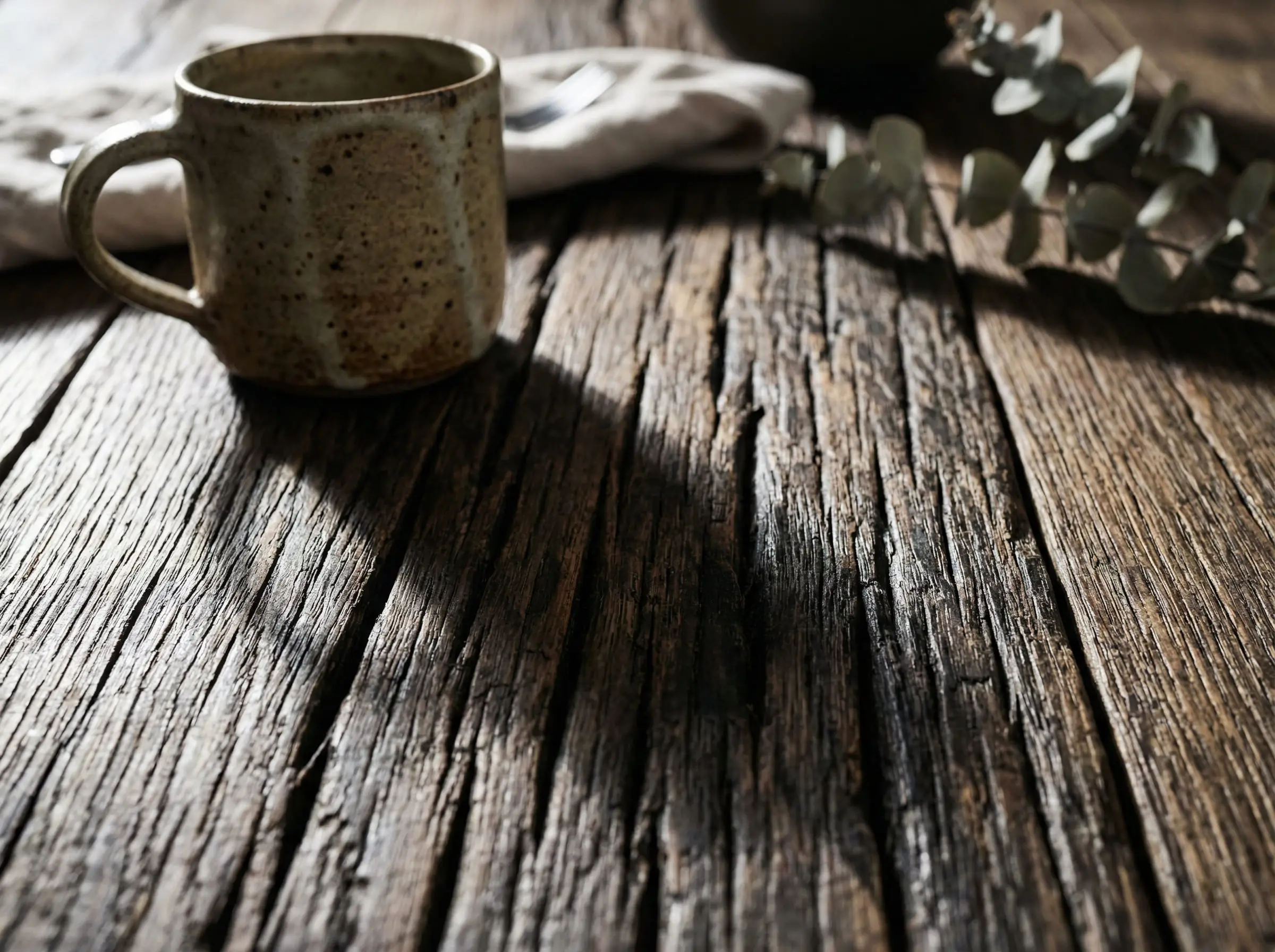
Focus your sourcing on smoked oak, European white oak treated exclusively with matte oil finishes, and reclaimed, deeply grooved timbers. You should be able to close your eyes, run your hand across a dining table, and feel the history in the grain.
This hard, tectonic wood must be immediately softened by highly tactile textiles. Mandate the use of slubby, heavy-weight Belgian linens, matte velvets, and coarse, unbleached wools.
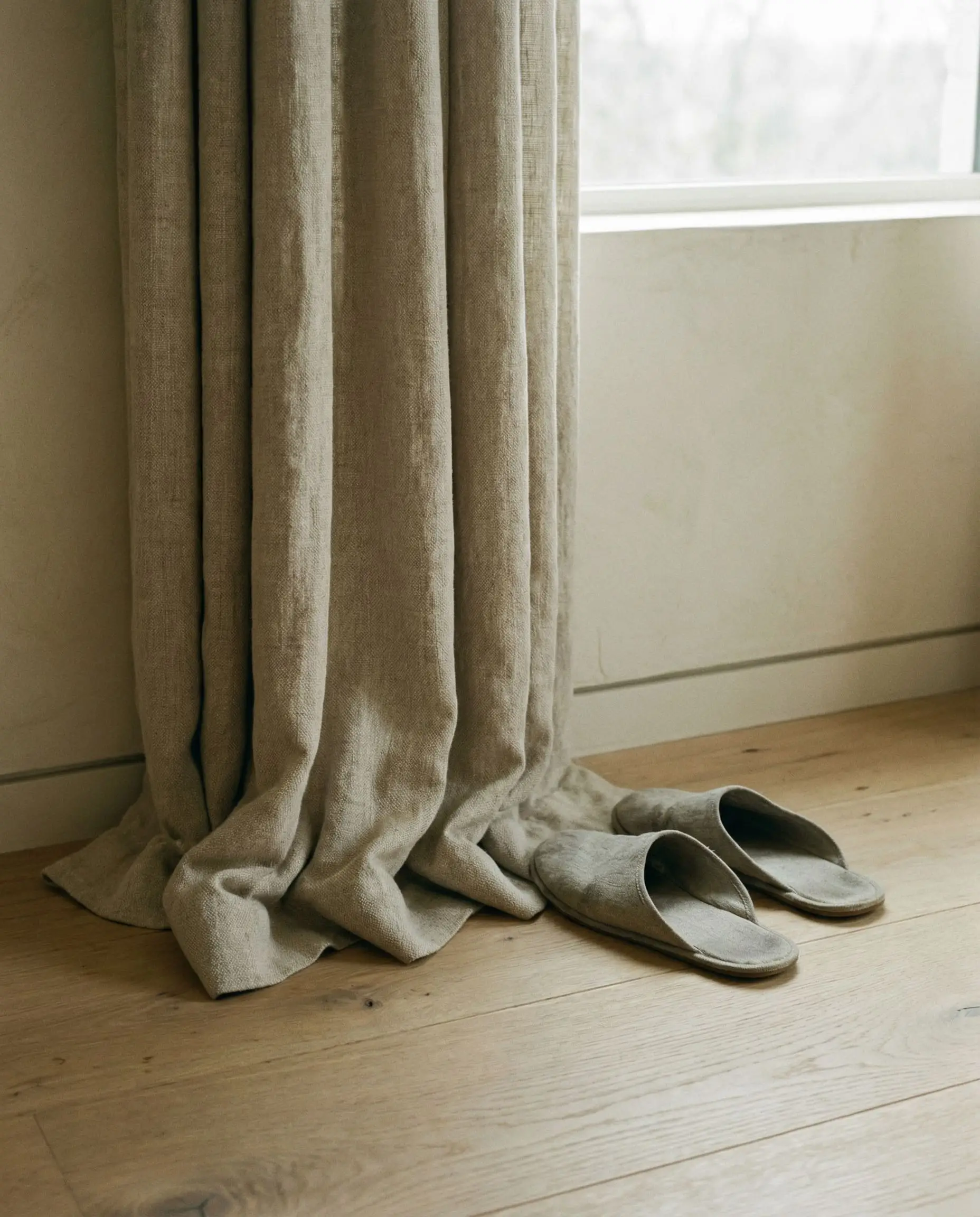
Synthetic blends or overly manicured, stiff fabrics have no place here. Window treatments should consist of sheer, unlined linen drapery that diffuses harsh sunlight into a soft, ambient glow. Every fabric must invite human touch. The juxtaposition of a heavy, draped linen curtain pooling effortlessly onto a wide-plank, matte-oiled European oak floor is the exact sensory experience this aesthetic demands. It is a masterclass in quiet, understated indulgence.
Curation Over Clutter (Furniture & Styling)
European Organic Modernism demands rigorous, almost painful restraint. It is not about filling every corner of a room; it is about utilizing negative space as a primary design element. By leaving walls bare and floors open, the few pieces you do choose are allowed to breathe and be admired as standalone sculpture.
Low-Profile, Sculptural Upholstery
Sofas and lounge chairs must sit exceptionally low to the ground, visually anchoring the room and increasing the perceived height of the ceilings.
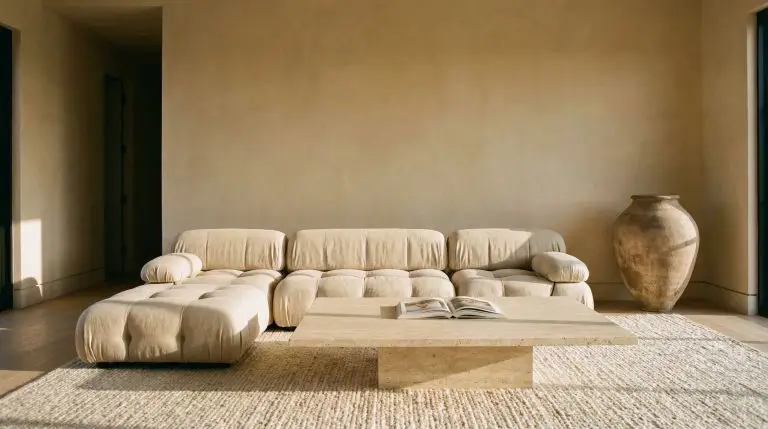
Look to the masters of Italian modernism for silhouette inspiration. Pieces echoing Mario Bellini’s iconic Camaleonda sofa, or the razor-sharp, minimalist lines of architects like Piero Lissoni and Vincent Van Duysen, are essential. The upholstery should feature generous, continuous volumes rather than being propped up on spindly, distracting metal legs.
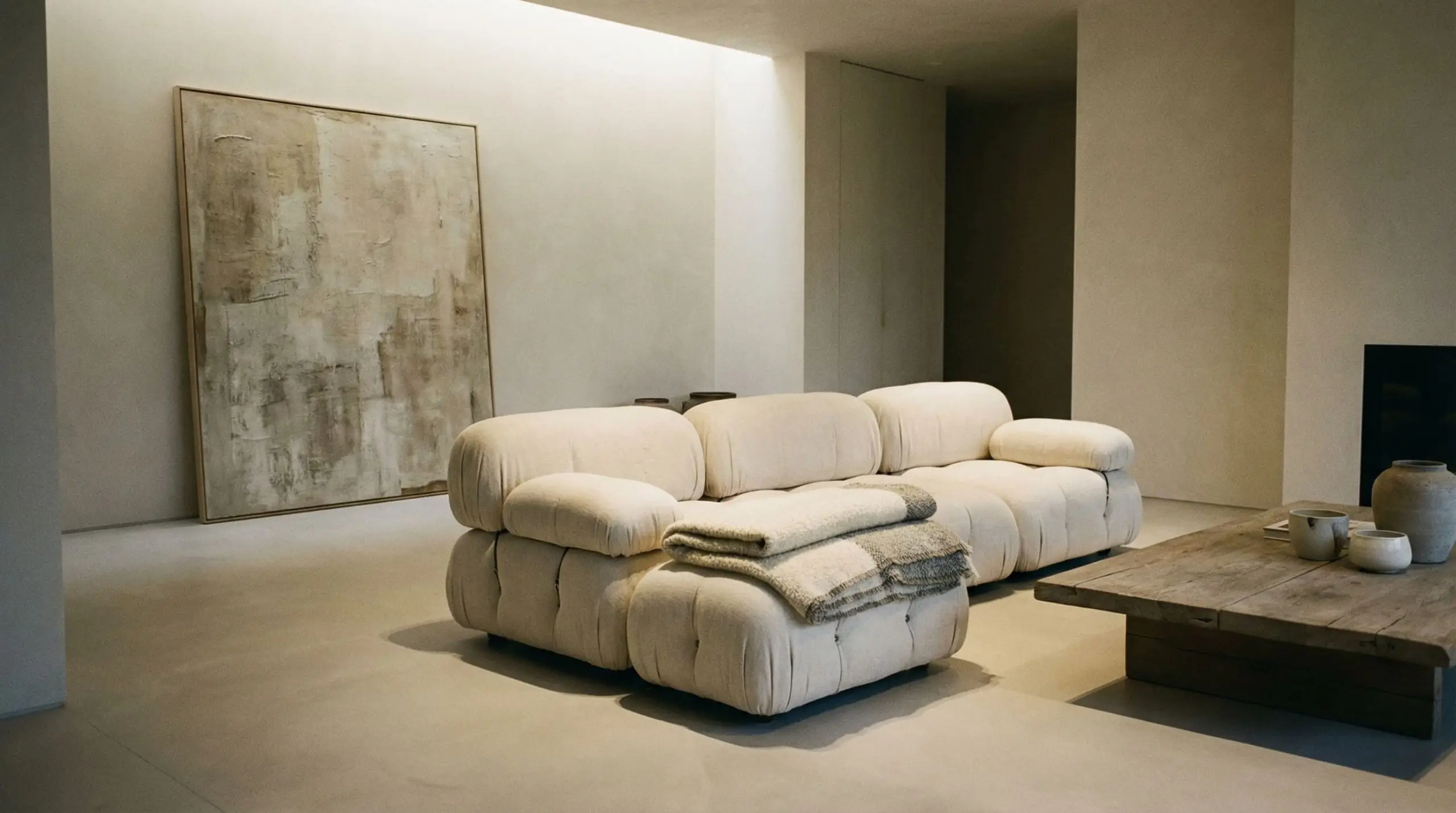
While physical comfort is paramount, the silhouette must remain rigorously architectural. A low-slung, monolithic linen sofa does not just provide seating; it acts as a soft, geometric landscape within the room. It commands the space through its sheer, undeniable visual weight. By keeping the sightlines completely unobstructed, these grounded, sculptural forms ensure that the architectural envelope of the room remains the true focal point of the interior.
The Art of the “Hero Object” (Antiquities in Modernity)
Here is the crucial secret to executing this look flawlessly: the inclusion of the ancient. A space only feels truly European when it features one or two monumental, historically significant objects.
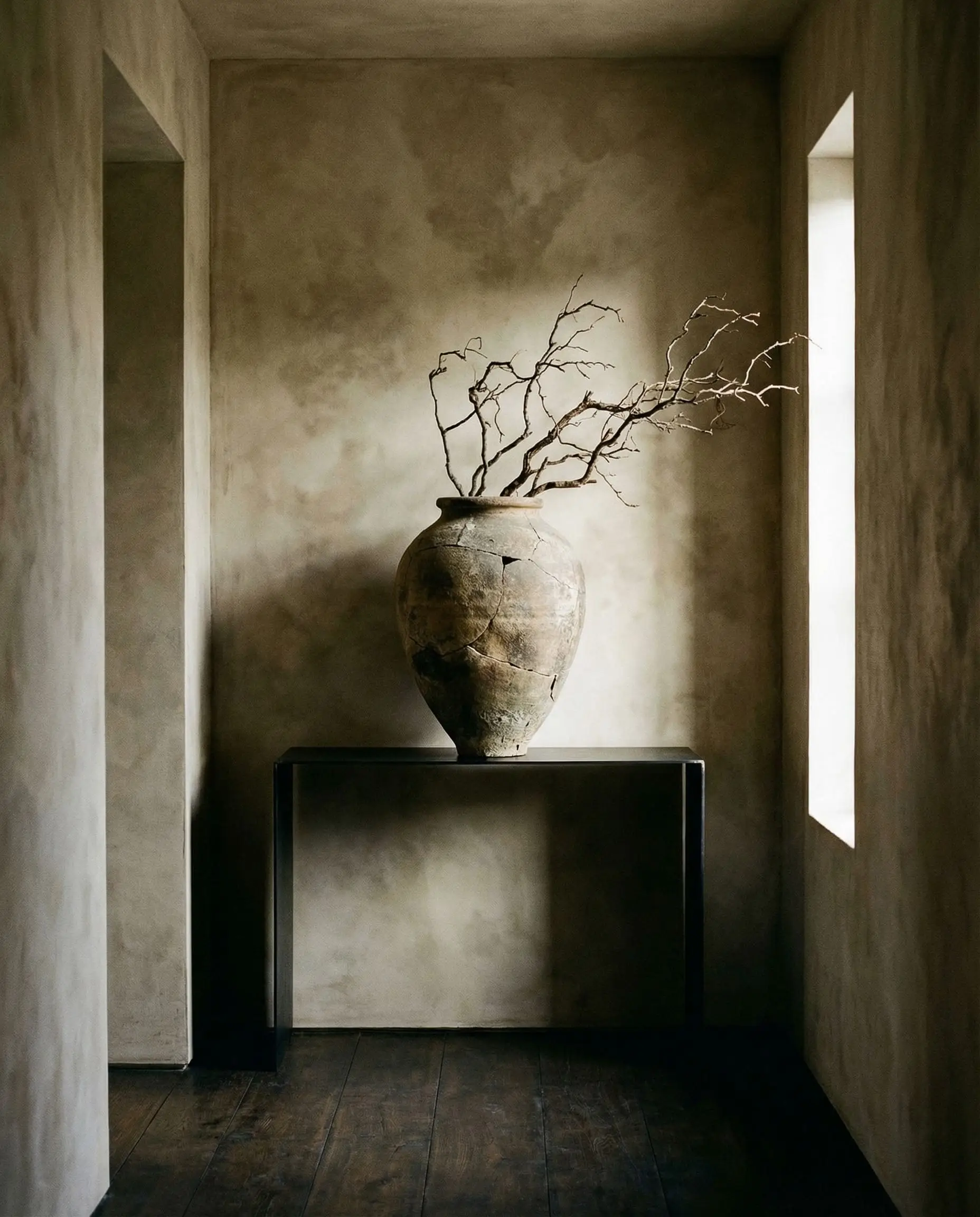
This is the “Hero Object.” It could be a weathered, 19th-century olive jar sourced from Provence, a fragmented Roman-style marble bust, an antique wabi-sabi milking stool, or a heavily patinated bronze bowl. These ancient objects serve a vital psychological function—they anchor the pristine, modern architecture to human history.
If you are studying Wabi-Sabi Design Principles, you understand that perfection is alienating. You must actively source vintage. Do not buy a mass-produced, faux-aged vase from a big-box retailer.
Where to Source Authentic Antiquities:
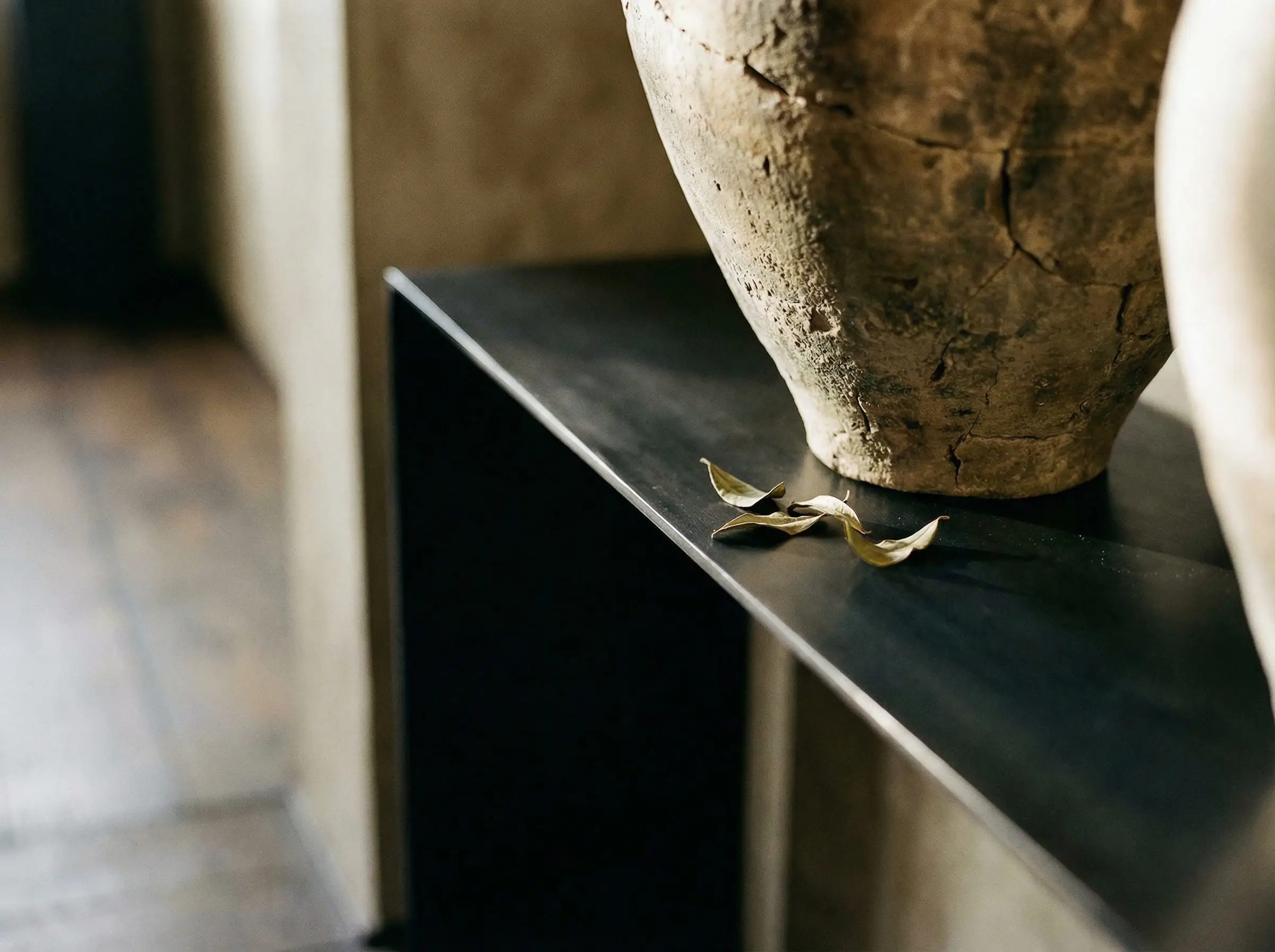
Placing an eroded, 200-year-old clay amphora atop a razor-sharp, ultra-modern blackened steel console table creates a museum-level installation in your own hallway.
Lighting as a Structural Element
Lighting in European Organic Modern design is never an afterthought or a mere decorative accessory. It is fundamentally integrated into the architecture itself to carve out spatial depth and highlight raw textures. Transitioning from standard illumination to strategic, ambient lighting is what ultimately dictates the emotional resonance of the home.
Ambient Wash and Hidden Luminaires
We must permanently ban the use of harsh, overhead recessed “can” lights that aggressively flatten a room and destroy its atmosphere.
Instead, advocate for grazing light. By installing hidden LED strips within architectural shadow gaps, you can wash light down a textured plaster wall, revealing every subtle trowel mark and imperfection. Sconces should act as sculptural art—think raw plaster fixtures that blend seamlessly into the wall, or unlacquered brass luminaires that will slowly patina over the years.
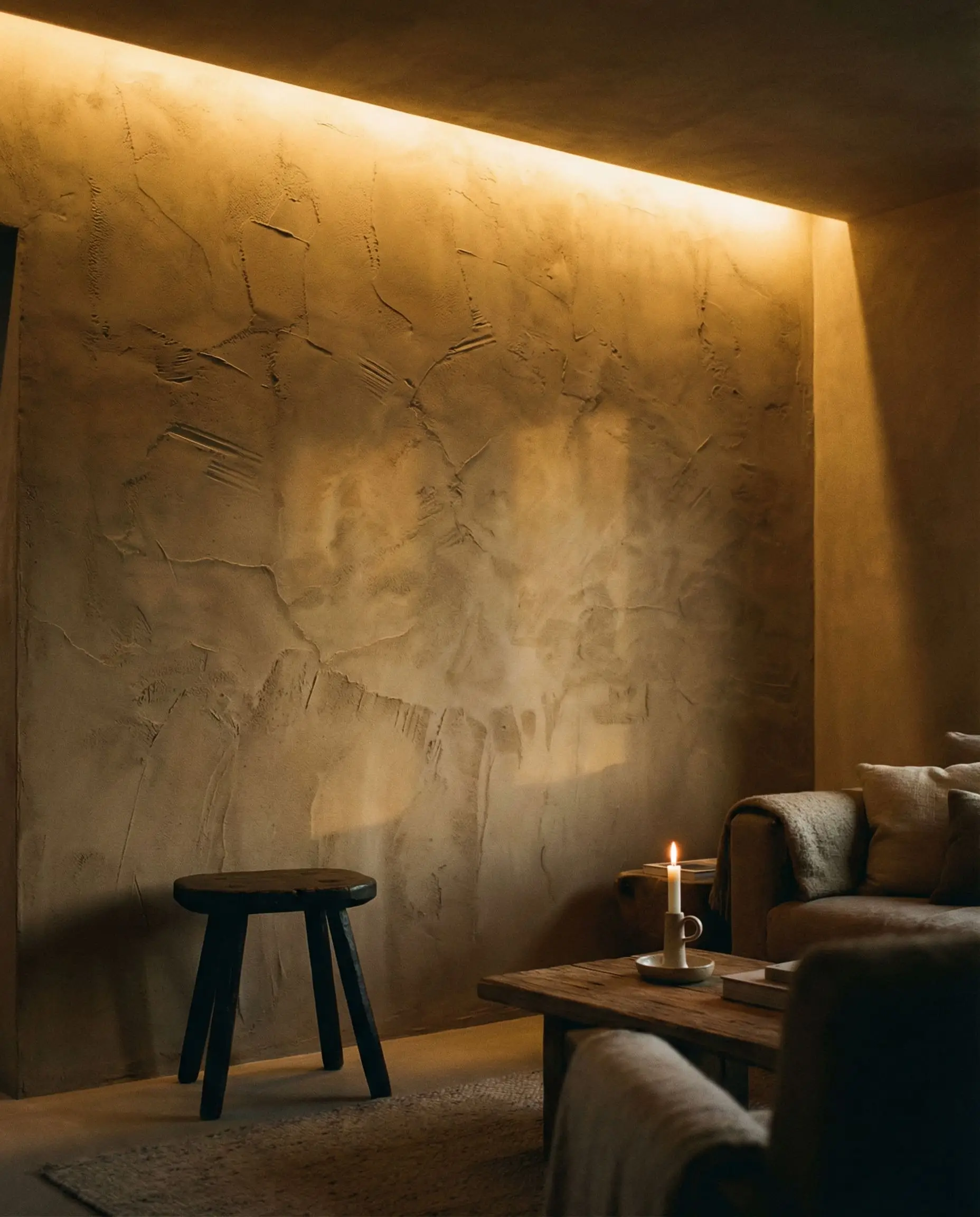
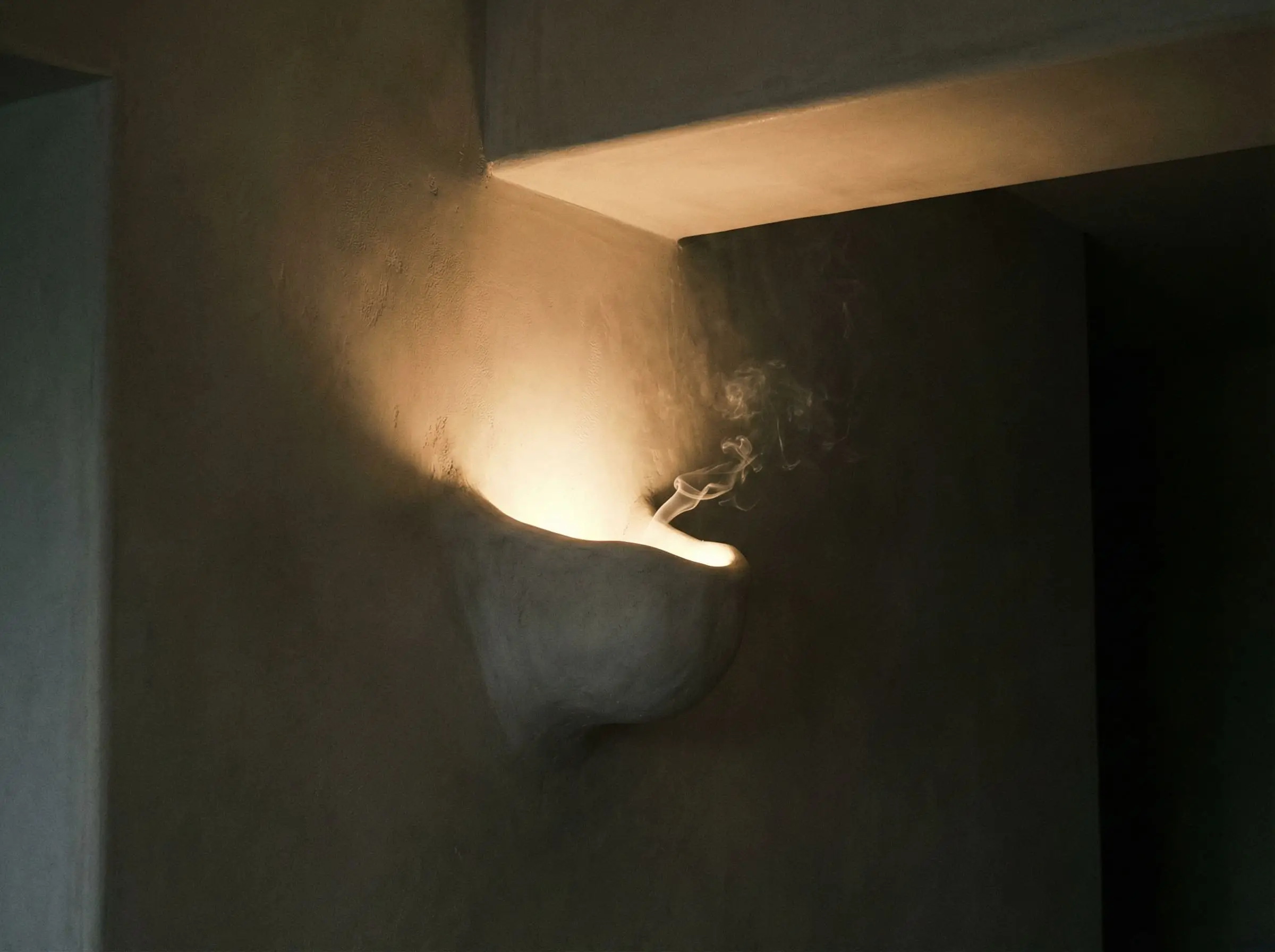
The goal is to create intimate “pools of light” at human height, rather than flooding the ceiling. When consulting our Minimalist Lighting Guide, the technical specifications are non-negotiable. You must exclusively use 2700K or 3000K bulbs to achieve a warm, candle-lit ambiance.
Lighting Execution Rules:
Room-by-Room Translation
Understanding the philosophy is only half the battle; applying it to the specific layout of your home requires rigorous curation. Taking these tectonic concepts and translating them into your most utilized spaces ensures that the aesthetic flows naturally. Maintaining absolute material consistency across these rooms is what makes a house feel like a cohesive, elite sanctuary.
The Living Space (Layering Textures)
Executing the living room is a masterclass in layering tactile materials. Begin at the floor. Ground the room with a massive, heavily textured wool or jute rug, providing a soft foundation for the architecture.
Resting upon this, place a low-slung, voluminous linen sofa that invites deep lounging. The center of the room should be anchored by a monolithic stone coffee table—perhaps a raw block of unhoned travertine that feels immovable.
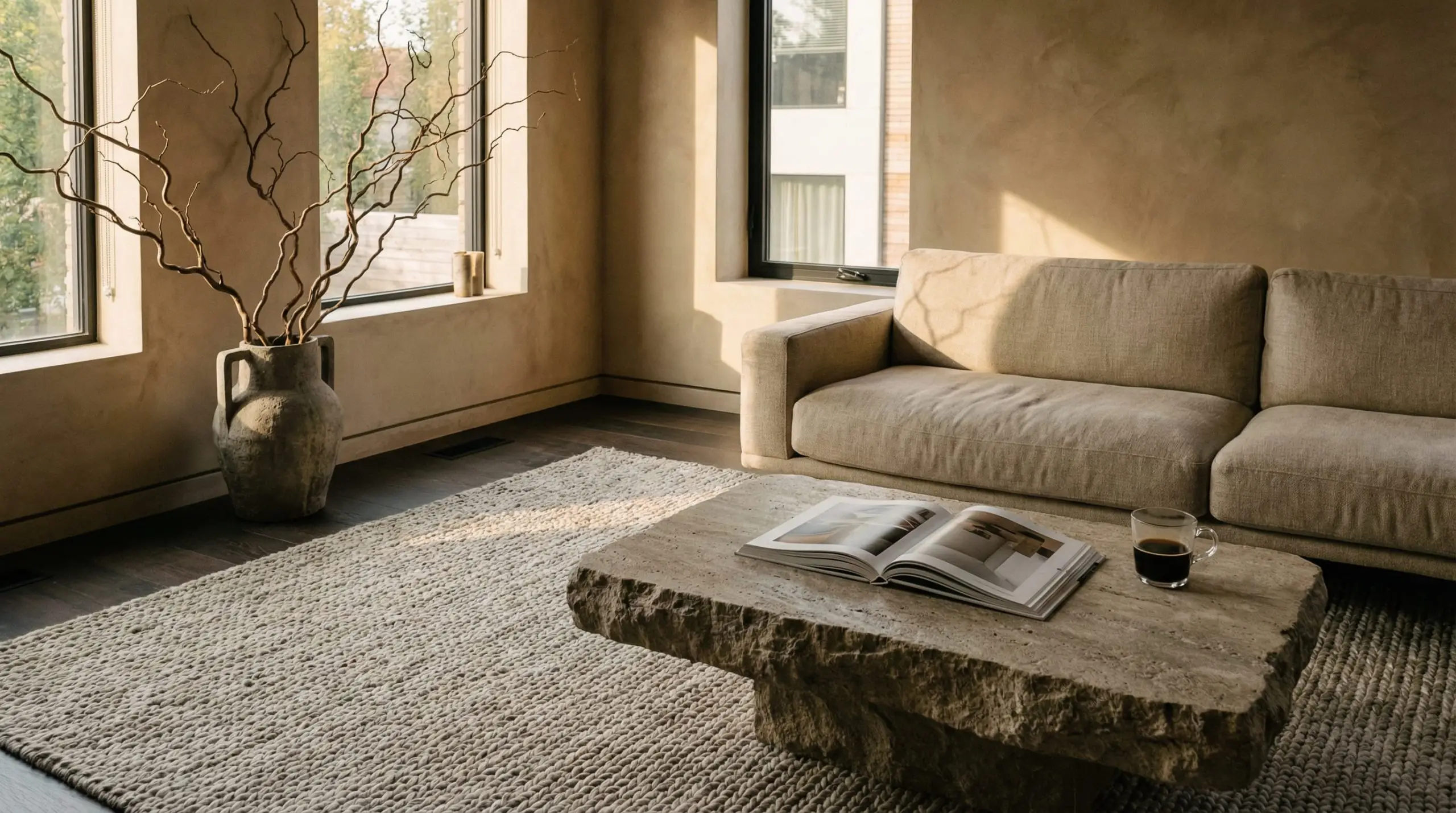
Keep artwork exceptionally minimal. Instead of a cluttered gallery wall, install a single, large-scale textural canvas, or a framed piece of fragmented, vintage European textile.
Abandon perfectly manicured, symmetrical floral arrangements. Instead, forage for large, asymmetrical, dried branches and place them in a heavy, brutalist floor vase.
🛋️ Hackrea Styling Tip
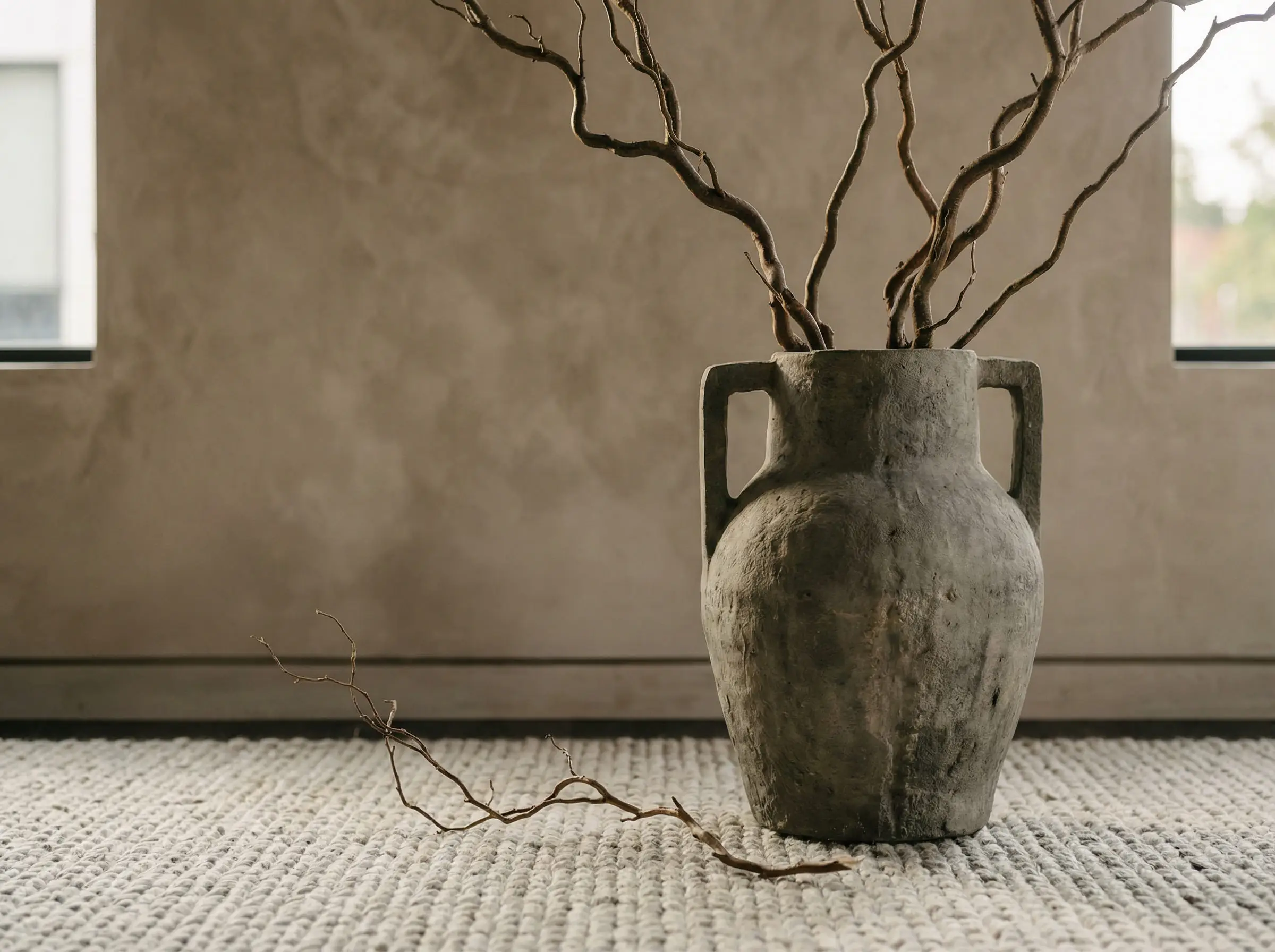
As your eye travels from the slubby wool rug, up the matte linen upholstery, across the cold, veined stone, and finally rests on the cloudy, plaster-washed walls, the room feels completely resolved. It is a space designed for quiet contemplation, not visual exhaustion. Every single texture plays a specific role in absorbing sound and diffusing light, ensuring the living space remains an acoustic and visual refuge from the outside world.
The Kitchen (Sleek Cabinetry Meets Raw Stone)
The kitchen provides the ultimate canvas for our core theory of juxtaposition. This highly searched, functional space must balance sterile utility with ancient warmth.
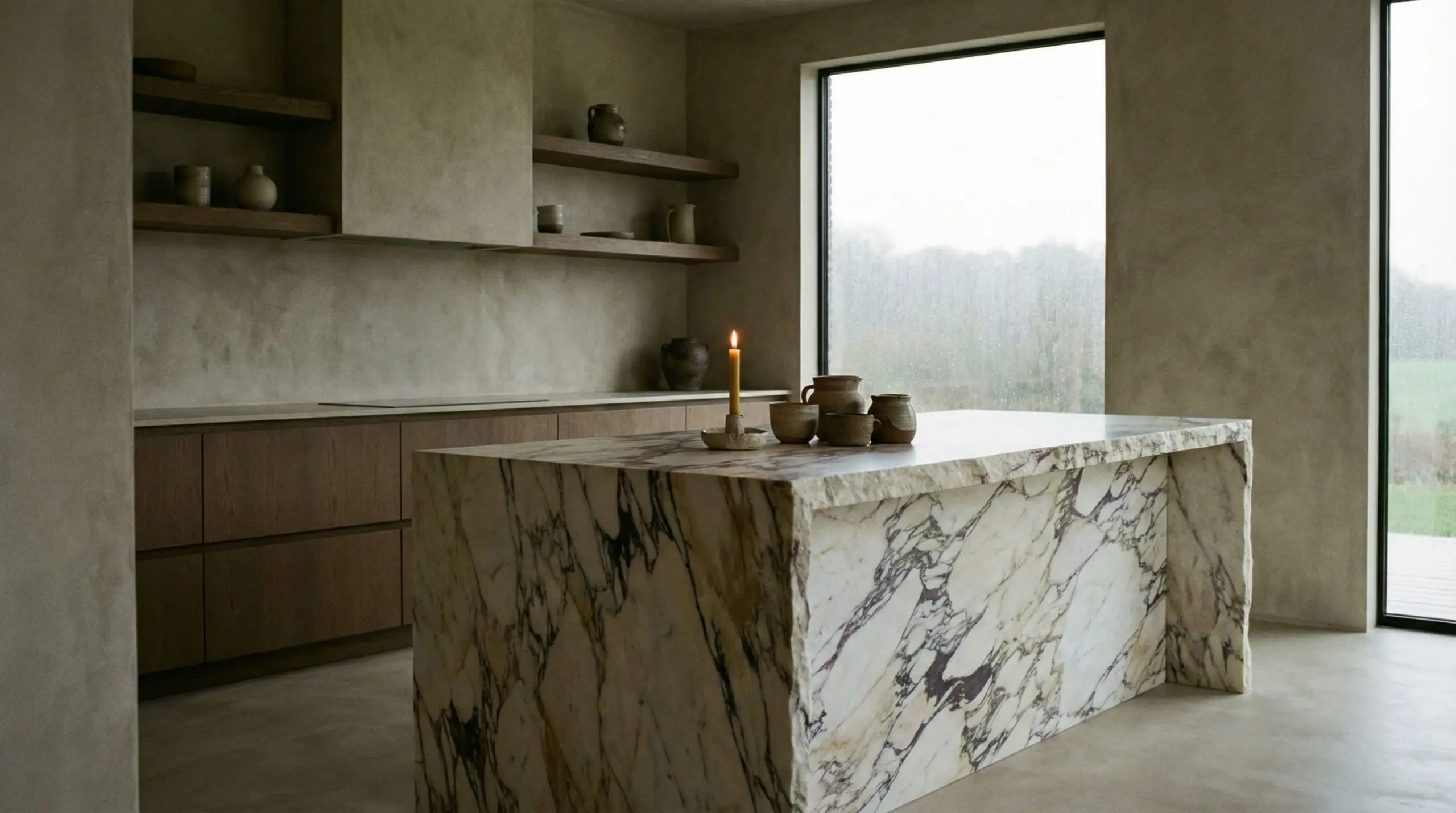
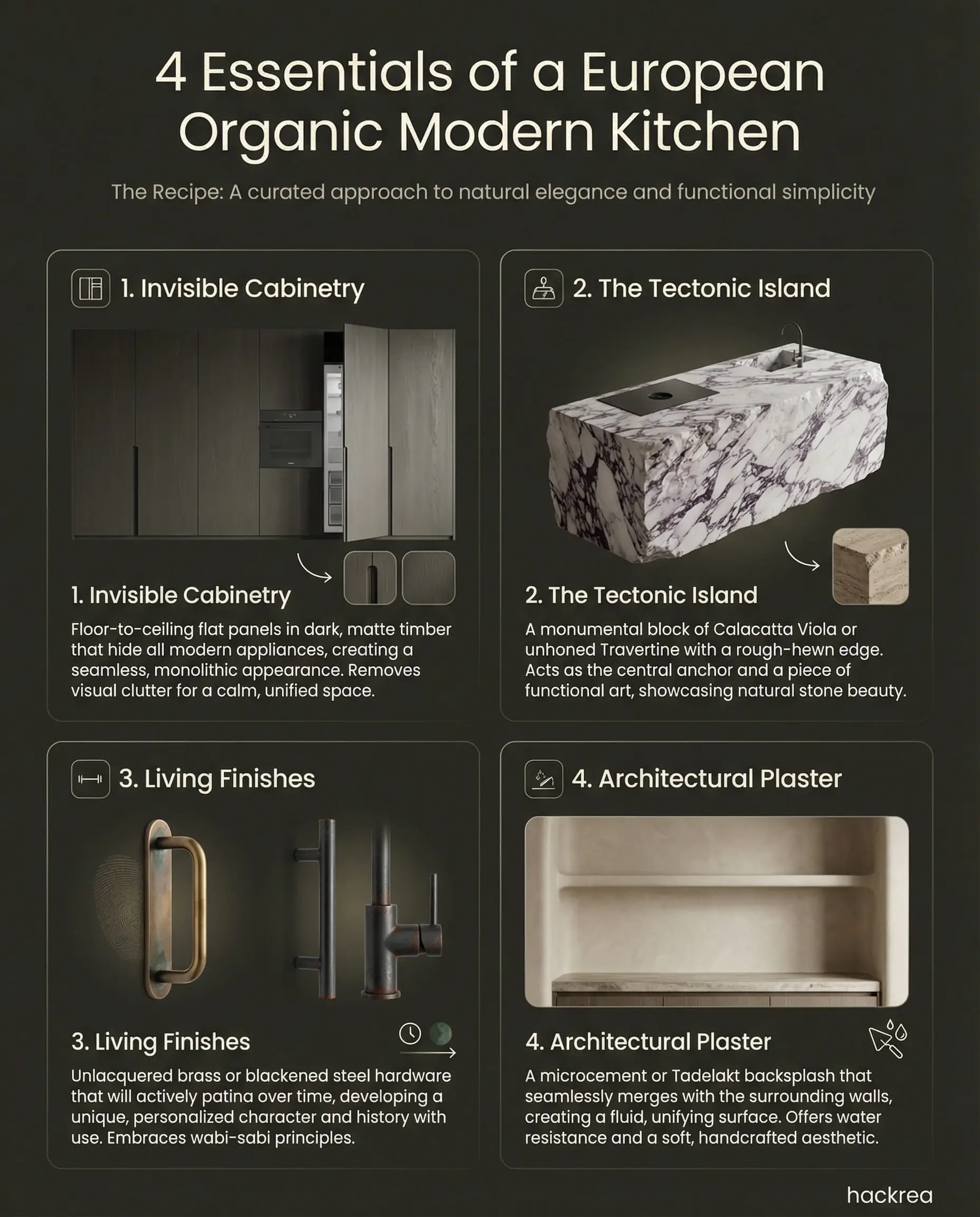
The foundation relies on flat-panel, completely handle-less cabinetry finished in a matte smoked oak or hand-troweled microcement. This sleek, invisible storage is then violently contrasted with a massive, dramatically veined stone island featuring a chipped, raw, or chiseled edge.
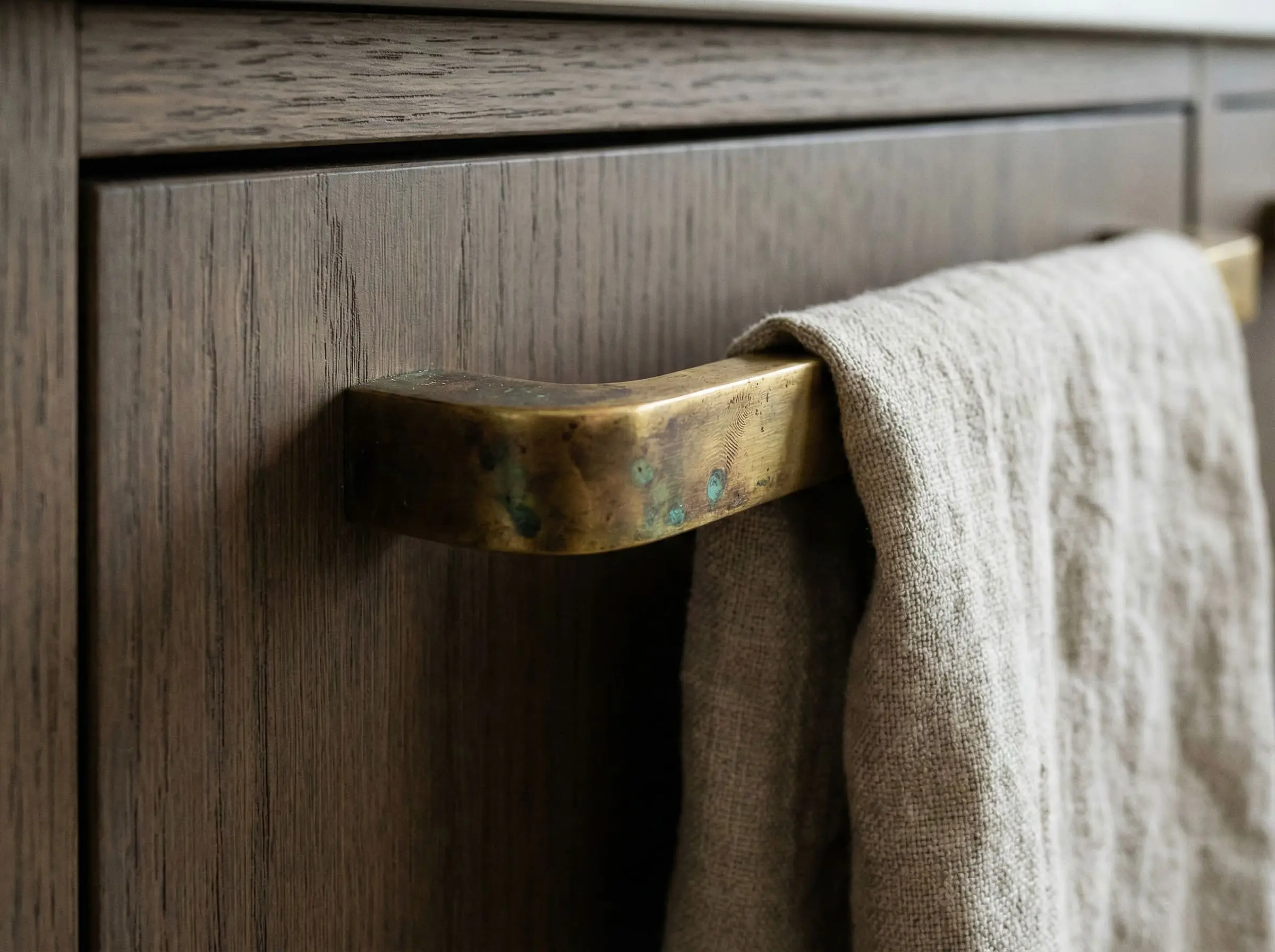
Upper cabinets are often entirely removed. In their place, thick, floating open shelving displays a tightly curated collection of handmade, wabi-sabi ceramics. The plumbing fixtures and remaining hardware must be solid, unlacquered brass, guaranteed to darken and visually age with the natural oils from human hands.
The Recipe: 4 Essentials of a European Organic Modern Kitchen
The Future of the Aesthetic: Sustaining the Soul of the Home
European Organic Modern is not a fleeting internet trend destined to be replaced next season. It is a profound return to enduring, elemental design. In a culture exhausted by mass-produced, disposable decor, this architectural philosophy offers a sustainable, deeply soulful alternative.
It is about creating a home that ages gracefully alongside you. When you utilize raw brass, unhoned stone, and solid European oak, you are installing materials that will look exponentially better in twenty years than they do on day one. A scratch on a microcement floor or a water ring on a travertine table is not a flaw; it is a permanent record of a life well-lived.
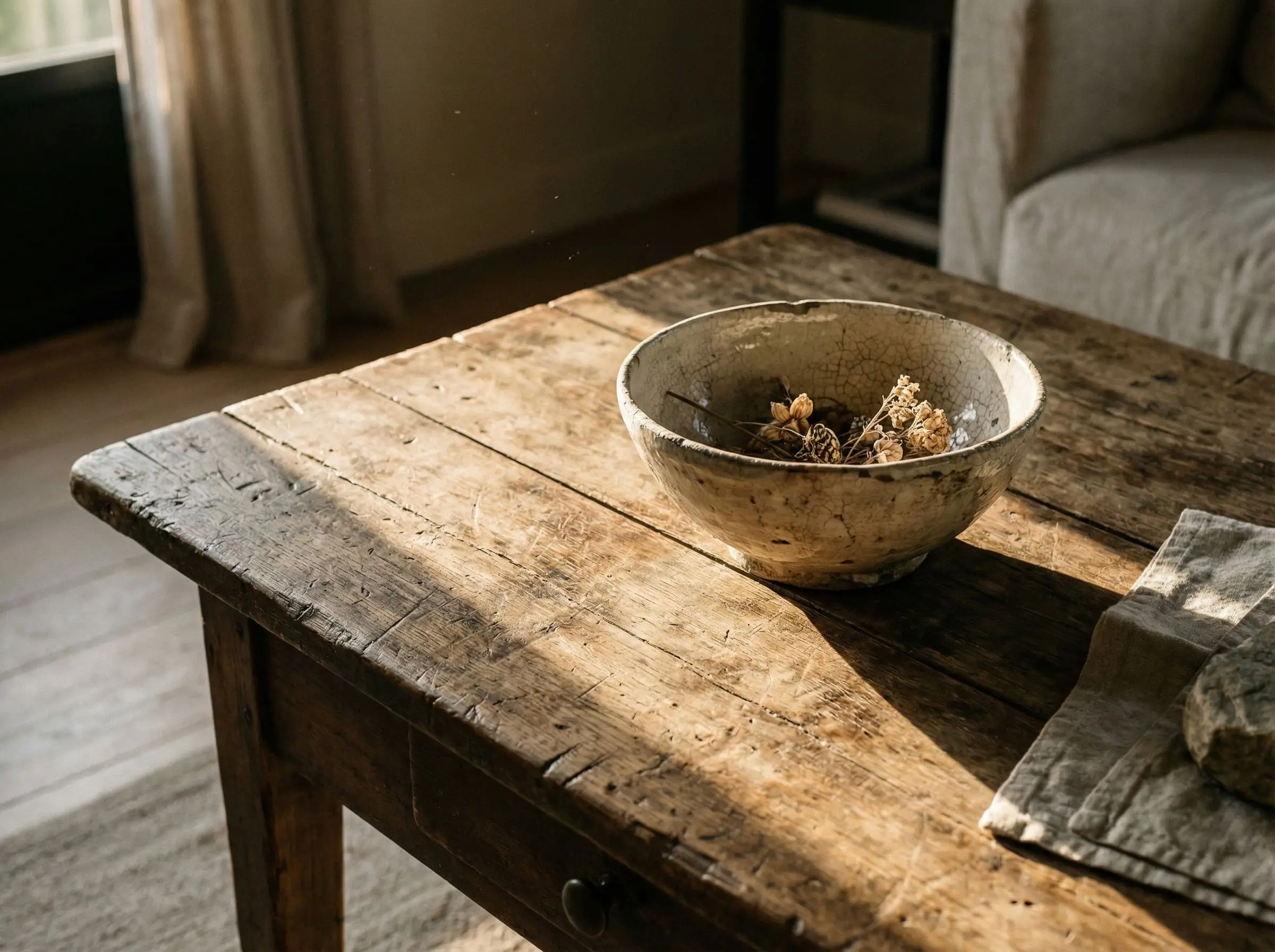
When testing swatches and materials in our Hackrea visualizer, we constantly remind our community to embrace this beautiful imperfection. Sourcing sustainably means rejecting the temporary. It means waiting to buy the perfect, reclaimed antique stool rather than settling for a cheap, synthetic replica.
We must shift our collective mindset away from decorating and toward curating. Invest in fewer, vastly better things. Let your walls breathe with natural plaster, let your stones etch, and let your brass darken in the shadows.
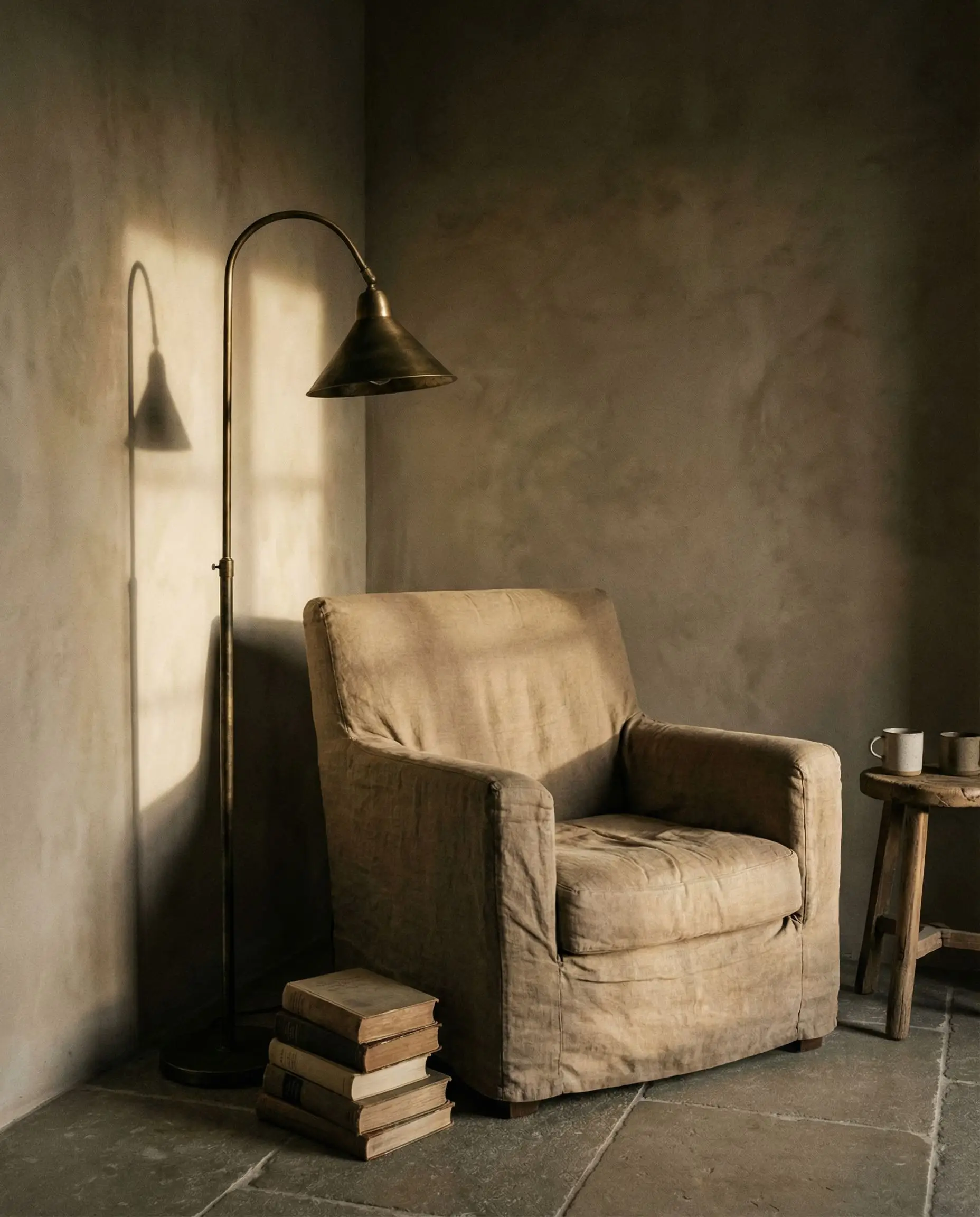
The spaces we inhabit dictate our internal emotional landscape. By surrounding yourself with materials pulled directly from the earth, shaped by master craftsmen, and steeped in history, you are building a sanctuary that transcends time. The ultimate luxury is not perfection; it is permanence. Stop buying disposable, soulless artifacts, and begin the rigorous, beautiful work of investing in the patina of your own life.
The Aesthetics Desk curates the visual direction for Hackrea. Specializing in design history, global architectural movements, and interior styling, this desk focuses on the psychology of space and how to translate high-end, magazine-quality aesthetics into approachable residential design without falling into fleeting micro-trends.