The double-hung window is losing ground in American residential construction – and the numbers explain why. Tilt and Turn windows deliver U-Factors as low as 0.14 BTU/hr·ft²·°F, STC ratings of 40, and air leakage as low as 0.10 CFM/ft² at 75 Pa / 1.57 psf – performance specs that most double-hung replacements can’t match, even at premium price points.
Why 2027 Is the Year Tilt and Turn Windows Started Replacing the Double-Hung in American Homes
Stricter energy codes and a broader U.S. dealer network pushed Tilt and Turn windows past a market tipping point in 2027. Two factors drove the shift: ENERGY STAR Version 7.0’s tightened U-Factor thresholds and the expansion of European window distribution into 10+ states.
The Energy Code Update That Raised the Bar
ENERGY STAR Version 7.0 – effective October 2023 – cut the maximum allowable U-Factor for windows in the Northern zone from 0.27 to 0.22 BTU/hr·ft²°F. Most standard double-pane double-hung windows test between 0.28 and 0.35. That gap eliminates them from new construction and from permitted window replacements in Northern climate zone states, regardless of price.
The 2021 IECC, now adopted in more than 20 states, extended that requirement to permitted work in existing homes. In Massachusetts, New York, and New Jersey, a permitted window replacement on a post-2024 permit requires NFRC-certified U-Factor documentation. That documentation requirement – not any marketing push – is what put Tilt and Turn windows on contractor spec sheets.
How a Growing U.S. Dealer Network Finally Made European Windows Accessible
Five years ago, sourcing a Tilt and Turn window meant placing an international order and managing customs clearance yourself. That’s no longer the case. European window systems are now available through dealer networks in NJ, NY, PA, MA, NC, CO, MT, TN, and several additional states, with lead times of 8–10 weeks from order confirmation to delivery.
Table 1: ENERGY STAR Version 7.0 U-Factor Requirements by Climate Zone (Effective October 2023)
| Climate Zone | U-Factor Max | SHGC Max | Example States |
| Northern | ≤ 0.22 BTU/hr·ft²·°F | ≤ 0.40 | MN, WI, MI, NY (upstate), ME, VT, NH |
| North-Central | ≤ 0.25 BTU/hr·ft²·°F | ≤ 0.40 | PA, NJ, OH, IL, CO, CT, MA |
| South-Central | ≤ 0.30 BTU/hr·ft²·°F | ≤ 0.25 | NC, TN, VA, TX (north), GA |
| Southern | ≤ 0.32 BTU/hr·ft²·°F | ≤ 0.25 | FL, TX (south), AZ, LA |
What a Tilt and Turn Window Actually Does – and Why the Mechanics Are Fundamentally Different
A Tilt and Turn window operates on two axes: tilt the sash inward at the top for ventilation, or swing it fully open like a casement door for cleaning and egress. One frame, two functions, controlled by a single handle rotation. That dual-axis mechanism is what makes the performance numbers possible – the frame is engineered around a perimeter seal that compresses at multiple points on every close.
Two Opening Modes, One Frame
Rotate the handle 90 degrees and the sash tilts inward at the top – typically 4 to 6 inches – for secure ventilation without breaking the locked perimeter. Rotate 180 degrees and the entire sash swings inward on a vertical hinge. The tilt position keeps the opening above child-reach height, which matters for second-floor installations where a fully open double-hung creates a fall risk without aftermarket stops.
What Multi-Point Locking Actually Does to Airtightness
Multi-point locking compresses the perimeter seal at 5 to 8 points simultaneously every time the handle closes. That distributed clamping force is what produces air infiltration of 0.10 CFM/ft² at 75 Pa / 1.57 psf. A double-hung relies on two cam latches – one at the upper rail, one at the lower – and those seals degrade as the sash wears on its tracks. In a strong wind, a Tilt and Turn window stays quiet; a worn double-hung rattles at the rail.
Table 2: Tilt and Turn vs. Double-Hung – Mechanical and Performance Comparison
| Feature | Tilt and Turn | Double-Hung |
| Opening mode | Tilt (ventilation) + turn (egress/cleaning) | Slide up or down |
| Lock type | Multi-point, 5–8 contact points | 2 cam latches (upper/lower rail) |
| Air infiltration | 0.10 CFM/ft² at 75 Pa / 1.57 psf (PAVA) | Typically 0.20–0.30 CFM/ft² |
| Cleaning access | Both faces accessible from inside | Requires exterior access or ladder |
| Frame depth | 82 mm (3¼ in.) PAVA / 70 mm (2¾ in.) PIXEL | 3–4 in. typical |
| Child safety | Tilt stop keeps opening above reach height | Requires aftermarket window stop |
European manufacturers like OKNOPLAST build the multi-point lock as a standard component on every Tilt and Turn unit – not an upgrade option.
How Do Tilt and Turn Windows Compare to Double-Hung on Energy Efficiency?
Tilt and Turn windows outperform double-hung on every measurable energy metric – U-Factor, SHGC where applicable, and air infiltration – because the frame geometry and locking mechanism close both major paths that heat takes through a window assembly.
The U-Factor Gap – Triple Glazing vs. Standard Double-Pane
A standard double-pane double-hung window tests at a U-Factor of 0.28 to 0.35 BTU/hr·ft²·°F under NFRC 100 protocols. That range falls below ENERGY STAR Version 7.0’s Northern zone threshold of 0.22, which eliminates it from permitted replacements in Northern climate states – regardless of price point or brand.
Tilt and Turn systems with triple glazing reach U-Factors of 0.14 to 0.22 BTU/hr·ft²·°F. The glazing adds a third lite with a second argon-filled cavity, but the frame contribution matters as much. A 7-chamber uPVC frame reduces conductive heat transfer across the frame section – DOE data attributes 25–30% of total window heat loss to frame conduction in standard double-pane assemblies. A deeper, multi-chamber frame cuts that path.
Air Leakage: Where Double-Hung Windows Lose the Battle
Windows and doors account for 25–30% of residential heating and cooling load, per DOE. Air infiltration through the window assembly is a compounding factor in that figure – and double-hung windows, with sliding sashes on tracks that wear over time, leak more than any other residential window type as the building ages.
For a 15-window home in a Northern zone state – a 2,200 sq. ft. Colonial is a reasonable reference – replacing 0.25 CFM/ft² double-hung windows with Tilt and Turn units rated at 0.10 CFM/ft² at 75 Pa / 1.57 psf reduces air infiltration at that component by roughly 60%. At current natural gas and electric rates across the Northeast, that translates to $200 to $400 in annual HVAC cost reduction, depending on heating degree days and fuel type.
Table 3: Energy Performance – Tilt and Turn vs. Double-Hung
| Metric | Tilt and Turn (triple glazing) | Double-Hung (standard double-pane) | Delta |
| U-Factor | 0.14–0.22 BTU/hr·ft²·°F | 0.28–0.35 BTU/hr·ft²·°F | 35–50% lower |
| Air infiltration | 0.10 CFM/ft² at 75 Pa / 1.57 psf | 0.20–0.30 CFM/ft² | 40–65% less |
| ENERGY STAR V7.0 Northern zone (≤ 0.22) | Category qualifies* | Does not qualify | – |
| Frame chambers (uPVC) | 6–7 chambers | 3–4 chambers typical | – |
| Argon cavities | 2 (triple glazing) | 1 (double-pane) | – |
*Category meets technical threshold. OKNOPLAST ENERGY STAR status pending EPA certification – confirm at time of purchase.
OKNOPLAST’s PAVA system – NFRC-certified through Keystone Certifications USA – reaches a U-Factor floor of 0.14 BTU/hr·ft²·°F and air infiltration of 0.10 CFM/ft² at 75 Pa / 1.57 psf.
What Double-Hung Windows Cost You Beyond the Energy Bill
The upfront cost comparison between Tilt and Turn and double-hung windows understates the real price gap. Double-hung windows carry ongoing costs in cleaning, hardware maintenance, and acoustic degradation that don’t appear on any proposal.
The Cleaning Problem Nobody Accounts For
A double-hung window – two sliding sashes, exterior-facing glass – requires cleaning from the outside. For anything above the ground floor, that means a ladder, a hired cleaning crew, or dirty windows. A professional window cleaning service for a 15-window home runs $200 to $270 per visit; at two visits per year, that’s $400 to $540 annually, or $1,200 to $2,700 over 10 years – not counting years when tracks, hardware, or weatherstripping also need service.
A Tilt and Turn window pivots fully inward. Both faces clean from inside the room. No ladder. No service call. No 10-year bill.
How Single-Point Latches Fail – and What That Costs
Double-hung cam latches apply contact pressure at two rail points. After 5 to 8 years of seasonal expansion and contraction, those cams wear, the latch misaligns, and the sash begins to rattle in wind or leak conditioned air around the compressed seal. Replacing a worn cam latch costs under $20 in parts – but the weatherstripping behind it rarely survives intact. Replacing weatherstripping on a double-hung sash typically runs $80 to $150 per window in labor.
Multi-point locks on Tilt and Turn windows distribute that stress across 5 to 8 contact points. There’s no single cam absorbing all the load, and the perimeter seal compresses evenly on every close. Hardware failures happen – but they’re less frequent, and OKNOPLAST covers manufacturing defects under a 10-year warranty.
The Acoustic Penalty That Compounds Over Time
A new double-hung window with standard double-pane glazing tests at STC 28 to 32. That’s enough to muffle light suburban ambient noise. In an urban or near-highway location – the context where most Tilt and Turn buyers are weighing the upgrade – STC 28 provides roughly 28 dB of mid-frequency transmission loss, and that figure degrades as the cam seal wears over time.
PAVA’s certified STC 40 rating represents an 8- to 12-point STC advantage over a standard double-hung – a difference the human ear perceives as a meaningful reduction in traffic and mechanical noise. That gap holds because the multi-point lock maintains the perimeter seal on every close, rather than relying on two cam contacts that wear.
Which Home Styles Are Driving the Shift Away from Double-Hung?
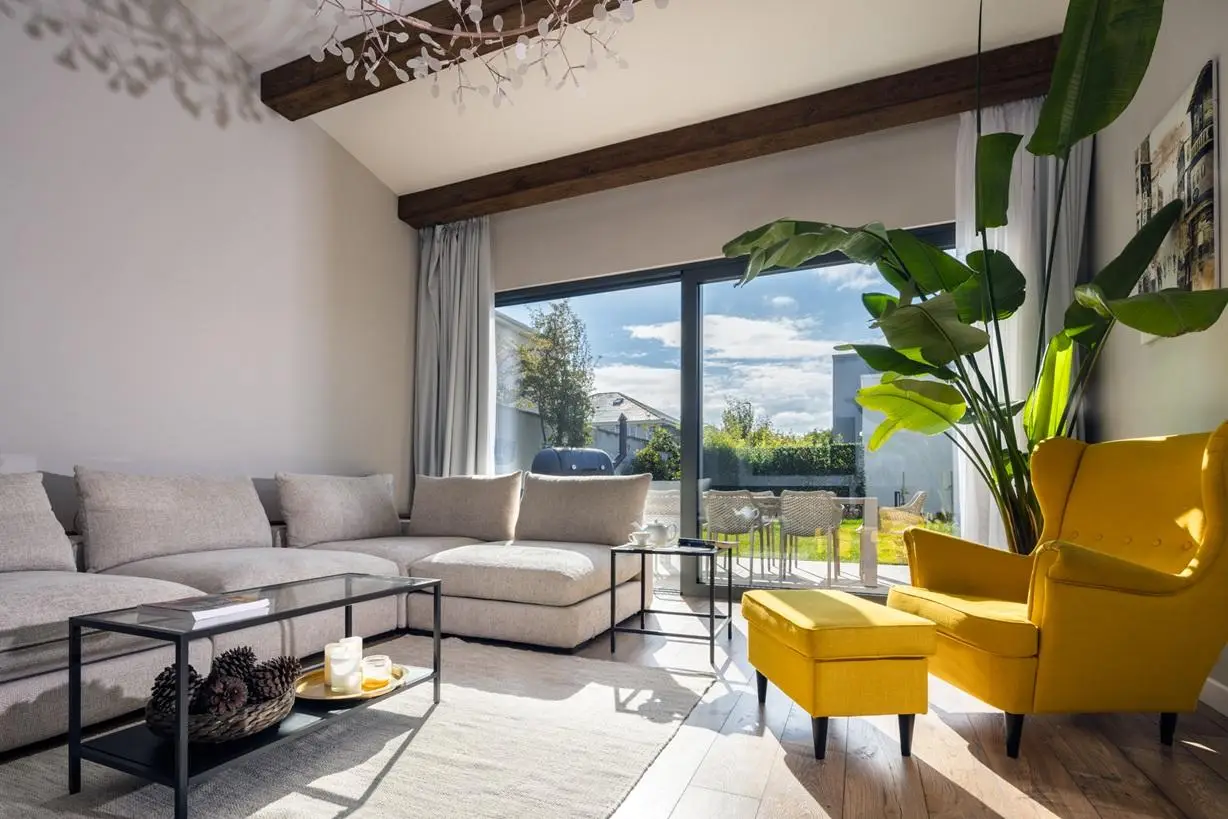
The shift isn’t uniform across home types. Contemporary builds, modern farmhouses, and high-performance construction are leading; traditional Colonials and Craftsman homes are moving more slowly, partly because the double-hung remains the aesthetic default for those styles.
Contemporary and Modern Farmhouse Homes
Contemporary and modern farmhouse builds favor Tilt and Turn windows because the profiles are slimmer and the hardware minimal. A 70 mm (2¾ in.) PIXEL frame sits flush within a 2×6 wall assembly and disappears into the exterior. No visible sash rail, no balance-system mechanism showing through the frame. The single handle controls both functions – tilt and turn – with no additional hardware.
OKNOPLAST offers 50+ color options on PAVA and PIXEL – including matte anthracite and wood-look laminates – which gives architects the exterior color palette of a painted wood window without repainting every 5 to 7 years. Designers specifying projects in CO, MT, and NC are increasingly listing European-profile windows by specification, with the double-hung noted as a downgrade option.
Passive House and High-Performance Construction
Passive House construction requires air infiltration below 0.06 ACH50 at the whole-building level. No double-hung window on the market contributes toward that target – the sliding sash geometry makes it structurally incompatible with the airtightness spec. Tilt and Turn has been the default for PHIUS-certified projects for years.
The same logic is extending into adjacent market segments. Builders pursuing ENERGY STAR Homes v3.2 certification or LEED for Homes credits are specifying higher-performance windows at the framing stage, not as a late-stage option. General contractors running 10 to 30 homes per year in the Northeast are adding Tilt and Turn as a standard package option because it simplifies energy compliance – fewer performance trade-offs to resolve later in the schedule.
Table 4: Home Style × Tilt and Turn Fit
| Home Style | Fit | Notes |
| Contemporary / Modern | Strong | Slim profiles, minimal hardware, flush sightlines |
| Modern Farmhouse | Strong | 50+ colors including matte black and wood-look laminates |
| Passive House (PHIUS) | Required | Airtightness spec eliminates sliding-sash alternatives |
| ENERGY STAR Homes v3.2 | Strong | Northern zone U-Factor ≤ 0.22 requirement |
| LEED for Homes | Strong | Contributes to Energy and Atmosphere credits |
| Traditional Colonial | Moderate | Style conventions favor double-hung aesthetics |
| Craftsman | Moderate | Casement or Tilt and Turn both meet code; style preference decides |
What Does Switching to Tilt and Turn Cost – and When Does It Pay Back?
Tilt and Turn windows cost more upfront than standard double-hung replacements. The frame depth, triple glazing, and hardware add material cost. The payback calculation includes energy savings, cleaning service eliminated, and reduced hardware maintenance over the warranty period.
Installed Cost by Scenario
A standard double-hung replacement in a 2,200 sq. ft. Colonial typically runs $350 to $550 per window installed, including frame and glazing. A Tilt and Turn replacement in the same rough opening runs $700 to $1,100 per window – roughly twice the upfront cost for the window itself. Installation labor is comparable. Older openings with non-standard rough-in dimensions typically need interior and exterior trim adjustment – budget 2 to 4 hours of finish carpentry per opening in a pre-1990 home.
For a 15-window project, the upfront premium over double-hung is $5,250 to $8,250.
How Long Until the Upgrade Pays for Itself?
Annual savings from the switch combine reduced HVAC load (200–400 per year in a Northern zone home) and eliminated professional cleaning service (400–540 per year). Combined: $600 to $940 per year.
At those savings rates, payback on the 5,250–8,250 premium runs 6 to 14 years – shorter in high heating-degree-day markets like Minnesota, Maine, and upstate New York, longer in milder North-Central zone states.
Table 5: 15-Window Project – Cost and Payback Comparison
| Metric | Double-Hung (15 windows) | Tilt and Turn (15 windows) | Difference |
| Installed cost | 5,250–8,250 | 10,500–16,500 | +5,250–8,250 |
| Annual HVAC savings | Baseline | 200–400/yr | – |
| Annual cleaning avoided | 400–540/yr | $0 | +400–540/yr saved |
| 10-yr hardware service (est.) | 1,200–2,250 | Lower (10-yr warranty) | – |
| Estimated payback period | – | 6–14 years | – |
How to Get Tilt and Turn Windows in the U.S.: Dealers, Lead Times, and What to Expect
Tilt and Turn windows (https://oknoplast.us/tilt-and-turn-windows/)are available through regional dealer networks in 10+ U.S. states – not a specialty import requiring direct international orders. Lead time is 8–10 weeks from order confirmation: 4–5 weeks manufacturing and 4–5 weeks ocean freight and U.S. customs clearance to East Coast points of entry.
OKNOPLAST USA Inc. – headquartered at 20 Commerce Dr., Cranford, NJ – distributes PAVA and PIXEL through a dealer network spanning NJ, NY, PA, MA, NC, CO, MT, TN, and additional states currently onboarding. Dealers provide NFRC performance documentation, custom sizing by rough opening, and installation support. A rough-opening measurement from your contractor is the starting point for a project quote.