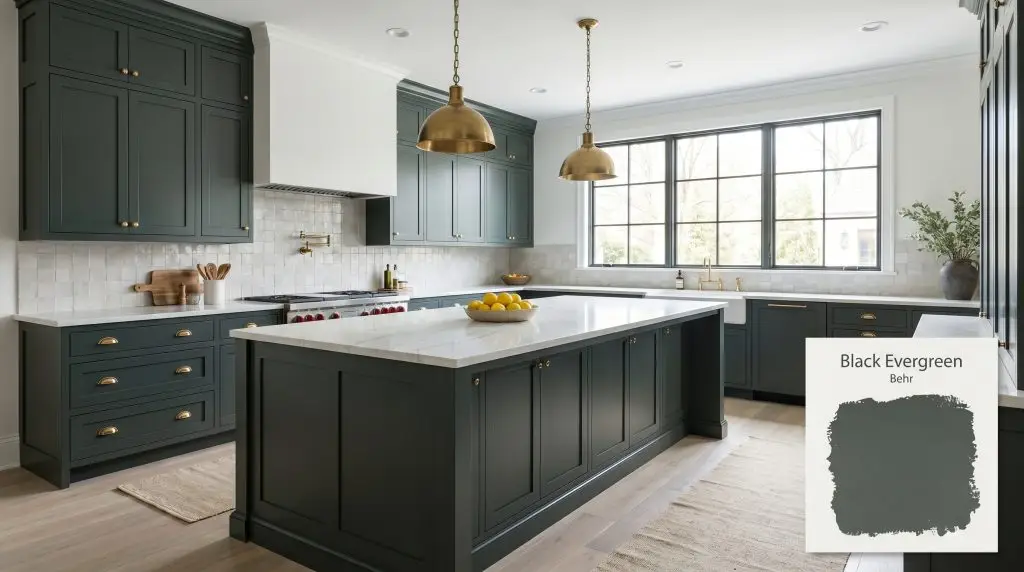
Behr Black Evergreen (MQ6-44) is a dramatic, near-black forest green. With an LRV of 8, it acts as a moody chameleon, appearing as a rich, deep green in bright sunlight and shifting to a sophisticated, flat charcoal in low-light conditions.
Will Black Evergreen clash with your room?
Paint Technical Profile
| Color ID / SKU | MQ6-44 |
| HEX Code | #45524f |
| Light Reflectance (LRV) | 8 |
| Temperature | Cool |
| Primary Undertone | Forest Green |
| Hidden Undertones | Charcoal, Slate Blue |
| Use | Interior, Exterior |
| Best Exposures | South-facing, East-facing |
| Best For | Kitchen cabinets, moody bedrooms, dens, exterior trim, accent walls |
Black Evergreen Digital Design Concept Boards
Kitchen Cabinetry & Islands
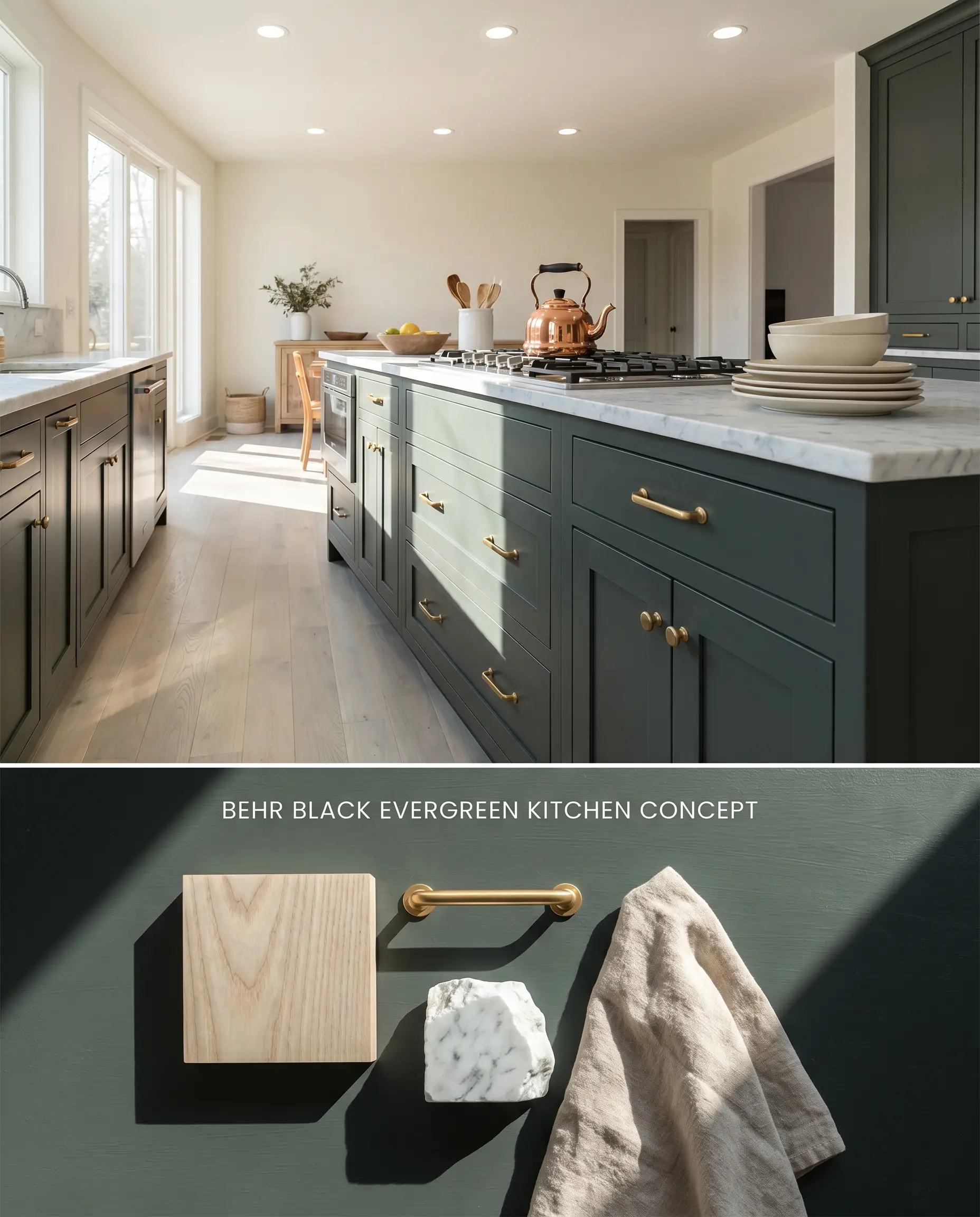
The deep green-black hue anchors lower cabinetry, drawing the eye downward and grounding lighter upper elements like white marble or pale zellige tile. Its cool undertone requires careful pairing, as orange-toned oak floors will push the green toward a muddy brown. Selecting cool-toned walnut or bleached ash flooring maintains the crisp, forest green cast while acting as a premium cabinetry paint application.
Moody Accent Walls & Dens
Will Black Evergreen work with your specific lighting, floor, or furniture?
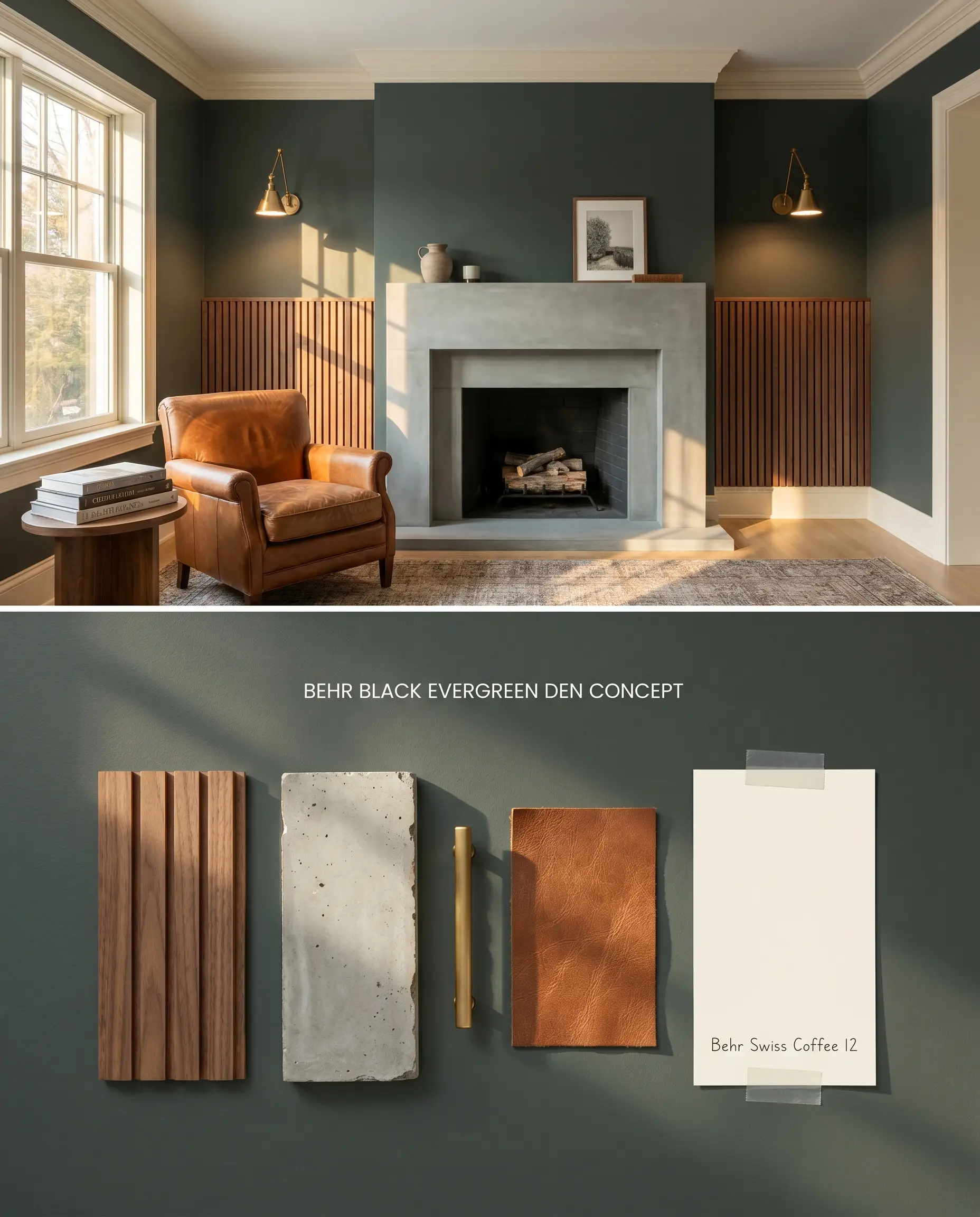
Applying this LRV 8 shade to a single focal wall instantly alters the room’s perceived depth, absorbing ambient light to make the wall recede into a moody interior design scheme. Because the color traps light and turns flat in dim environments, flanking the accent wall with layered artificial lighting is mandatory. Avoid a matte sheen here if the wall sees any physical contact, as the dark pigment burnishes quickly upon impact.
Color-Drenched Bedrooms
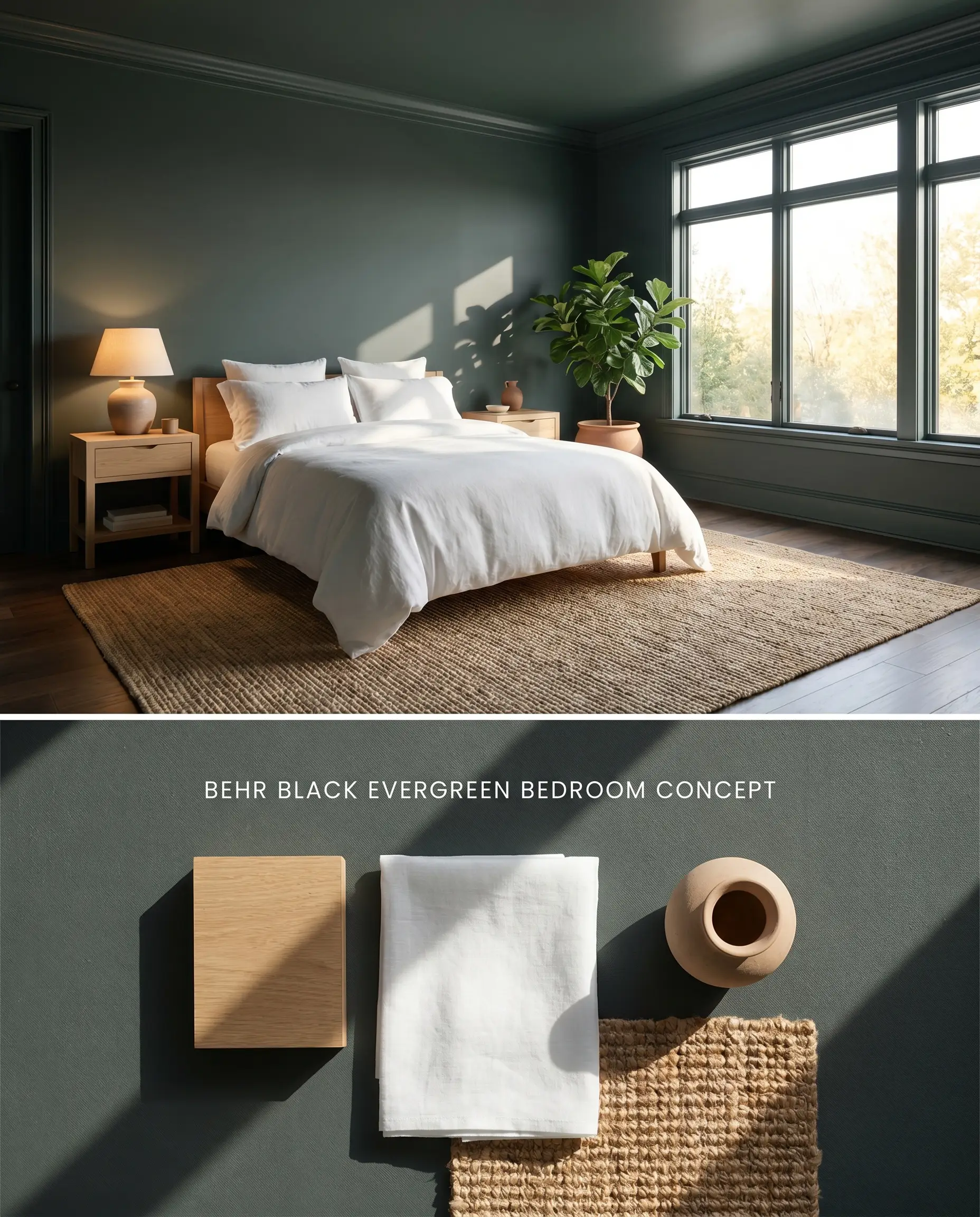
Wrapping a bedroom entirely in Black Evergreen blurs the boundaries between walls, trim, and ceiling, creating an expansive, continuous visual plane. This color-drenching application strictly requires significant natural light; otherwise, the space immediately feels enclosed and loses all its green character. A tinted primer followed by three coats is necessary to prevent a patchy, pink-white bleed-through on the expansive drywall surfaces.
Exterior Trim & Front Doors
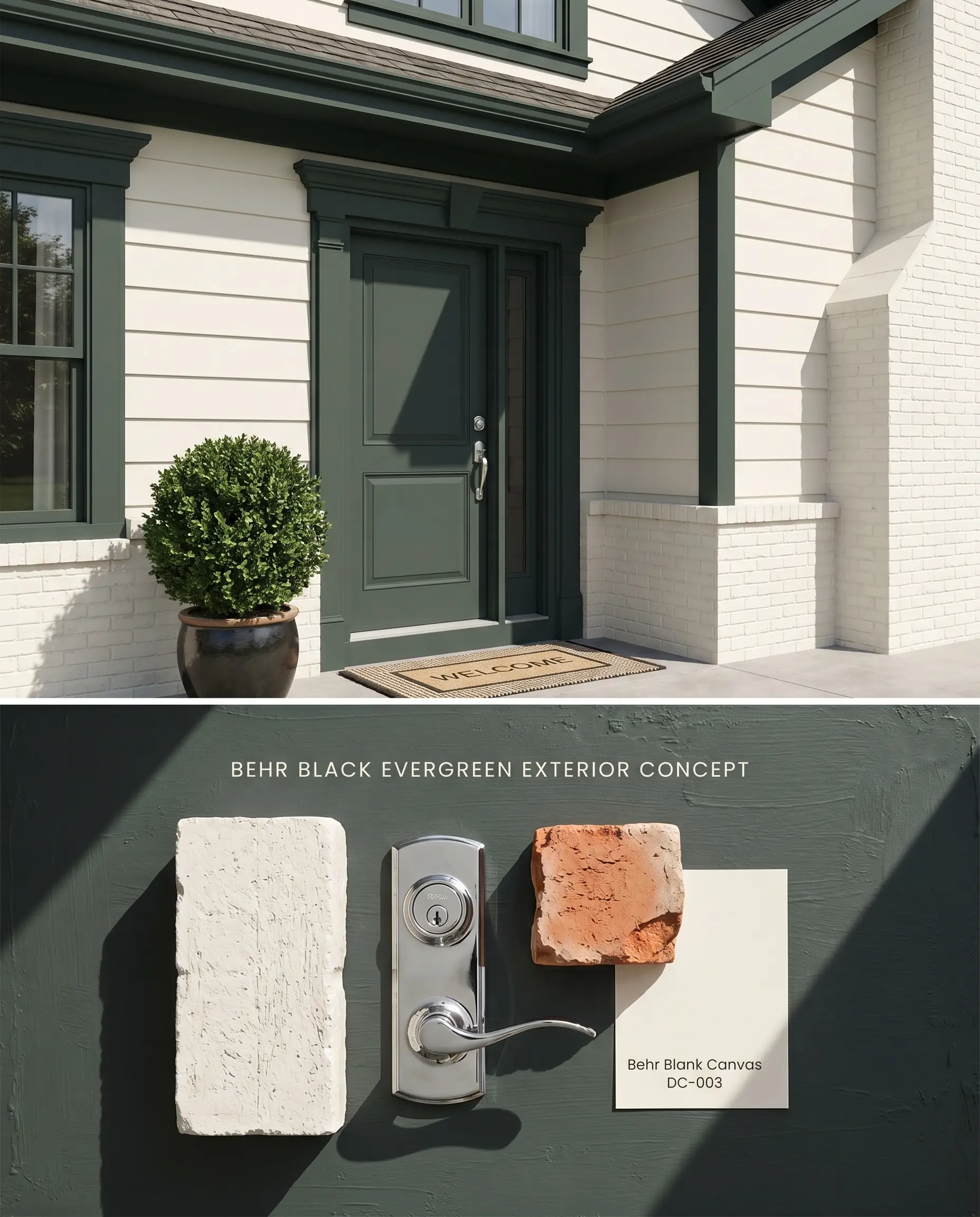
On exteriors, direct sunlight washes out dark colors, allowing the subtle green-black hue of Behr MQ6-44 to read as a vivid, tailored forest green. It provides sharp, architectural contrast against neutral stucco or white painted brick facades. The deep pigment requires a premium base to resist fading and chalking under intense UV exposure.
Mid-Century Modern Living Rooms
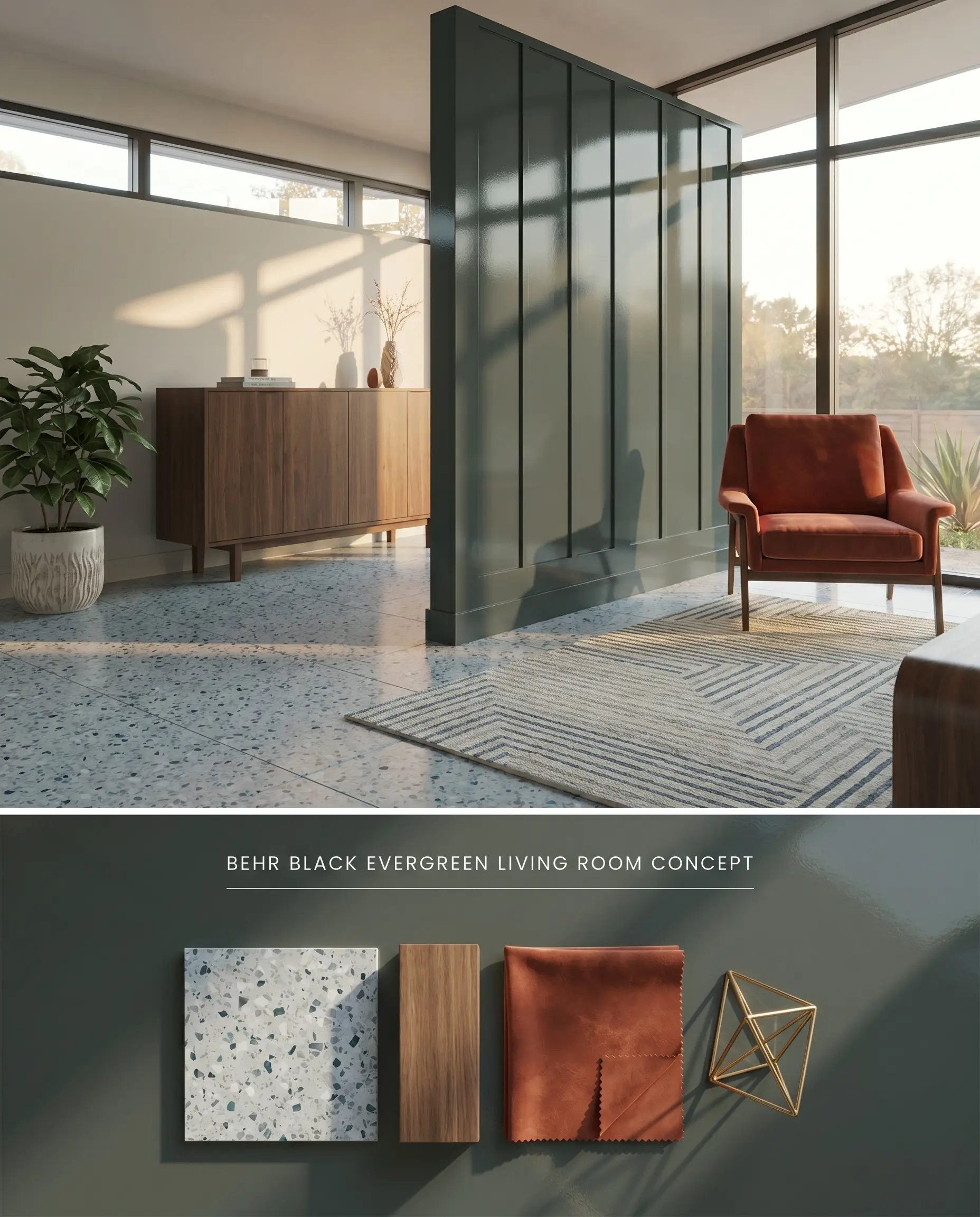
The cool undertone of this green-black anchors the linear profiles and organic textures typical of mid-century design. It acts as a grounding backdrop for teak or walnut credenzas, provided those woods lean neutral or cool rather than yellow-dominant. Using a high-gloss finish on a specific architectural element, like a paneled room divider, forces light to bounce off the otherwise light-absorbing LRV 8 surface.
Comparative Color Theory: Green-Black Hue Alternatives
Behr Black Evergreen MQ6-44 vs. Benjamin Moore Black Forest Green HC-187
Will Black Evergreen work with your specific lighting, floor, or furniture?
Benjamin Moore Black Forest Green HC-187 carries a slightly higher LRV and a more pronounced olive undertone compared to the cooler, truer black base of Behr Black Evergreen MQ6-44. In north-facing rooms where Behr’s paint reads as a flat charcoal, Benjamin Moore’s option retains a faint hint of its green identity. Specify Black Evergreen for south-facing rooms where its cool undertone tempers warm natural light, and reserve Black Forest Green for spaces requiring a slightly warmer, more traditional green cast.
Behr Black Evergreen MQ6-44 vs. Sherwin-Williams Ripe Olive SW 6209
Will Black Evergreen work with your specific lighting, floor, or furniture?
Sherwin-Williams Ripe Olive SW 6209 sits significantly lighter on the LRV scale and introduces a distinct yellow-gray undertone, making it a muted, earthy olive rather than a true green-black hue. Ripe Olive transitions smoothly alongside warm wood tones, whereas Behr Black Evergreen MQ6-44 severely clashes with orange-toned oak cabinets. Deploy Ripe Olive in transitional spaces with mixed wood finishes, and utilize Black Evergreen strictly when pairing with cool-toned woods or stark white architectural finishes.
Behr Black Evergreen MQ6-44 vs. Farrow & Ball Studio Green No.93
Farrow & Ball Studio Green No.93 shares the extreme light-absorbing qualities of Black Evergreen but utilizes a complex blend of raw umber and black pigments, causing it to shift brownish-green under incandescent light. Behr Black Evergreen MQ6-44 maintains a cooler, more rigid forest green cast without the brown shift. Choose Studio Green for historic renovations relying on warm, ambient lighting, and select Black Evergreen for crisp, modern applications under bright, natural daylight.
Technical FAQs: Application and Coverage Adjustments
Yes, without direct sunlight, its low light-reflectance causes the green pigments to recede, leaving a flat, near-black charcoal appearance.
The cool undertones of this paint clash with orange-toned oak and yellow-dominant wood floors, resulting in a muddy visual contrast. It requires neutral or cool-toned woods to maintain its crisp green cast.
This specific pigment structure requires a tinted primer followed by at least three coats to prevent patchiness and a pink-white bleed-through on the drywall.
Dark pigments in flat or matte sheens burnish quickly upon contact. You must upgrade to a scuff-resistant, higher-sheen finish for high-traffic corridors to prevent flashing and the need for corner-to-corner repaints.
Room Compatibility & Clashes Diagnoses
Hackrea's reports evaluating the compatibility of Black Evergreen in real rooms.No compatibility tests for Black Evergreen yet.
Be the first to see how this color reacts to your space. Run a free architectural diagnostic now.
Paint Aesthetic & Practical Analysis
| Profile | Analysis | |
|---|---|---|
| Aesthetic | Black Evergreen delivers incredible architectural drama, but it demands excellent lighting to prevent it from falling flat. While the color structure is stunning for cabinetry and color-drenching, be prepared to apply at least three coats for a truly flawless, opaque finish. | |
| The Coverage Catch | Requires at least 3 coats for full, even coverage, especially when tinted into lower-tier bases. Users frequently report patchiness or a 'pink-white' bleed-through if a tinted primer isn't used. | |
| The Lighting Shift | In north-facing or windowless rooms, it reads as a flat, near-black charcoal. Direct south-facing sunlight is required to reveal its rich, forest green depth. | |
| The Clash Warning | Can clash heavily with orange-toned oak cabinets or yellow-heavy wood floors, making the green look muddy. Pairs best with neutral or cool-toned woods. | |
| The Bounce Effect | Absorbs light heavily (LRV 8). It will not bounce light, making small spaces feel instantly smaller and more enclosed if not balanced with ample artificial lighting. | |
| The Low Light Trap | Turns flat and loses all its green character in low light, appearing as a stark, heavy black. | |
| The Touch Up | As a deep, dark color, it burnishes easily in matte or eggshell finishes. Touch-ups often flash, requiring corner-to-corner repainting for seamless repairs. |