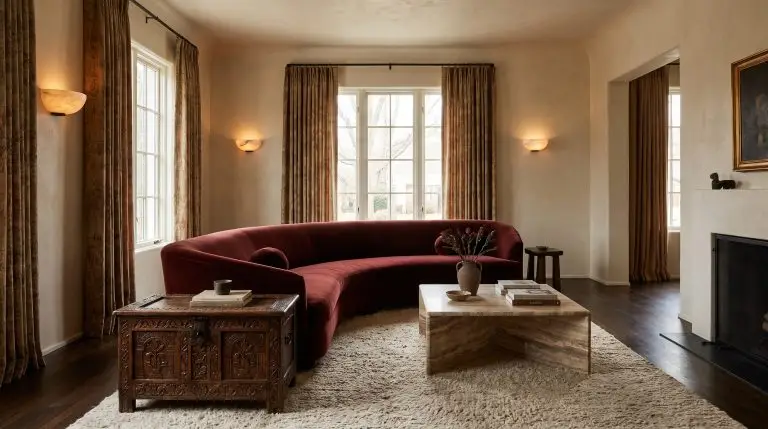
The Architect’s Guide to Marble Fireplaces: 22 Ways to Redefine Your Hearth
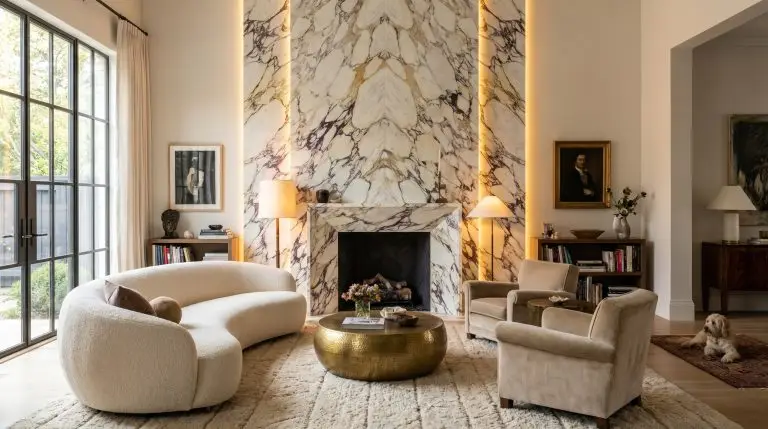
Natural stone fireplaces are rapidly shedding their outdated, glossy McMansion reputation in favor of tactile, understated applications that command a room. The secret to a truly bespoke hearth does not lie solely in the slab you select, but in the architectural precision of the cut, the edge profile, and the surface finish.
When treated as an architectural anchor rather than a mere utility, a custom surround brings unmatched spatial gravity and tremendous real estate value to a living space. Whether you are leaning into the raw geometry of a monolith or the quiet luxury of a honed mantel, execution is everything.
Here are 22 structural and aesthetic approaches to transform your firebox into a masterful focal point.
The Modern Monolith (Floor-to-Ceiling Slabs)
Expansive living rooms demand continuous stone to draw the eye upward and establish a commanding vertical axis. While executing a floor-to-ceiling application requires rigorous structural planning to support the heavy weight, the resulting seamless facade offers unparalleled visual impact.
1. Seamless Book-Matched Calacatta
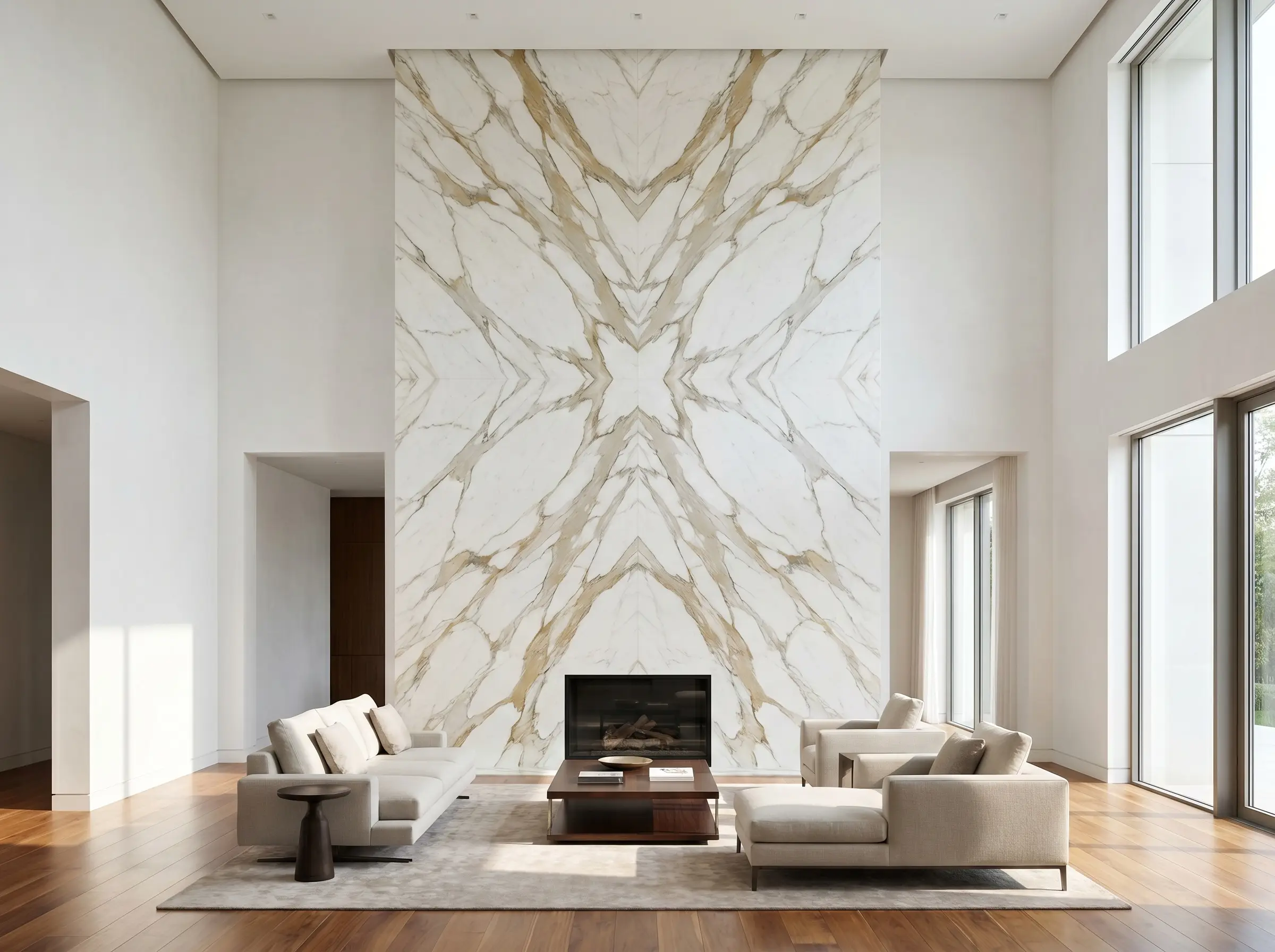
High-volume spaces with double-height ceilings demand continuous visual momentum, which is perfectly achieved by mirroring the organic veining across two adjacent slabs. This highly technical book-matched application—where a fabricator slices a block of stone and opens it like a book—creates an expansive, symmetrical art piece.
- Vibe: Bespoke Contemporary
- Key Material: Calacatta Gold or Statuario Marble
- Styling Pro-Tip: Keep the surrounding wall devoid of art to let the mirrored veining act as the room’s sole vertical anchor.
2. Off-Center Asymmetrical Hearths
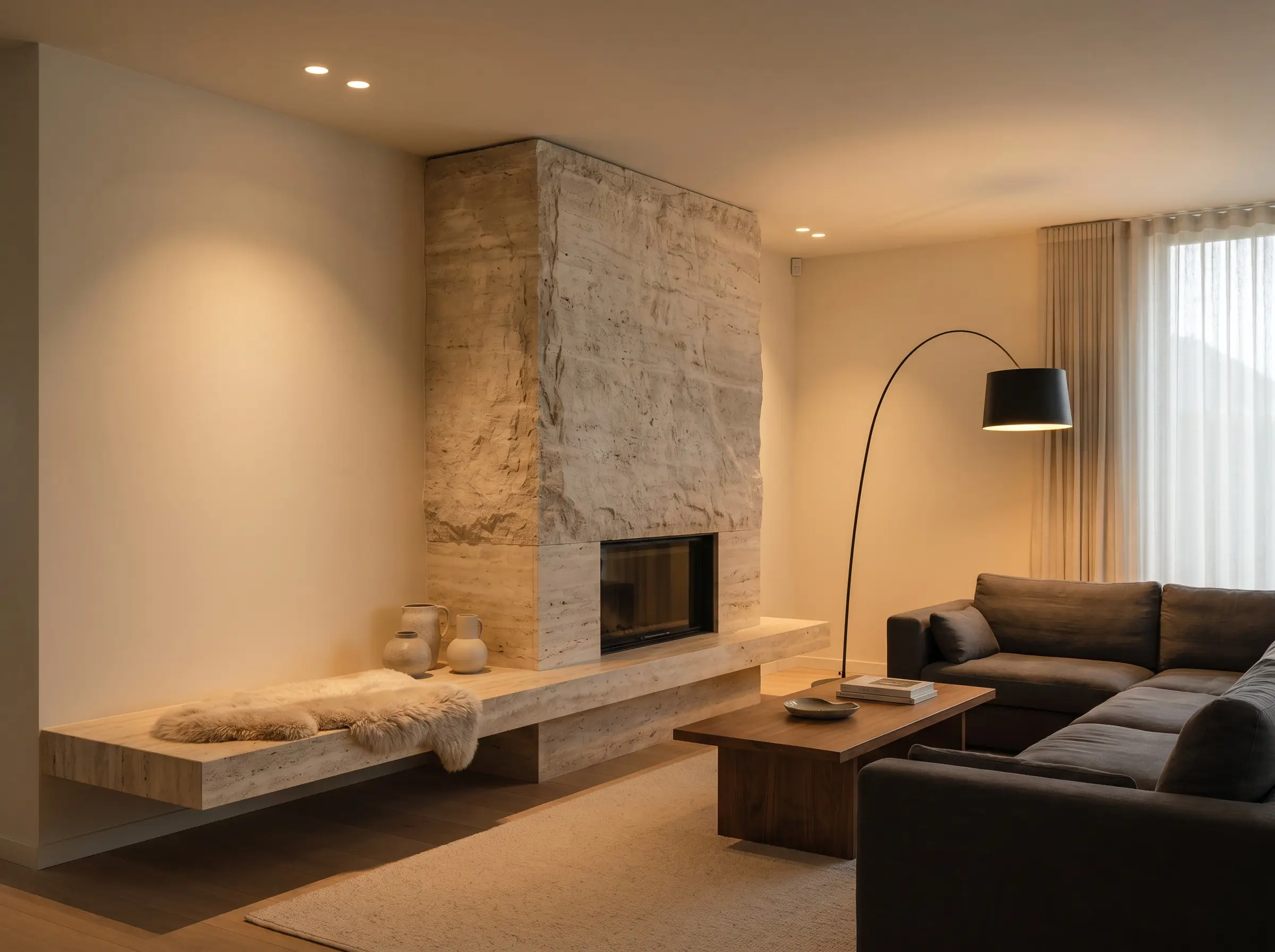
Breaking traditional symmetry creates dynamic spatial tension, extending the hearth heavily to one side of the firebox. This geometric layout doubles as integrated seating or a rigid display ledge for sculptural objects.
- Vibe: Mid-Century Brutalism
- Key Material: Travertine or heavily veined Arabescato
- Styling Pro-Tip: Balance the visual weight of the extended hearth by placing a tall, overarching floor lamp on the opposing short side.
3. The Floating Marble Bench
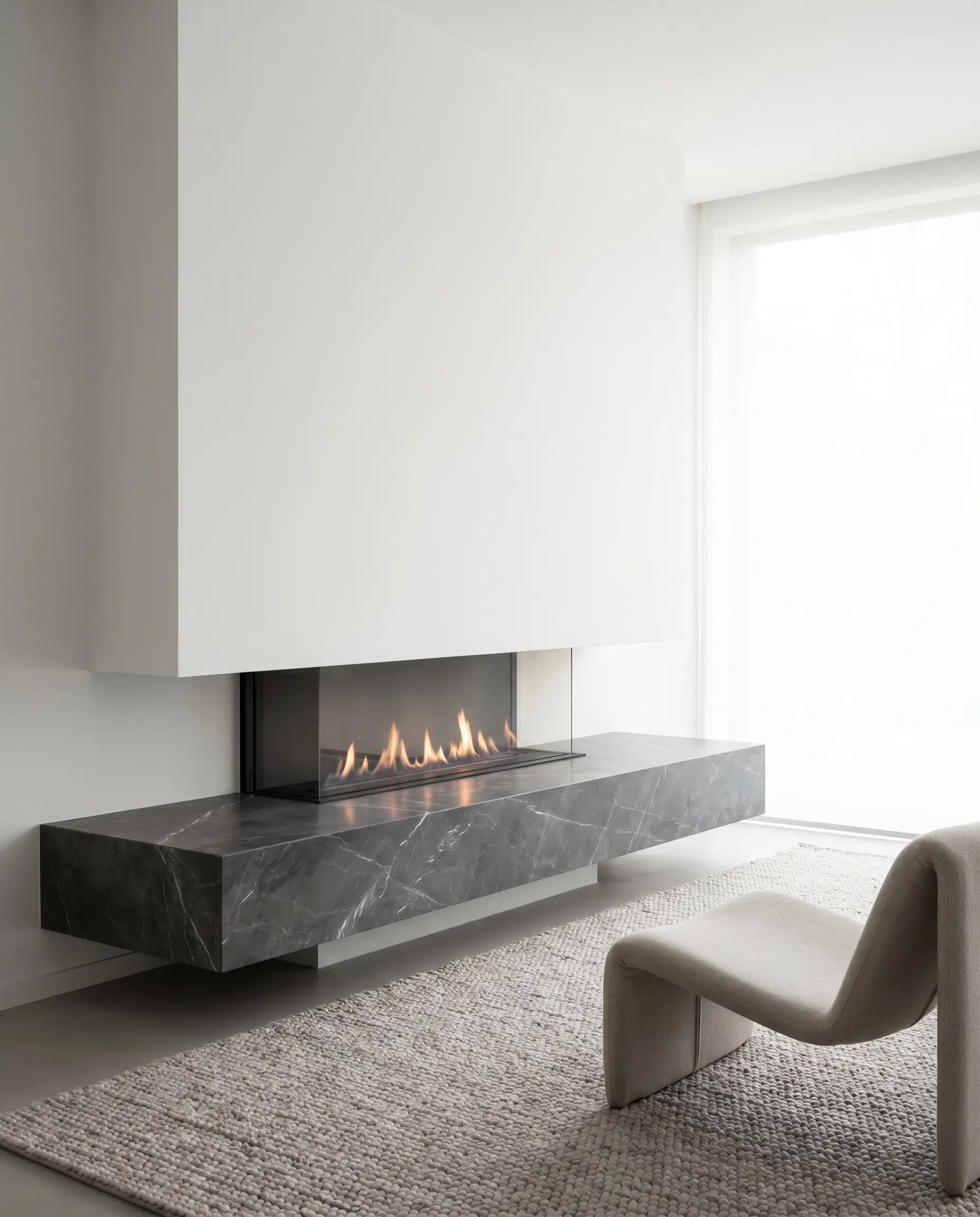
A thick, mitered-edge slab hovering inches above the floor beneath a linear gas firebox creates a profoundly airy, minimalist aesthetic. This requires hidden steel cantilevered supports bolted directly into the wall studs before the drywall is finished.
- Vibe: Ultra-Modern
- Key Material: Pietra Gray Marble
- Fabrication Match: Require a 3-inch mitered drop-edge to give the illusion of a massive solid block.
4. Wrap-Around Three-Sided Peninsulas
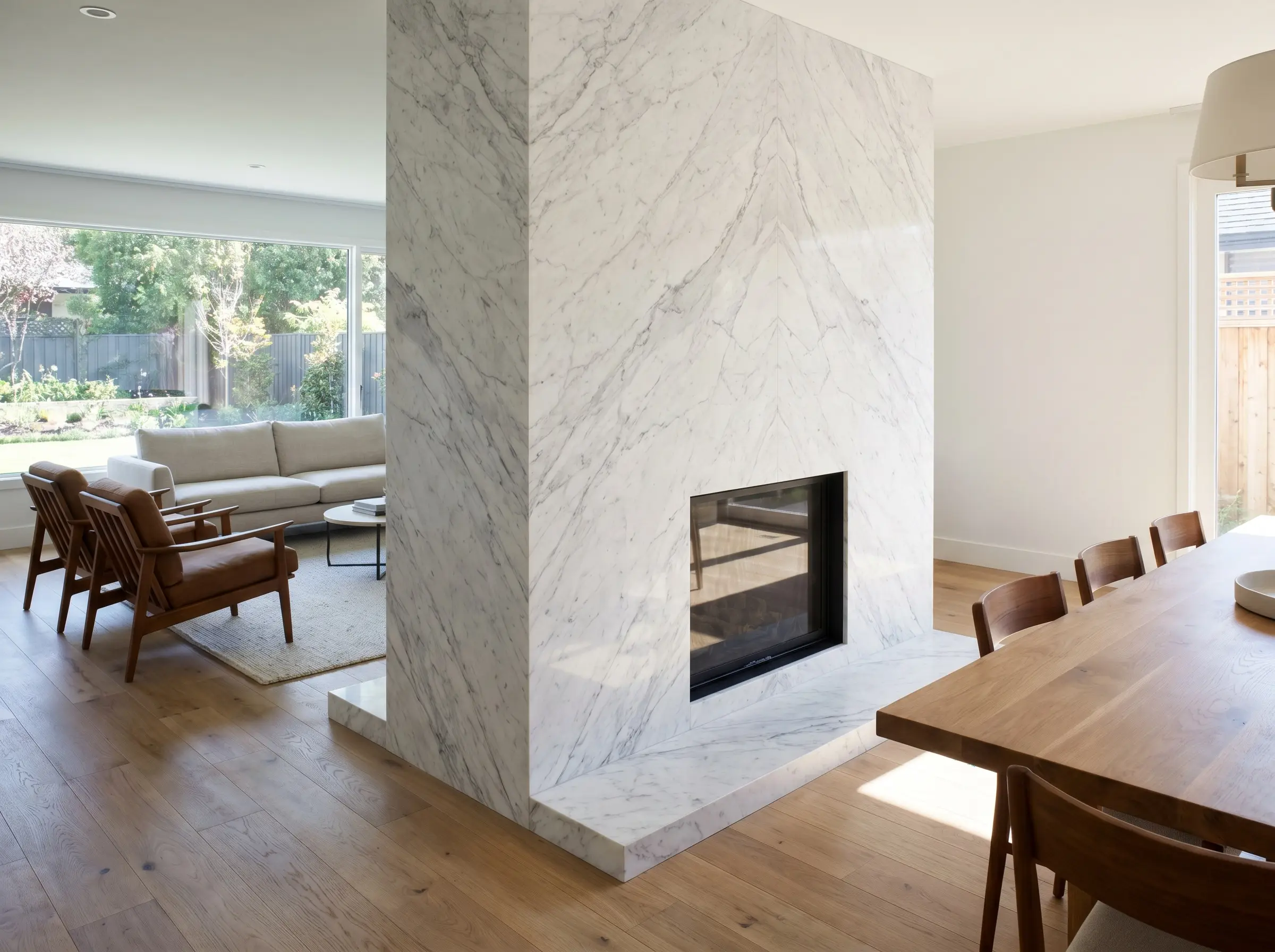
Open-concept homes require definitive room dividers, and wrapping a multi-sided firebox in continuous stone grounds the architecture beautifully. The structural secret here is slip-matching—ensuring the veining wraps continuously around the outside corners without visually breaking the pattern.
- Vibe: Transitional Open-Concept
- Key Material: Bianco Carrara
- Styling Pro-Tip: Use a flush-hearth installation so the flooring material runs directly up to the base of the peninsula.
5. Plaster and Marble Split-Level
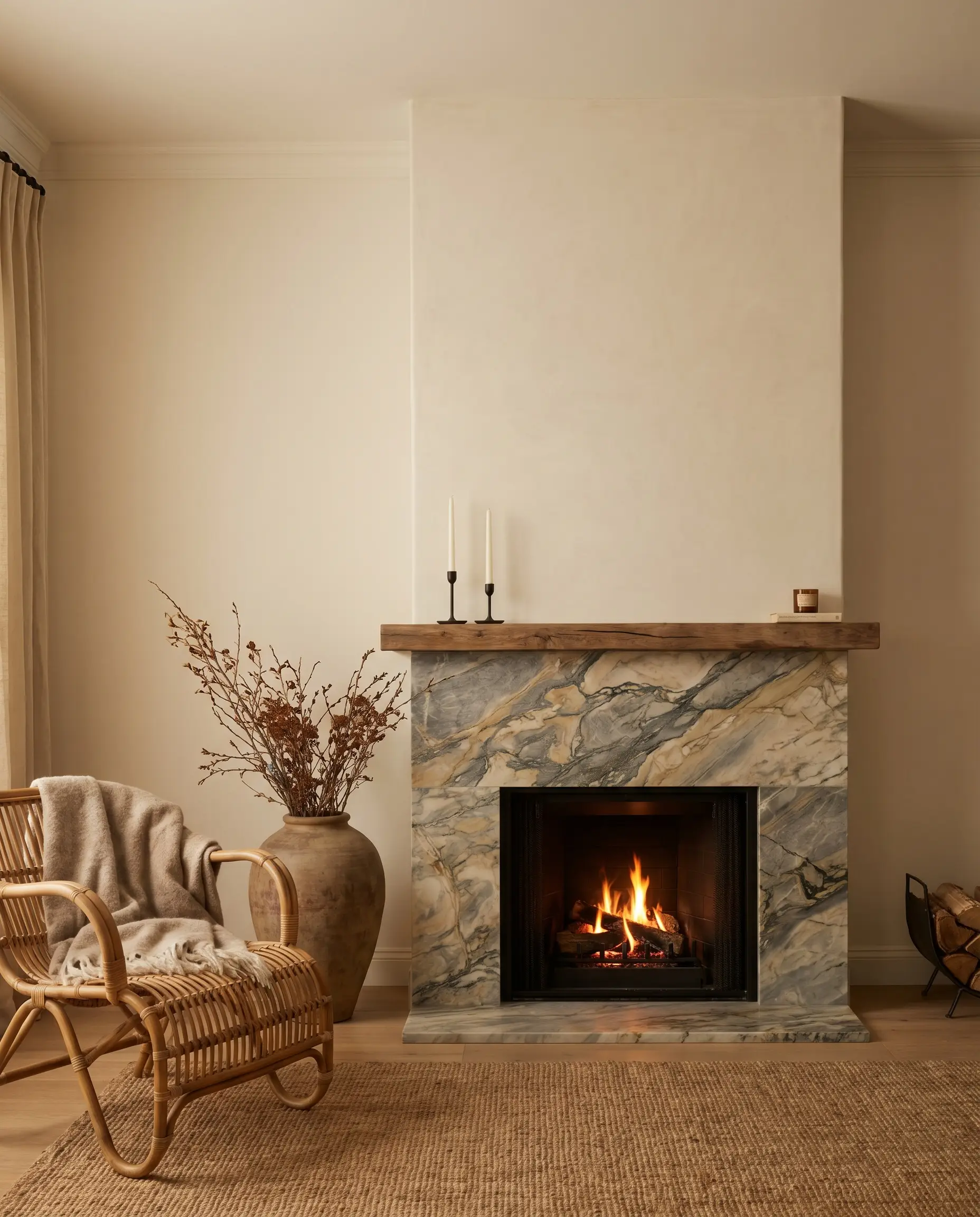
Balancing raw texture with polished stone, this hybrid application pairs a heavy marble surround on the lower half with Roman clay or Venetian plaster on the upper chimney breast. It offers a warm, tactile contrast while grounding the firebox in a solid, heat-resistant base.
- Vibe: Organic Modern
- Key Materials: Tadelakt plaster paired with heavily veined marble
- Color Match: Match the plaster tint to the lightest background tone of the stone.
This split-level approach significantly reduces raw material costs. By limiting the expensive marble to the lower surround and utilizing plaster above, you achieve a high-end bespoke look without paying for a secondary upper slab.
Designer Secret
Tactile & Textural (Moving Beyond Polished)
The default high-gloss polish is stepping aside for finishes that absorb light and invite touch. Designers are actively manipulating the surface of the stone, utilizing milling and brushing techniques to perfectly align with the earthy, grounded principles of Organic Modern and Japandi interiors.
6. Fluted Marble Surrounds
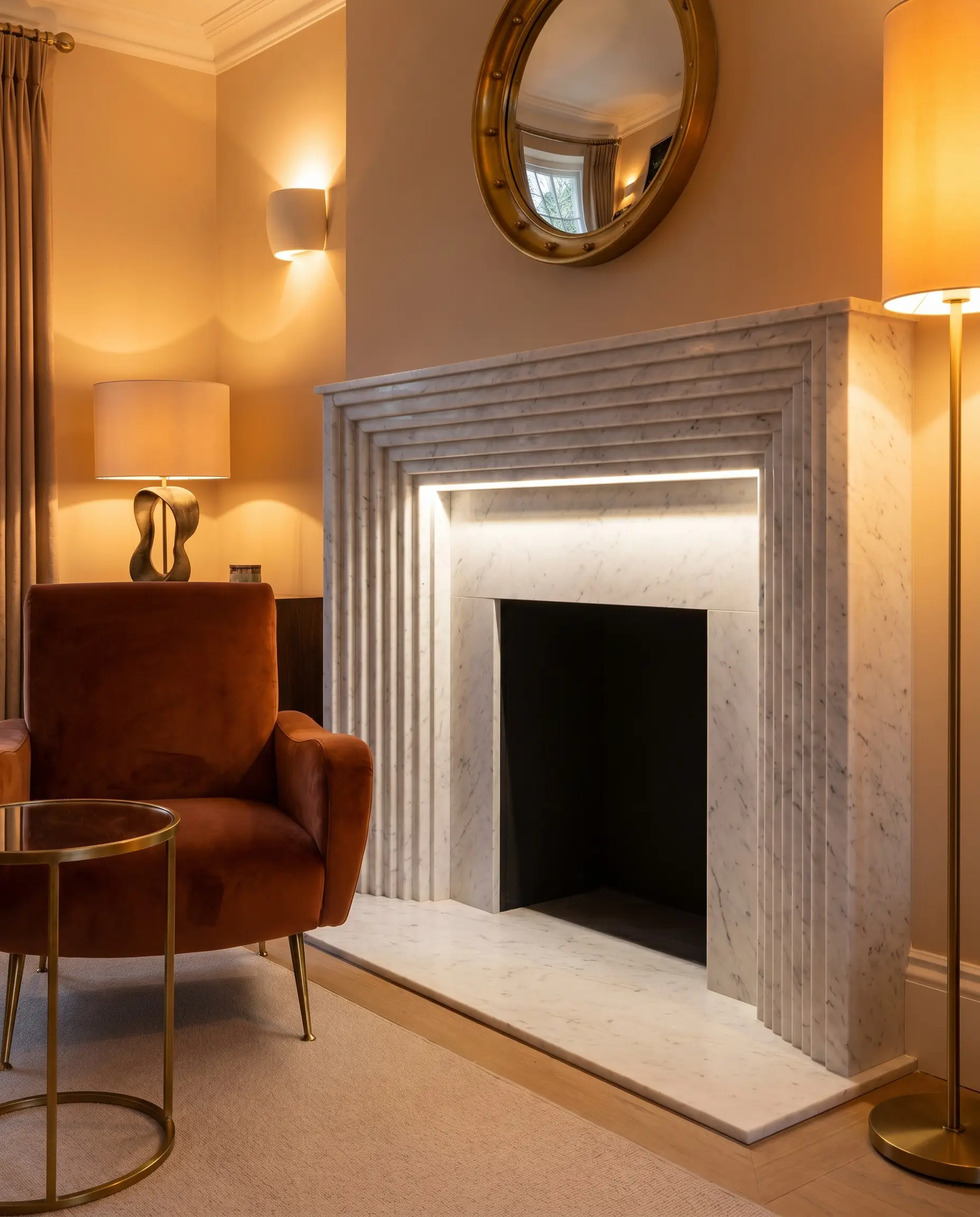
Carving deep vertical ridges into the face of the surround creates a rhythmic shadow play that shifts as the ambient light of the fire flickers. This intense milling technique is best executed on the vertical fascia, paired with a perfectly flat, un-milled hearth to ground the geometry.
- Vibe: Architectural Art Deco
- Key Material: Solid block Carrara or Thassos White
- Styling Pro-Tip: Illuminate the fluted texture from above with recessed, narrow-beam grazing lights.
7. Honed Finishes for Japandi Spaces
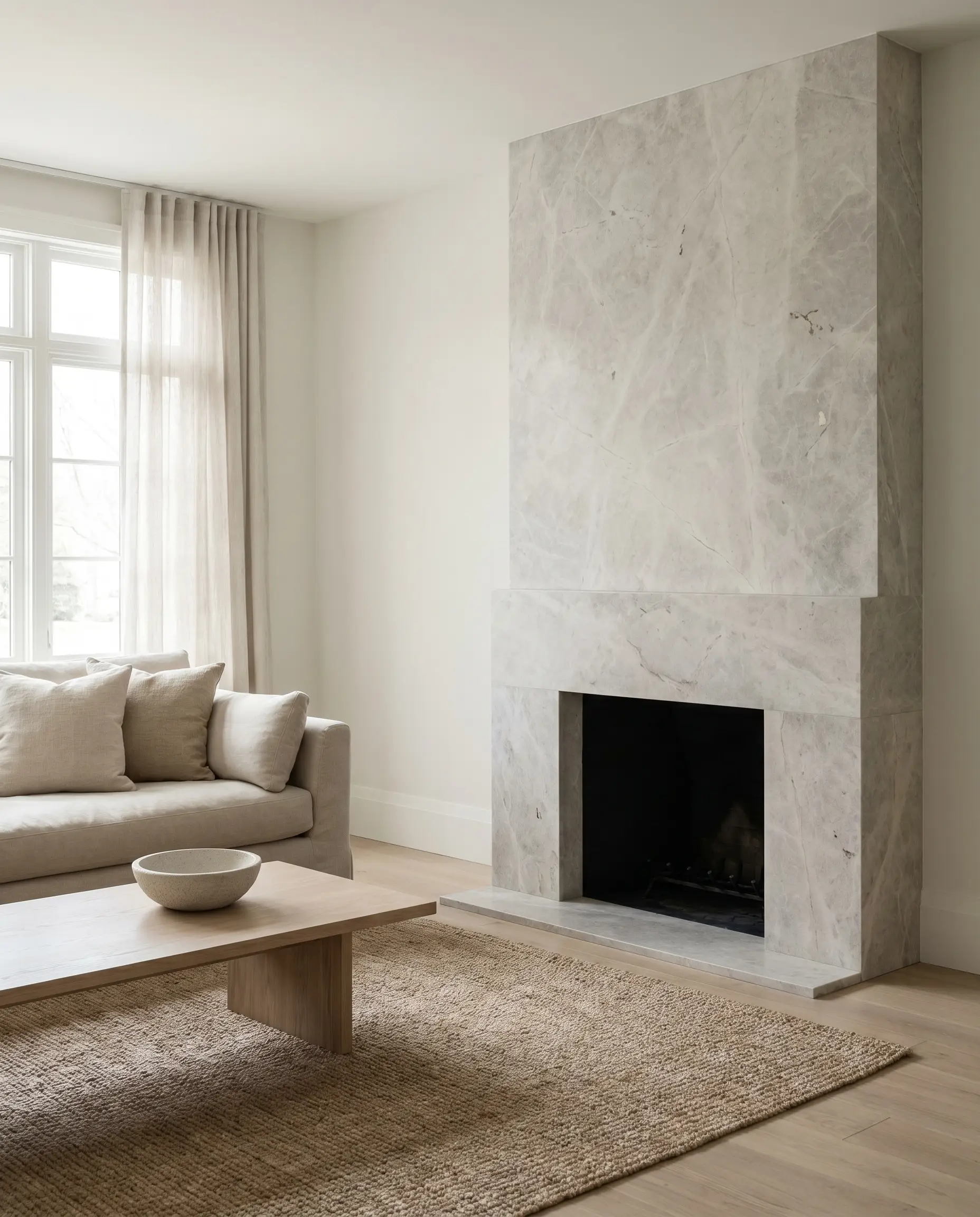
Stripping away the high-gloss polish leaves a muted, matte surface that absorbs light rather than reflecting it. This soft, honed finish aligns perfectly with Japandi minimalism, allowing the subtle natural characteristics of cream or light grey marble to read as earthy and grounding.
- Vibe: Japandi Minimalism
- Key Material: Honed Crema Marfil or Taj Mahal Quartzite (marble alternative)
- Paint Recommendation: Sherwin-Williams Alabaster
8. Leathered Black Marble for Mood
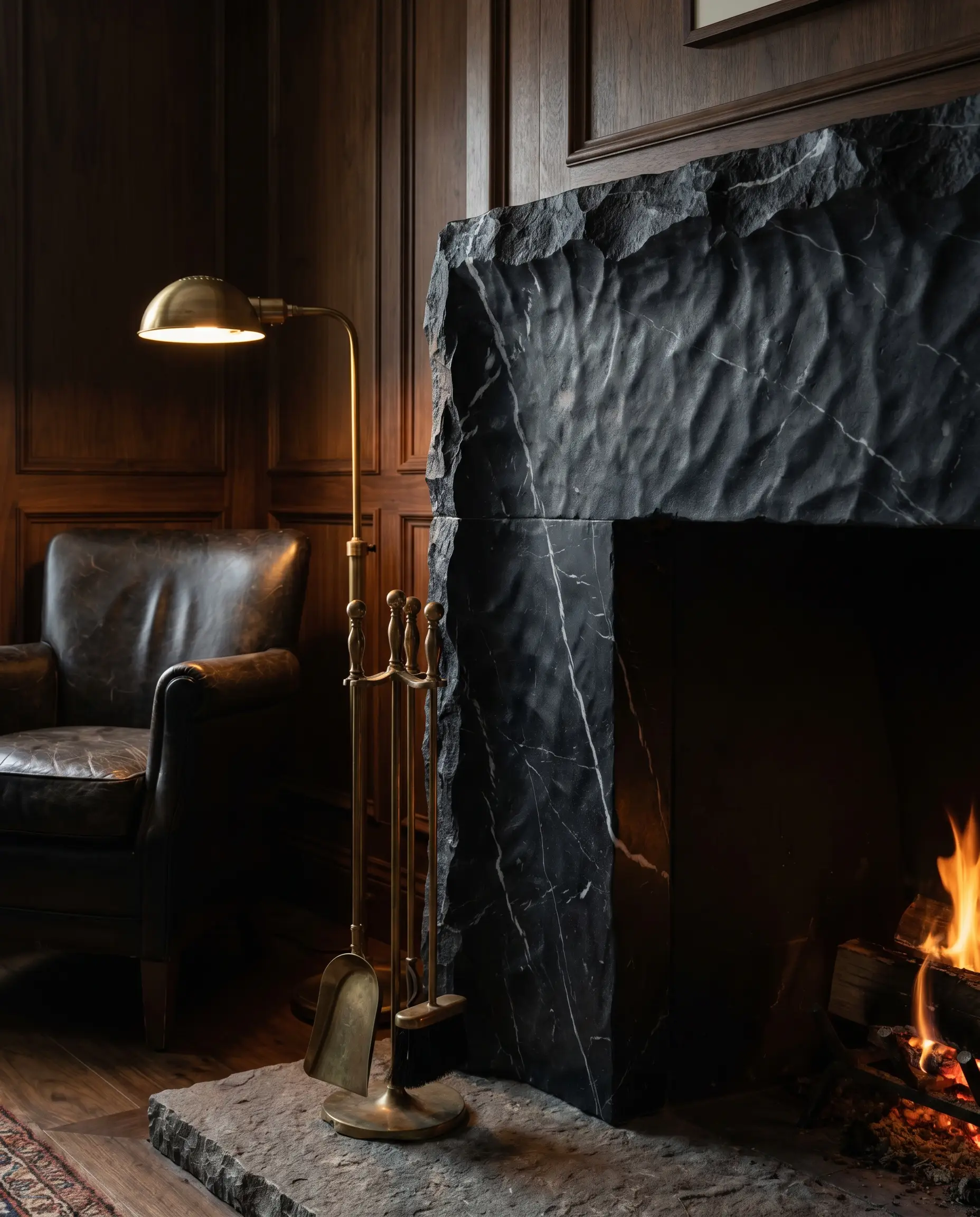
A leathered finish involves brushing the stone to create a slightly undulating, highly tactile surface that expertly hides fingerprints and soot. When applied to dark stones, it absorbs the harsh glare of interior lighting, making it an exceptional choice for moody dens or library spaces.
- Vibe: Masculine Luxury
- Key Material: Leathered Nero Marquina or Black Belvedere
- Styling Pro-Tip: Pair the dark, textured stone with unlacquered brass fireplace tools to create a rich metallic contrast.
9. Ribbed and Scalloped Edge Profiles
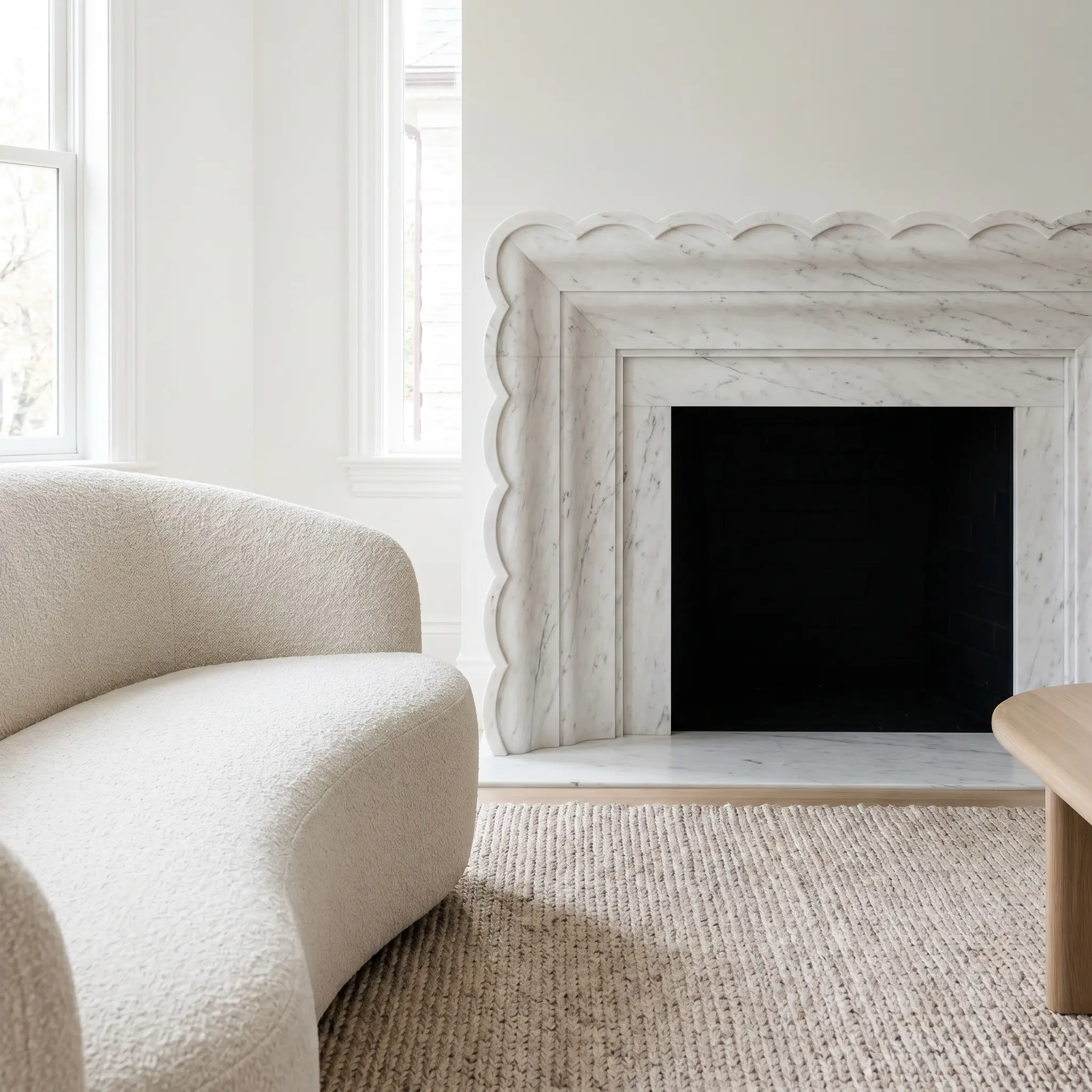
Standard square or bullnose edges are easily upgraded by requesting custom-milled scalloped profiles along the lip of the mantel. This CNC-machined detailing adds an immediate layer of bespoke craftsmanship, catching the light across its undulating curves.
- Vibe: Soft Contemporary
- Key Material: Any dense, fine-grained marble (e.g., Danby)
- Fabrication Match: Specify a 1.5-inch radius scallop edge profile to your CNC fabricator.
10. Stacked Marble Ledger Stone
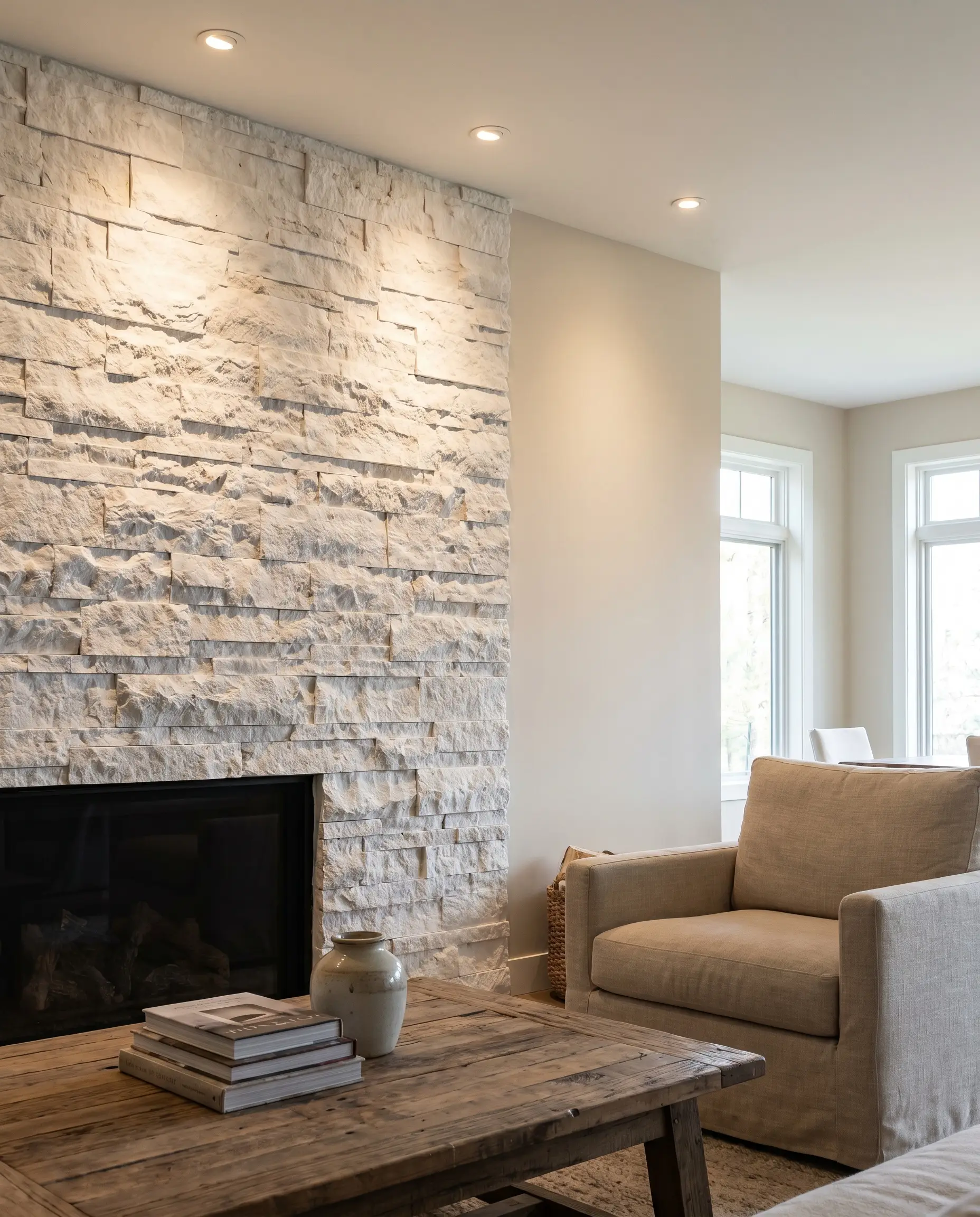
Bringing a rugged, biophilic element indoors, split-face marble strips are stacked to create a highly textured, three-dimensional facade. This bridges the gap between raw outdoor architecture and refined interior luxury, offering immense depth without needing a solid slab.
- Vibe: Rustic Modern
- Key Material: White marble ledger panels
- Styling Pro-Tip: Keep the surrounding mantel completely devoid of trim; let the rugged texture of the stacked stone transition directly into the drywall.
Transitional & Parisian Chic (The Mantel)
A properly carved marble mantel acts as an inherited piece of architectural art rather than a mere building material. It serves as the definitive transitional anchor, effortlessly bridging the gap between classic European apartment detailing and highly modern furnishings.
11. The Ornate Carved Carrara Mantel
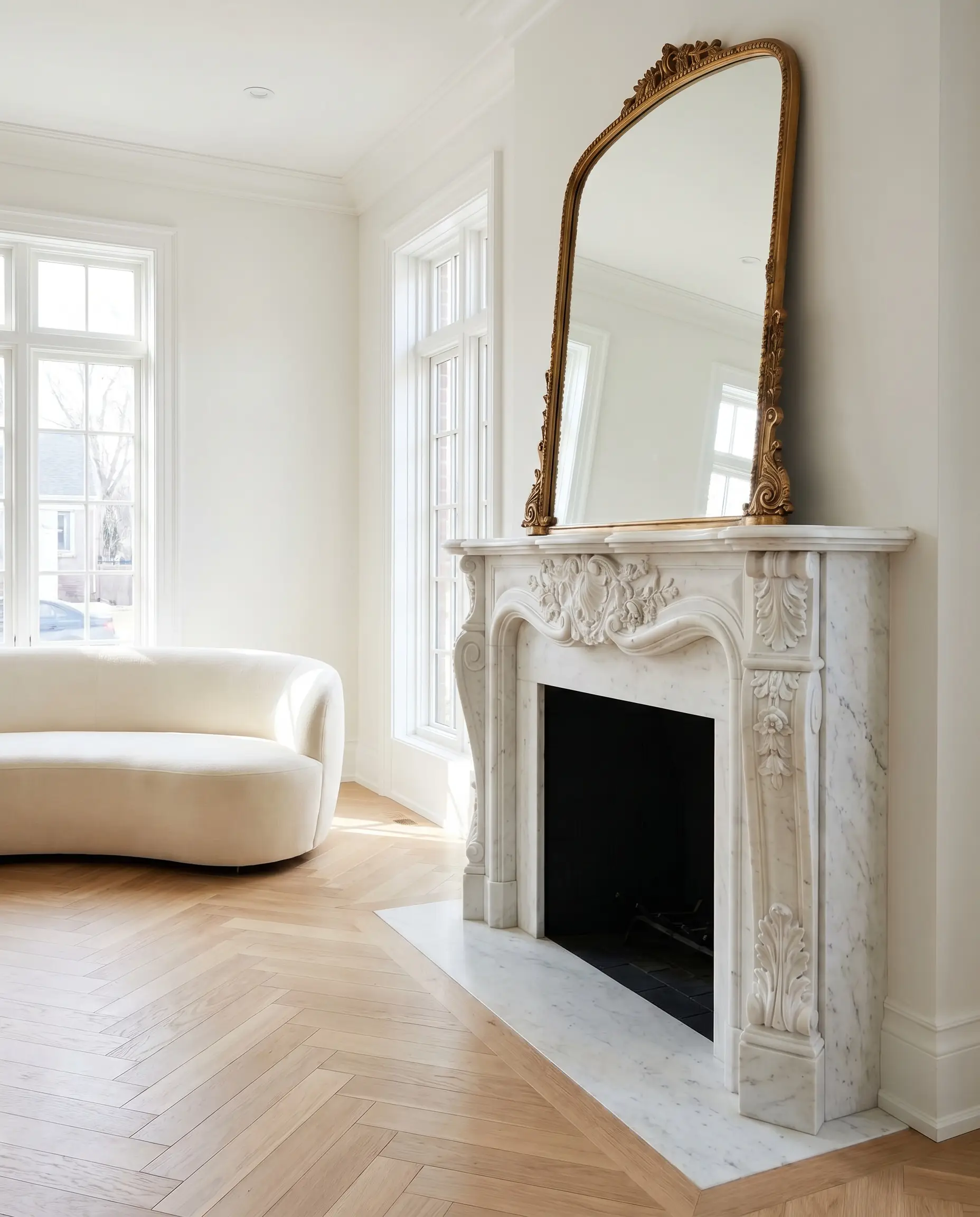
Featuring classic French silhouettes, scalloped edges, and romantic floral or corbel detailing, a hand-carved mantel commands the room. To nail the Parisian Chic aesthetic, the ornate nature of the stone must be juxtaposed against impeccably clean, modern surroundings.
- Vibe: Parisian Chic
- Key Material: White Carrara Marble
- Styling Pro-Tip: Pair directly with herringbone oak floors, a vintage oversized gilded mirror resting on the mantel lip, and a minimalist curved sofa.
12. The Micro-Mantel (Slim Profiles)
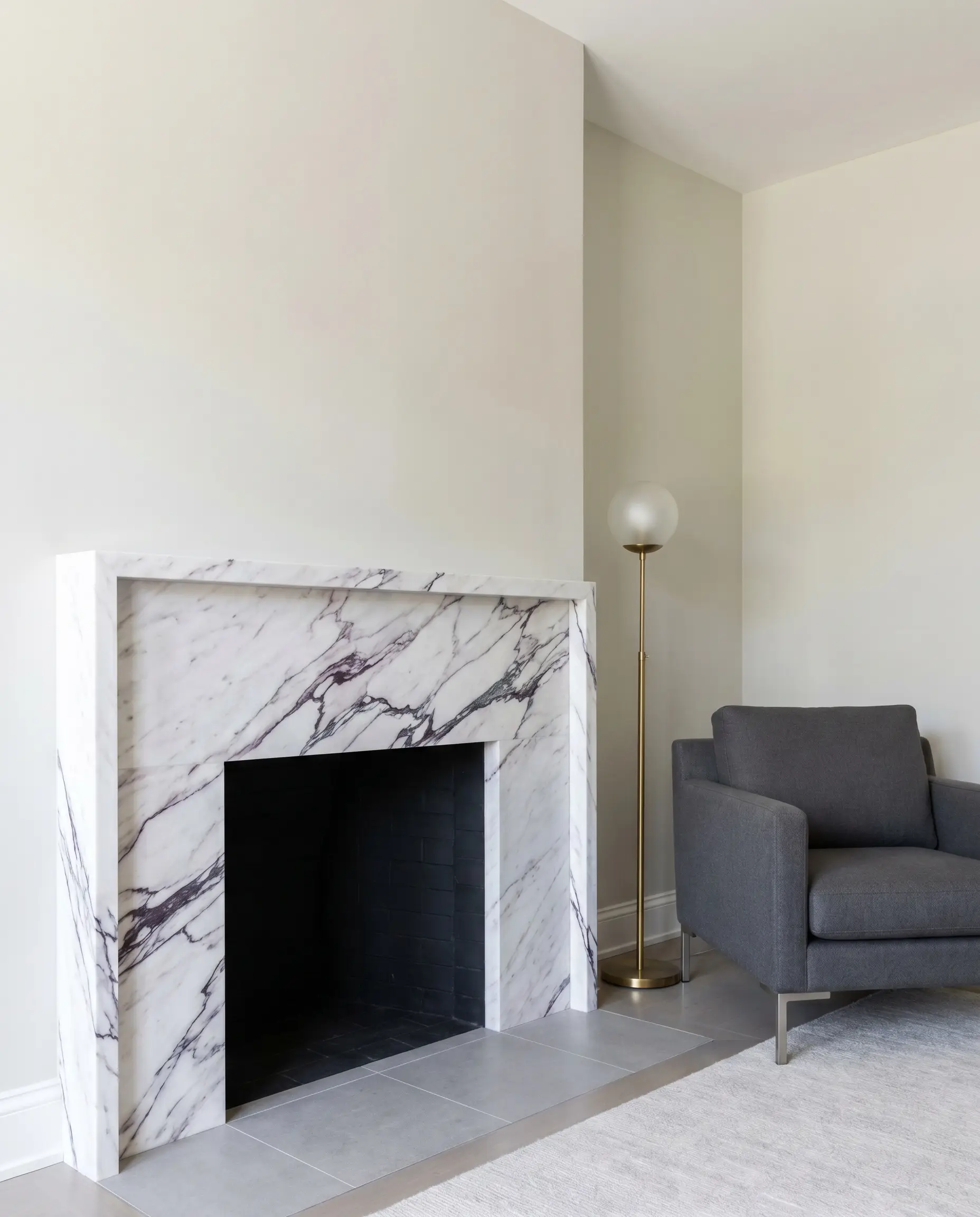
Stripping the traditional mantel down to its barest geometry yields an ultra-thin, right-angled marble frame with virtually zero overhang. This slim-profile approach is the perfect transitional compromise, offering the structure of a classic mantel without the heavy, ornate bulk.
- Vibe: Tailored Transitional
- Key Material: Honed Lilac Marble
- Styling Pro-Tip: Ensure the depth of the mantel shelf does not exceed 4 inches to maintain the sharp, micro-profile.
13. High-Contrast Insert Framing
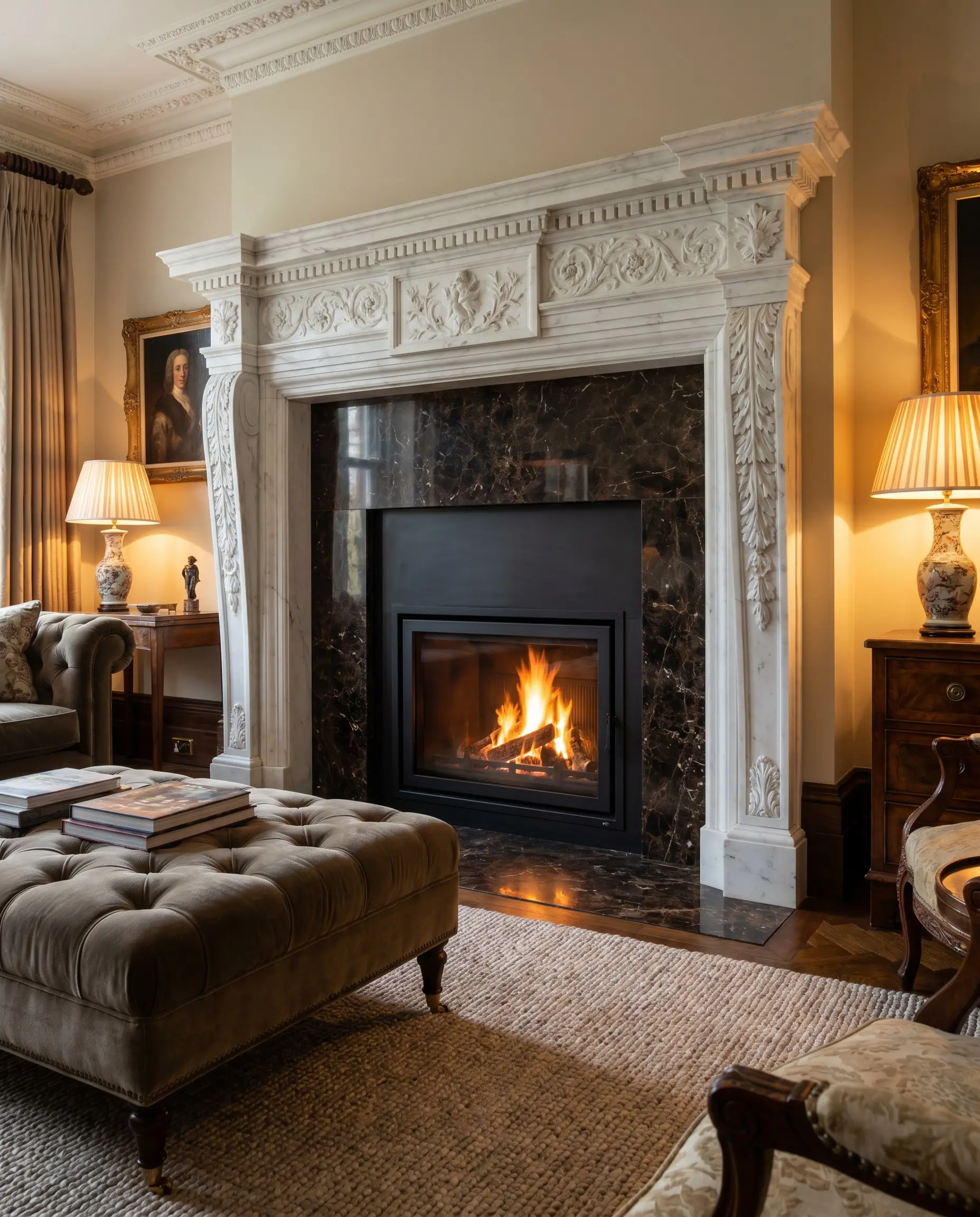
Anchoring the firebox requires visual depth, perfectly achieved by placing a dark stone immediately around the firebox opening, framed by a lighter, carved outer mantel. This layered approach creates an optical illusion that recesses the firebox deeper into the chimney breast.
- Vibe: Classic Heritage
- Key Materials: Dark Emperador inner surround; White Statuario outer mantel
- Fabrication Match: Ensure the inner dark stone is cut completely flush with the firebox metal housing.
14. Arched Marble Firebox Openings
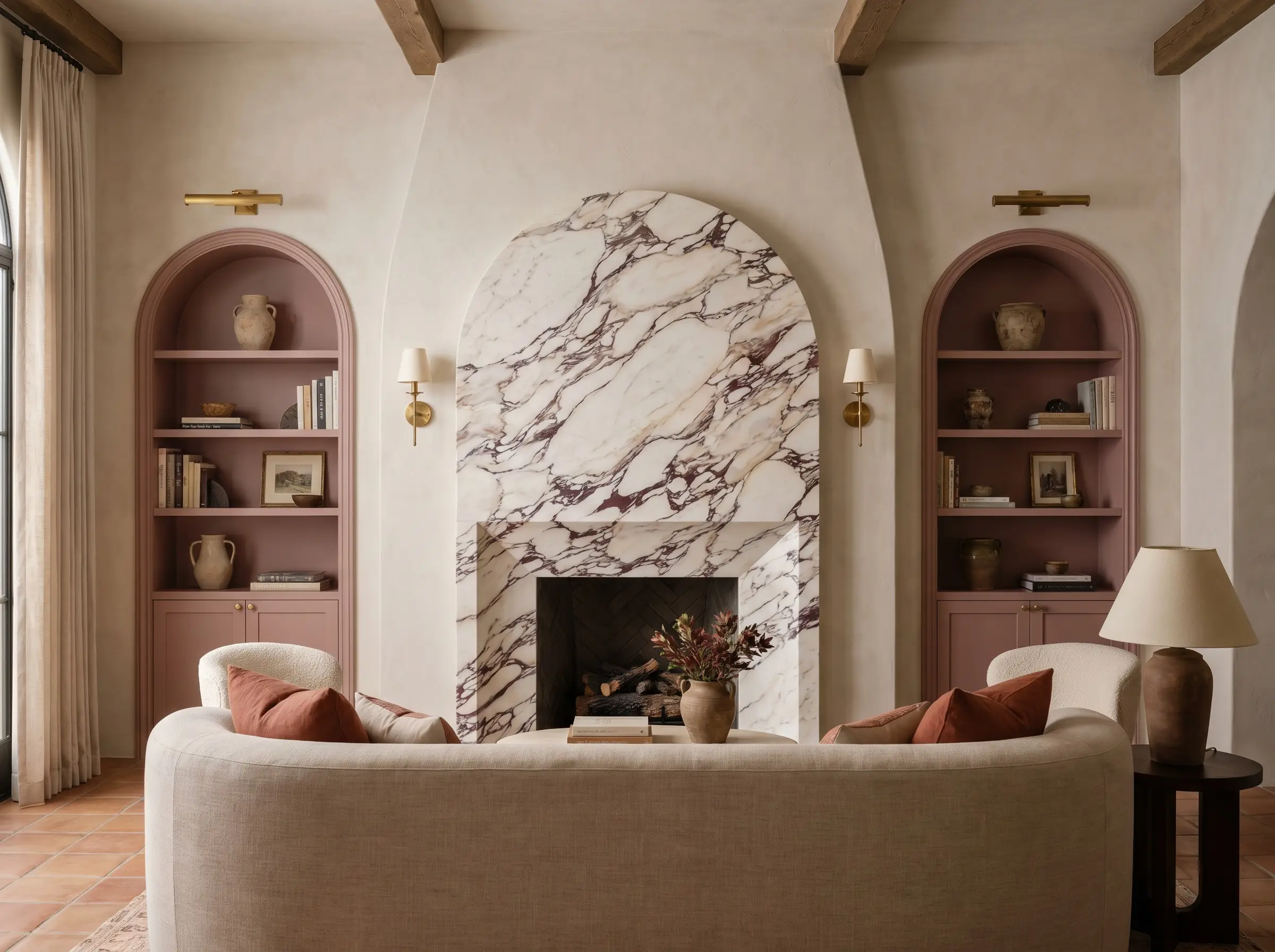
Moving away from rigid rectangular fireboxes, custom-cutting the marble fascia into a soft Roman arch introduces sweeping, organic lines to the architecture. This structural softening effect beautifully counterbalances low ceilings or harsh, boxy room dimensions.
- Vibe: Mediterranean Revival
- Key Material: Calacatta Viola
- Styling Pro-Tip: Echo the arch of the firebox by flanking the chimney breast with arched built-in bookcases.
15. Tone-on-Tone Painted Walls
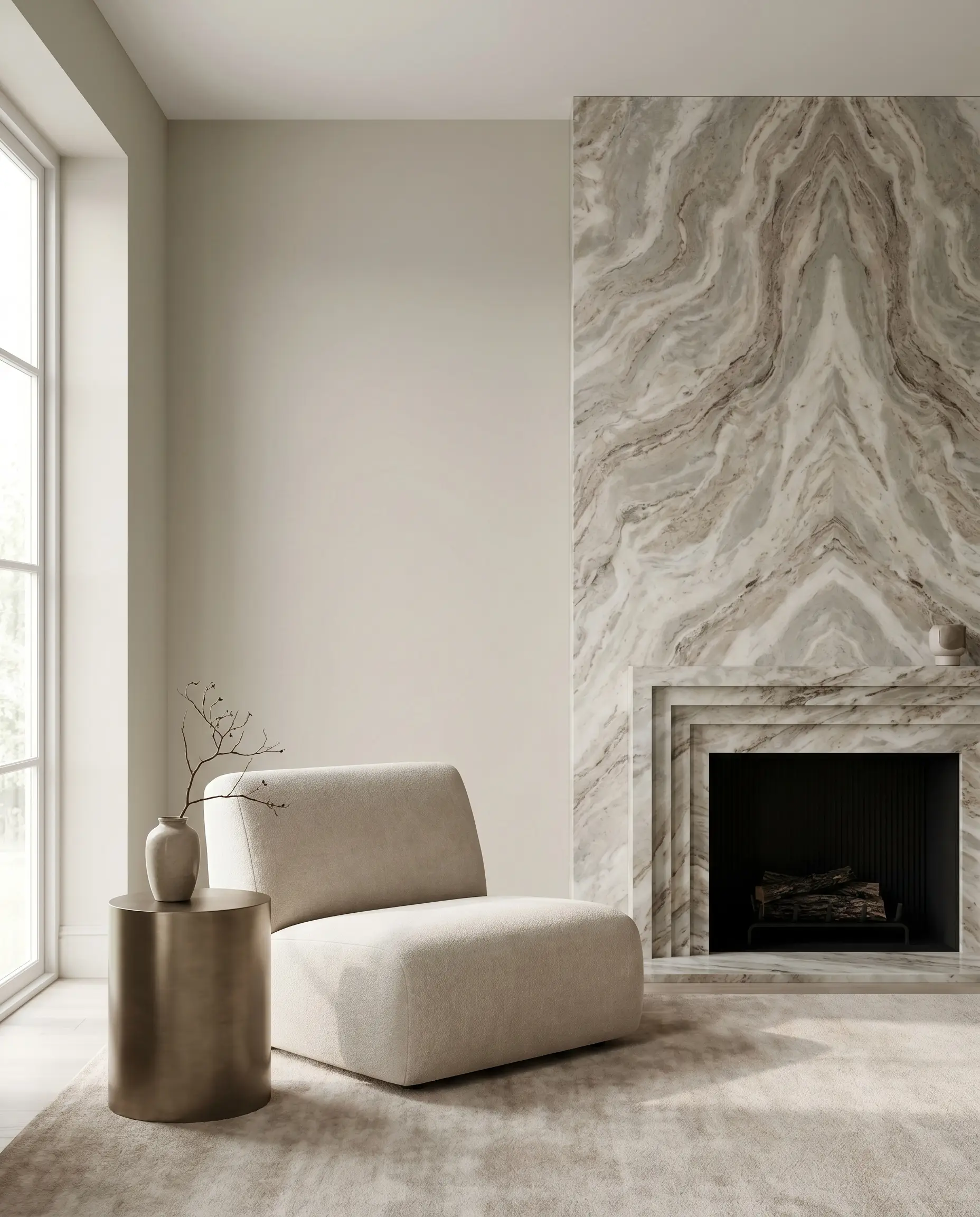
To make the natural veining of the stone the undisputed star, match the wall paint perfectly to the base background tone of the marble. This seamless integration ensures the heavy stone feels like a natural extension of the architecture rather than an applied afterthought.
- Vibe: Monochromatic Luxury
- Key Material: Taupe-veined marble (e.g., Fior di Bosco)
- Paint Recommendation: Farrow & Ball Drop Cloth
Take a physical chip of your specific marble slab to the paint store. Do not match the dark veins; match the lightest background field color for a flawless tone-on-tone wrap.
Designer Secret
Distinctive Stone Selections (Color & Veining)
Defaulting to standard white Carrara is a missed opportunity when the stone yard is filled with expressive, mineral-rich statement slabs. The unique veining and vivid background tones of these specialized marbles will dictate the entire color palette of your living space.
16. Dramatic Nero Marquina
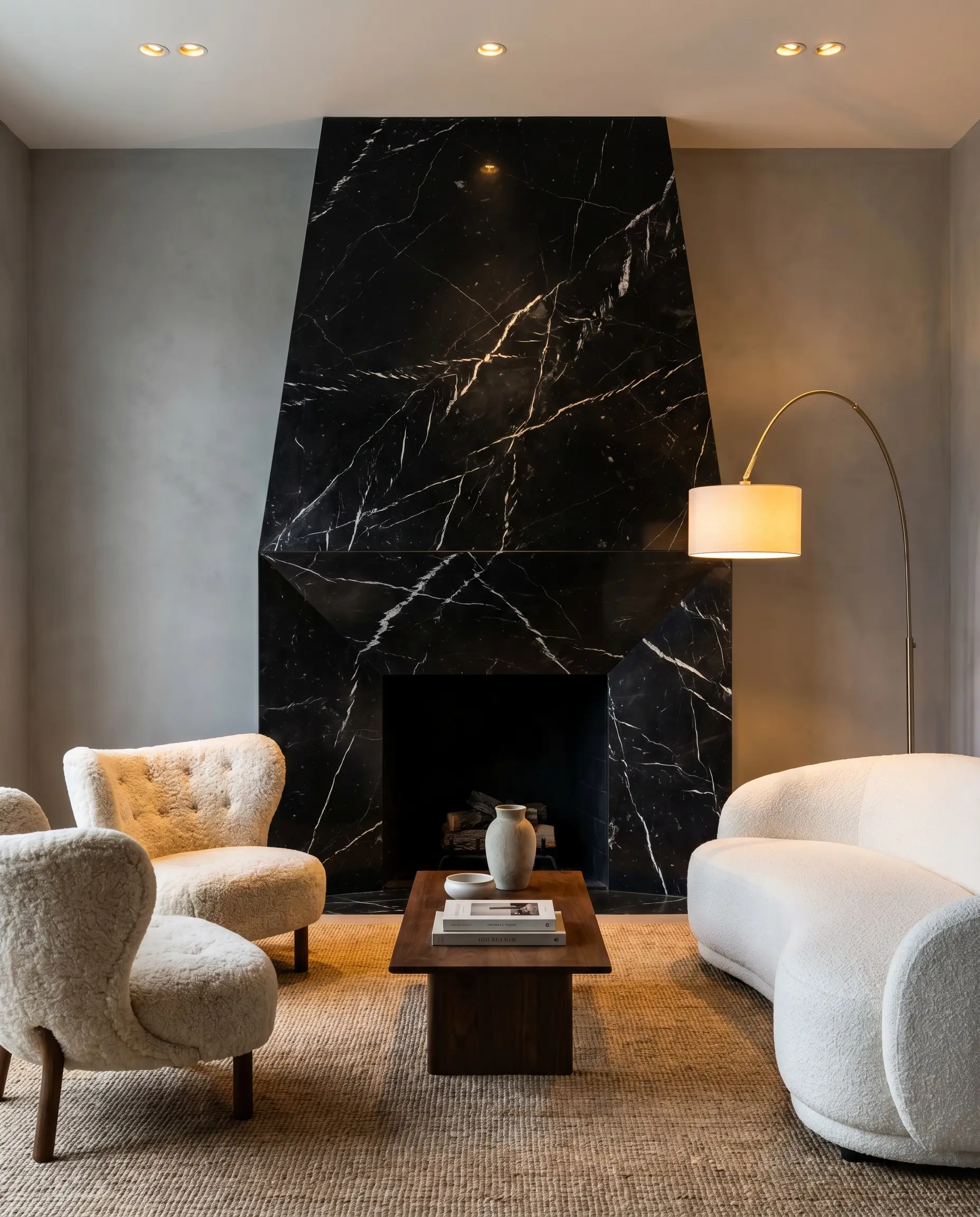
Defined by its high-contrast, pitch-black background sliced by striking white lightning-strike veins, this stone demands attention. It serves as a formidable architectural anchor, particularly effective in highly contemporary or Brutalist spaces where bold geometry is required.
- Vibe: Contemporary Brutalism
- Key Material: Nero Marquina
- Styling Pro-Tip: Contrast the harsh black stone with warm, textured fabrics like boucle or shearling in your seating arrangement.
17. Warm Emperador and Caramel Veining
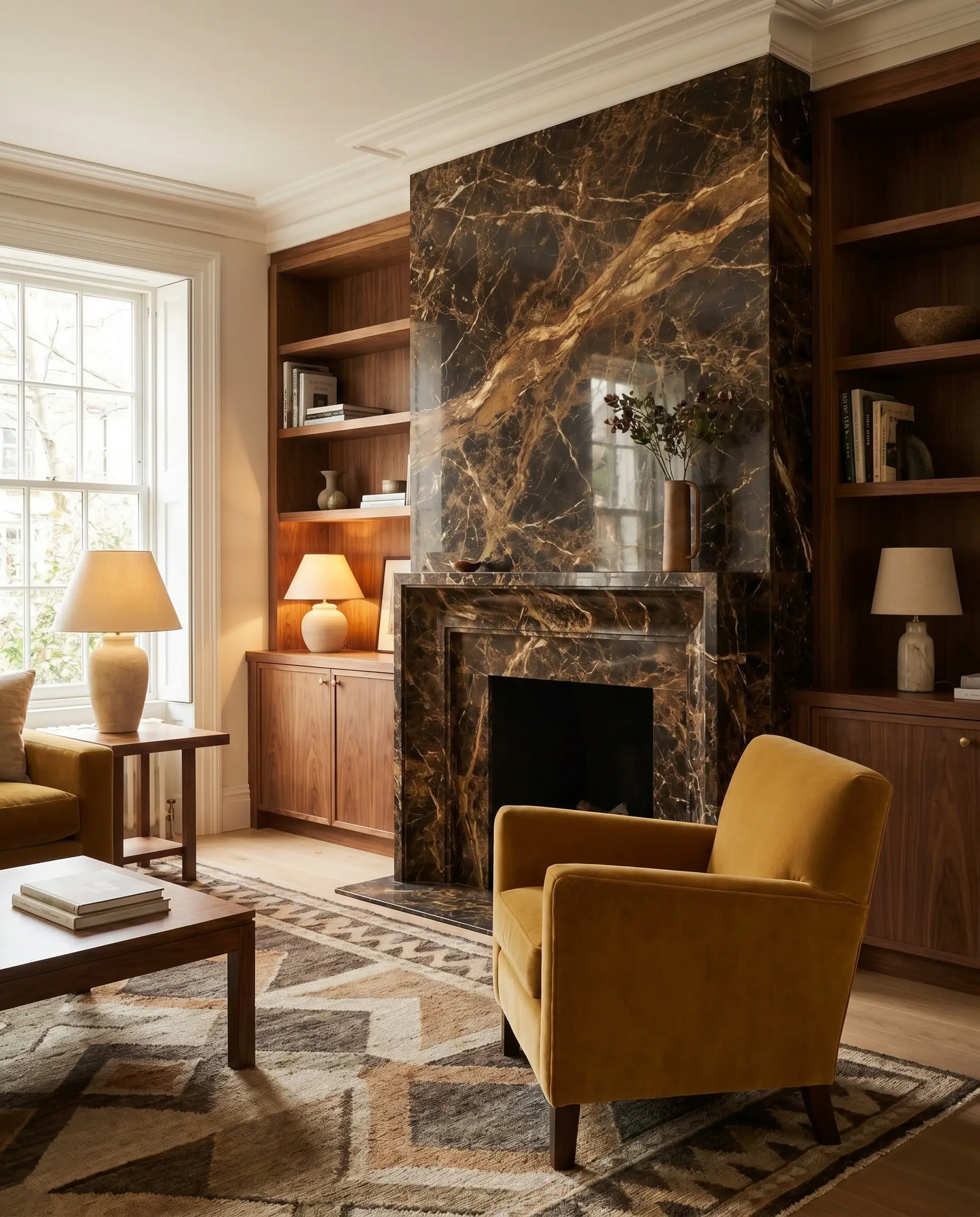
Injecting profound warmth into spaces that risk feeling too sterile, this stone features rich brown and gold tones interwoven with creamy veining. It is the perfect material to bridge the gap between cold masonry and rich architectural woodwork.
- Vibe: Mid-Century Warmth
- Key Material: Dark or Light Emperador
- Styling Pro-Tip: Conceptually pair this stone with warm, mid-tone woods like walnut or smoked oak for the surrounding cabinetry.
18. Bold Verde Antigua (Green Marble)
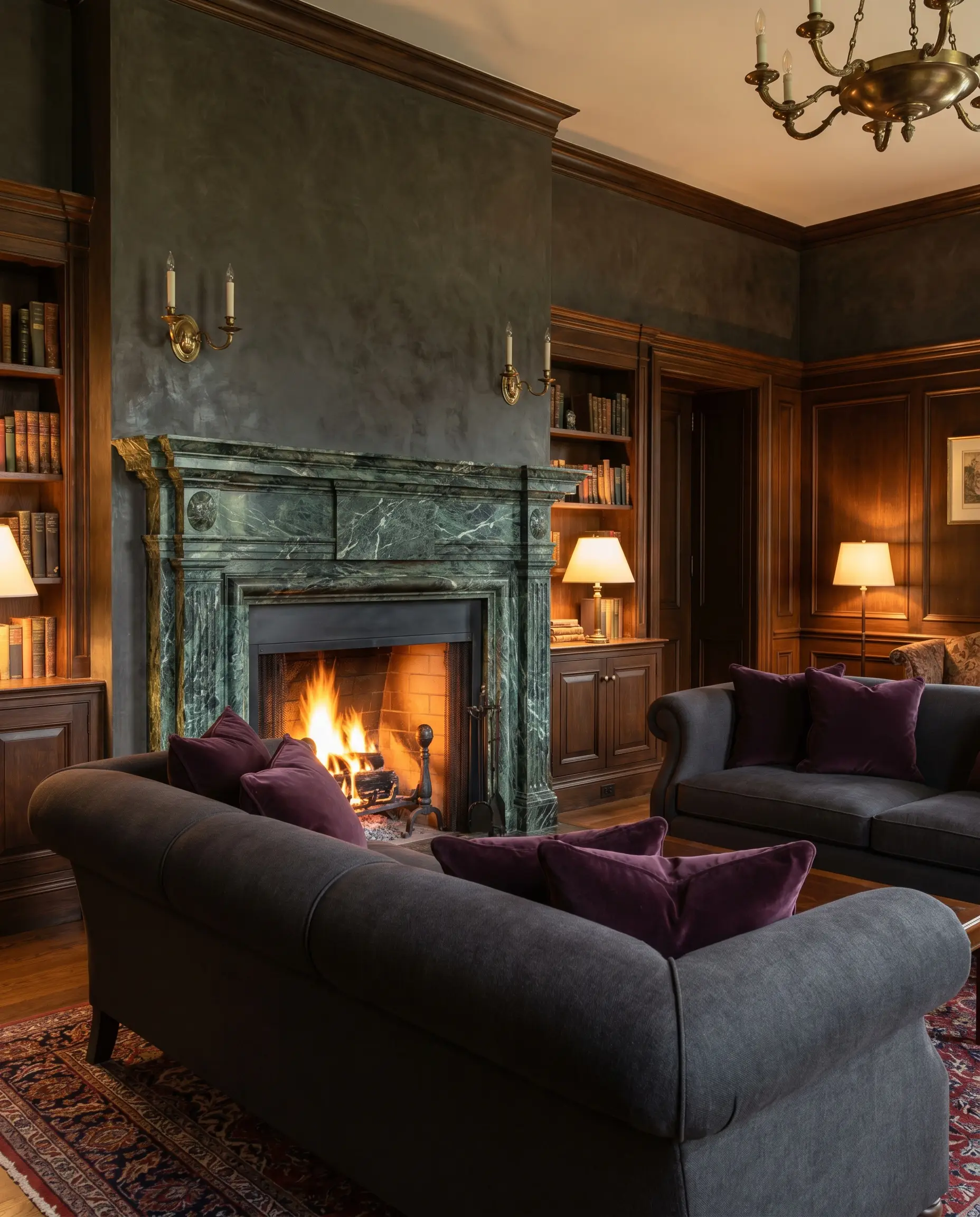
Offering a massive infusion of color while remaining deeply rooted in natural earth tones, green marble provides a rich, historical gravity to a room. Because historical homes often hide original green marble under decades of paint, restoring or installing it serves as a stunning nod to heritage.
- Vibe: Heritage Eclectic
- Key Material: Verde Antigua or Verde Alpi
- Color Match: Pair with deep, moody brass fixtures and dark, muted plum accents.
19. The “Quiet Luxury” of Danby Marble
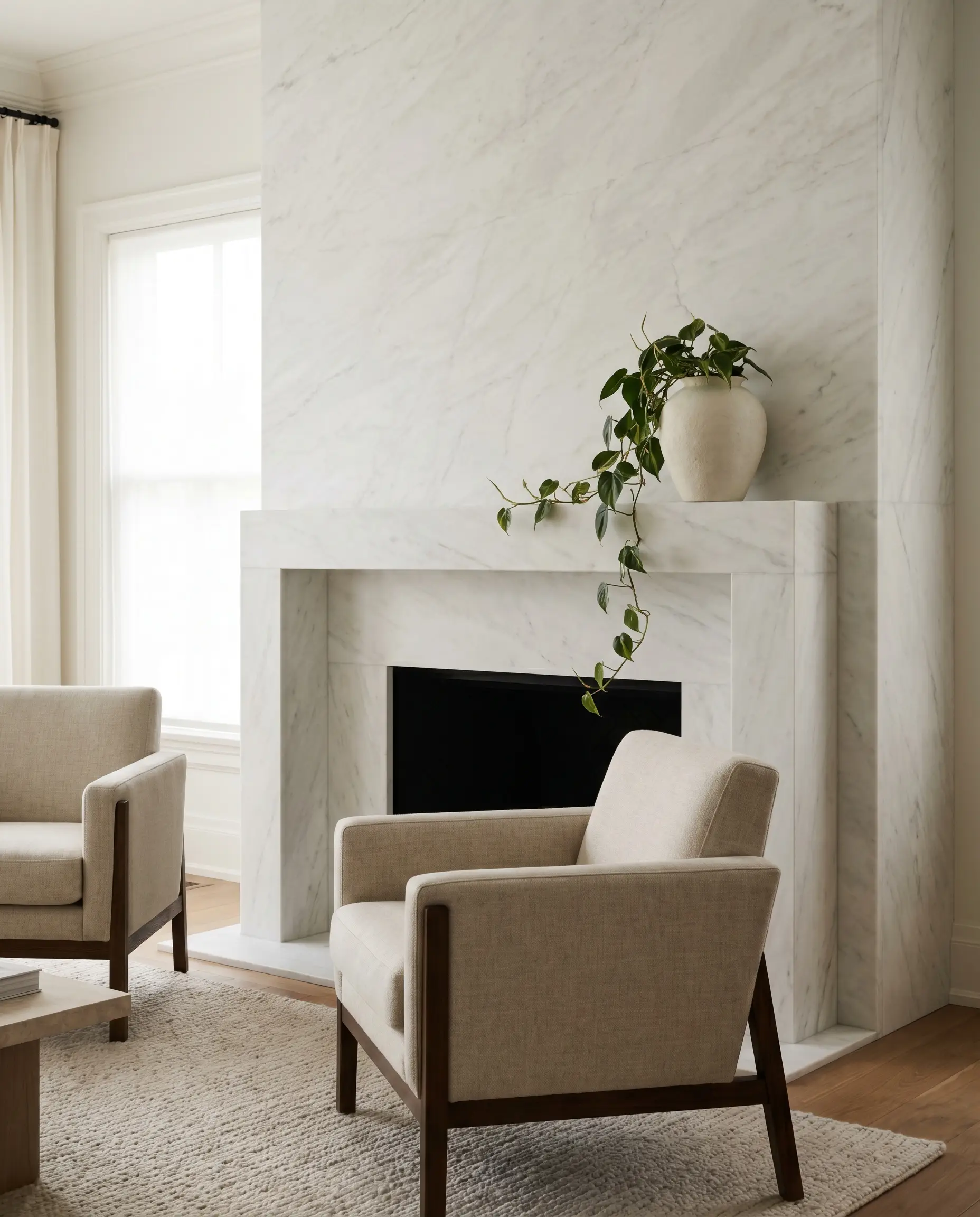
Quarried domestically, this incredibly dense marble features soft, subtle veining that whispers rather than shouts. It offers a highly exclusive, refined aesthetic that starkly contrasts the chaotic, heavy patterns of highly aggressive imported stones.
- Vibe: Understated Elegance
- Key Material: Imperial Danby or Olympian White Danby
- Styling Pro-Tip: Keep the mantel styling minimal—a single ceramic vessel and a trailing green vine are all that is required.
20. Breccia Viola for Vintage Character
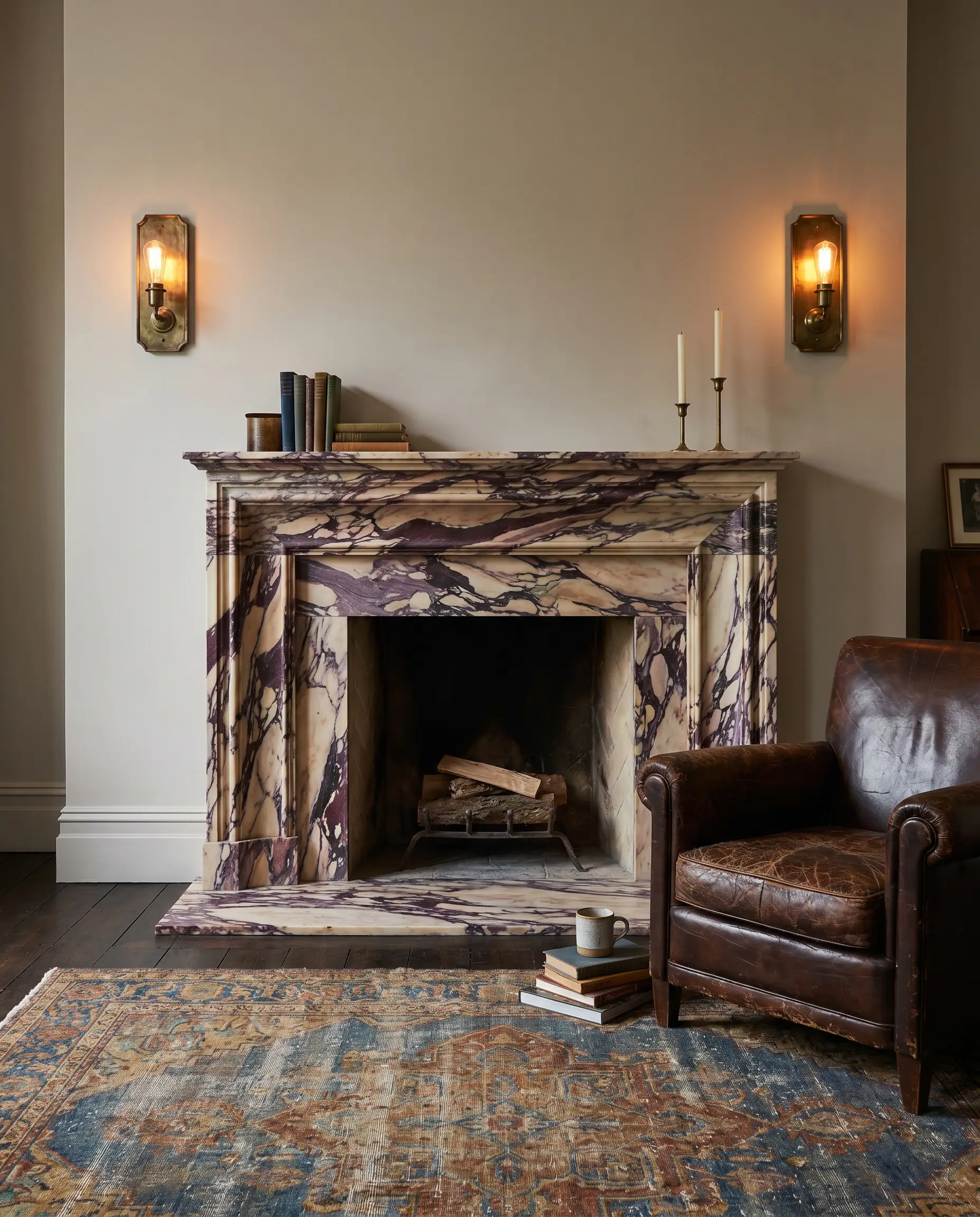
Characterized by intense purple and burgundy veining across fragmented, brecciated patterns, this stone is a favorite among high-end curatorial designers. It feels instantly vintage, providing a sense of collected history to eclectic spaces.
- Vibe: Curated Eclectic
- Key Material: Breccia Viola
- Styling Pro-Tip: Lean into the vintage aesthetic by flanking the surround with antique, rewired brass sconces.
Accessible Luxury (Smart Fabrication)
Achieving a high-end, bespoke aesthetic does not always require purchasing a $10,000 full slab. By utilizing highly strategic fabrication techniques and alternative materials, you can secure maximum visual impact while strictly managing your renovation budget.
21. Using Remnant Slabs for the Hearth
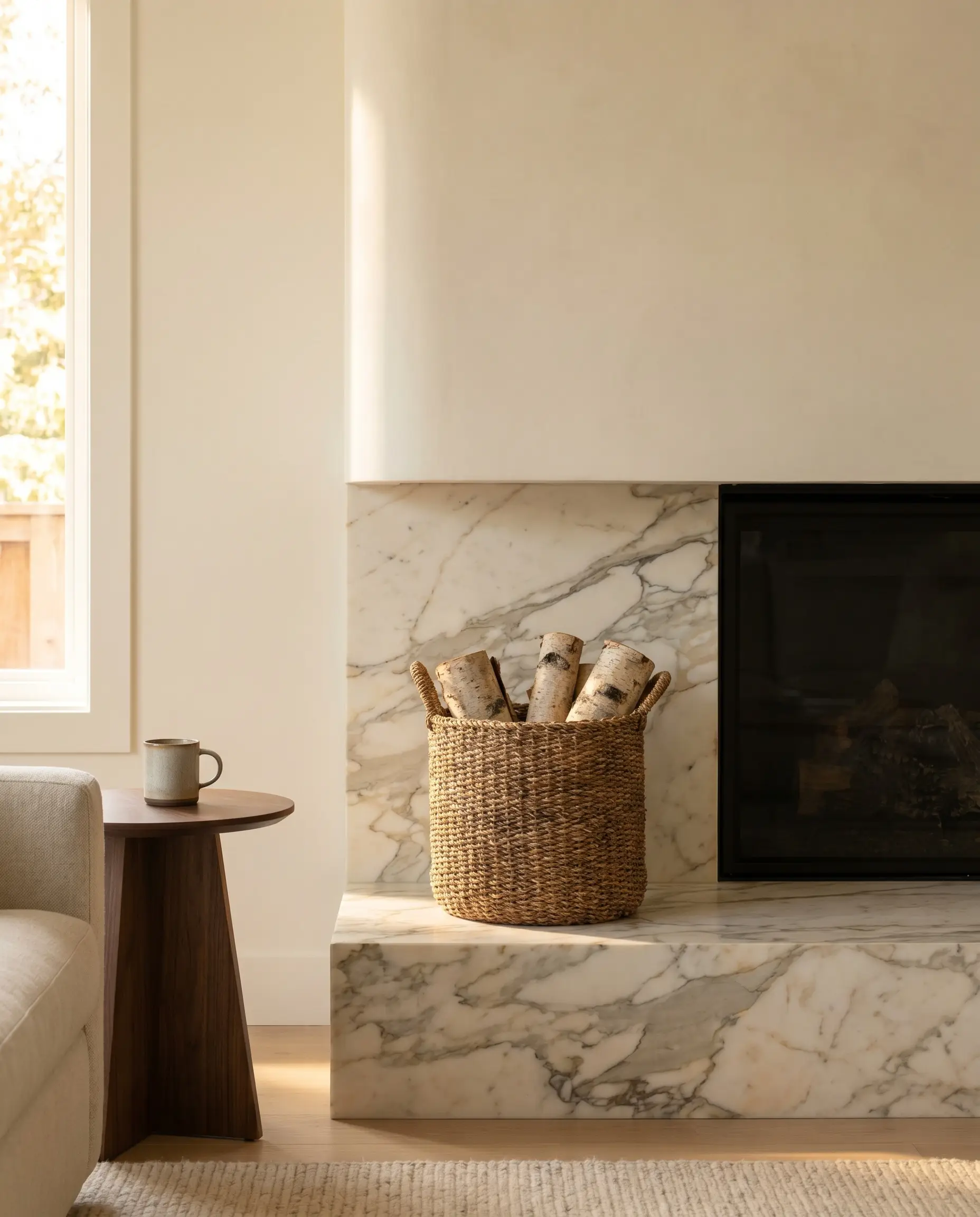
Fabricators frequently hold onto high-end offcuts from massive kitchen projects, which are perfectly sized for a fireplace hearth or inner surround. Pairing a premium marble remnant at the base with an inexpensive wood or plaster upper surround yields a luxury look for a fraction of the cost.
- Vibe: Smart Custom
- Key Material: Premium slab remnants
- Fabrication Match: Ensure the remnant is thick enough (typically 3cm) to support the visual weight of the hearth.
Visit your local stone yard’s “boneyard” in person. Fabricators are often highly motivated to negotiate the price of these offcuts just to clear space in their inventory.
Fabricator Tip
22. Large-Format Porcelain Marble Alternatives
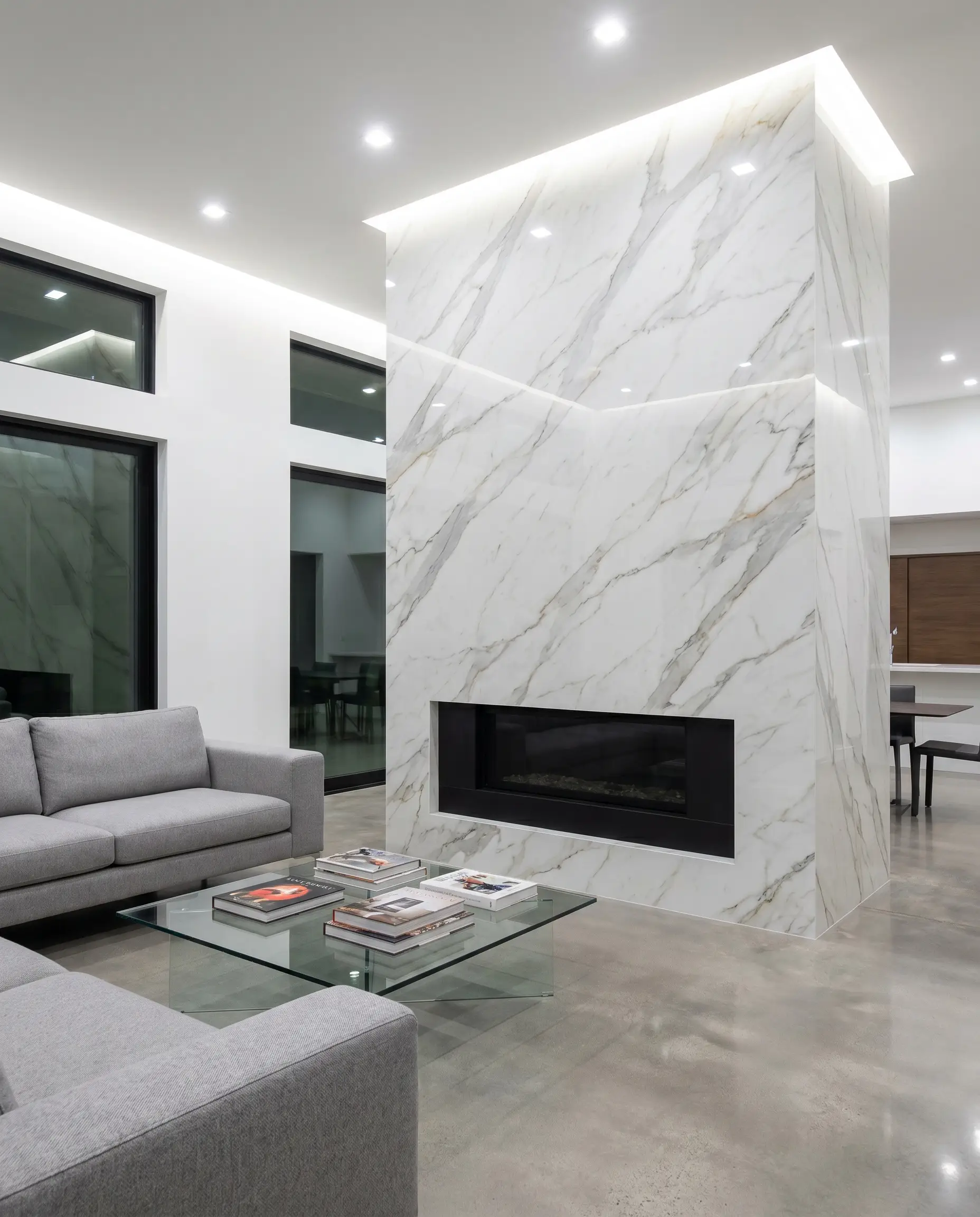
For strict budgets, ultra-compact 5×10 foot porcelain slabs mimic the veining of natural marble flawlessly while offering extreme heat resistance and zero porosity. Because porcelain is printed on the surface, the fabrication of the edges is the single factor that determines if the installation looks authentic or cheap.
- Vibe: High-Tech Accessible
- Key Material: Large-format porcelain slabs
- Fabrication Match: Use a specialized porcelain fabricator to ensure perfectly clean cuts without chipping.
DO mandate perfectly mitered edges for every outside corner. DON’T ever use a standard butt-joint or bullnose edge, as it will immediately expose the unprinted, non-through-body core of the porcelain.
Do/Don’t Rule
The Fabricator’s Guide to Maintenance & Protection
Natural marble is inherently porous due to its limestone base, making proper protection an absolute necessity for the longevity of your investment. Wood-burning fireplaces present a significant risk of soot staining, while gas inserts require protection from the intense, localized heat. The application of a high-quality, penetrating stone sealer immediately after installation is non-negotiable. Furthermore, acidic cleaners will instantly etch the calcium carbonate in the stone; daily maintenance requires nothing more than a damp microfiber cloth and a pH-neutral stone soap.
| Finish Type | Visual Vibe | Maintenance Level | Best For (Design Style) |
|---|---|---|---|
| Polished | High-gloss, formal, highly reflective | Moderate (Shows dust and etching easily) | Traditional, Glamour, Parisian Chic |
| Honed | Matte, soft, absorbs ambient light | Low to Moderate (Hides etching, susceptible to oil) | Japandi, Organic Modern, Transitional |
| Leathered | Textured, undulating, highly tactile | Low (Expertly hides soot, fingerprints, and dust) | Brutalism, Moody Dens, Masculine Luxury |
Final Walkthrough (Planning Your Installation)
The structural success of your custom hearth relies entirely on the rigorous collaboration between your interior designer, your stone fabricator, and your installation team. Never finalize your material choice based on a small 4×4 sample; natural veining varies wildly, and you must visit the slab yard to select your specific piece of stone in person. When you treat the fireplace as a serious architectural intervention, the results will fundamentally transform the gravity of your home. Ready to finalize your material palette? Explore our comprehensive guide on Choosing Natural Stone for Interiors to ensure your selection perfectly aligns with your lifestyle and layout.
The Aesthetics Desk curates the visual direction for Hackrea. Specializing in design history, global architectural movements, and interior styling, this desk focuses on the psychology of space and how to translate high-end, magazine-quality aesthetics into approachable residential design without falling into fleeting micro-trends.