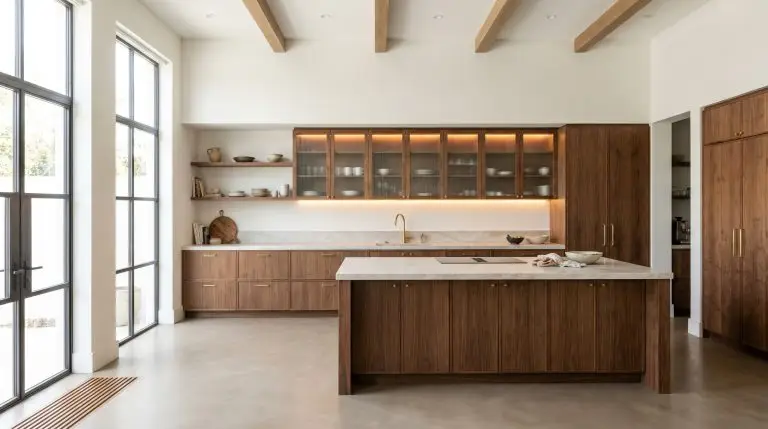
The era of stark, clinical white kitchens has officially yielded to spaces driven by tactile, organic millwork. High-end European design houses are currently dominating the interior landscape by returning to rich, grounding materials, treating the kitchen less like a utilitarian prep zone and more like bespoke architectural joinery.
However, executing this warmth requires extreme precision. Solid black walnut is beautifully rich but can quickly feel visually heavy and monolithic, while clear glass upper cabinets demand a level of relentless curation that is impractical for daily living. Reeded glass acts as the definitive architectural solution—its vertical fluting diffuses ambient light, adds rigorous texture, and gracefully obscures everyday clutter while maintaining a luminous, airy sightline.
Mastering this material pairing is an exercise in balancing weight and light. From grain-matching rift-sawn veneers to the exact color temperature of your internal cabinet lighting, the following masterclass details the exact specifications required to achieve a refined, high-end installation. Before finalizing your millwork order, review the baseline costs and material realities below.
| Material | Visual Effect | Budget Impact |
|---|---|---|
| Solid North American Black Walnut | Heirloom-quality depth, heavy grounding weight, distinct organic grain. | High-End ($$$$) |
| Rift-Sawn Walnut Veneer | Highly stable, sleek linear grain, modern architectural finish. | Accessible Luxury ($$$) |
| Custom Reeded (Fluted) Glass | Luminous vertical texture, high privacy, diffused light transmission. | Premium ($12-$22/sq ft) |
1. Spatial Layout: Balancing Visual Weight
Successful custom millwork relies entirely on spatial geography and visual proportion. You cannot apply these materials arbitrarily; the heavy wood must ground the space, while the fluted glass lifts the eye.
Anchor the Room with Flat-Slab Walnut Base Cabinets
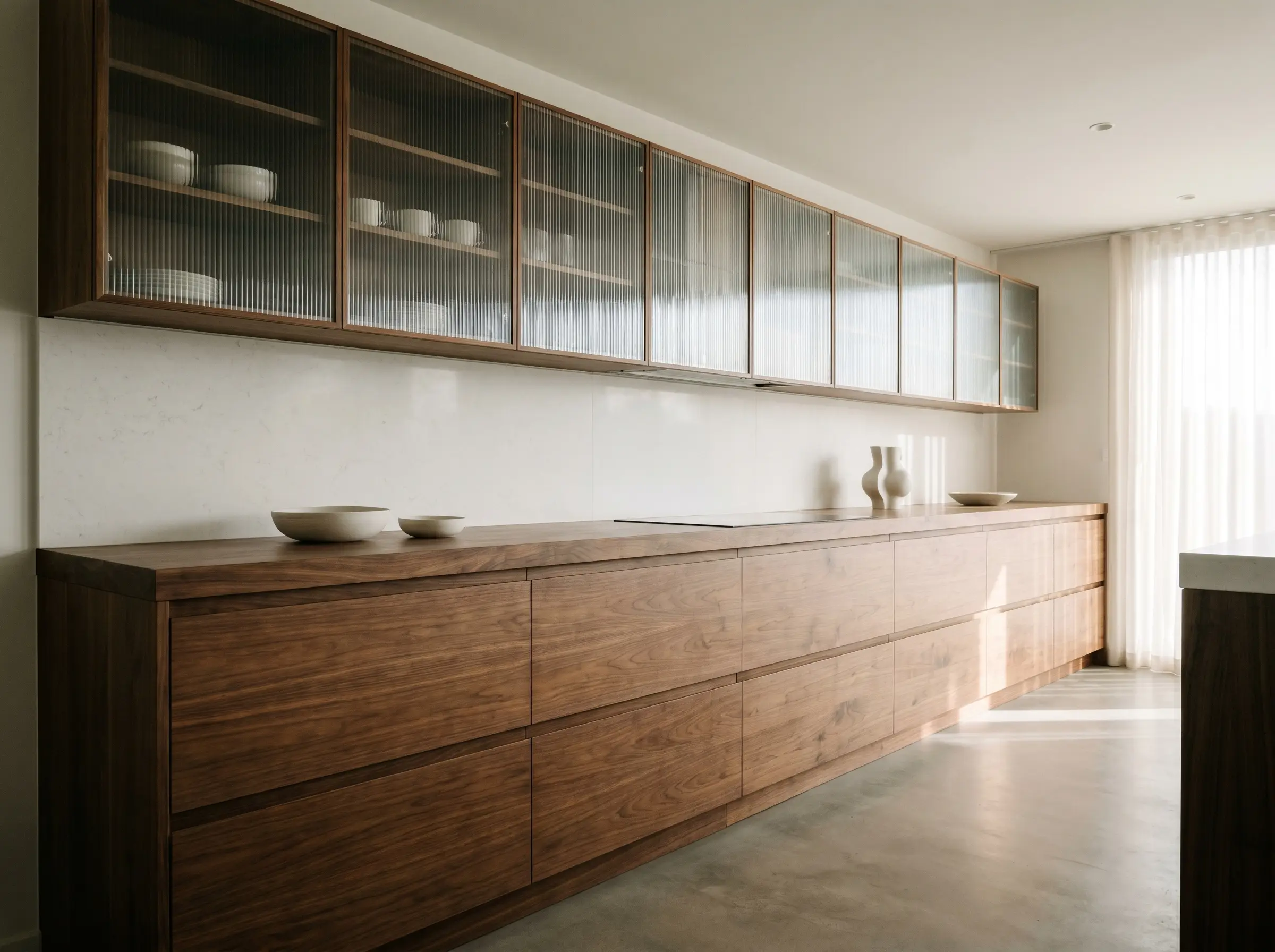
Running flat-panel walnut cabinets continuously along the base establishes a moody, organic foundation without overpowering eye-level sightlines. Utilizing a slab profile allows the continuous horizontal grain-matching to dictate the visual rhythm of the room.
- Vibe: Grounded Organic Modernism.
- Key Material: Rift-sawn walnut veneer (for linear grain consistency).
- Styling Pro-Tip: Run the grain horizontally across drawer banks to visually widen the space.
Maintain a strict 18-inch clearance between the heavy walnut countertops and the lighter glass upper cabinets to ensure the sightline feels breathable.
Spatial Tip
Lift the Sightline with Continuous Fluted Glass Uppers
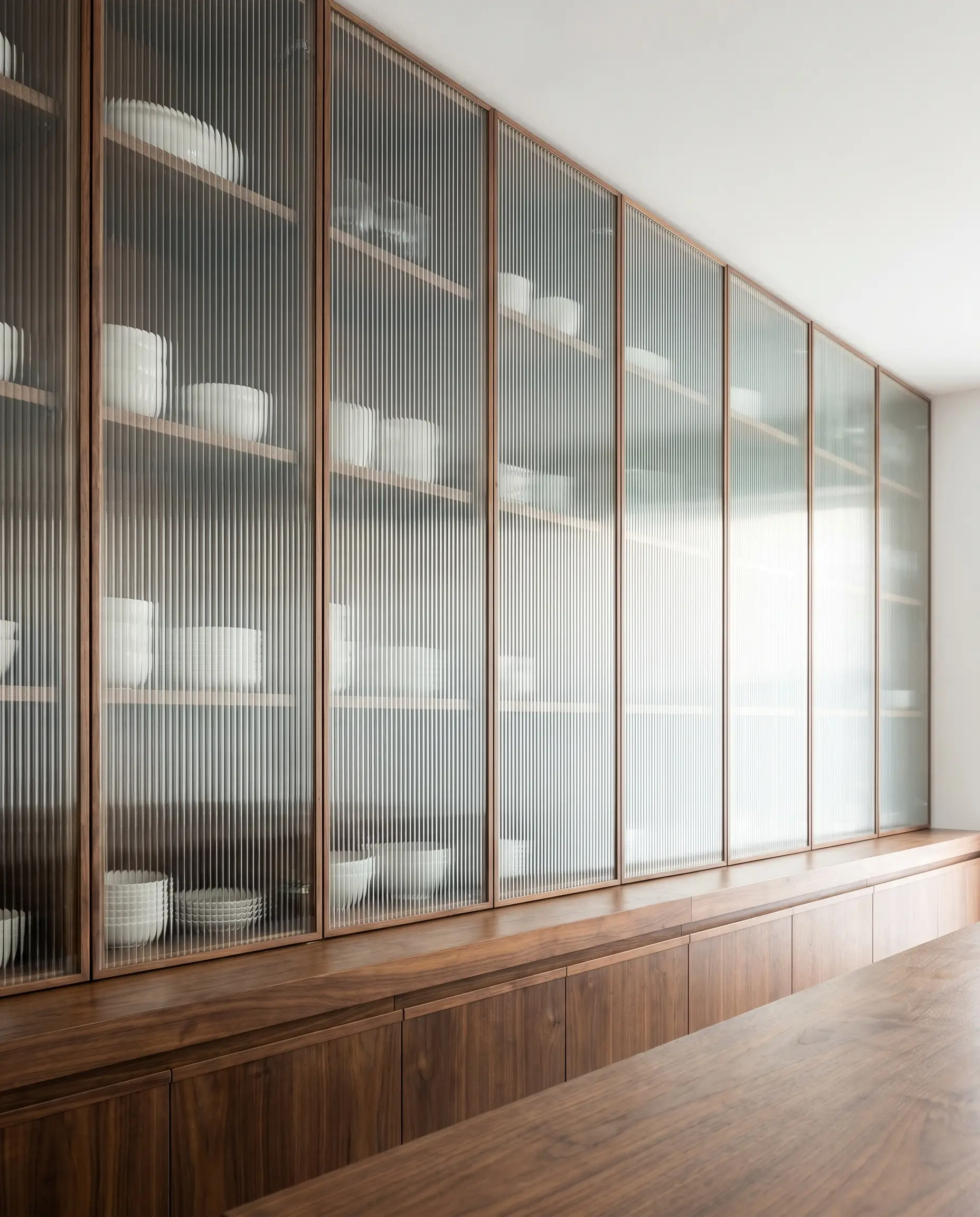
Deploying reeded glass for the entire upper cabinet run effectively neutralizes the visual weight of the wood below. The vertical fluting actively draws the eye upward to the ceiling, while the glass bounces ambient light around the space to maintain an expansive atmosphere.
- Vibe: Luminous European Contemporary.
- Glass Specification: 1/2-inch pitch fluted glass.
- Paint Recommendation: Sherwin-Williams Pure White (SW 7005) for the ceiling to maximize light bounce.
Take the glass upper cabinets completely to the ceiling, finishing with a minimal flush fascia rather than heavy crown molding, to maximize perceived vertical height.
Spatial Tip
Break Up Appliance Walls with Ribbed Glass Pantries
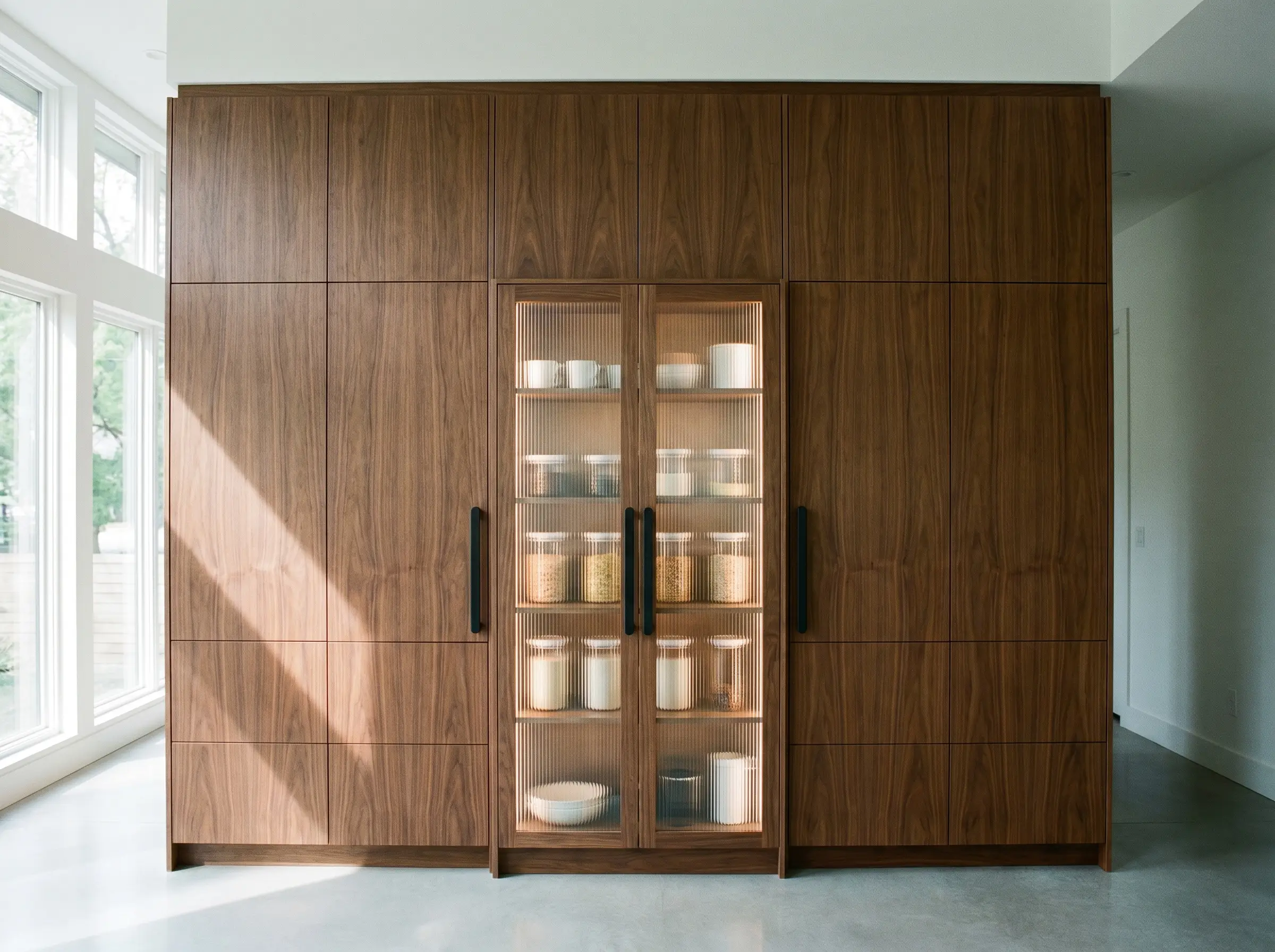
Modern kitchens frequently feature massive banks of floor-to-ceiling walnut hiding integrated refrigeration, which can easily feel like a dark, imposing wall. Inserting a single, tall freestanding-style pantry with reeded glass doors directly into the center breaks up the monolithic wood block and creates a deliberate architectural moment.
- Vibe: Bespoke Concealed Kitchen.
- Hardware Match: Oversized vertical appliance pulls.
- Functionality: Ideal for housing dry goods in uniform glass jars.
Size the glass pantry unit to be exactly one-third the total width of the appliance wall to adhere to the rule of thirds and maintain asymmetrical balance.
Spatial Tip
Flank the Range Hood with Symmetrical Glazing
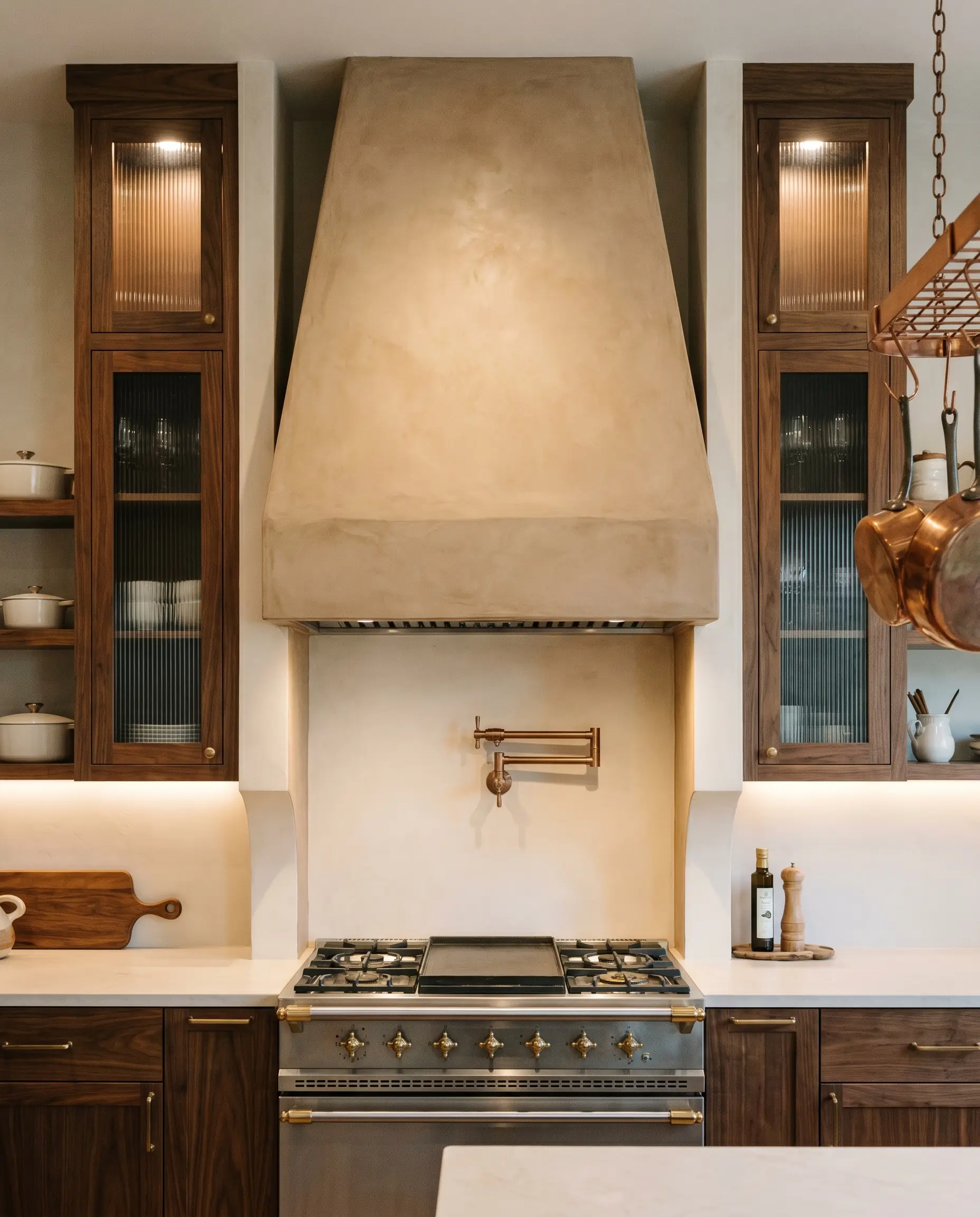
For a refined, European bistro aesthetic, wrap a custom plaster or metal range hood with identical walnut-framed reeded glass cabinets on either side. This symmetric approach turns the cooking zone into a classic focal point while ensuring the heavy hood is flanked by light-diffusing textures.
- Vibe: High-End Transitional.
- Hood Material: Hand-troweled Roman clay or raw steel.
- Joinery Detail: Match the walnut frame width to the thickness of the hood surround.
Leave a minimum of 3 to 4 inches of negative space between the glass cabinet frames and the range hood to allow the plaster finish to breathe.
Spatial Tip
2. Framing & Joinery: The Architectural Details
The transition between the luminous glass and the organic wood is exactly where custom joinery distinguishes itself from off-the-shelf cabinetry. Focus closely on the tactile framing materials to craft a truly bespoke finish.
House the Glass in Matte Black Metal Extrusions
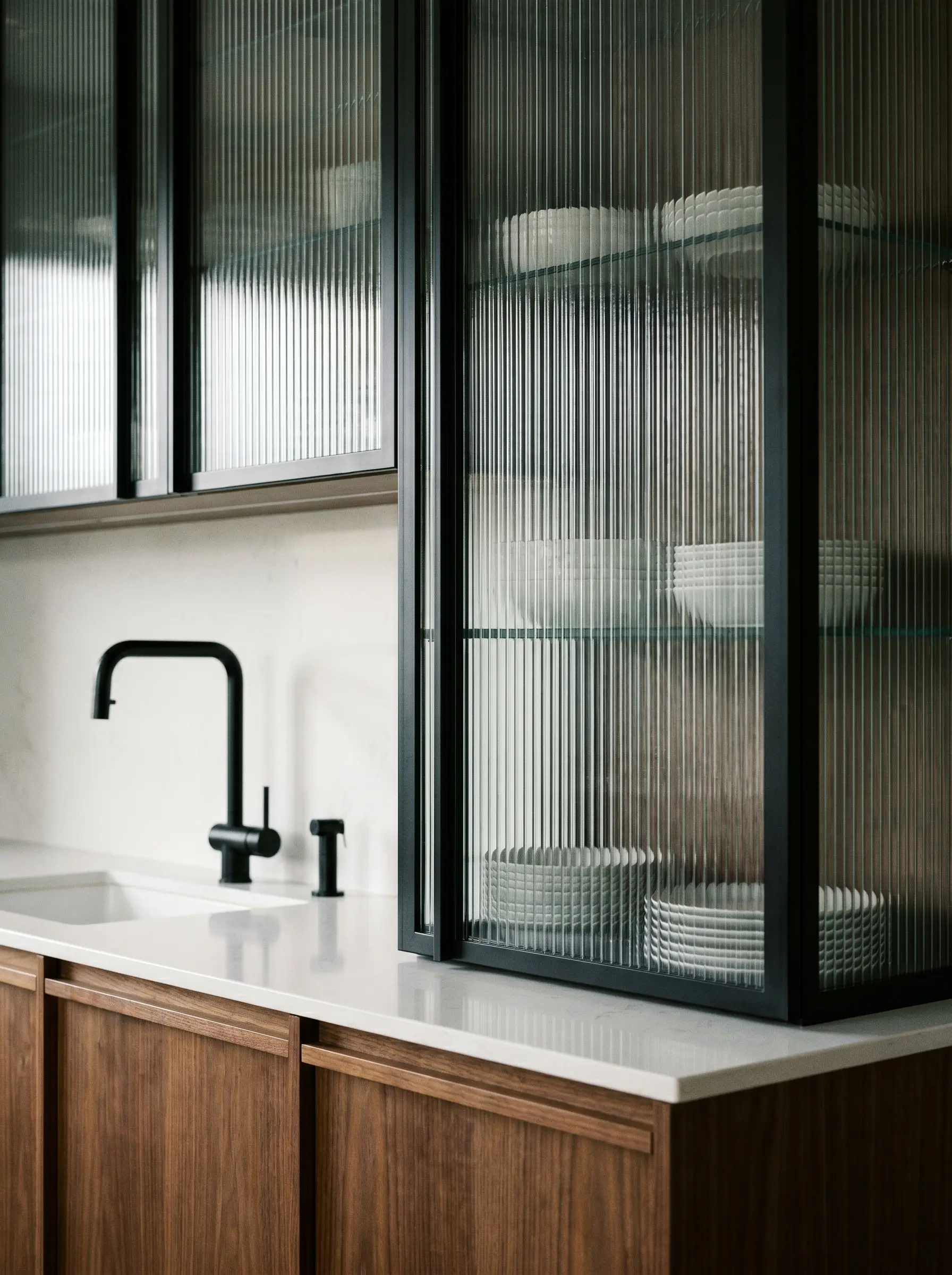
Instead of routing the glass directly into a traditional wooden frame, set the reeded panels inside slim, matte black aluminum extrusions. This black metal acts as a crisp, graphic eyeliner that sharply contrasts against the warm walnut bases, injecting a soft industrial edge.
- Vibe: Soft Industrial / Contemporary European.
- Key Material: Powder-coated aluminum extrusions (slim profile).
- Design Integration: Pair with matte black fixtures from our Flat-Panel vs. Shaker Cabinets design guide.
Soften the Edges with Arched Walnut Frames
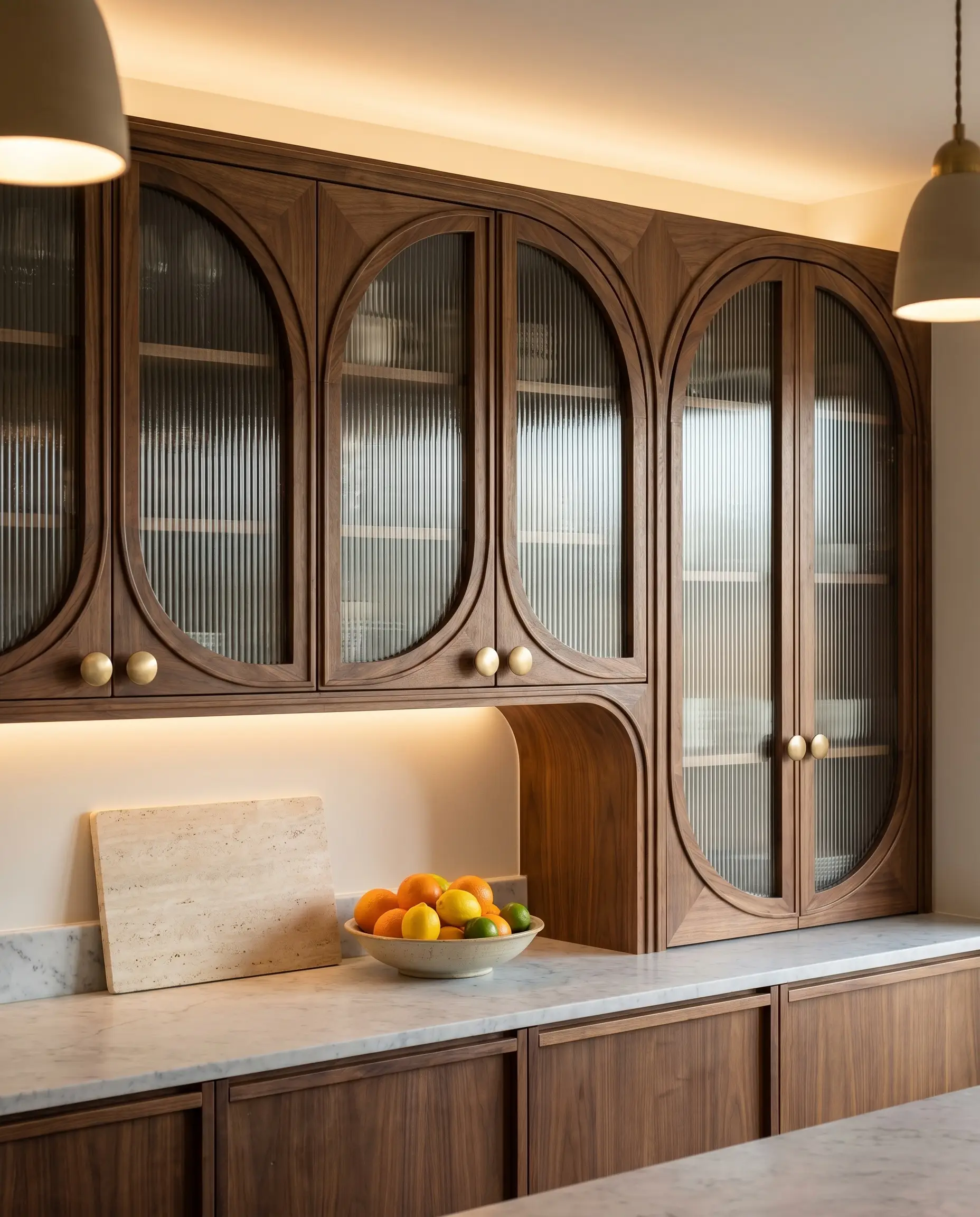
To introduce a softer, highly bespoke aesthetic, craft the upper cabinets with arched walnut frames encasing the reeded glass. The sweeping curves soften the rigid vertical lines of the fluting and offer a subtle nod to Art Deco geometry.
- Vibe: Curvilinear Organic Modern.
- Joinery Detail: Steam-bent solid walnut framing.
- Hardware Pairing: Soft, rounded brass knobs rather than harsh linear pulls.
Utilize Pocket and Sliding Tambour-Style Doors
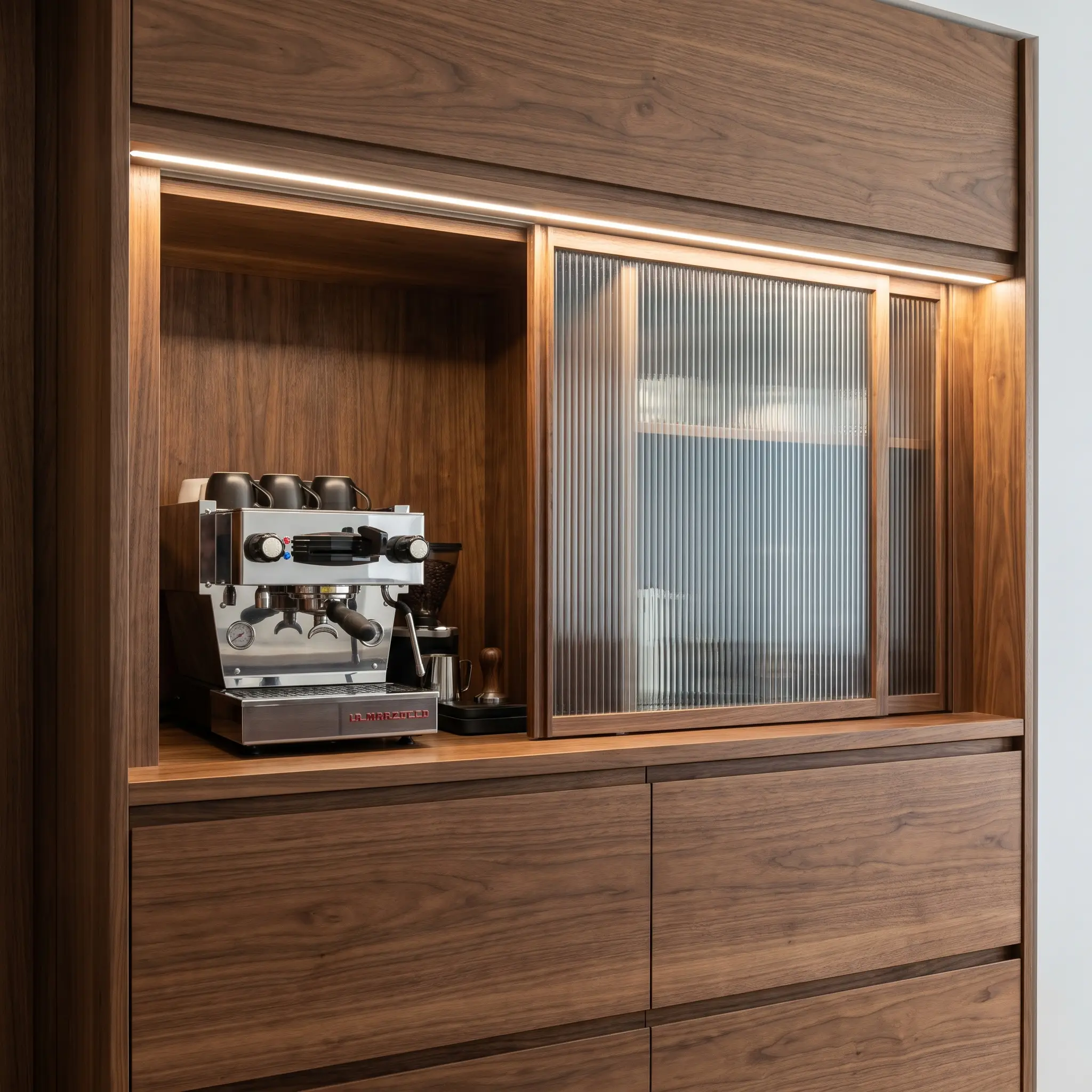
Hide countertop appliance garages or coffee stations behind sliding reeded glass doors set on recessed tracks, or utilize tambour-style rolling applications. This European concealed-kitchen approach allows messy prep zones to be quickly hidden behind beautiful, textured glass while maintaining a flush cabinet profile.
- Vibe: Minimalist Concealed Functionality.
- Mechanism: High-weight-capacity concealed sliding track systems.
- Styling Pro-Tip: Line the interior of the appliance garage with matching walnut veneer for a seamless reveal.
Design a Floating Walnut and Glass Credenza
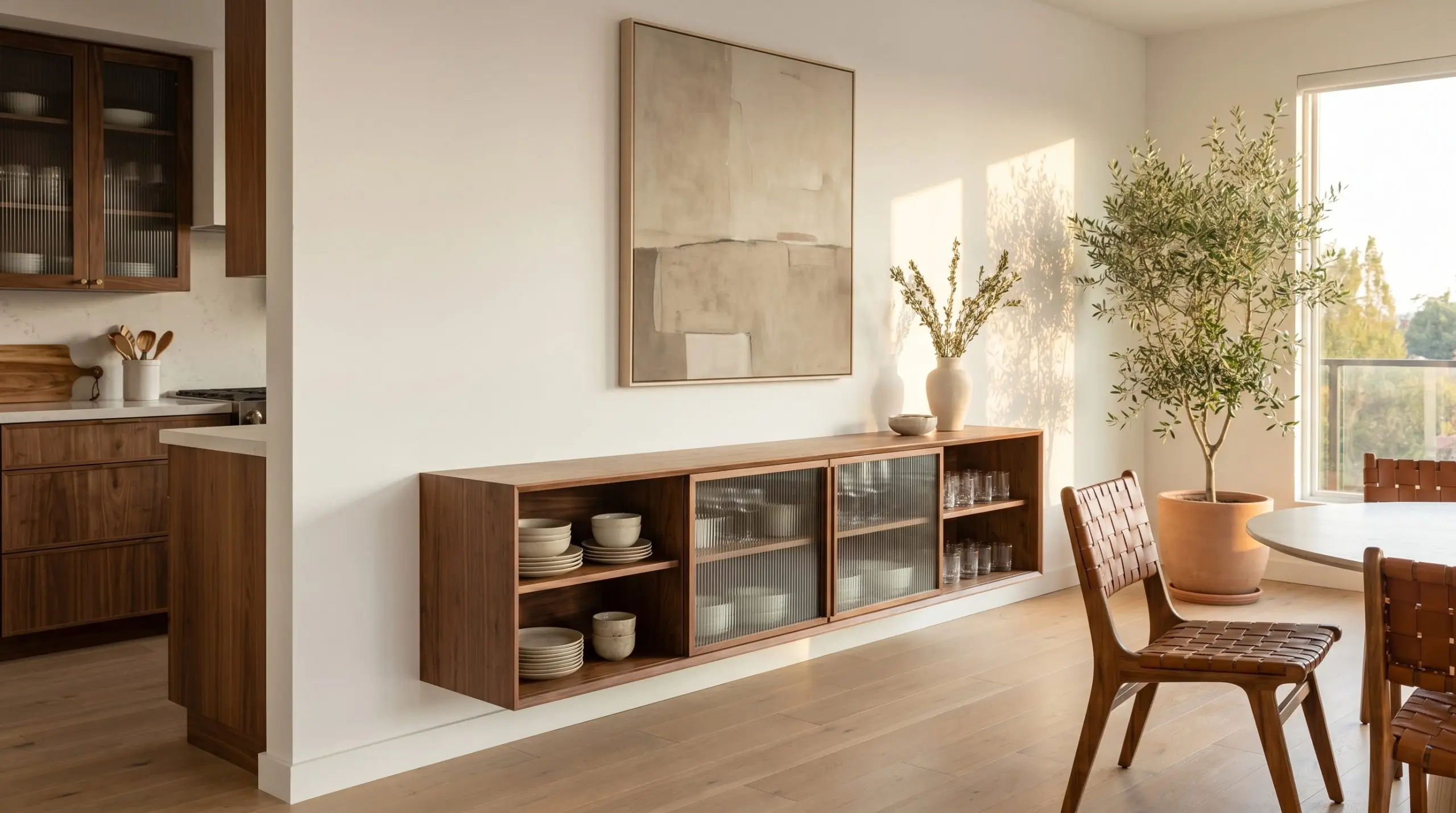
Build a floating, wall-mounted buffet in the dining transition zone to seamlessly bridge the kitchen and living spaces. Use a solid walnut casing with sliding reeded glass fronts to store formal dinnerware, treating the kitchen cabinetry like fine, freestanding furniture.
- Vibe: Mid-Century Bespoke.
- Mounting Requirement: Heavy-duty steel wall cleats anchored into studs.
- Design Integration: Read our insights on cohesive styling in our warm minimalism kitchen ideas dossier.
3. Lighting & Hardware: Activating the Materials
Reeded glass remains lifeless without proper internal illumination, and walnut requires specific metallic pairings to activate its rich undertones. Execute your lighting and hardware selections with rigorous technical precision.
Backlight the Fluting with 3000K LED Channels
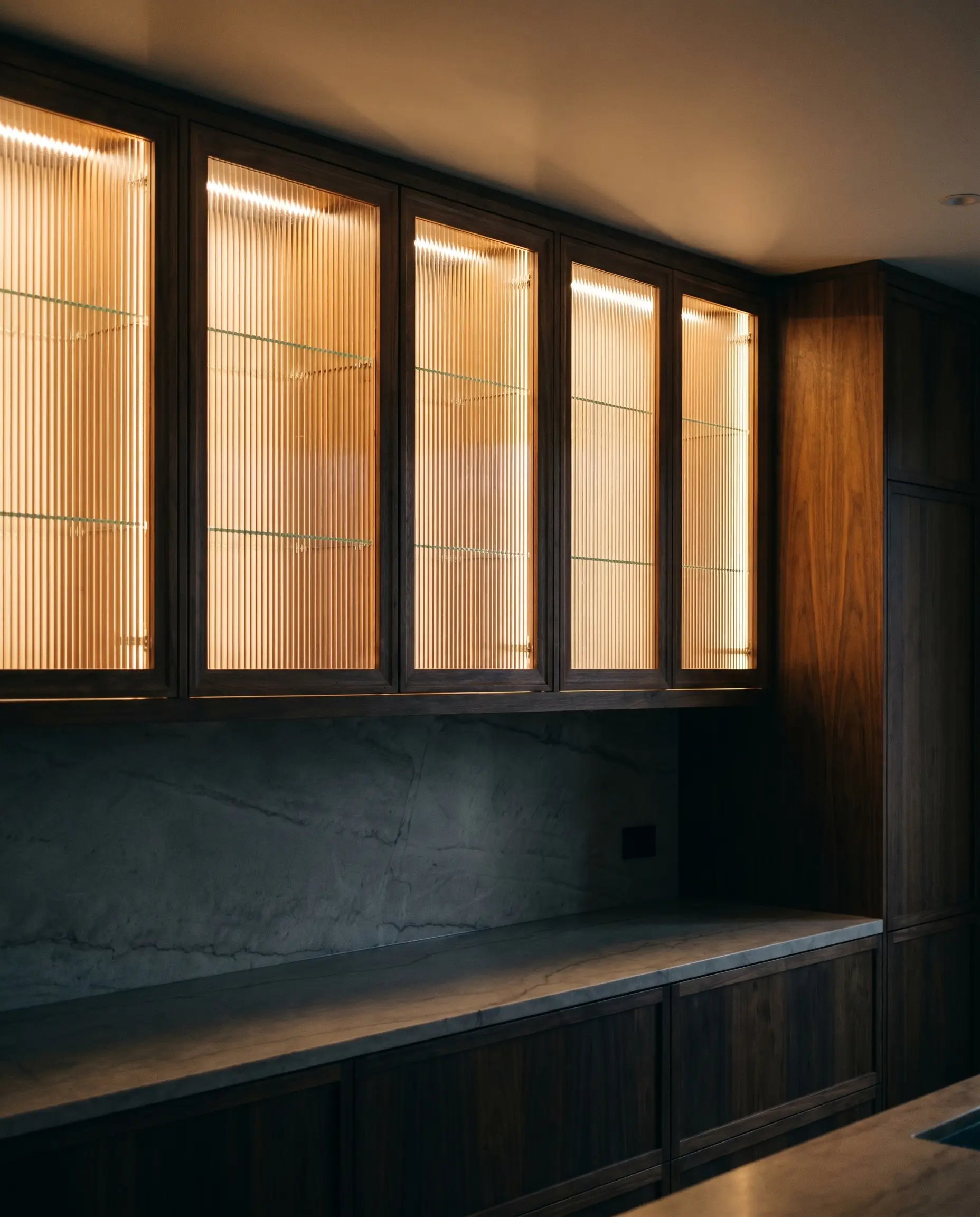
You must install recessed LED strip lighting inside the glass cabinets to transform the millwork into glowing lanterns at night. The vertical fluting catches the light brilliantly, provided the temperature is calibrated to flatter the wood tone.
- Vibe: Luminous Architectural.
- Lighting Spec: 3000K color temperature LED tape inside aluminum diffusion channels.
- Installation Detail: Rout the channels directly into the top and bottom interior cabinet panels for invisible light sourcing.
Pair with Unlacquered Brass Knurled Hardware
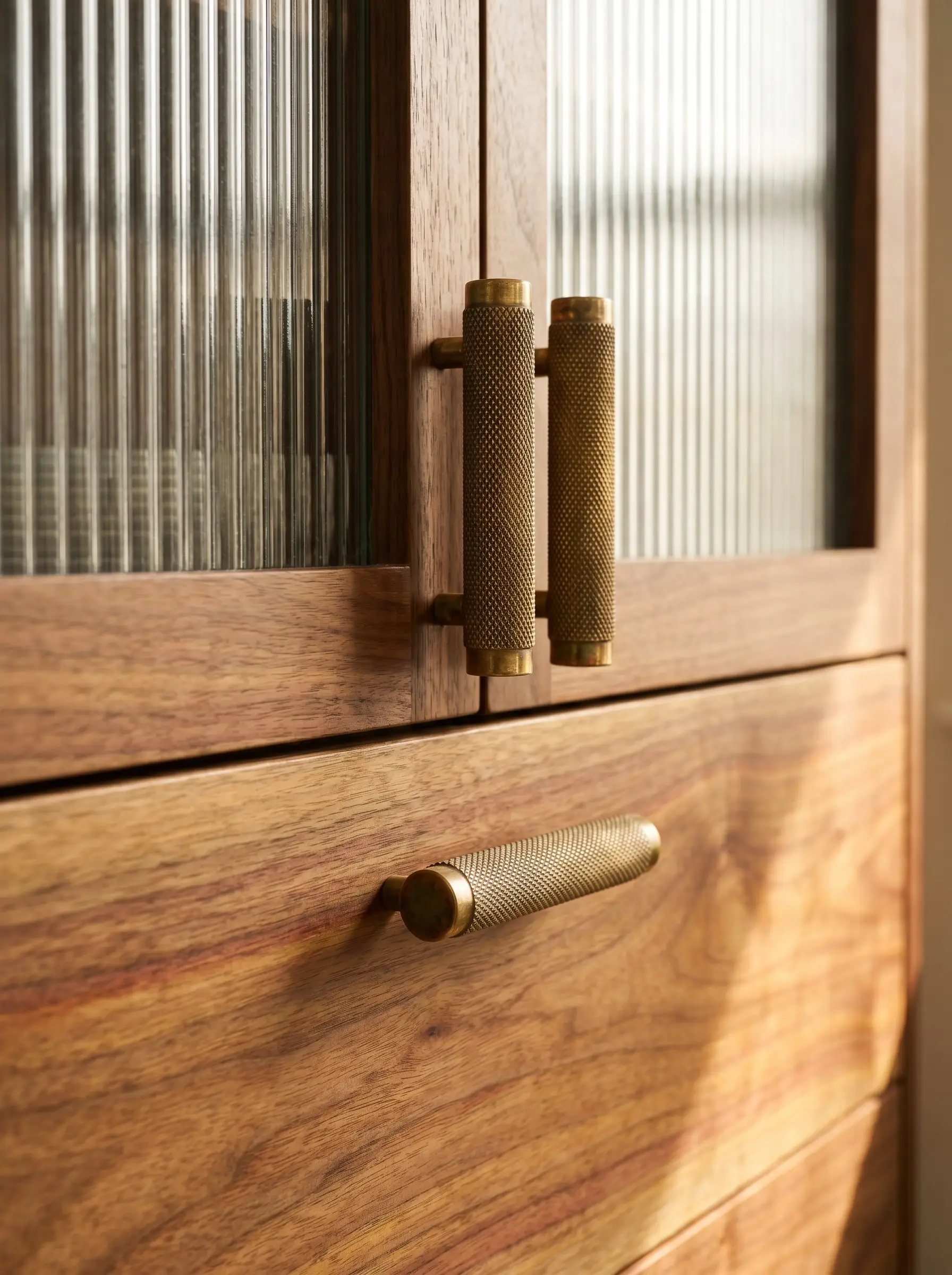
Unlacquered brass acts as the perfect metallic bridge, pulling out the golden and red undertones inherent in natural walnut. Selecting heavy, knurled hardware ensures the tactile grip perfectly echoes the vertical ribbed texture of the fluted glass.
- Vibe: Tactile Luxury.
- Hardware Spec: Solid unlacquered brass cylinder pulls with diamond knurling.
- Patina Note: The living finish will naturally darken and oxidize over time, adding historical character.
Use Mirrored Backings Inside the Glass Cabinets
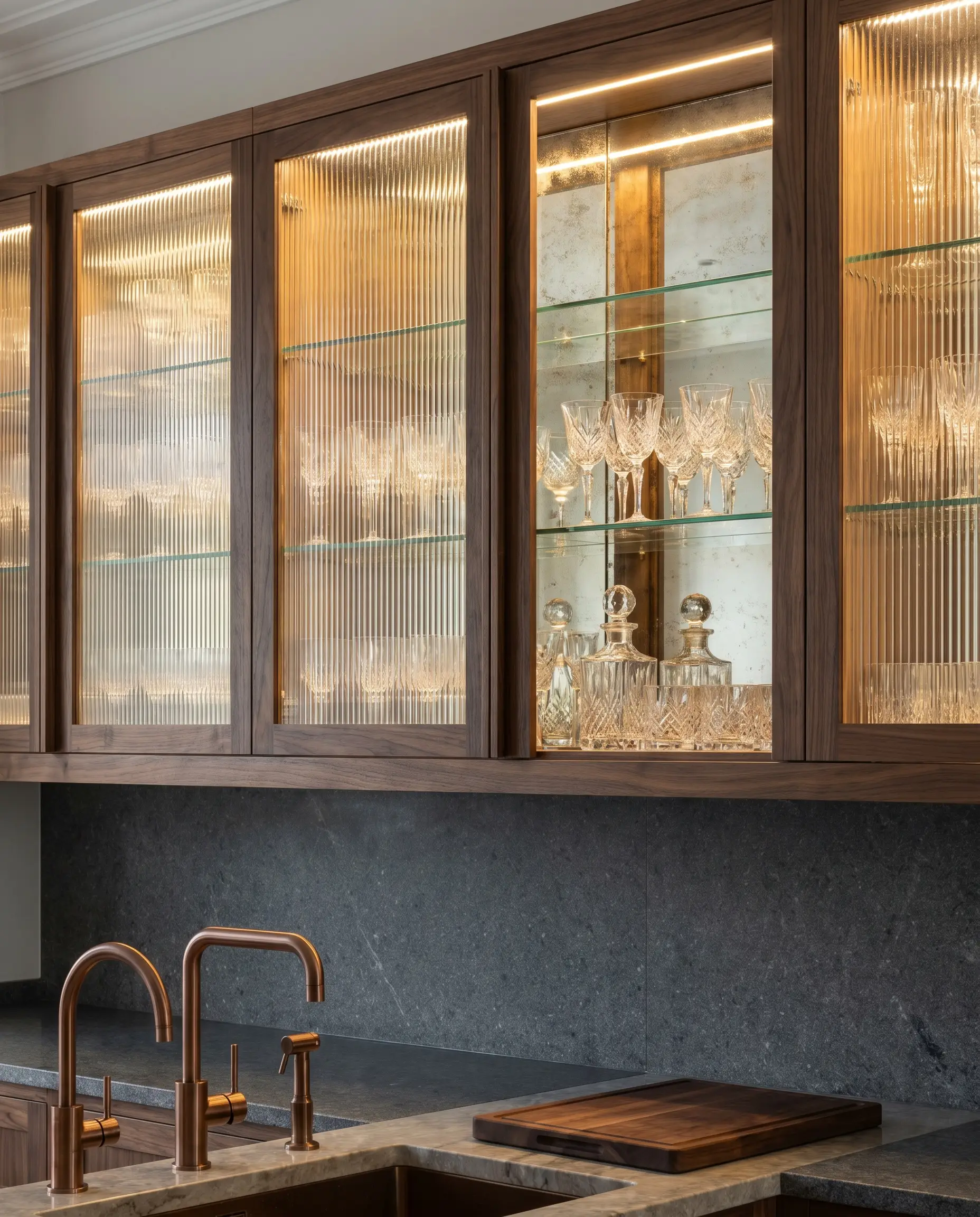
For kitchens suffering from a lack of natural light, line the back wall of the reeded glass cabinets with antique mirror panels. The mirror actively reflects the internal LED lighting back through the fluted glass, doubling the luminous effect and making the cabinet interior look infinitely deep.
- Vibe: Glamorous Depth.
- Material Spec: Lightly oxidized antique mirror glass (1/4-inch thickness).
- Styling Pro-Tip: Use glass interior shelving rather than wood to allow light to pass uninterrupted from top to bottom.
Keep Hardware Minimal with Push-to-Open Latches
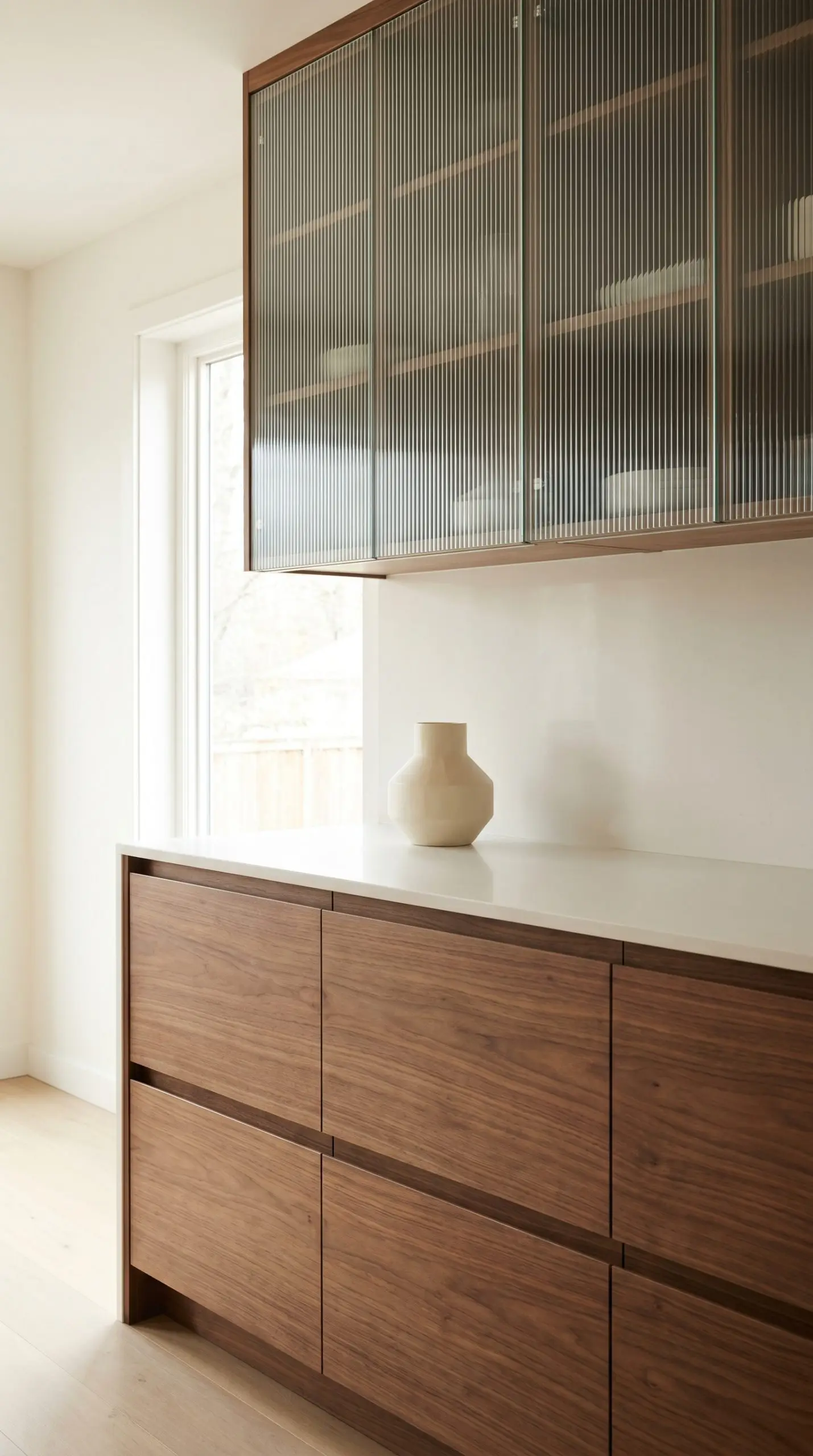
If your architectural goal is stark, warm minimalism, skip external hardware entirely on the glass upper cabinets. Utilizing mechanical push-to-open latches keeps the reeded texture completely uninterrupted, allowing the walnut grain below to command the room’s visual focus.
- Vibe: Seamless Minimalism.
- Hardware Spec: Heavy-duty magnetic push-to-open latches with a minimum 4lb push force.
- Joinery Detail: Ensure a perfectly flush overlay door installation to maintain a tight 1/8-inch reveal line.
4. Material Pairings: Completing the Palette
The walnut and glass do not exist in a vacuum. The countertops and backsplashes you select must successfully bridge these two dominant finishes without fighting them for attention.
Contrast with Honed Calacatta Viola Marble
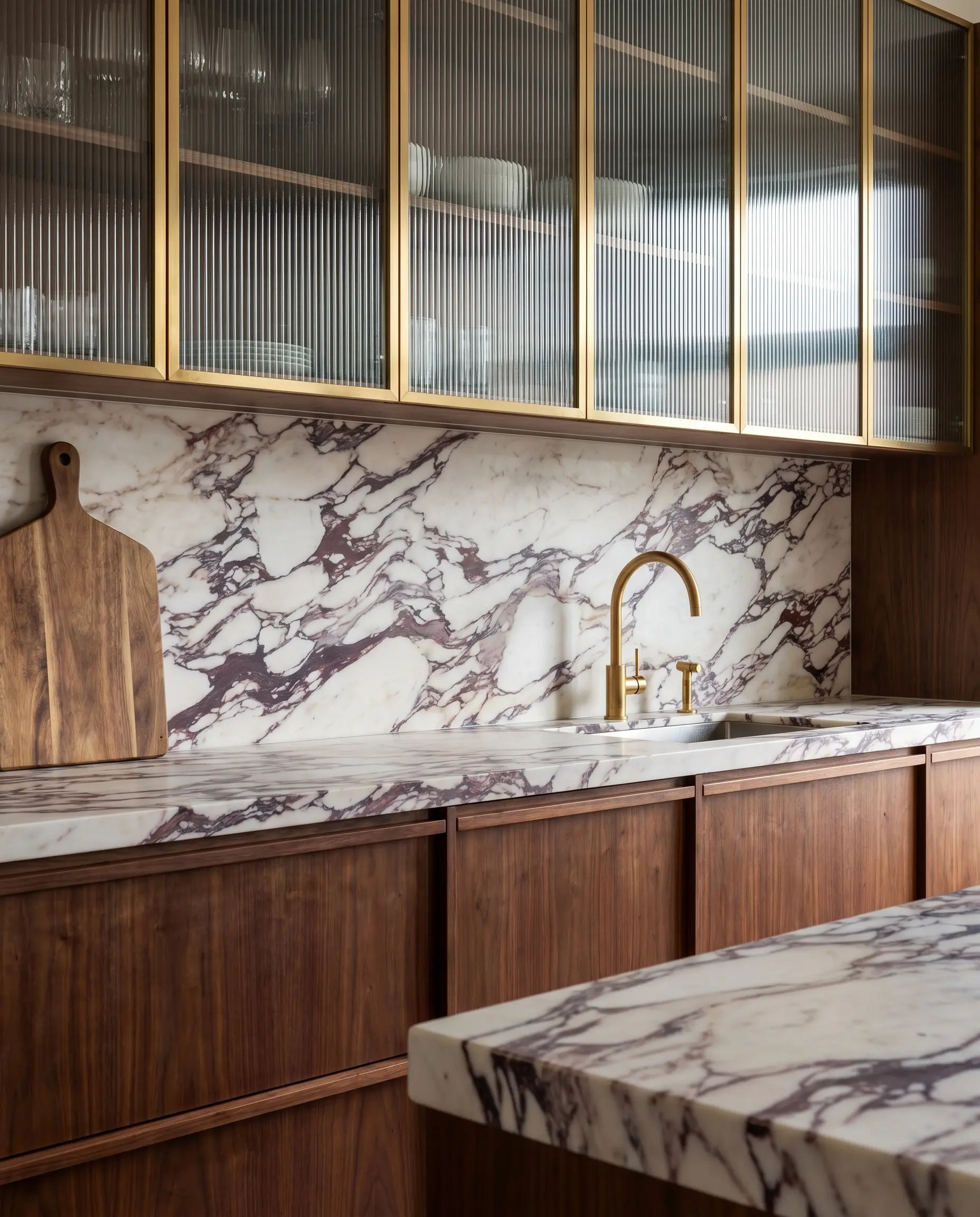
Introduce a heavy, dramatically veined natural stone like Calacatta Viola for the countertops and backsplash. The deep burgundy and purple veining speaks directly to the richness of the walnut, while a honed finish ensures the stone does not look excessively glossy alongside the textured glass.
Why it works:
- The organic, chaotic movement of the marble offsets the strict, linear geometry of the fluted glass and rift-sawn wood.
- The honed (matte) finish absorbs light, perfectly complementing the light-diffusing properties of the reeded glass above.
- The burgundy veining acts as a natural color bridge to the red undertones in the solid walnut.
Bridge the Gap with Vertical Stacked Ceramic Tile
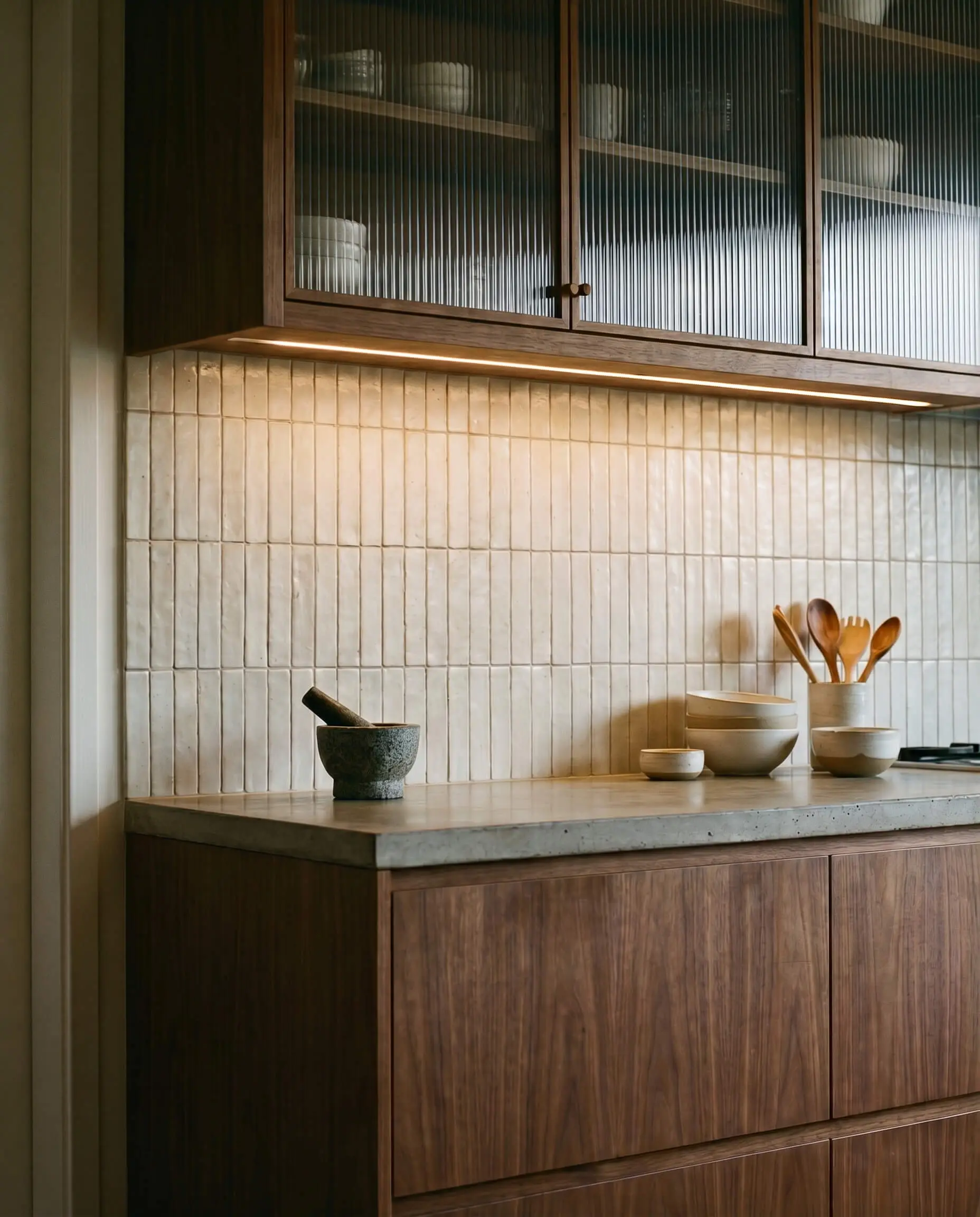
Install a matte, handcrafted ceramic backsplash tile stacked in a strict vertical grid. The vertical orientation of the tile perfectly mirrors the vertical lines of the reeded glass above it, establishing a highly cohesive architectural language throughout the space.
Why it works:
- The vertical stacking draws the eye continuously from the countertop to the ceiling, amplifying perceived height.
- Handcrafted ceramic offers subtle surface imperfections that play beautifully against the precision of the milled walnut.
- A matte glaze prevents harsh under-cabinet glare, keeping the focus on the softly lit glass uppers.
Ground the Palette with Microcement Floors
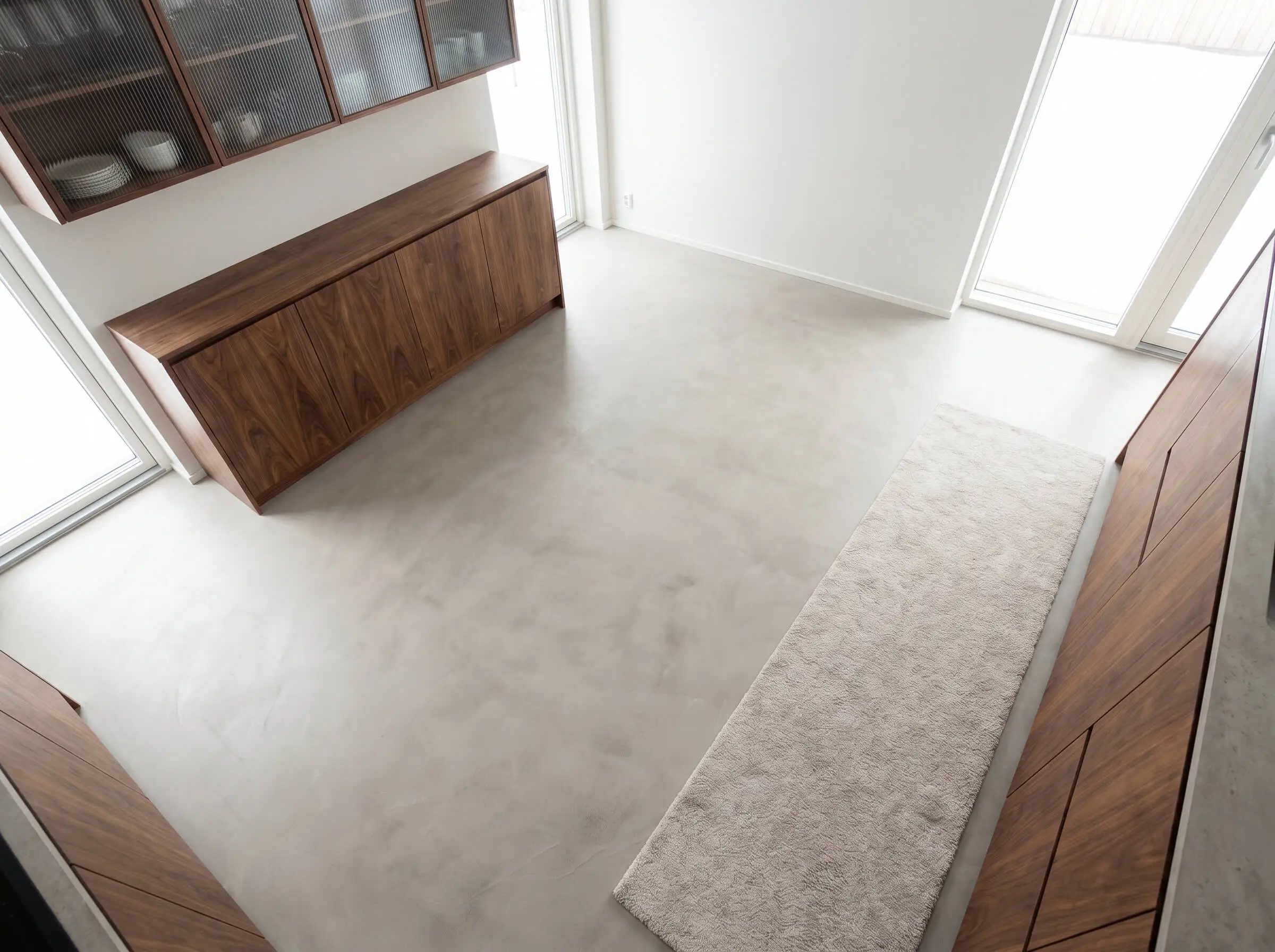
We strongly advise against installing natural wood floors alongside walnut base cabinets to avoid a heavy, cabin-like clash of competing grains. Instead, pour seamless microcement or lay large-format matte porcelain tiles in a soft greige to let the cabinetry stand as the undisputed focal point.
Why it works:
- Microcement provides a quiet, monolithic foundation that eliminates grout lines and visual clutter.
- The cool, concrete-like texture balances the intense, organic warmth of the walnut.
- It establishes a contemporary European foundation that prevents the mid-century wood tones from feeling dated.
Executing Your Bespoke Kitchen Vision
Pairing walnut and reeded glass is a rigorous exercise in balancing visual weight, tactile texture, and light diffusion. The success of this aesthetic relies entirely on the precision of your joinery and the deliberate calibration of your lighting. Order physical material samples of rift-sawn veneer and fluted glass to test exactly how your specific kitchen’s natural light interacts with the textures throughout the day. To finalize the metallic accents that will pull this entire palette together, explore our comprehensive Kitchen Hardware Guide and begin specifying your finishes.

The Hackrea Style Desk treats interior decoration as an exact visual science. Rather than focusing on demolition or floor plans, this desk masters the art of color theory, undertone matching, material pairings, and spatial proportion. From balancing the visual weight of mixed metals to finding the perfect bridging tone between disparate wood species, this desk provides the rigorous aesthetic rules needed to achieve high-end, editorial-quality harmony in any space.