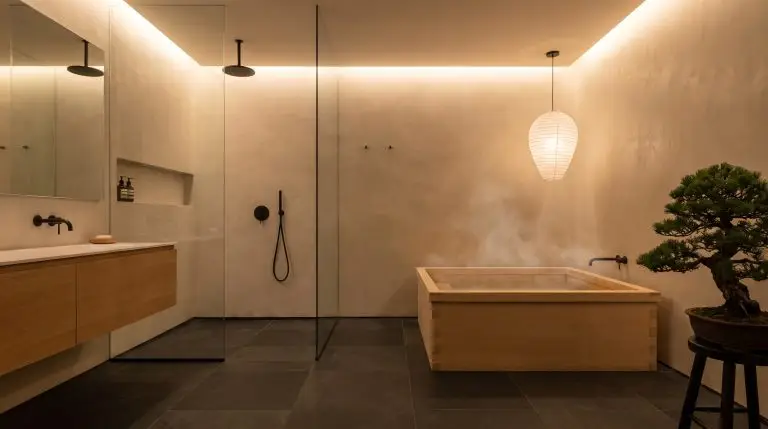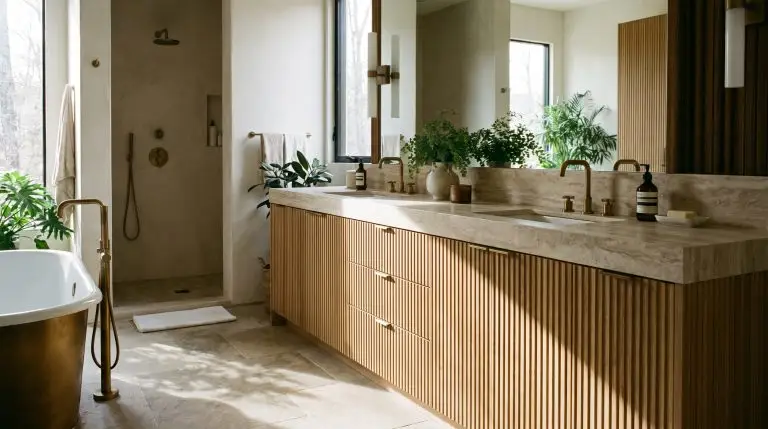
The fluted white oak bathroom vanity has established itself as the undisputed architectural centerpiece of the organic modern bathroom. It answers a complex spatial challenge: introducing rigid, linear geometry while delivering the unmatched tactile warmth of natural wood grain. Executing this bespoke look flawlessly requires moving beyond standard cabinetry to understand the nuances of rift-sawn wood cuts, precise millwork profiles, and intentional material pairings. Let’s break down the exact specifications required to master this texture.
Decoding Millwork Profiles: The Fluting Scale
Selecting the correct radius and depth of the wood profile is not a minor detail; it dictates the entire room’s aesthetic direction. The scale of the groove determines how light interacts with the wood, casting shadows that range from subtle gradients to sharp, high-contrast lines.
Micro-Reeded Oak for Soft Minimalism
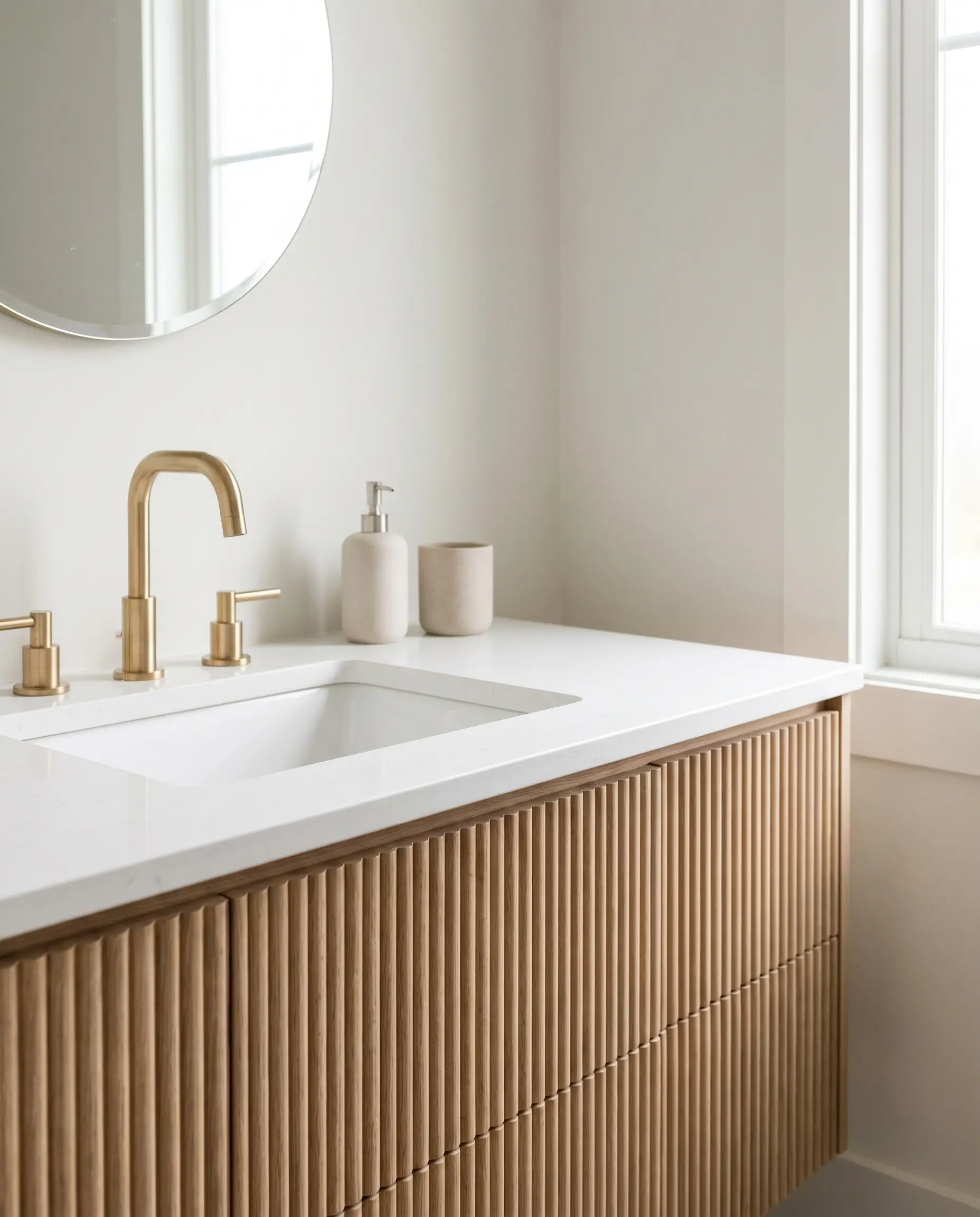
Micro-reeded tambour millwork features tight, highly repetitive convex curves that read almost like a woven fabric from across the room. This delicate scale creates a continuous, subtle optical illusion that prevents the woodwork from feeling heavy, making it perfectly suited for compact powder rooms or highly minimalist spatial layouts.
- Vibe: Soft Minimalism
- Profile Scale: 1/4-inch to 3/8-inch convex curves
- Millwork Fact: To achieve seamless curves at this tight radius without splintering, custom fabricators rely on flexible tambour panels backed with heavy-duty canvas rather than routing solid boards.
- Wall Color Pairing: Benjamin Moore White Dove
Classic Half-Moon Tambour for Scandi Warmth
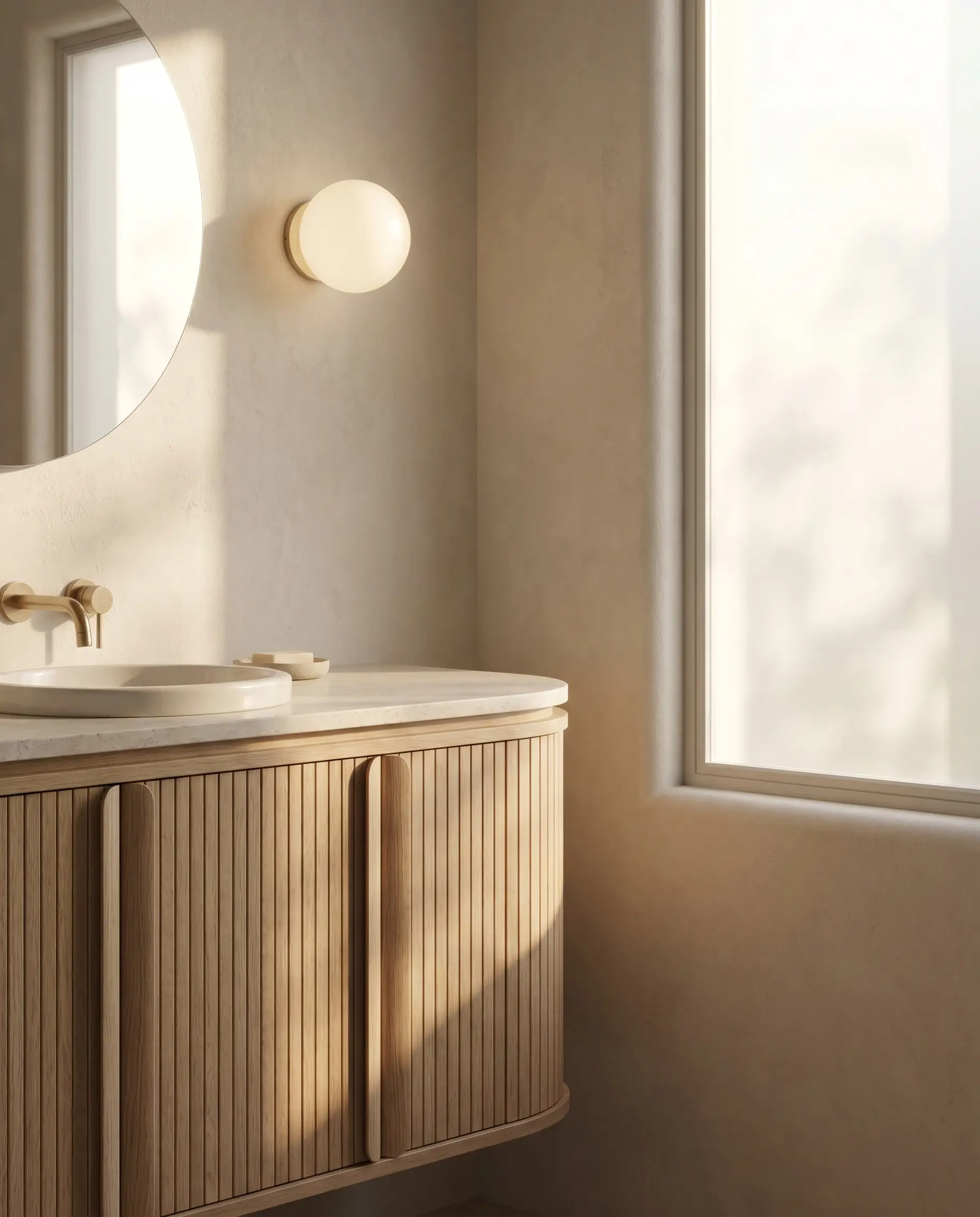
This is the standard half-inch to one-inch convex curve that most designers envision when specifying fluted casework. The gentle, rolling profile captures natural, diffused light beautifully, casting soft shadows that ground Japandi or Scandi aesthetics without overwhelming the eye.
- Vibe: Japandi / Scandi Warmth
- Profile Scale: 1/2-inch to 1-inch convex curves
- Lighting Pro-Tip: Pair with frosted globe wall sconces to enhance the soft gradient shadows on the wood.
If your bathroom receives harsh, direct afternoon sunlight, the classic half-moon tambour will soften the glare, turning heavy shadows into a gentle ribbed texture.
Hackrea Styling Tip
Wide-Scallop Profiles for Bold Transitional Spaces
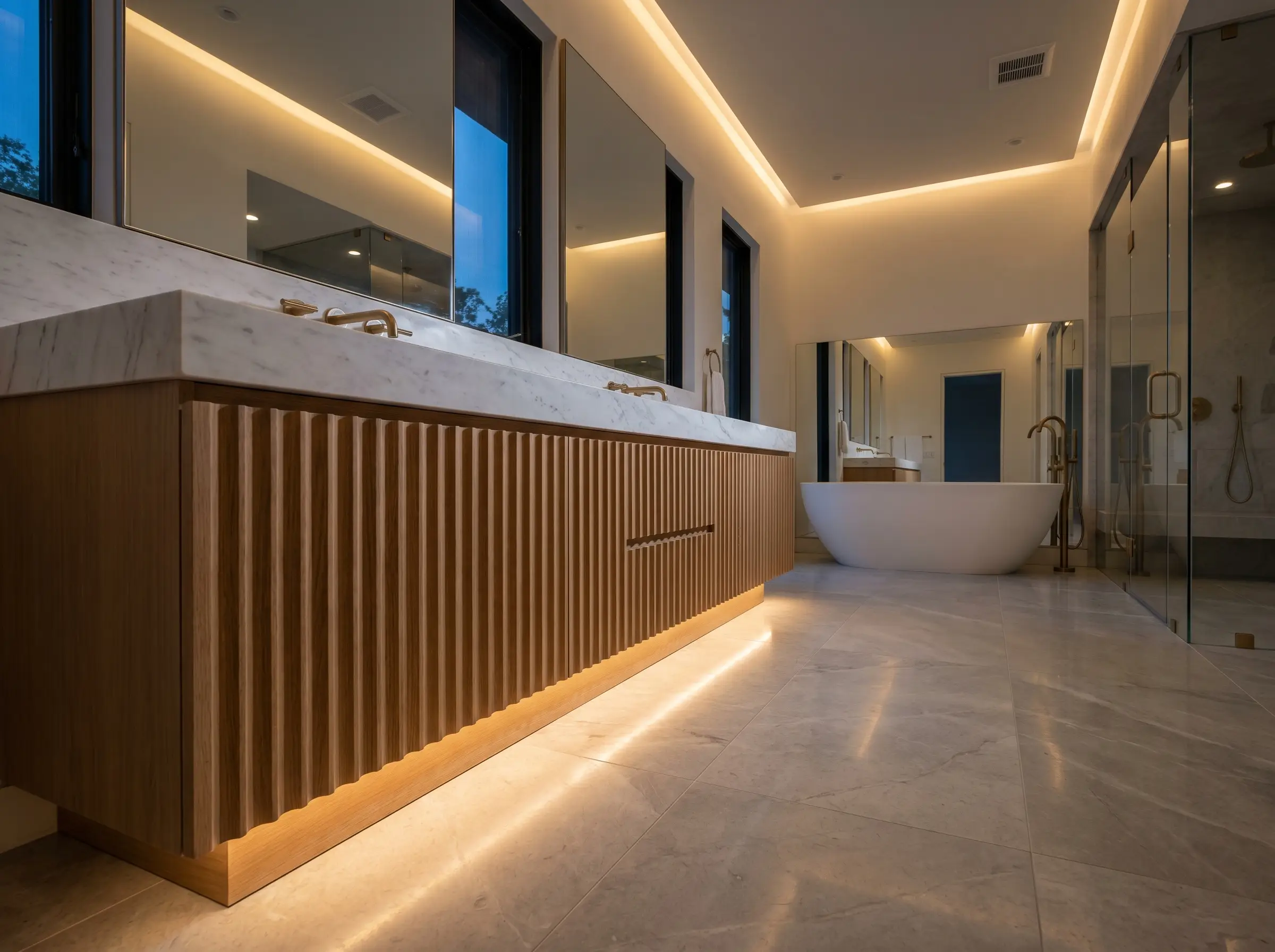
Unlike convex reeding, wide-scallop profiles feature concave grooves spanning two to three inches wide. This heavier, chunkier approach leans slightly Postmodern or Transitional, requiring a larger primary en-suite so the aggressive pattern has room to breathe.
- Vibe: Postmodern / Transitional
- Profile Scale: 2-inch to 3-inch concave grooves
- Millwork Fact: Concave scalloping demands thicker veneer stock and custom router bits, often increasing the fabrication cost by 20% over standard tambour profiles.
Flat-Slat Paneling for Rigid Geometry
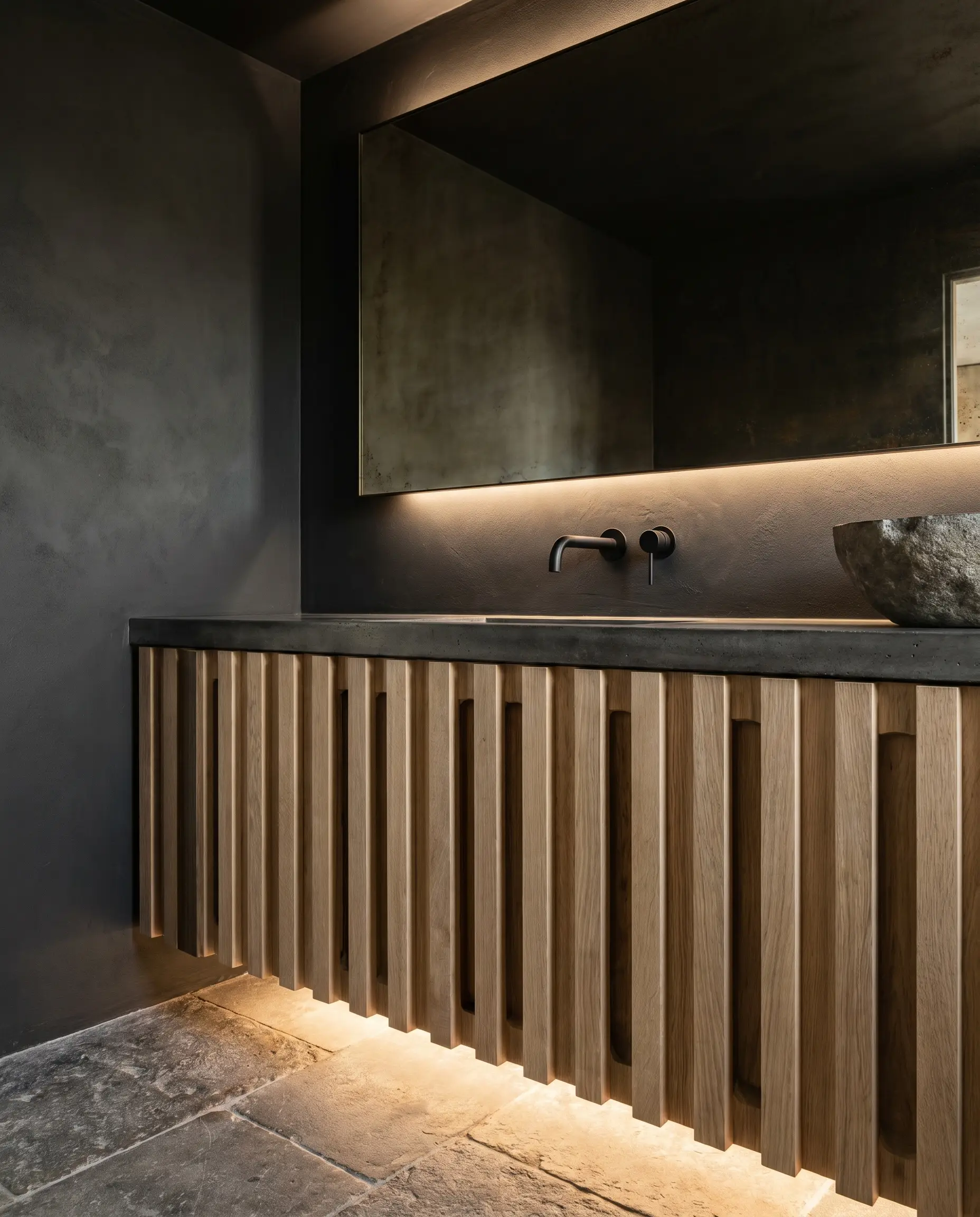
Technically slatted rather than curved, this profile utilizes hard 90-degree angles to create deep, rectangular channels. The resulting aesthetic delivers sharper, higher-contrast shadow lines, injecting a more brutalist or masculine organic modern edge into the space.
- Vibe: Brutalist / Masculine Organic Modern
- Profile Scale: 1-inch flat slats with 1/2-inch spacing
- Wall Color Pairing: Sherwin-Williams Iron Ore
Structural Formats and Spatial Planning
Fluted wood inherently carries immense visual weight, making the physical footprint and mounting style of the furniture piece crucial for spatial balance. You must decide whether the vanity should anchor the room heavily to the floor or float weightlessly against the wall.
The Wall-to-Wall Floating Console
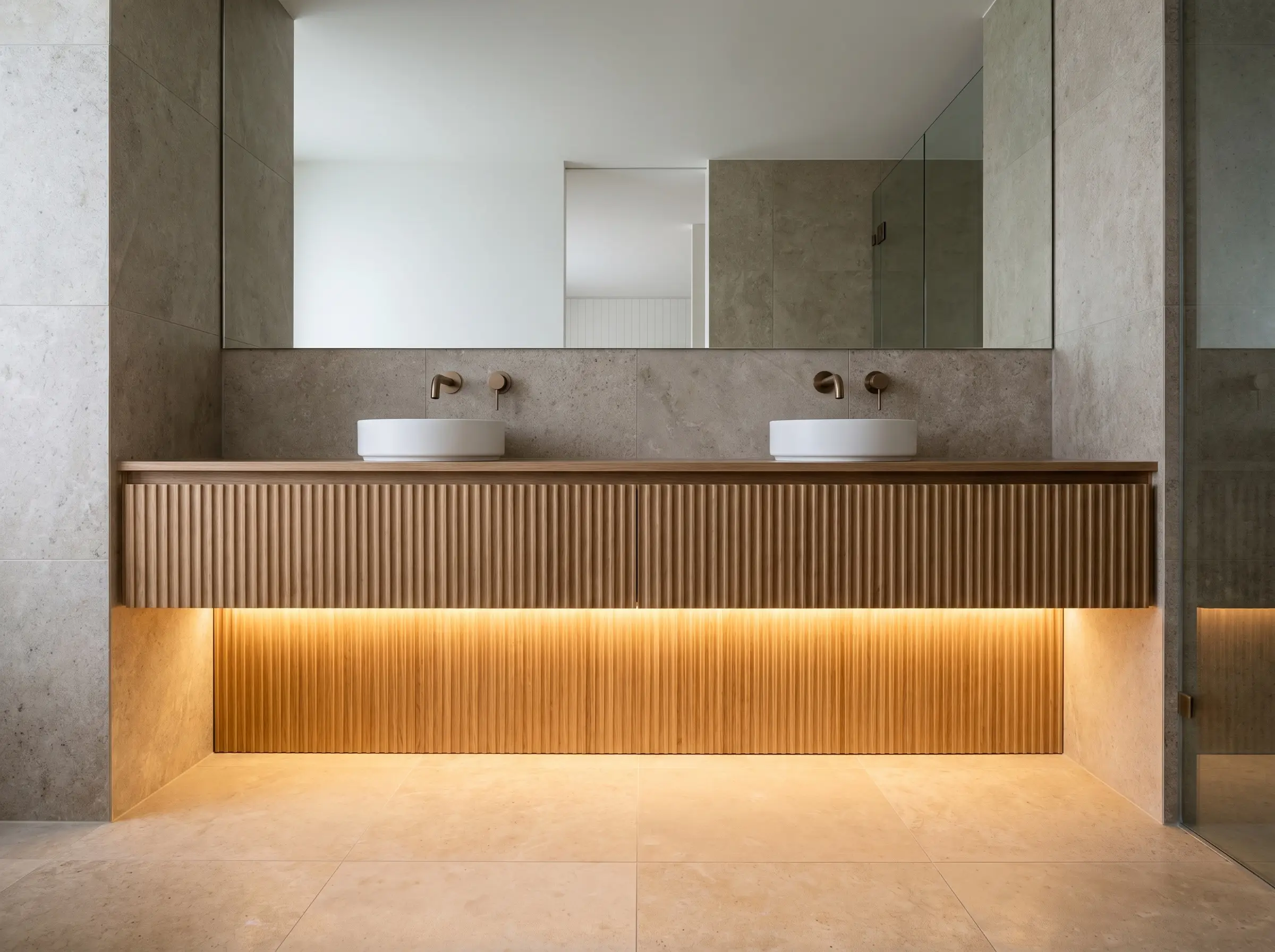
Suspending a heavy, textured monolithic piece between two walls transforms the vanity into a floating architectural feature. This execution demands under-cabinet LED channel lighting to wash light down the flutes and accentuate the weightless illusion.
- Vibe: High-End Spa / Bespoke Modern
- Structural Requirement: Heavy-duty in-wall wood blocking is mandatory prior to drywall installation to support the cantilevered weight.
- Lighting Integration: 2700K LED tape light recessed in an aluminum channel directly underneath the cabinet.
Open-Shelf Bottom Hybrids for Towel Storage
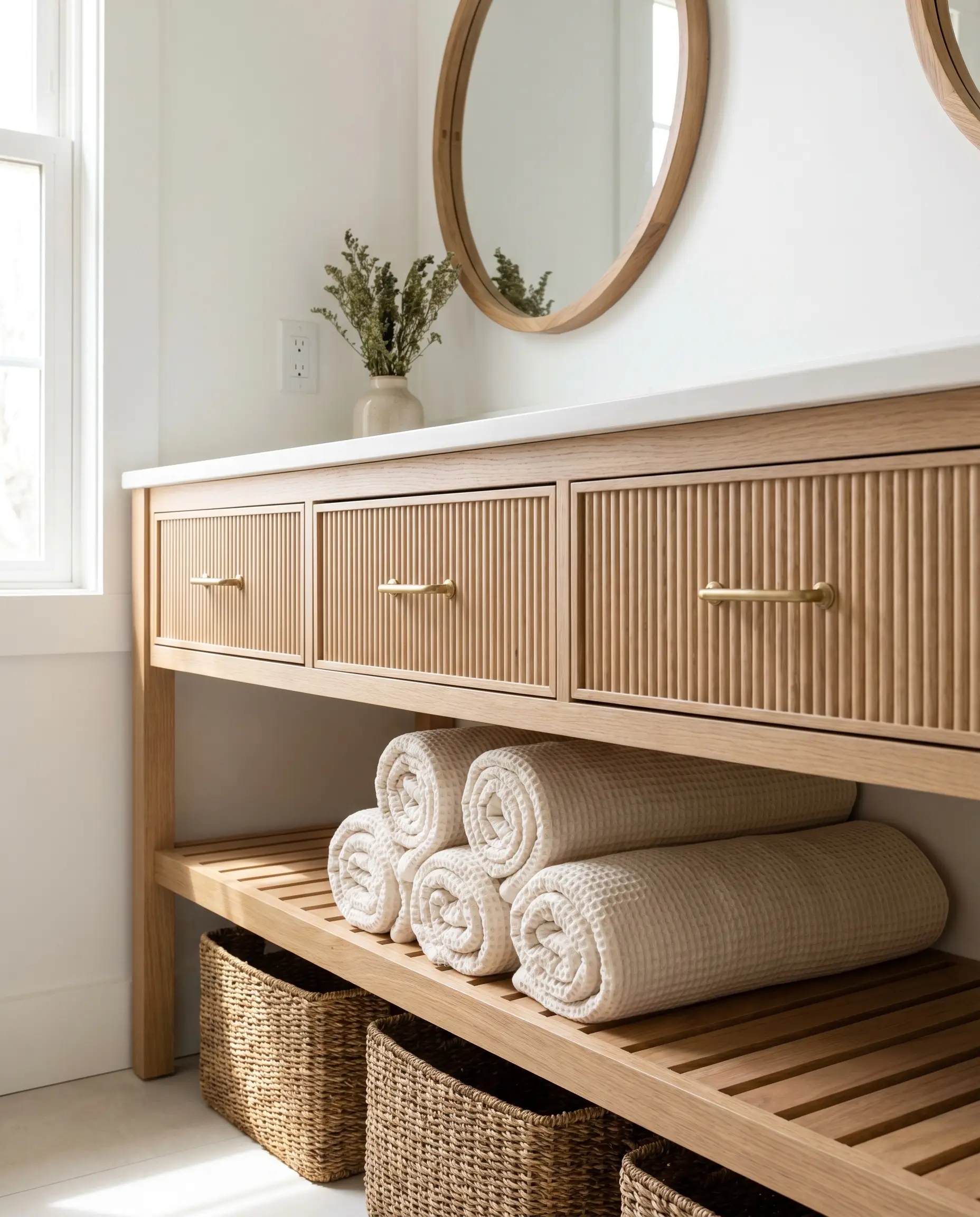
This accessible luxury design features fluted drawers on top with an open slatted or solid oak shelf beneath. It effectively breaks up the massive wood block, providing negative space to style organic cotton towels or woven baskets, making it the ideal layout for a welcoming guest bathroom.
- Vibe: Approachable Luxury
- Styling Pro-Tip: Roll oversized waffle-weave bath sheets on the lower shelf to introduce a secondary textile texture.
- Millwork Fact: Ensure the bottom shelf is finished on all six sides, as the underside will be highly visible from seated positions.
Freestanding Consoles with Tapered Legs
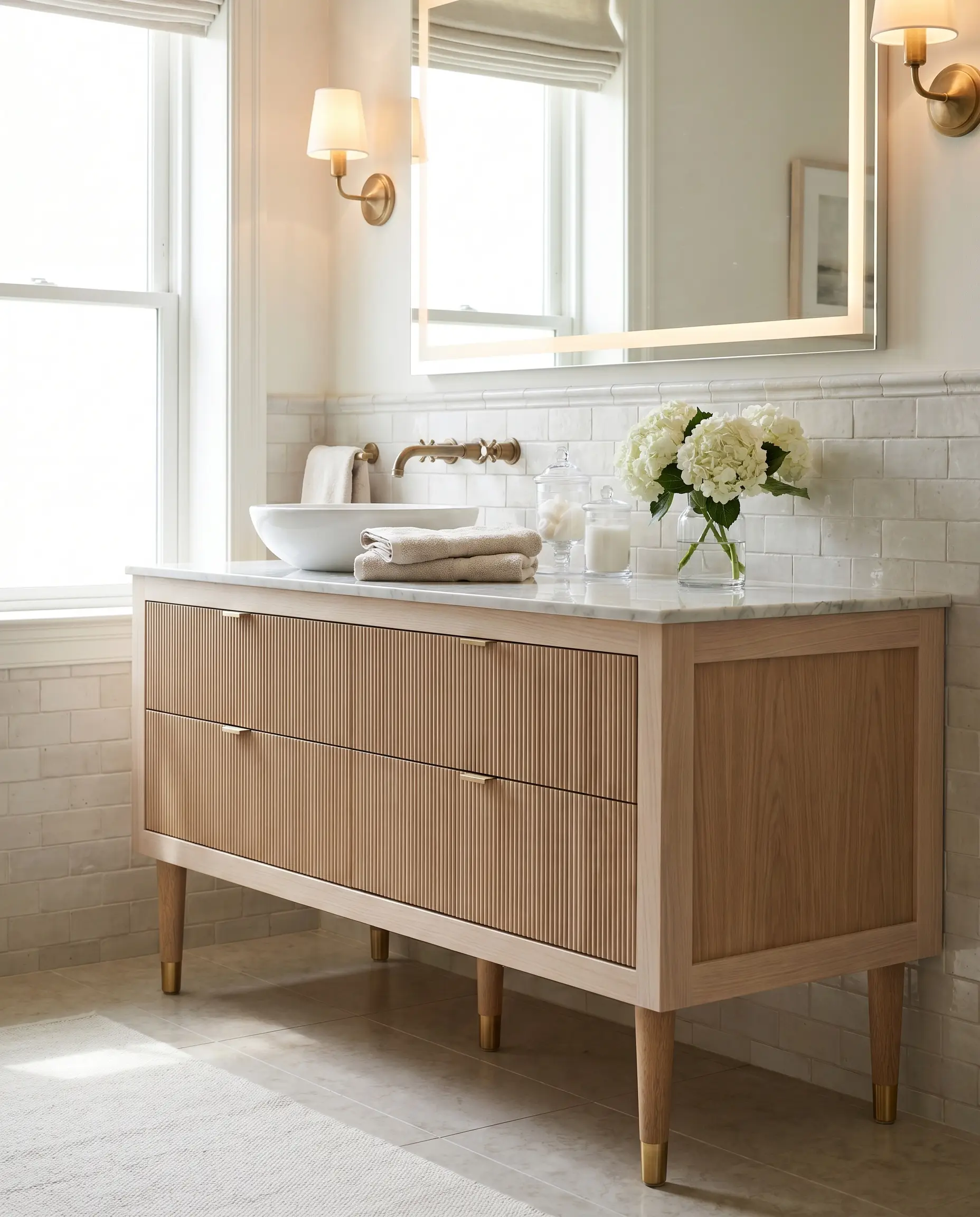
Treating the vanity like heirloom-quality millwork, this approach frames the heavily textured fluted casing within smooth, untextured borders. Tapered white oak legs provide necessary visual relief and lift the piece elegantly off the floor.
- Vibe: Heritage / Transitional
- Leg Specification: Round tapered or square chamfered solid oak legs.
- Proportion Rule: Maintain at least 6 inches of clearance beneath the bottom rail to ensure the piece feels like furniture rather than a bulky box.
Asymmetrical Single-Sink Offsets
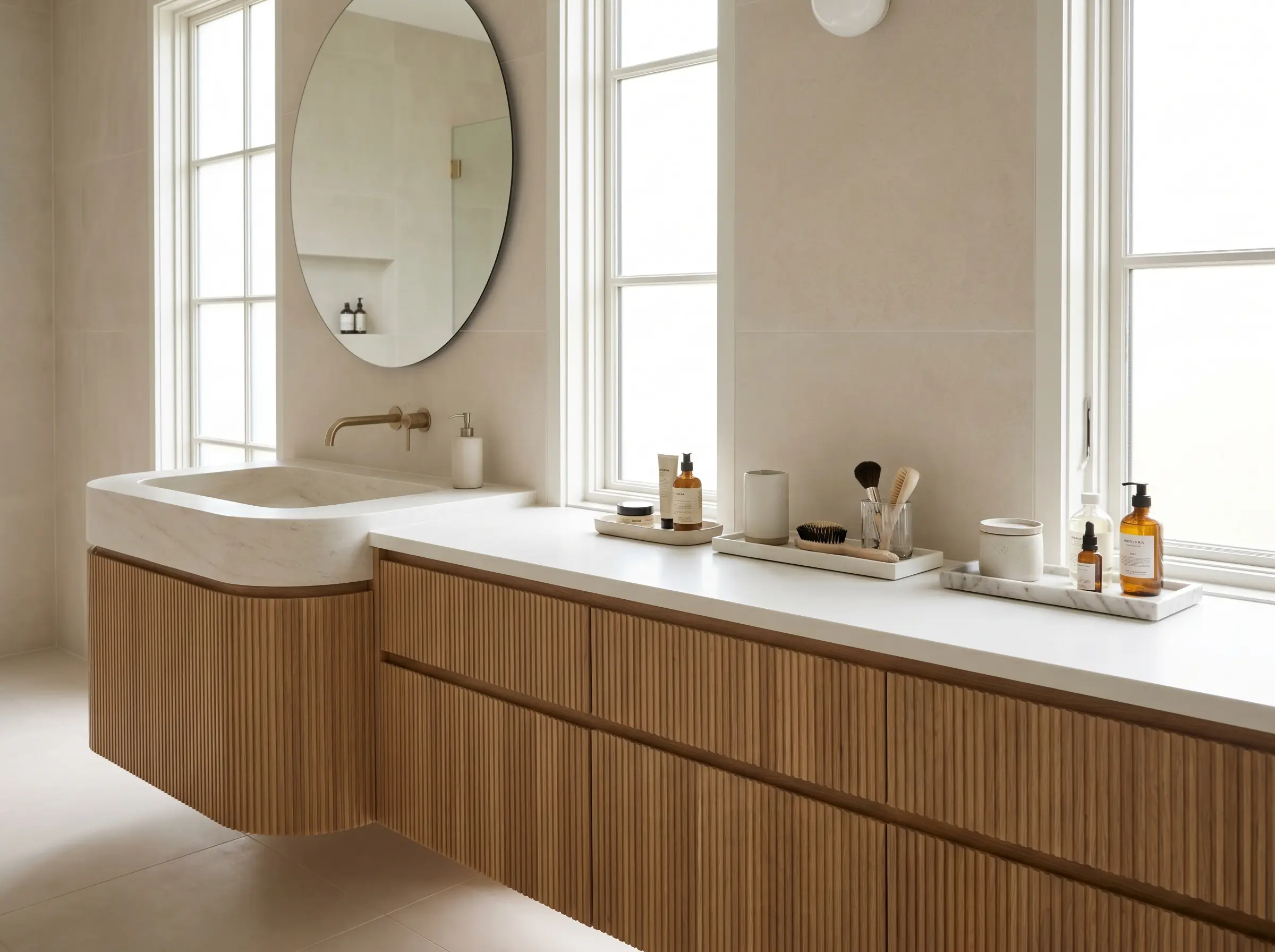
For vanities spanning 48 to 60 inches, pushing the sink entirely to the left or right transforms the piece into a highly functional, asymmetrical statement. This leaves a long, uninterrupted expanse of fluted drawers on one side and vast counter space above for styling trays or daily grooming routines.
- Vibe: Avant-Garde / Highly Functional
- Ideal Size: 48″ to 60″ single-sink setups
- Plumbing Warning: Requires off-center rough-in plumbing during the framing stage; do not attempt this as a retrofit without opening the wall.
Floor-to-Ceiling Fluted Linen Towers
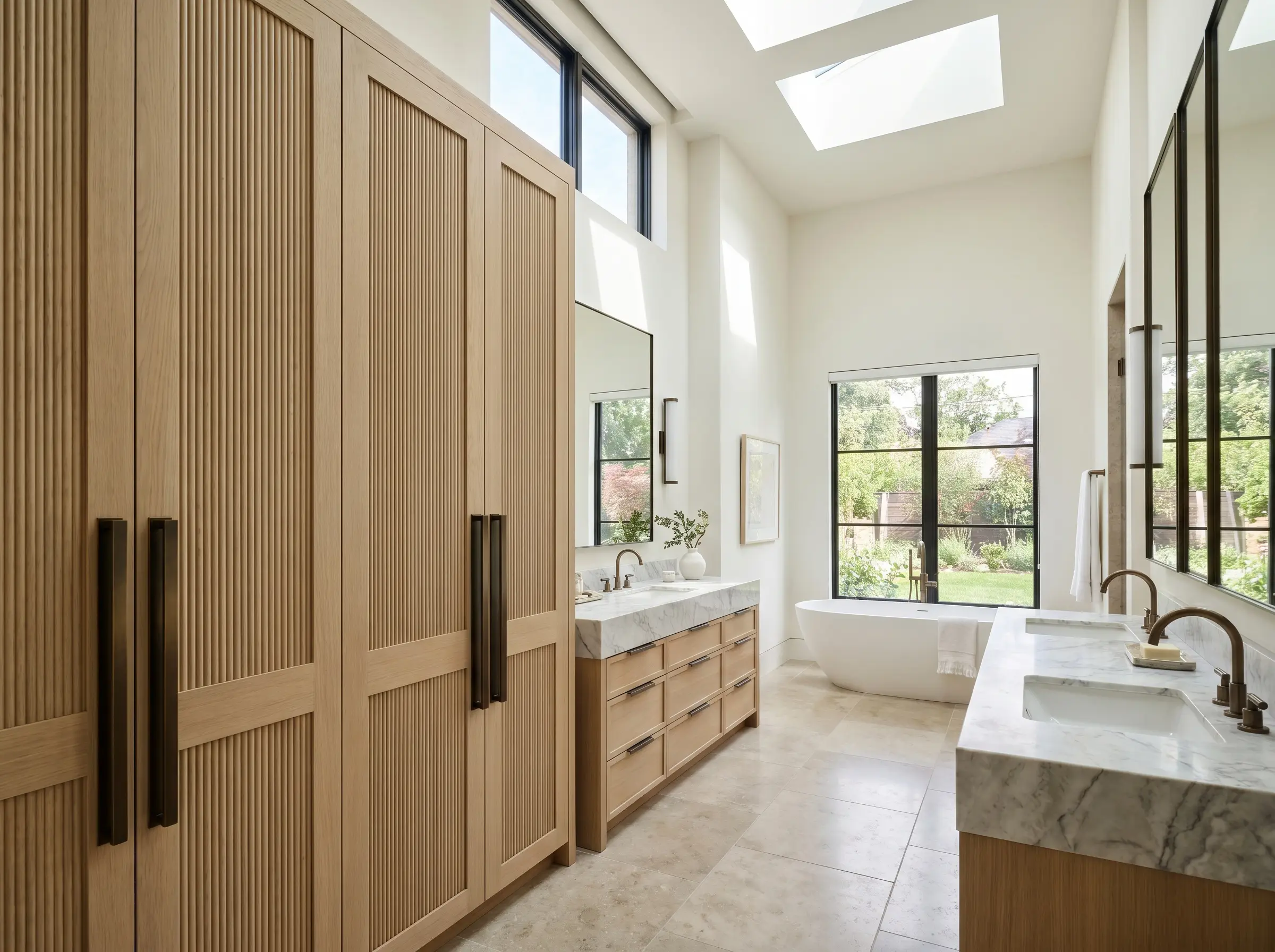
Extending the aesthetic beyond the vanity base by fluting a tall, adjacent storage cabinet draws the eye upward and dramatically accentuates ceiling height. This high-end, custom architectural execution unifies the room and maximizes vertical storage.
- Vibe: Bespoke Architectural
- Hardware Placement: Use oversized vertical pulls placed squarely on the flat stiles, avoiding the curved flutes entirely.
- Millwork Fact: Tall panels require expansion gaps at the ceiling line to account for seasonal wood movement.
Countertop and Sink Pairings
Because a fluted oak base is highly active to the eye, the countertop must act as either a quiet, monolithic complement or a deliberate, high-contrast anchor. Selecting the wrong surface will create a chaotic visual clash that destroys the room’s serenity.
| Material Category | The Pros for Fluted Vanities | The Cons for Fluted Vanities |
|---|---|---|
| Natural Marble (Honed) | Unmatched organic veining; warm undertones pull out the honey hues of white oak; aging process feels authentic. | Highly porous; requires rigorous sealing; prone to etching from toothpaste and acidic skincare products. |
| Engineered Quartz | Non-porous and maintenance-free; allows for ultra-thick mitered edges without extreme weight or cost. | Can look artificial if printed veining clashes with the natural, organic grain of the white oak. |
Honed Calacatta Marble with Undermount Sinks
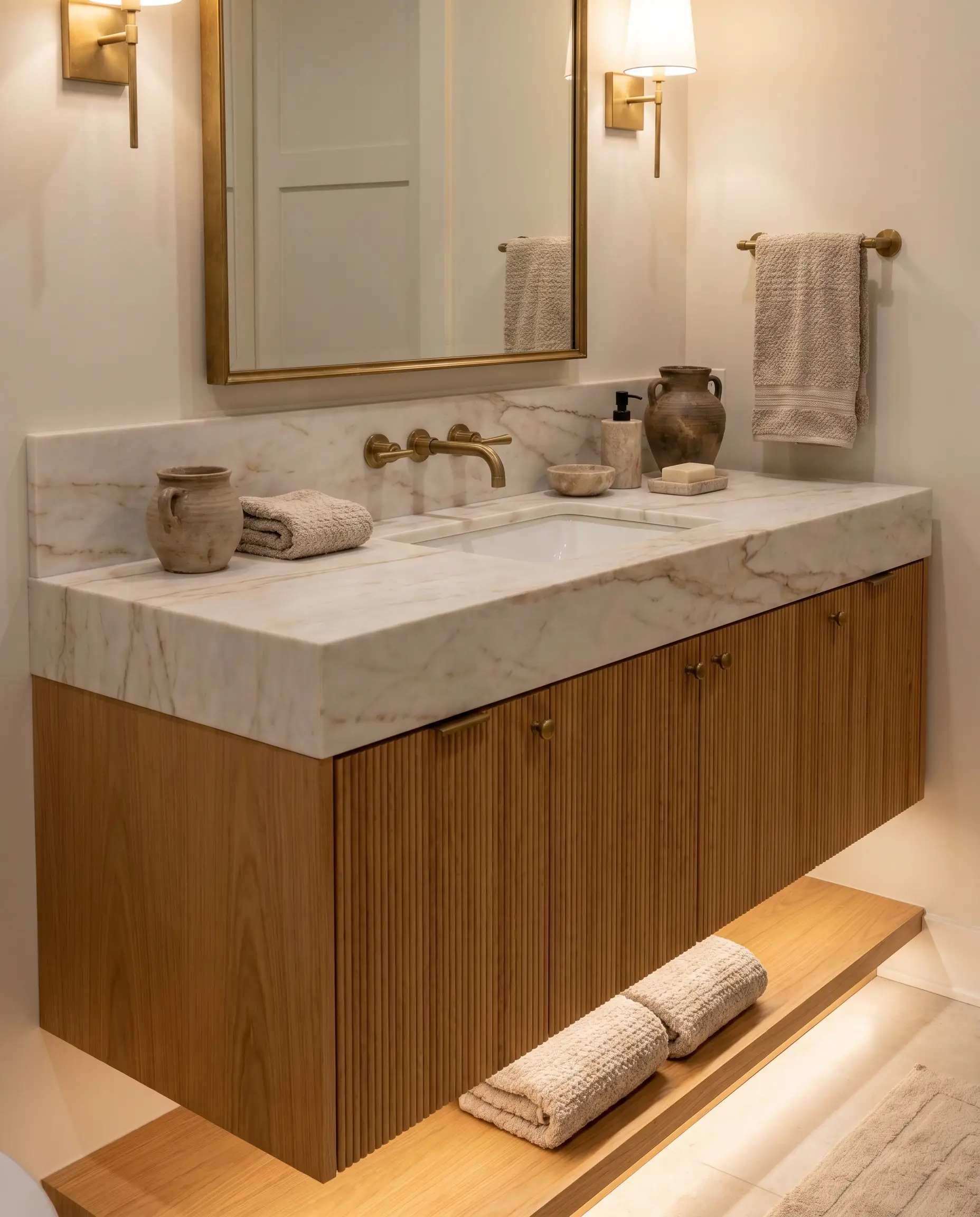
This is the classic luxury pairing, where the warm, dramatic veining of Calacatta naturally pulls out the honey tones of the white oak. You must insist on a honed finish rather than polished, ensuring the stone maintains a matte, organic aesthetic that harmonizes with raw wood.
- Vibe: Timeless Luxury
- Stone Finish: Honed (Matte) only
- Pairing Directive: Never pair polished marble with matte fluted oak; the mismatched sheen levels will visually disconnect the top from the base.
Matte Black Soapstone for High-Contrast Drama
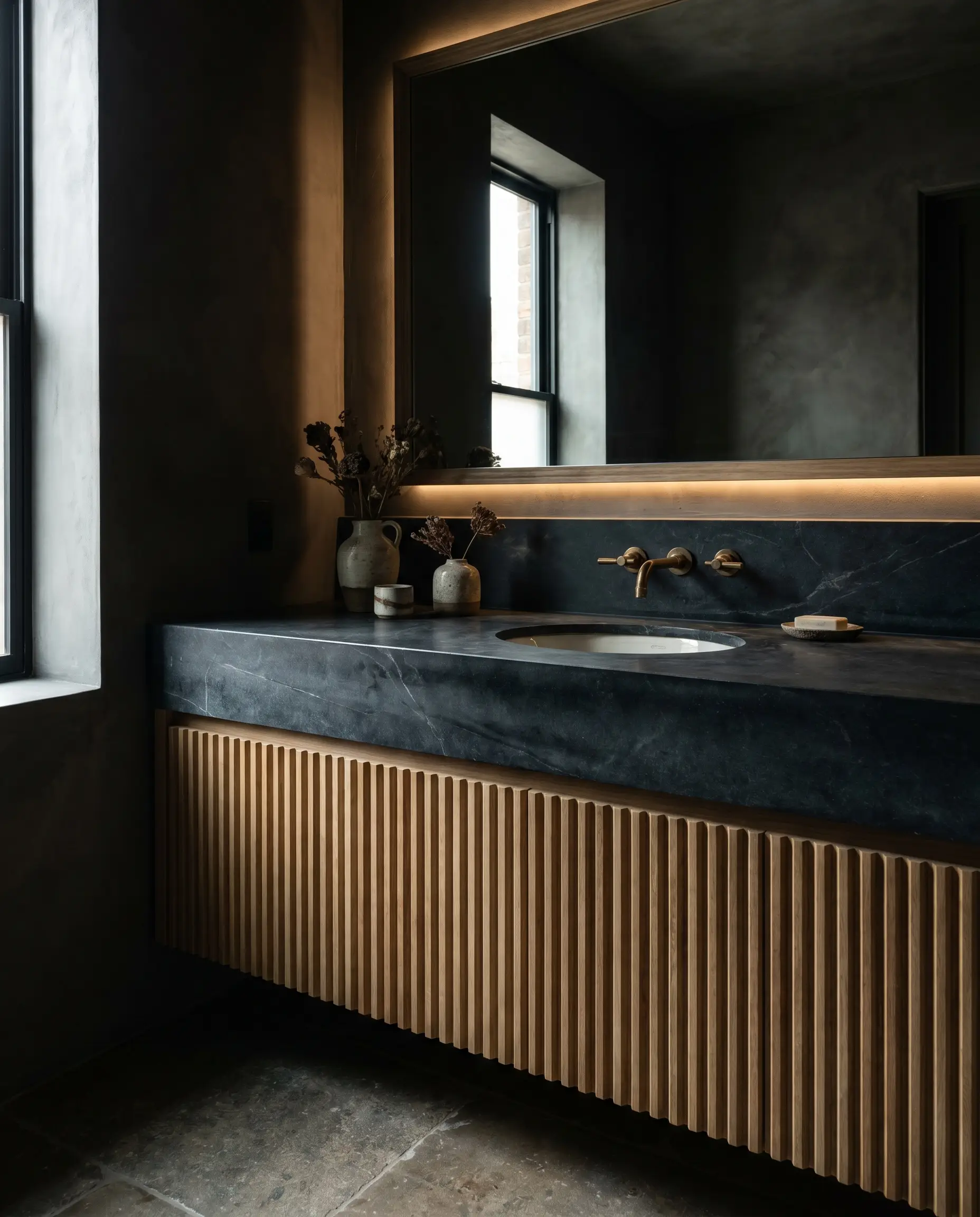
Grounding the light, airy wood with a dark, moody stone creates instant architectural tension. Soapstone’s incredibly smooth, almost soapy tactile feel provides a brilliant sensory contrast to the rigid, ribbed wood flutes.
- Vibe: Moody Organic Modern
- Stone Property: Naturally non-porous and antibacterial.
- Maintenance Note: Requires periodic oiling with mineral oil to maintain a deep, rich charcoal black finish.
Integrated Concrete Trough Sinks
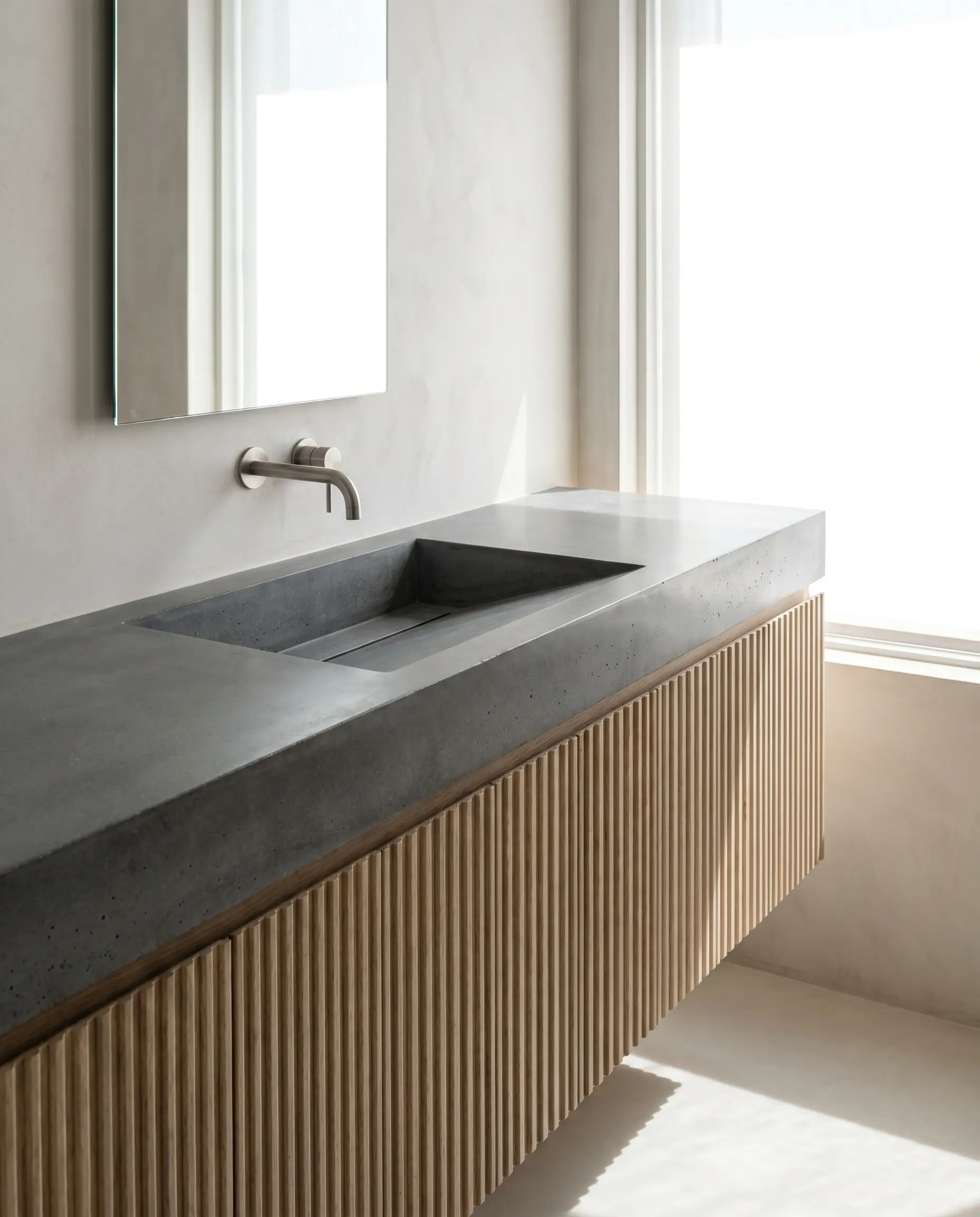
Pouring a custom concrete top with a sloped, integrated trough sink pushes the aesthetic firmly toward industrial-minimalism. The seamless visual flow of the concrete eliminates the visual clutter of sink seams, allowing the fluted wood to remain the sole focal point.
- Vibe: Industrial Minimalism
- Sink Style: Ramp sink with a hidden slot drain.
- Pairing Directive: Seal the concrete with a penetrating matte sealer to prevent dark water spots from forming around the drain.
Monolithic Thick-Mitered Quartz Edges
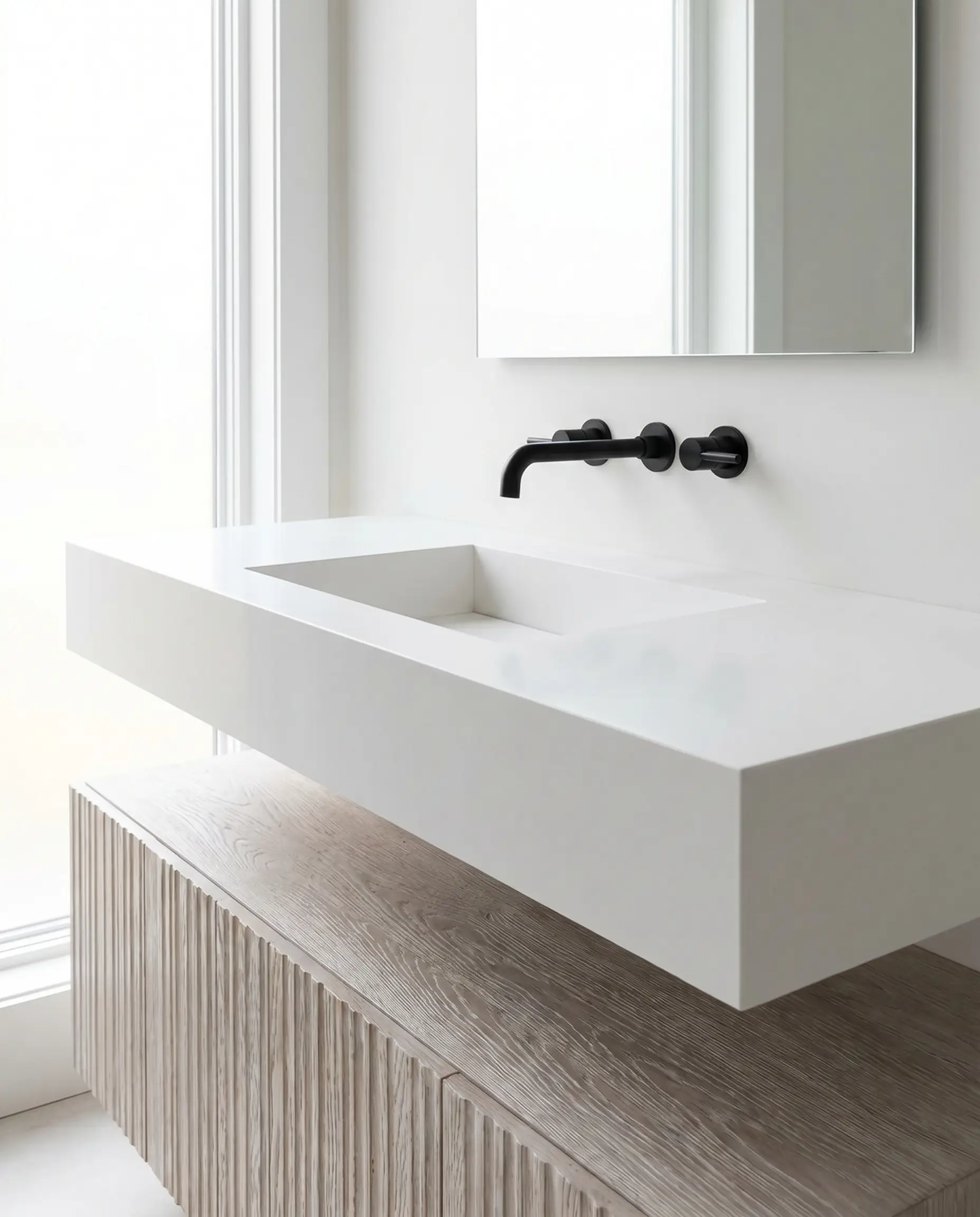
Dropping a 2-inch to 3-inch thick mitered edge on a pure white quartz top provides the necessary visual weight to sit aggressively atop the highly textured wood. A mitered edge involves cutting the stone at a 45-degree angle and joining a front apron piece, creating the illusion of a massive, solid block of stone.
- Vibe: Contemporary Bold
- Edge Profile: 2″ to 3″ straight mitered drop edge.
- Color Recommendation: Pure white or very faintly veined quartz (e.g., Caesarstone Pure White).
Warm Travertine Vessel Sinks
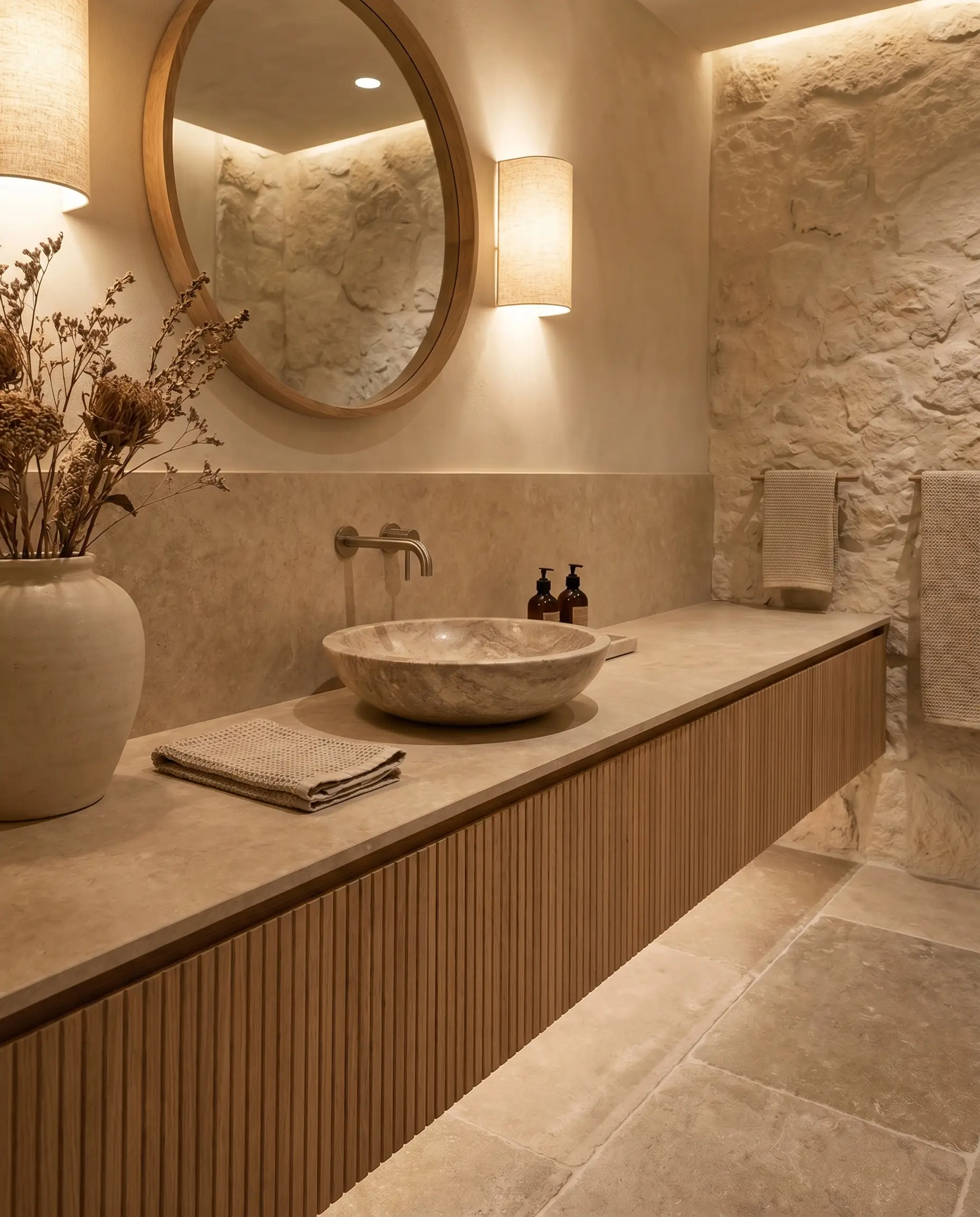
Pairing a minimalist, thin-profile countertop with a carved travertine vessel sink creates a stunning tonal harmony. The beige, taupe, and cream tones of natural travertine harmonize perfectly with white oak, introducing an earthy, spa-like texture.
- Vibe: Earthy Spa Retreat
- Countertop Profile: Ultra-thin 1.2cm or 2cm edge to let the sink stand out.
Avoid overly tall or steeply angled vessel sinks. Keep the vessel low and shallow to maintain ergonomic comfort and prevent awkward wrist angles when washing your hands.
Hackrea Styling Tip
Hardware and Fixture Integration
Mounting flat, rigid metal hardware onto an undulating, curved wood surface is notoriously difficult and visually risky. You must either bypass the flutes entirely with clever routing or select fixtures that actively lean into the tactile nature of the millwork.
Unlacquered Brass Wall-Mounted Faucets
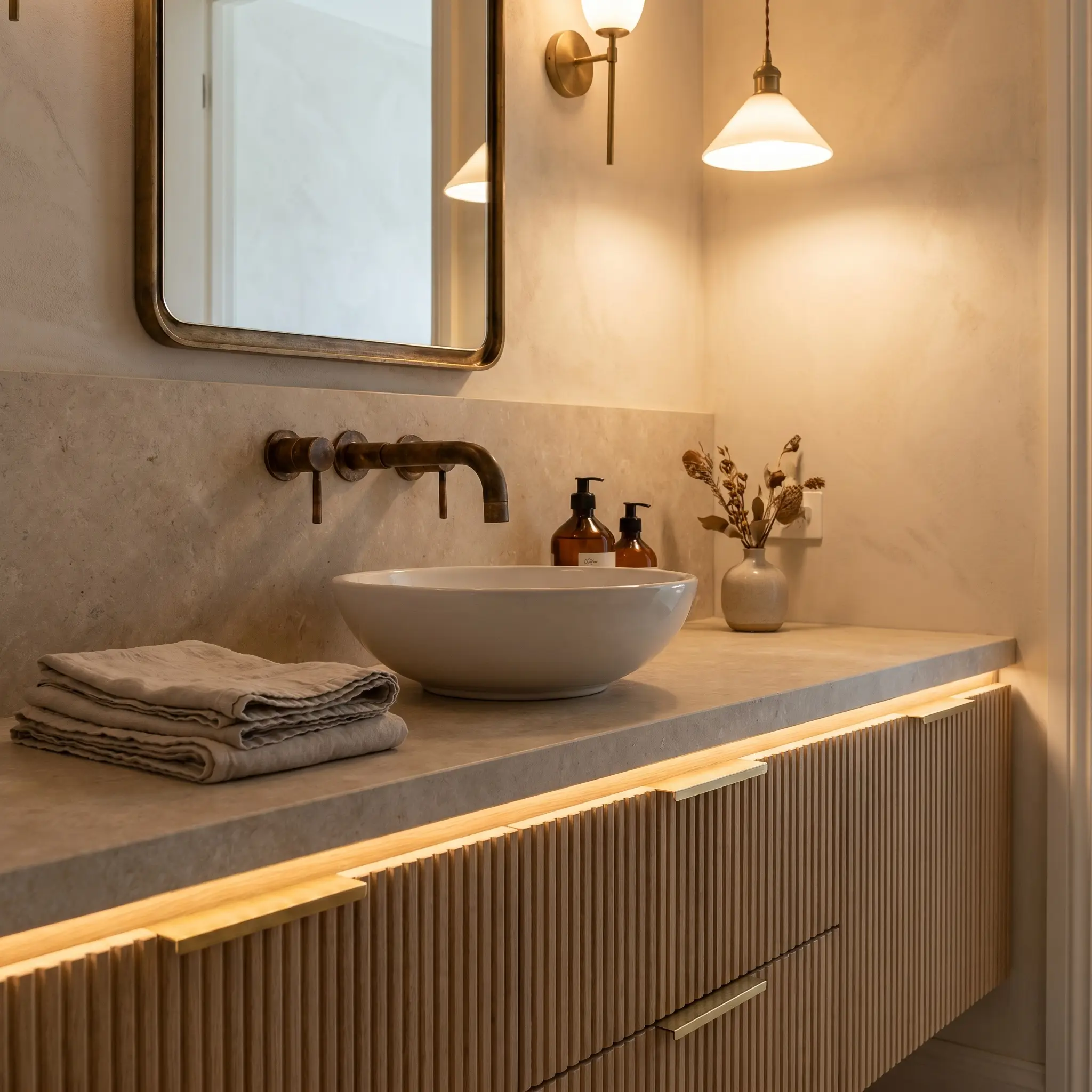
Moving the faucet to the wall frees up precious countertop space and drastically enhances the custom, architectural look of the vanity. Unlacquered brass is a living finish that will patina and age beautifully alongside the natural wood, deepening the organic narrative of the space.
- Vibe: Lived-In Luxury
- Mounting Height: Typically 8 to 10 inches above the countertop.
Finger-Pull Integrated Edges (Hardware-Free)
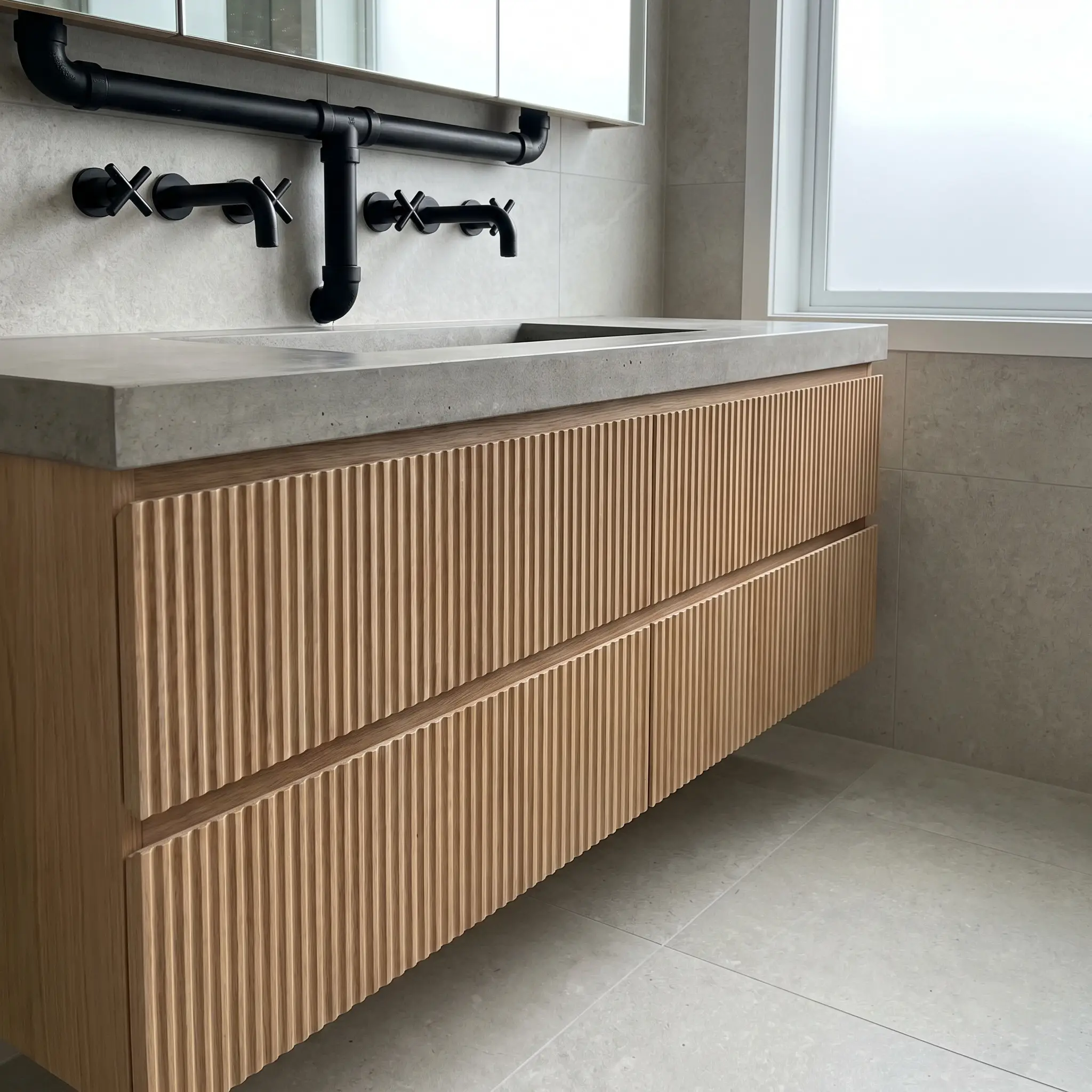
For the ultimate minimalist choice, this bespoke cabinetry option routes the top edge of the drawers with a 45-degree bevel, acting as a hidden grip. This ensures no metal pulls are required, allowing the fluted texture to remain entirely uninterrupted across the vanity face.
- Vibe: Ultra-Minimalist / Bespoke
- Fabrication Detail: 45-degree continuous reverse-bevel on the drawer headers.
- Pairing Directive: If using a hardware-free vanity, ensure your plumbing fixtures have strong visual presence to anchor the vanity area.
Matte Black Knurled Pulls
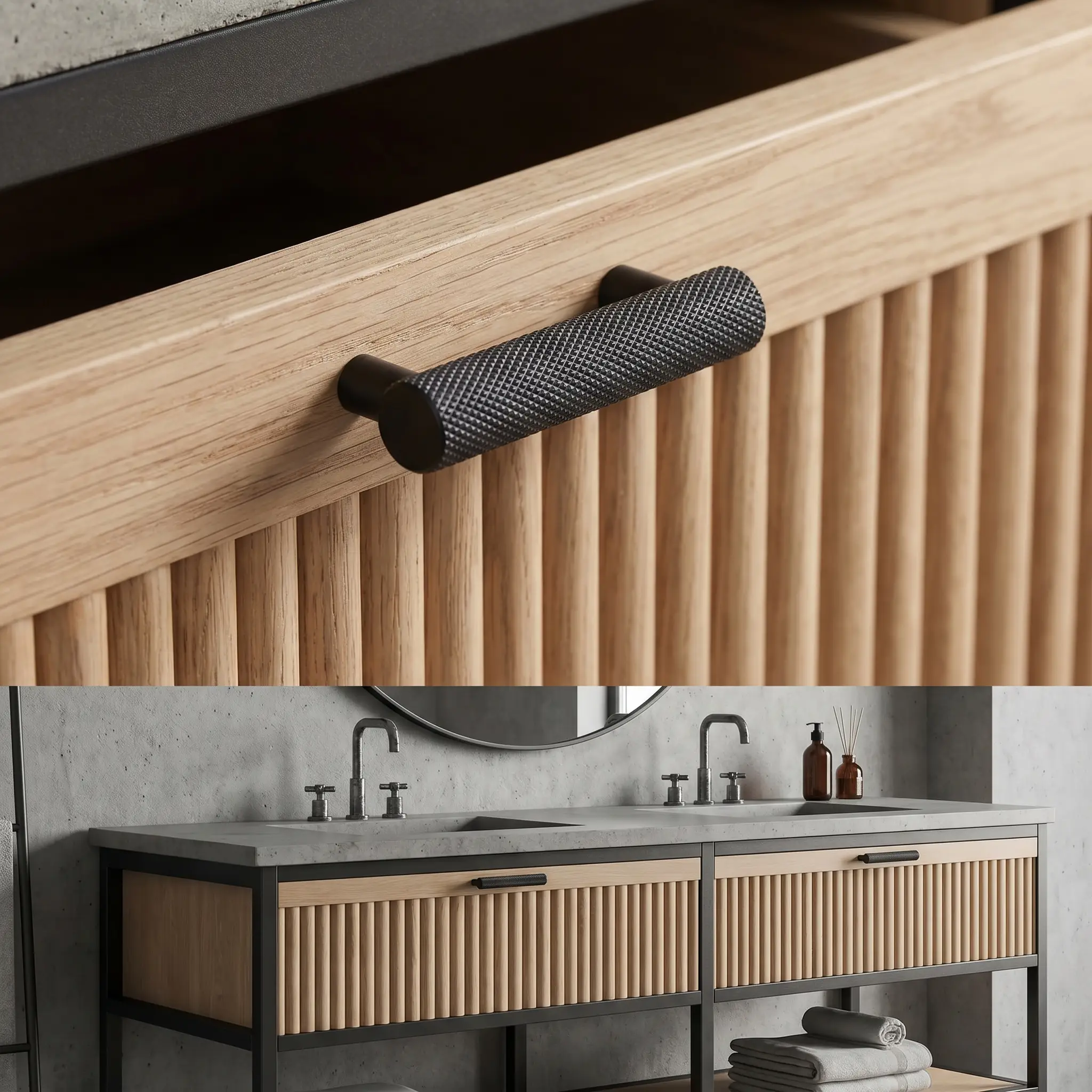
If you prefer the functionality of physical hardware, match the highly tactile nature of the fluted wood with textured metal. Knurled pulls—featuring a diamond-patterned grip—provide exceptional hand-feel and inject a modern industrial edge into the soft oak.
- Vibe: Modern Industrial
- Hardware Style: Solid brass with matte black PVD finish.
- Styling Rule: Mount pulls strictly horizontally on the flat top rail of the drawer face, avoiding the deep curved flutes entirely.
Polished Nickel Cross-Handles
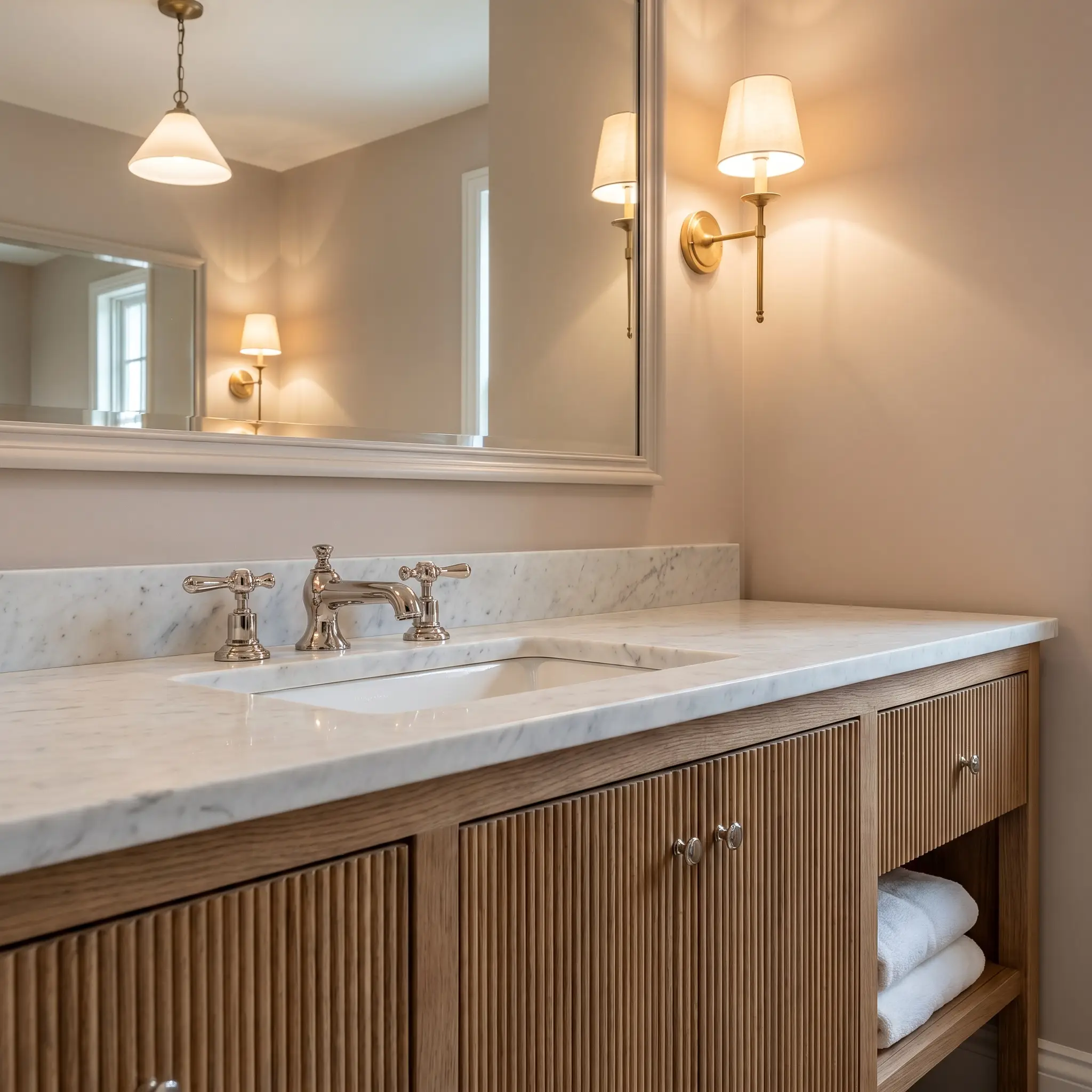
To achieve a sophisticated Transitional aesthetic, pair the rustic, matte wood with highly polished, classic nickel cross-handles. The cool, mirrored finish of the nickel provides a sharp, pristine contrast to the warm, light-absorbing oak.
- Vibe: Classic Transitional
- Fixture Style: Wall-mounted or widespread 3-hole cross-handles.
- Wall Color Pairing: Farrow & Ball Setting Plaster
Essential Maintenance and Moisture Control
The fastest way to ruin an expensive millwork installation is to ignore the realities of bathroom humidity and daily use. Protecting fluted wood requires specific fabrication techniques and rigorous sealing to prevent warping, peeling, or water damage.
Selecting Rift-Sawn Veneer over Solid Wood
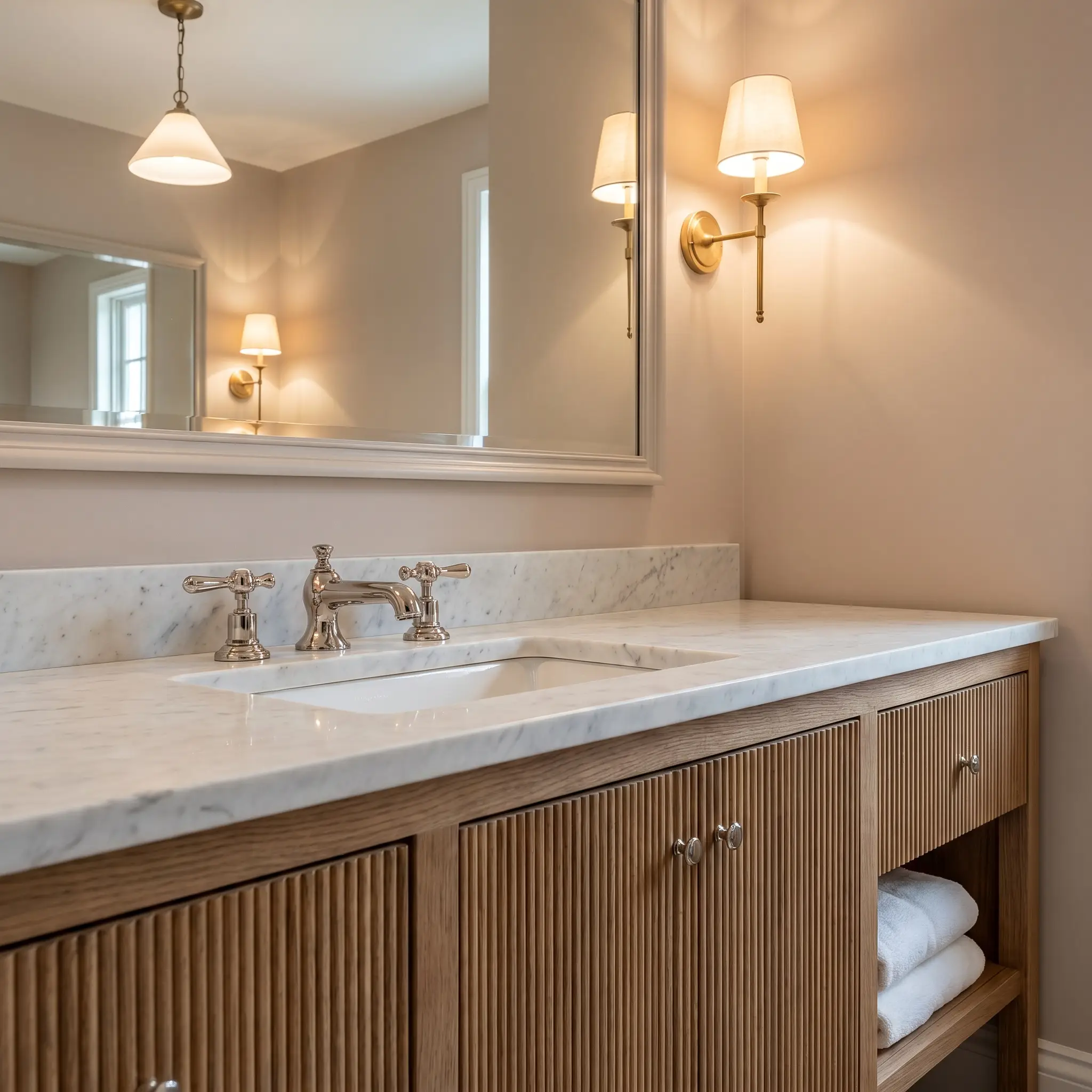
Despite common misconceptions, solid wood warps heavily in humid bathrooms, making it a liability for intricate fluting. High-end custom vanities utilize a premium rift-sawn white oak veneer pressed over a highly stable plywood core to prevent the expansion, contraction, and cracking of the flutes.
- Material: Premium 1/8″ rift-sawn white oak veneer.
- Core Material: 3/4″ Baltic Birch or exterior-grade plywood.
- Millwork Fact: Rift-sawn cuts provide a perfectly straight, linear grain that visually aligns with the vertical fluting, whereas plain-sliced wood creates busy “cathedral” arches that fight the reeded texture.
Marine-Grade Polyurethane Sealing
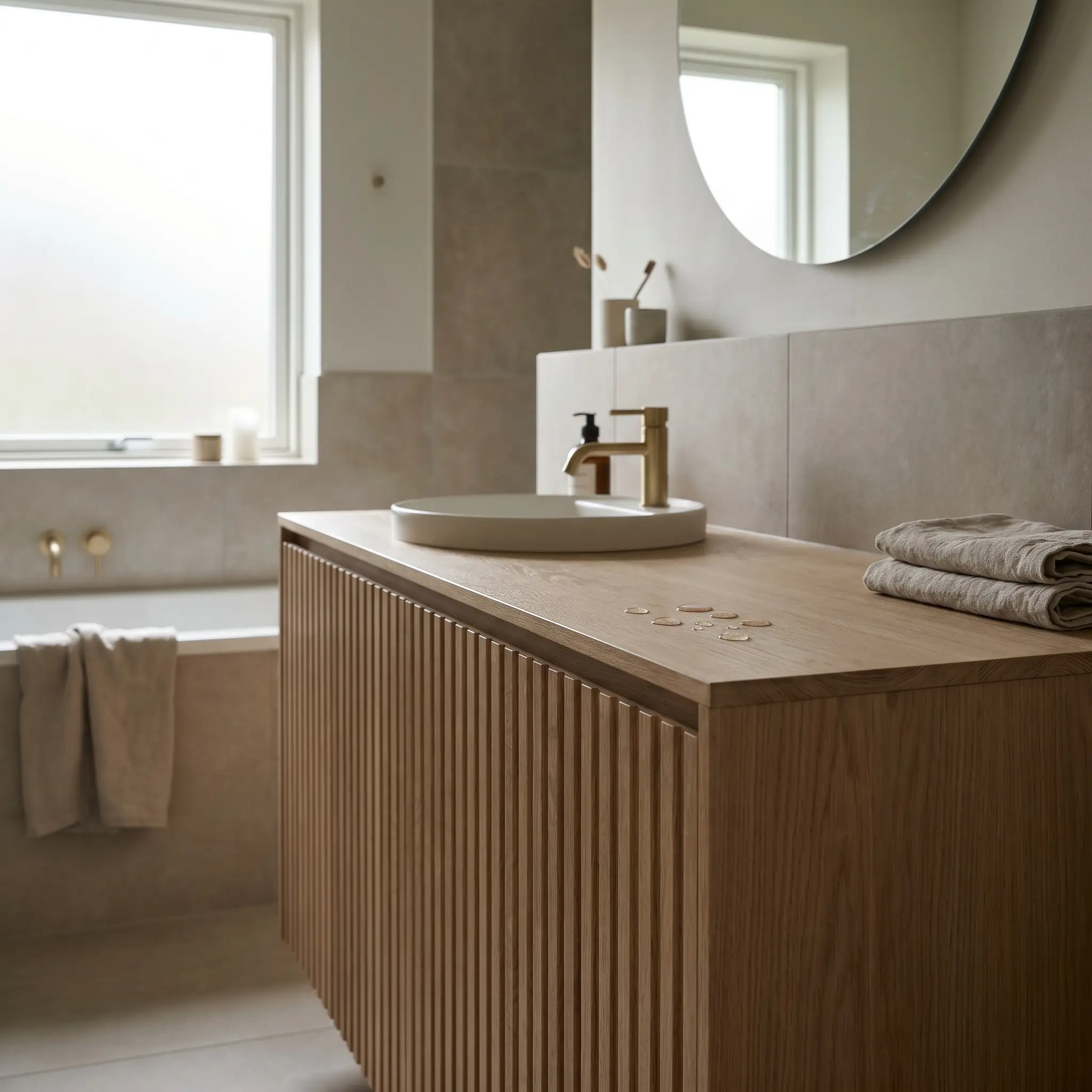
Raw oak in a wet zone is a recipe for water rings and irreversible toothpaste stains. The wood must be meticulously sealed with a dead-flat clear coat or a marine-grade matte polyurethane, protecting the surface while maintaining the raw, unfinished aesthetic.
- Product Type: Water-based, dead-flat marine polyurethane.
- Application Method: Spray application (HVLP) to ensure the sealant coats the deep grooves evenly without pooling.
Never use high-gloss or satin sealers on organic modern pieces. The plastic-like sheen will instantly cheapen the look of your expensive millwork.
Hackrea Protection Tip
Dusting and Cleaning the Grooves
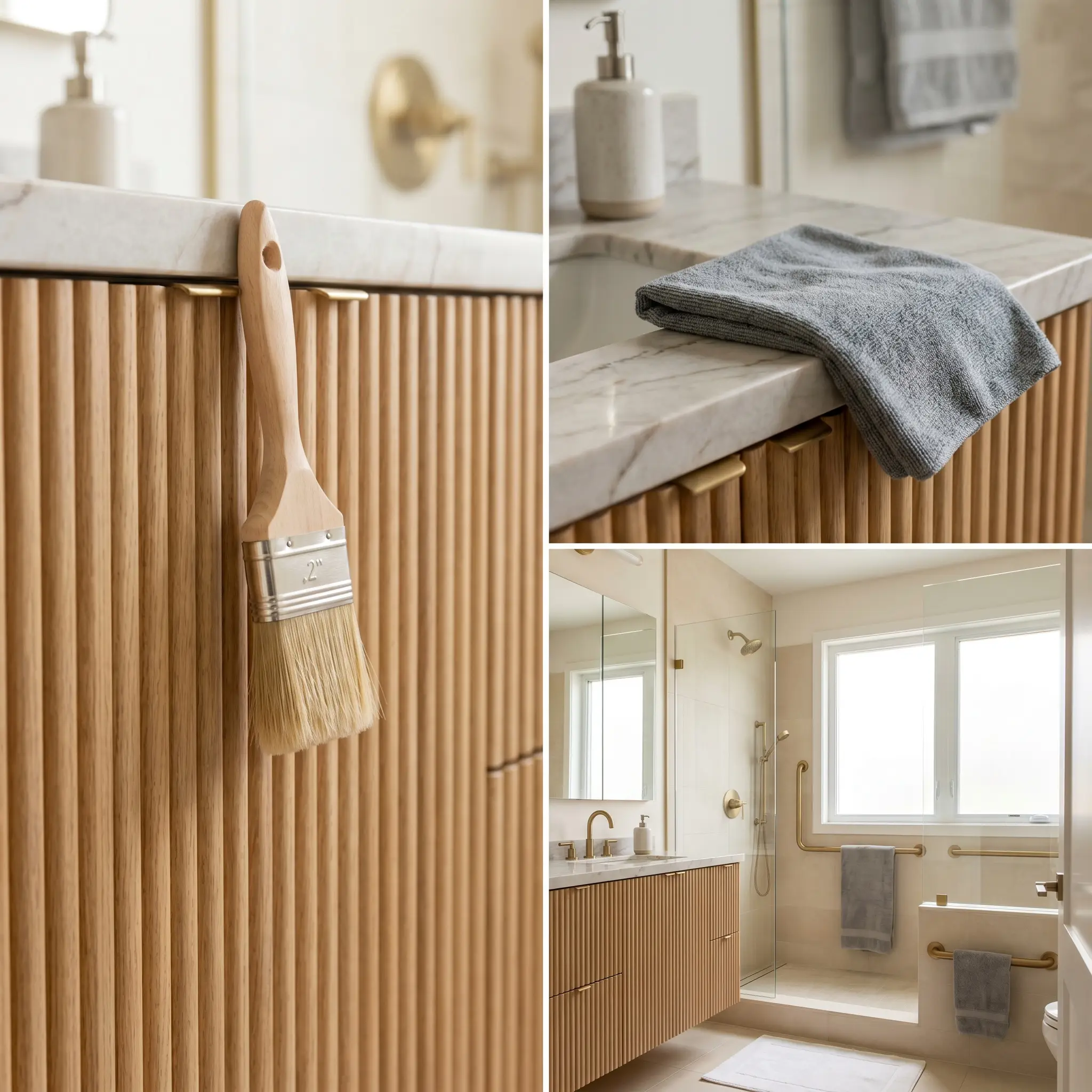
The physical reality of fluted millwork is that dust and powder will settle in the concave channels. Maintain the vanity by using a soft-bristle paint brush or a microfiber duster to pull debris out of the grooves gently.
- Cleaning Tool: 2-inch natural bristle paint brush.
- Maintenance Cadence: Weekly dry dusting.
- Brush vertically down the flutes to dislodge dust.
- Wipe the surface with a barely damp microfiber cloth.
- Dry immediately with a clean towel.
- Strictly avoid harsh chemical sprays that strip the protective clear-coat.
Finalizing Your Millwork Vision
A fluted white oak vanity is not just another piece of bathroom storage; it is an architectural investment piece that defines the entire atmosphere of your space. Success lies in balancing the aggressive visual weight of the wood with perfectly proportioned stone, intentional hardware placement, and rigorous moisture protection. Take the time to specify the exact profile scale, demand rift-sawn cuts, and insist on matte finishes. Which profile will anchor your next project—the delicate micro-reeded texture, the classic half-moon tambour, or the bold scalloped edge? Explore our comprehensive bathroom planning guides to finalize your layout and begin the fabrication process.

The Hackrea Style Desk treats interior decoration as an exact visual science. Rather than focusing on demolition or floor plans, this desk masters the art of color theory, undertone matching, material pairings, and spatial proportion. From balancing the visual weight of mixed metals to finding the perfect bridging tone between disparate wood species, this desk provides the rigorous aesthetic rules needed to achieve high-end, editorial-quality harmony in any space.