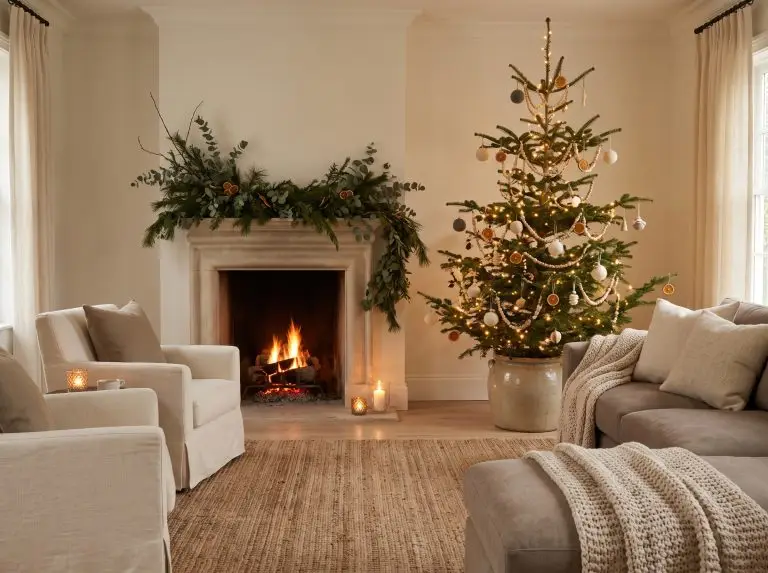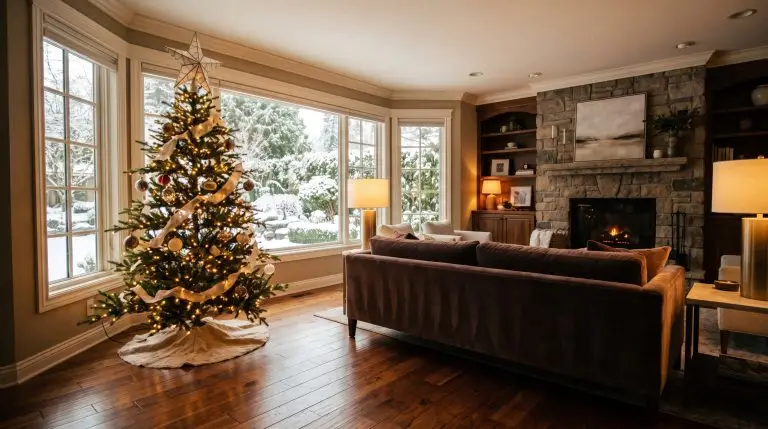
If you have ever stared at a beautifully curated boutique window display and then looked back at your own cluttered, unbalanced living room centerpiece in frustration, you are not alone. The gap between professional holiday styling and amateur execution often comes down to spatial mathematics and material restraint, not just a lack of beautiful ornaments. For 2026 Christmas tree decor, the heavy, hyper-dense, perfectly conical frosted trees of the past decade are yielding to something far more breathable, tactile, and authentic.
This year, high-end holiday interior styling is defined by curated imperfection and sensory nostalgia. We are seeing a distinct shift toward organic sparse branching that allows heirloom ornaments to dangle freely, moody maximalist jewel tones that absorb light beautifully, and the highly specific revival of 1970s-inspired tinsel applied with architectural precision. The secret to achieving this look in your own home requires engineering the tree from the inside out.
Instead of arbitrarily hanging baubles until the branches are full, professional execution relies on disciplined color palettes, strategic lighting canopies, and strict ornament-to-branch ratios. From mastering the trunk-to-tip lighting technique to executing the flawless Z-pattern ribbon drape, here are the exact spatial formulas and styling techniques defining 2026’s most stunning holiday centerpieces.
2026 Color Palettes & Aesthetic Themes
A cohesive, professionally styled tree demands strict color discipline before a single branch is touched. We are moving away from stark white-and-silver themes toward warmer, richer, and highly tactile color stories that anchor the room’s winter psychology.
1. Embrace the Moody “Dark Academia” Jewel Tones
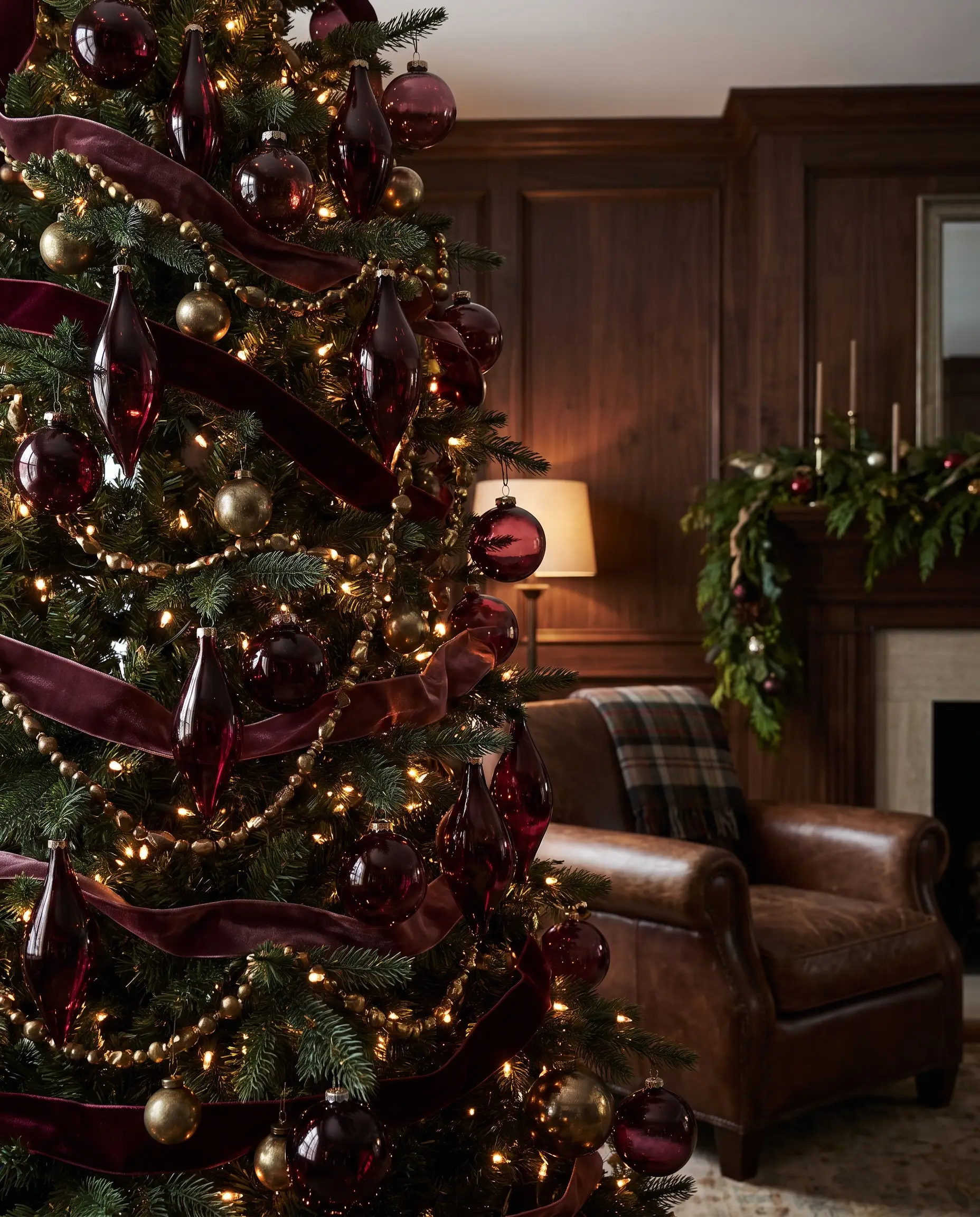
The 2026 aesthetic demands depth, which is why we are trading flat primary reds for the sophisticated, light-absorbing qualities of oxblood, deep plum, and chartreuse. These rich hues look incredibly tailored against dark pine needles, especially when paired with the warm, heavy luster of unlacquered brass accents.
To prevent dark jewel tones from disappearing into the shadows of the inner canopy, always position these ornaments directly in front of a cluster light to illuminate their glass profiles from behind.
Designer Secret
- Vibe: Moody Maximalist
- Key Materials: Heavy blown glass, unlacquered brass, cotton velvet
- Color Match: Sherwin-Williams Carnelian (Oxblood)
- Color Match: Farrow & Ball Brinjal (Deep Plum)
2. Transition to “Barely-There” Nostalgic Pastels
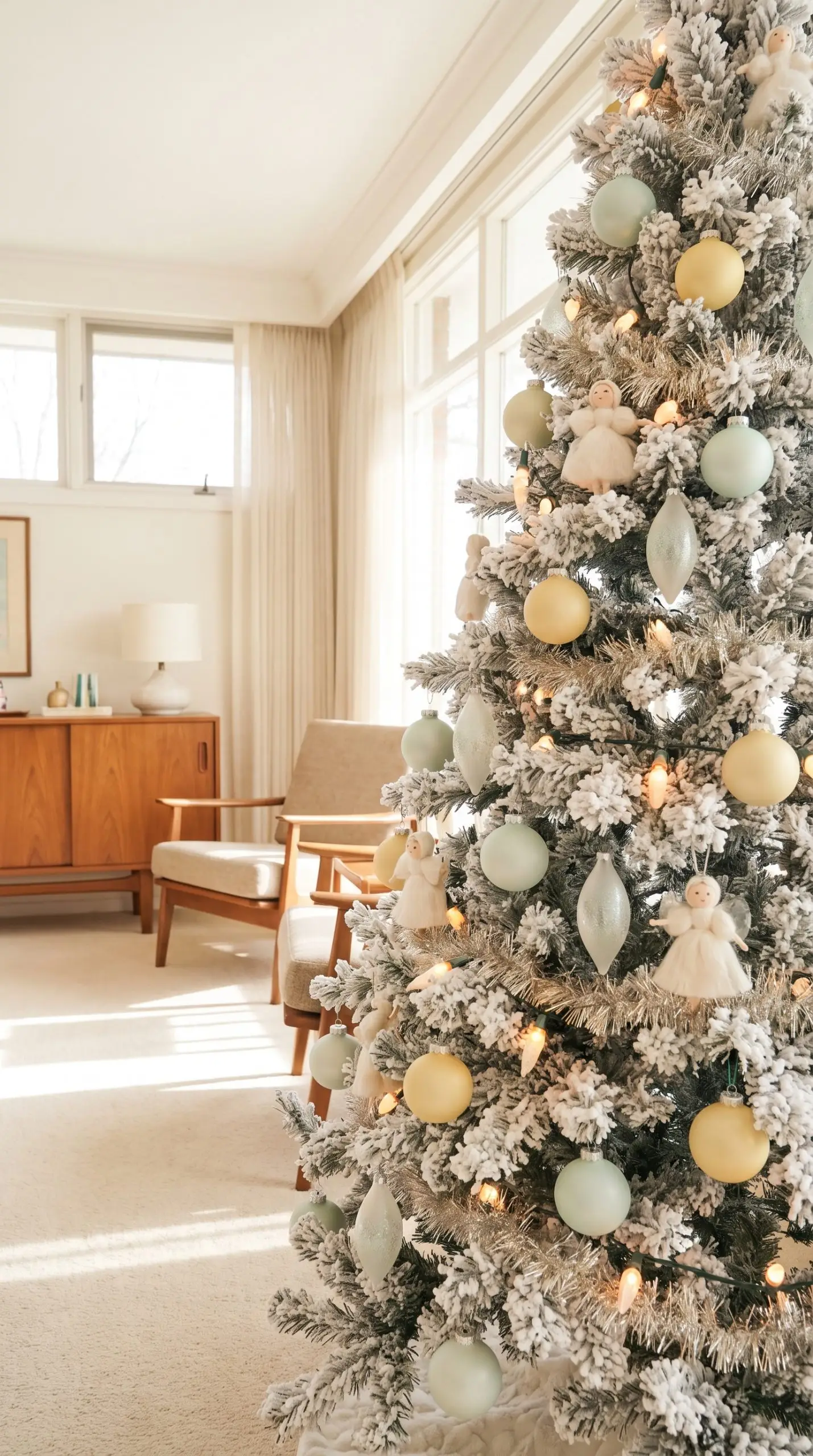
Echoing the mid-century aluminum tree styling of the 1960s, faded mint, blush pink, and soft butter yellow are returning with an heirloom, washed-out quality. This palette works exceptionally well on heavily flocked or white trees, providing a soft, almost powdery visual texture that feels both retro and highly sophisticated.
- Vibe: Nostalgic / 1960s Retro Revival
- Key Materials: Matte ceramic, frosted glass, spun cotton
- Color Match: Farrow & Ball Cabbage White (Faded Mint)
- Color Match: Sherwin-Williams Butter Up (Soft Yellow)
3. The Organic Modern Foraged Palette
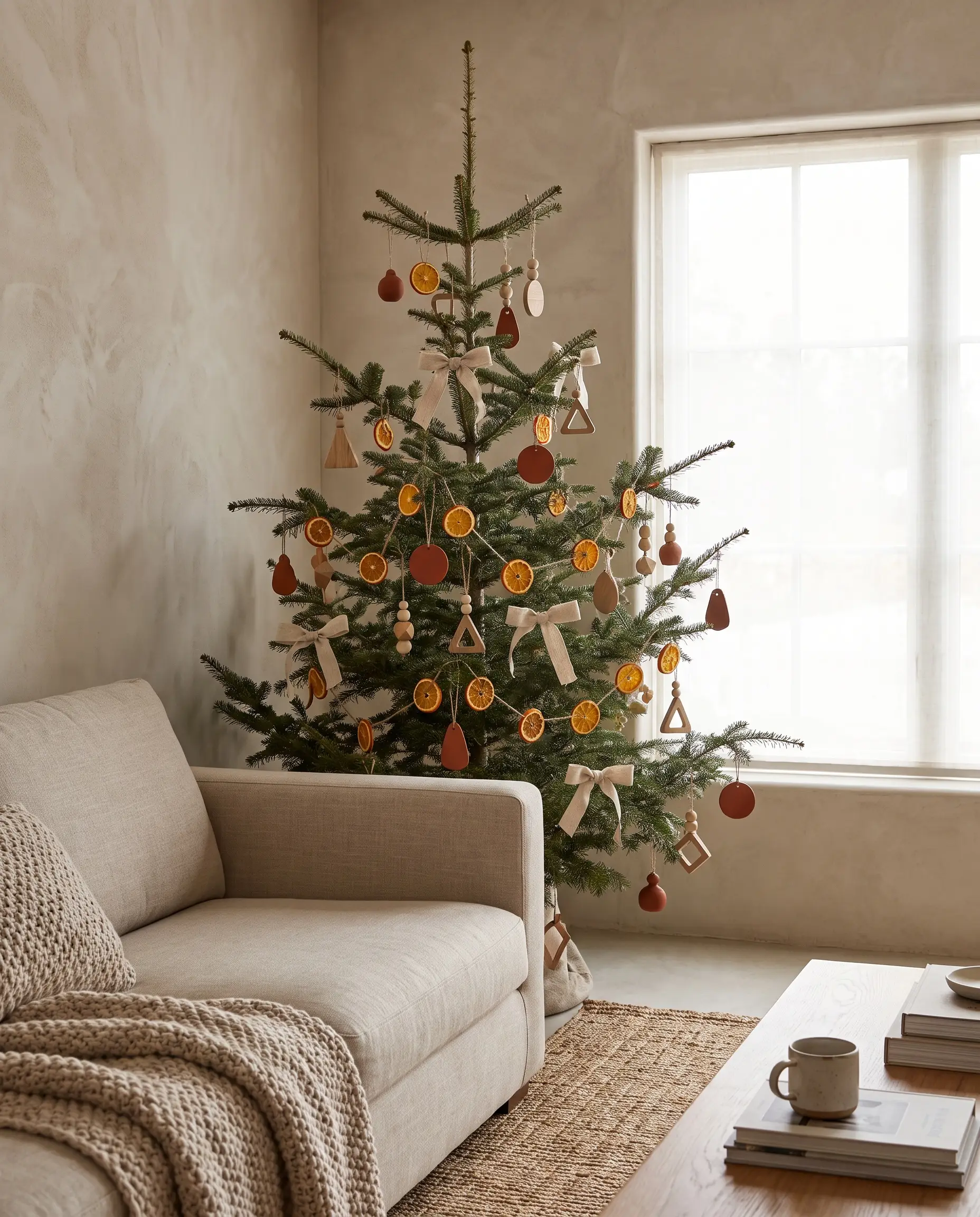
For those who favor Wabi-Sabi and organic design principles, the focus shifts entirely to earth-toned sustainability and raw textures. Matte terracotta, dried orange slices, unbleached linen, and raw wood tones create a deeply grounding, foraged aesthetic that strictly avoids anything artificial or overly manufactured.
- Vibe: Organic Modern
- Key Materials: Dehydrated citrus, raw oak, unbleached linen, matte clay
- Color Match: Sherwin-Williams Cavern Clay (Matte Terracotta)
- Styling Pro-Tip: String dried citrus slices on natural jute twine rather than nylon thread to maintain the organic, tactile narrative.
4. Monochromatic Amber and Burnished Gold
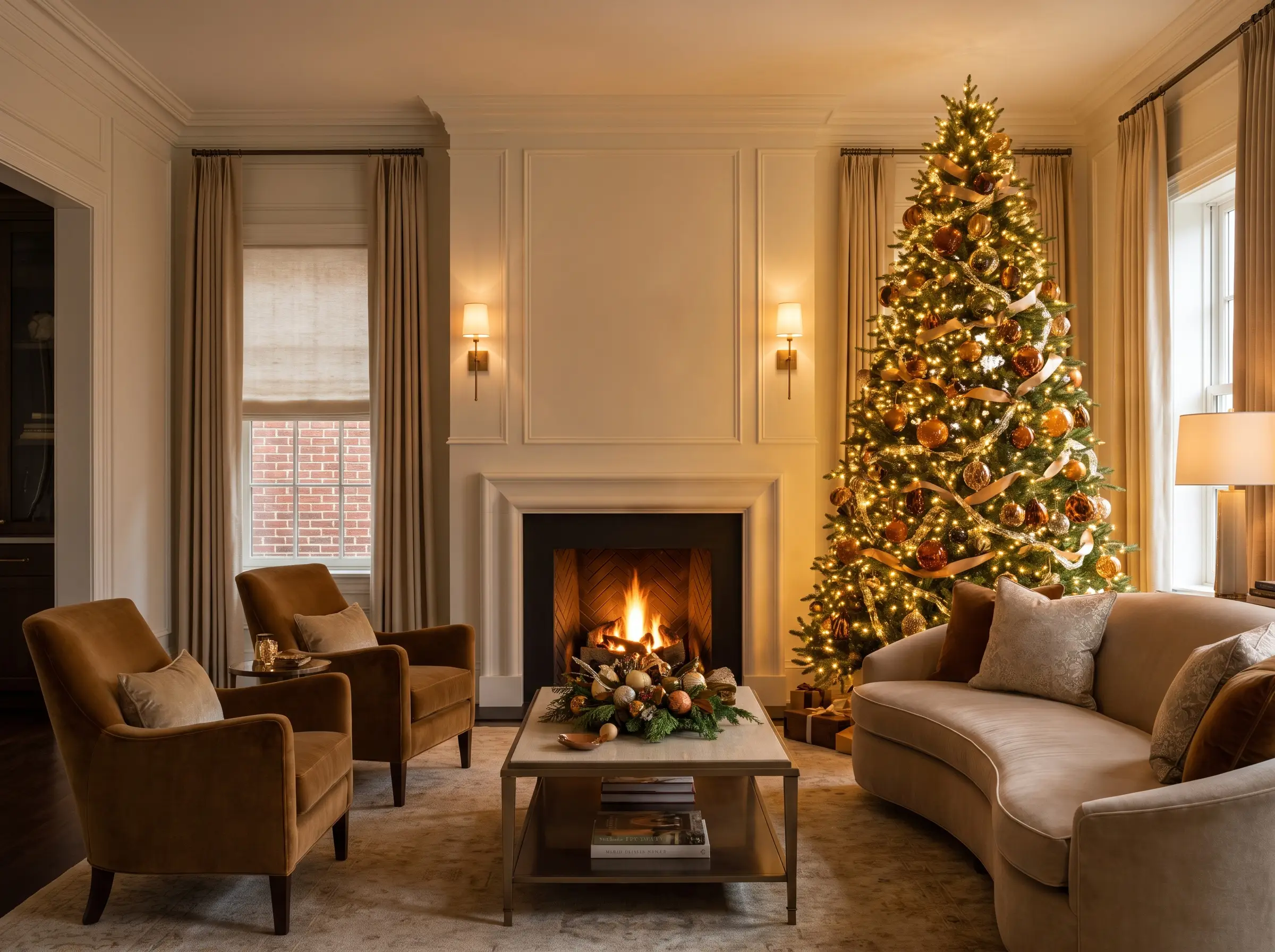
Ditch the bright, glittery, mass-market gold in favor of a luxurious, fireside glow achieved through amber glass, tortoiseshell finishes, and burnished bronze. This monochromatic approach builds incredible warmth, turning the tree into a glowing, ambient focal point that feels incredibly expensive.
- Vibe: Transitional Elegance
- Key Materials: Amber translucent glass, oxidized bronze, tortoiseshell acrylic
- Lighting Pairing: Strictly 2700K warm white cluster lights
- Styling Pro-Tip: Mix matte burnished metals with highly polished amber glass to create necessary textural contrast within the same color family.
5. High-Contrast Black and Crisp Ivory
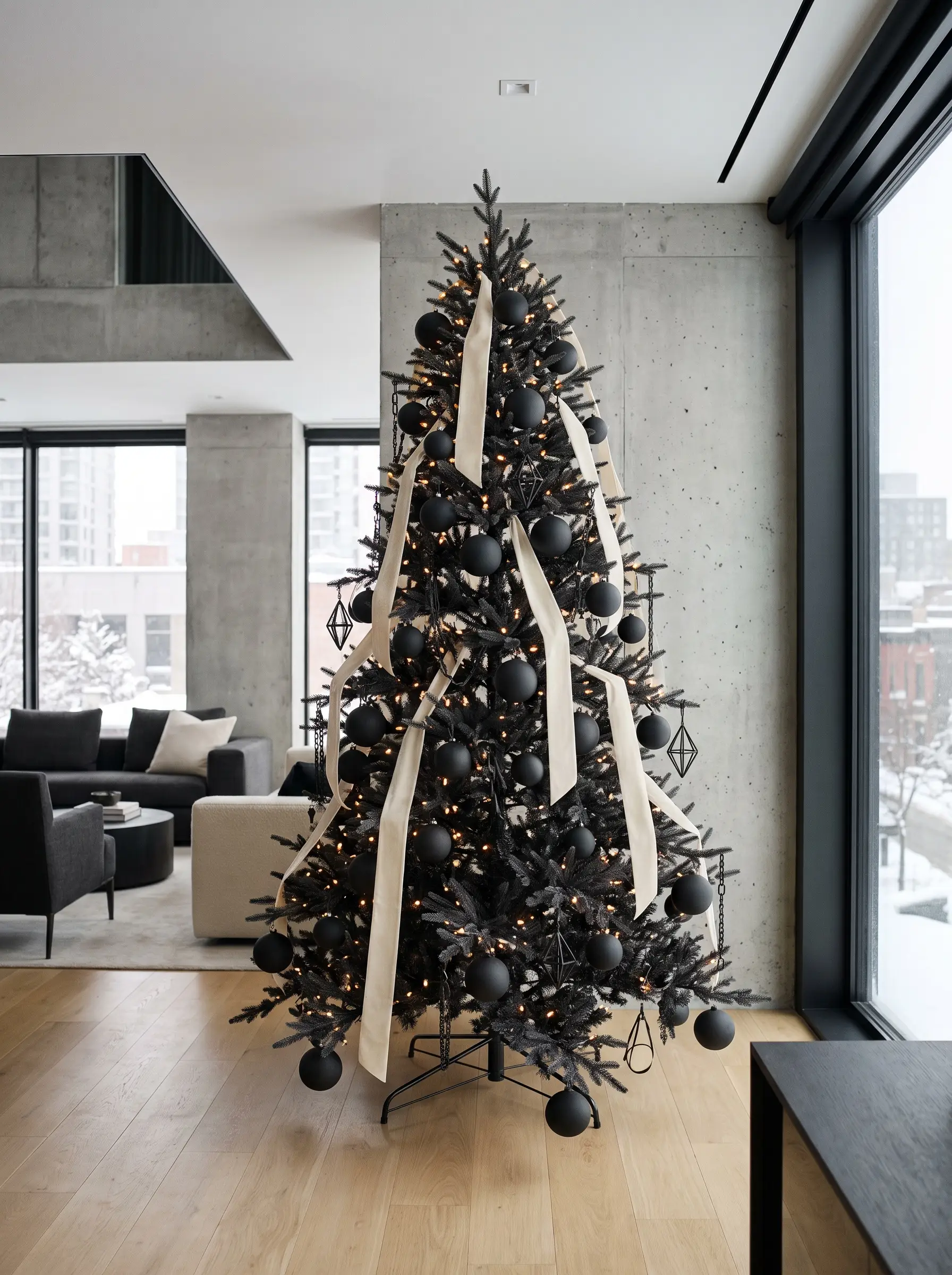
Using matte black ornaments mixed with soft ivory velvet ribbon creates a striking, architectural look tailored for modern minimalist homes. The black ornaments act as intentional negative space, pushing the eye deep into the tree and making the crisp ivory elements leap forward visually.
- Vibe: Modern Minimalist / High-Contrast
- Key Materials: Matte black ceramic, ivory silk velvet, dark iron
- Color Match: Sherwin-Williams Tricorn Black
- Color Match: Farrow & Ball School House White
6. The “Frost and Moss” Botanical Blend
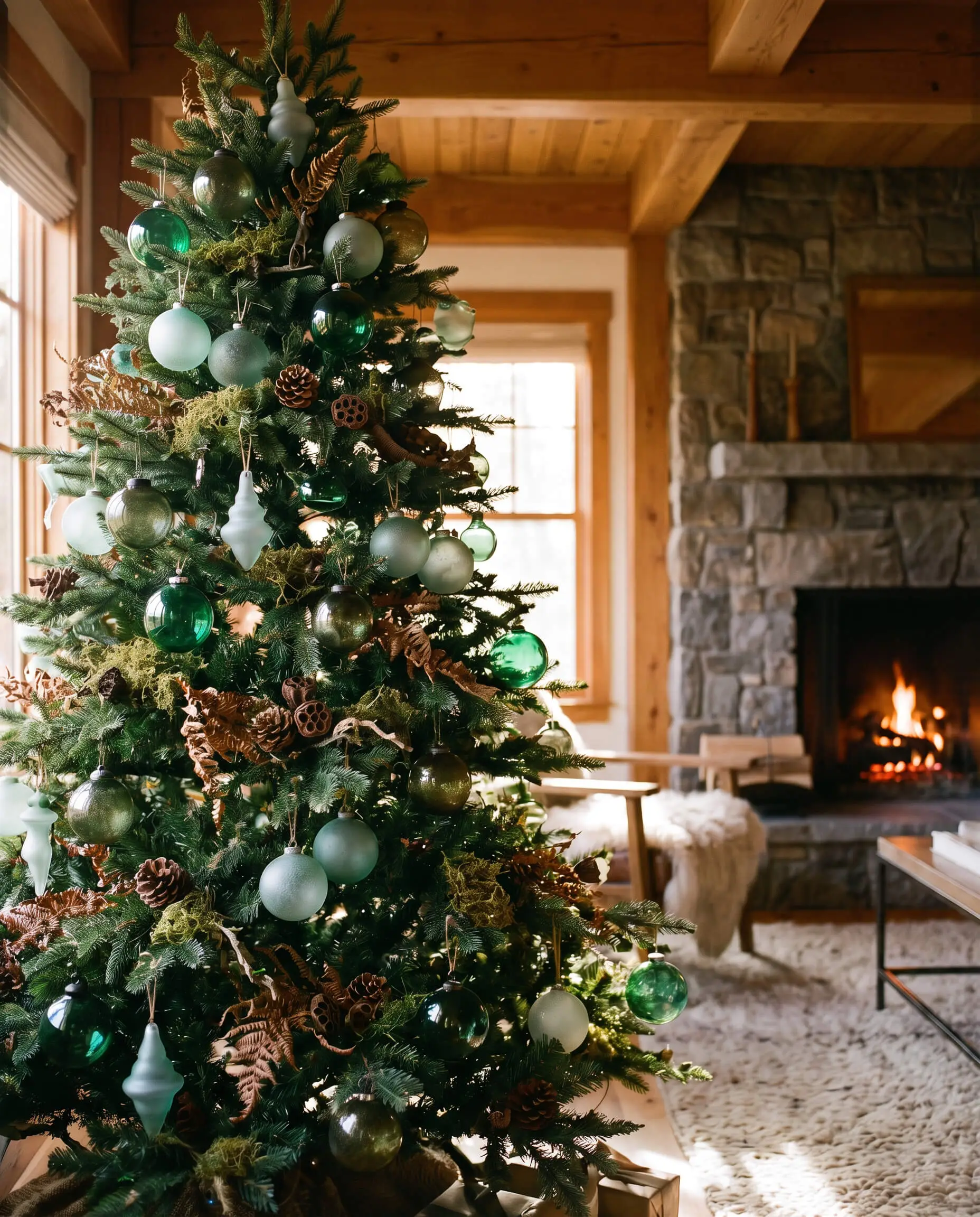
This is a highly textured, woodland approach to the traditional green tree, achieved by layering varying opacities of sage, moss, and emerald glass. When interspersed with frosted sea-glass elements, the tree takes on a chilled, botanical atmosphere that feels fresh rather than heavy.
- Vibe: Curated Woodland
- Key Materials: Seeded glass, frosted sea-glass, raw moss accents
- Color Match: Sherwin-Williams Pewter Green (Moss)
- Styling Pro-Tip: Group three different opacities of green ornaments (one matte, one translucent, one frosted) on the same branch to mimic natural botanical variance.
The Foundation: Lighting Techniques & Branch Architecture
A beautifully decorated tree will fail instantly if the lighting is flat or the branches are crushed together. Professional styling requires engineering the base layer to create structural depth and a glowing inner canopy.
7. Source Sparse, Asymmetrical Alpine Silvertips
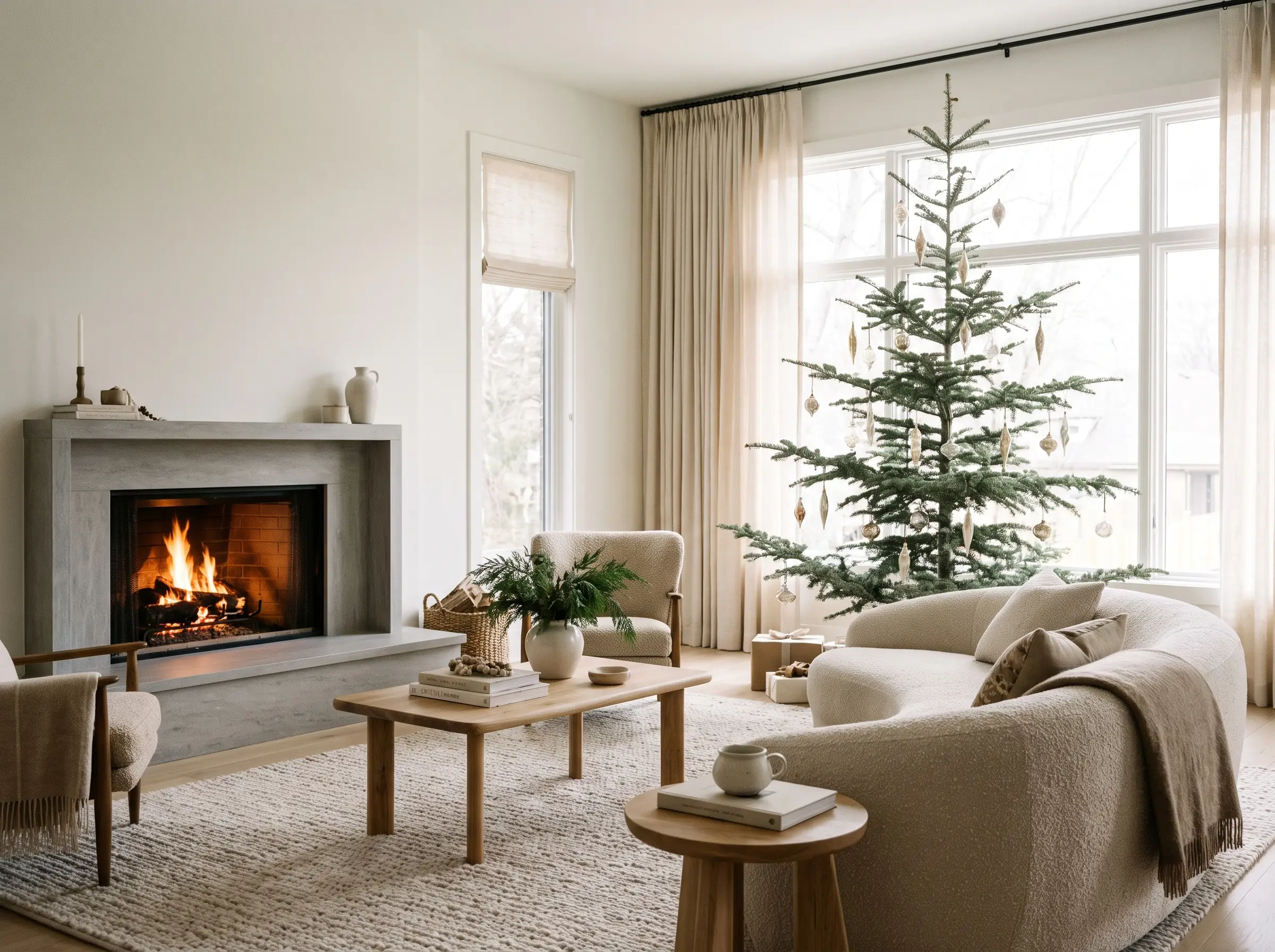
The most significant shift in 2026 is the departure from dense, mathematically perfect triangles in favor of sparse, asymmetrical Silvertip or Alpine firs. This branch architecture provides crucial negative space between tiers, allowing elongated, heirloom ornaments to dangle cleanly without resting awkwardly on the branches below.
- Vibe: Organic Modern / Minimalist
- Key Feature: Wide gaps between branch layers
- Structural Benefit: Prevents visual clutter and highlights individual feature ornaments
- Styling Pro-Tip: Do not attempt to fill the gaps with oversized ribbon; the empty space is a deliberate architectural feature.
8. Execute the Trunk-to-Tip Wrapping Method
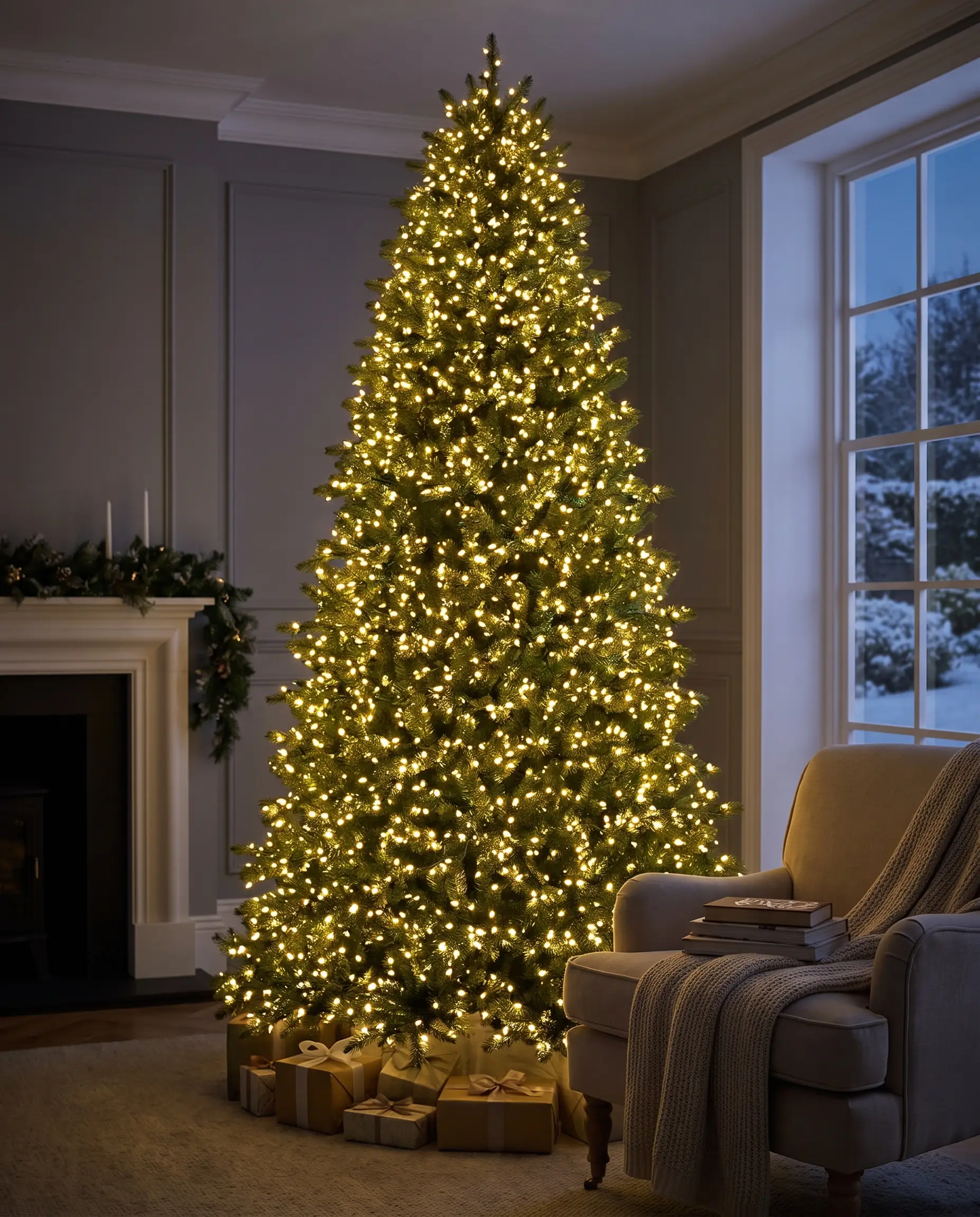
Stop wrapping your lights around the outside of the branches in a flat, mummy-like spiral. Illuminating the core of the tree creates three-dimensional depth, transforming the trunk into a glowing central pillar that radiates warmth outward.
1. Anchor: Start at the base of the trunk and select a single branch. 2. Wrap Out: Wrap the light strand tightly around that branch from the trunk all the way to the tip. 3. Wrap In: Wrap the strand back down the exact same branch to the trunk, then move to the next branch.
Hackrea Lighting Guide
- Vibe: Professional / High-End
- Key Materials: Green or brown-wired light strands (matching the tree)
- Time Investment: High (requires 2-3 times longer than standard wrapping)
- Visual Impact: Creates a deeply backlit, glowing inner canopy.
9. Layer Micro-Cluster Lights for Maximum Glow
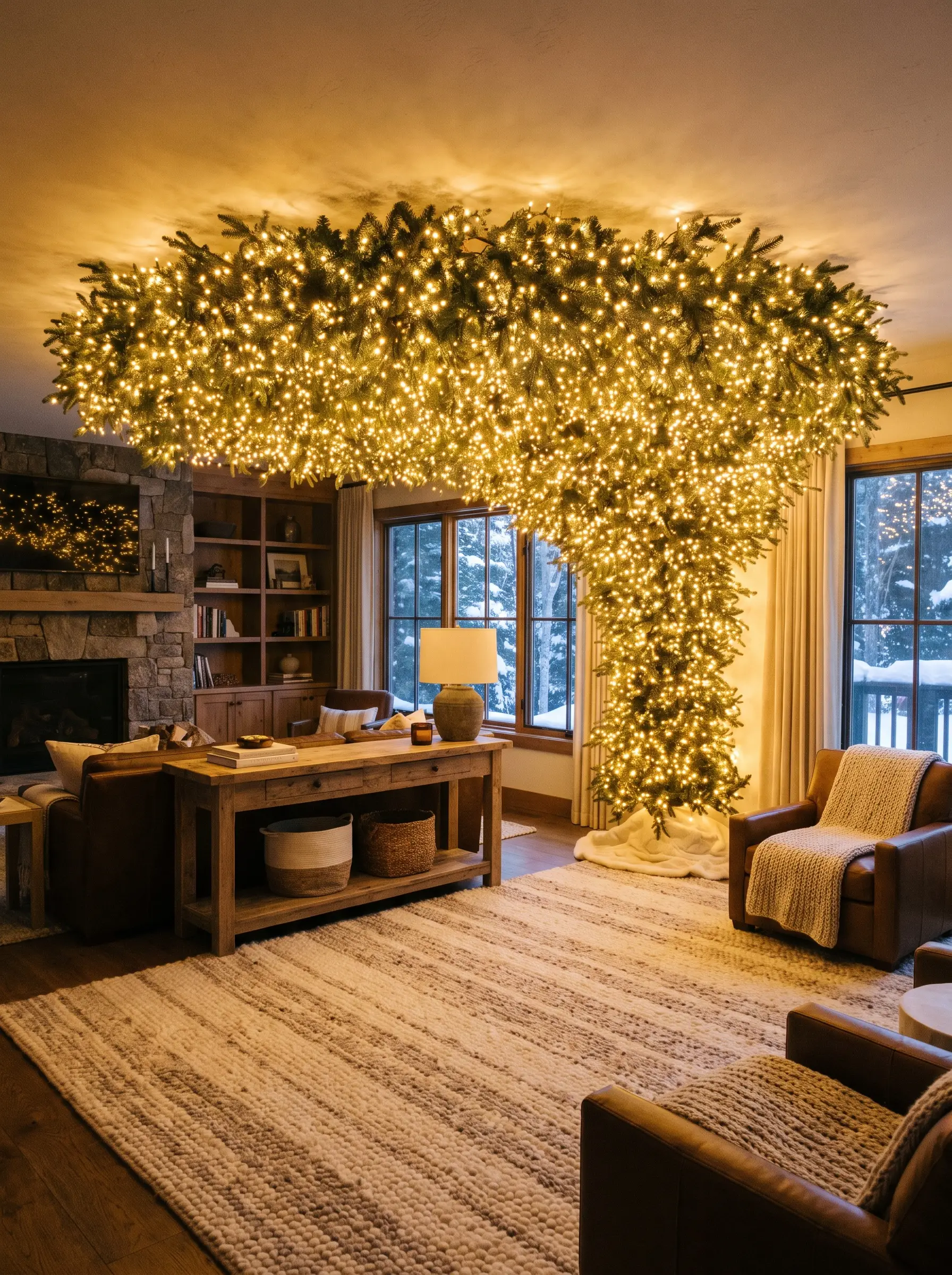
Cluster lights—strands featuring a micro-LED bulb every half-inch—create a thicker, more magical halo of light than standard string lights. To achieve a high-end, bespoke look, you must strictly control the color temperature, entirely avoiding harsh, blue-toned cool whites.
- Vibe: Accessible Luxury
- Key Materials: Micro-cluster LED strands
- Technical Spec: 2700K to 3000K (Warm White)
- Bulb Density: Aim for at least 100 bulbs per foot of tree height.
10. Incorporate Smart Mapping Technology
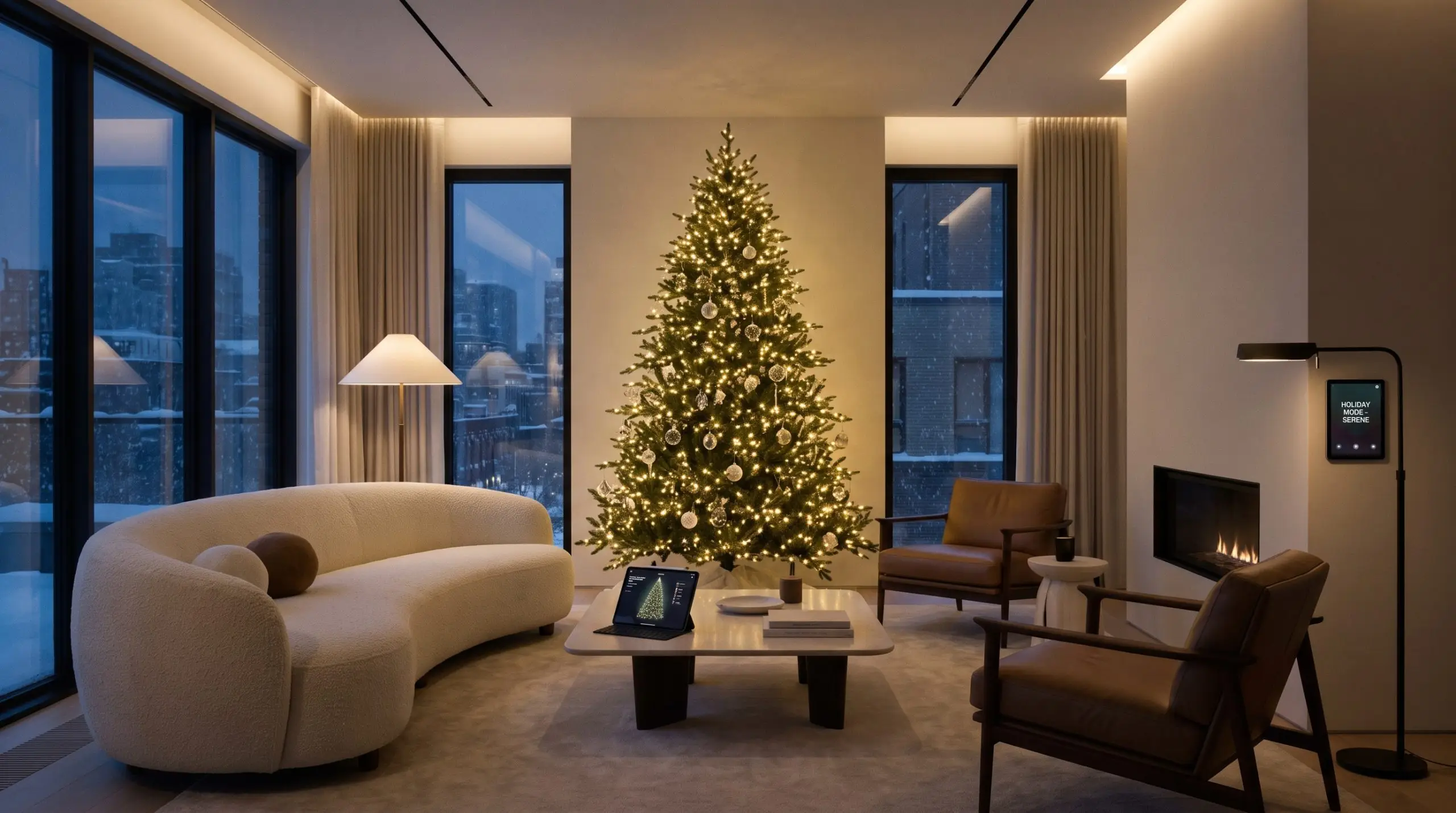
Advanced lighting systems allow users to map their tree’s exact light placement via a smartphone camera, unlocking subtle, custom gradients. The goal is to program slow, sophisticated twinkle effects or soft color shifts, strictly avoiding the chaotic, rapid-fire strobe settings that cheapen the room.
- Vibe: Tech-Forward Elegance
- Key Materials: Twinkly smart LEDs or equivalent mapping systems
- Recommended Setting: Slow, 5% random twinkle on a warm white baseline
- Styling Pro-Tip: Use the mapping software to slightly dim the lights at the very back of the tree to enhance forward-facing depth.
Ribbon & Garland Architecture
Ribbon acts as the structural skeleton of your tree decor, dictating the eye’s movement from the topper down to the base. It is a spatial formula, not a mystical art, and utilizing the correct proportions ensures a balanced, professional cascade.
Ribbon Width to Tree Height Cheat Sheet
| Tree Height | Minimum Ribbon Width | Recommended Ribbon Style |
| 5 – 6 Feet | 1.5 to 2 Inches | Delicate velvet or thin silk |
| 7 – 8 Feet | 2.5 to 4 Inches | Frayed chiffon or mid-weight velvet |
| 9 – 10+ Feet | 4 to 6+ Inches | Heavy cotton velvet or layered double-ribbon |
11. Master the “Z-Pattern” Tuck and Drape
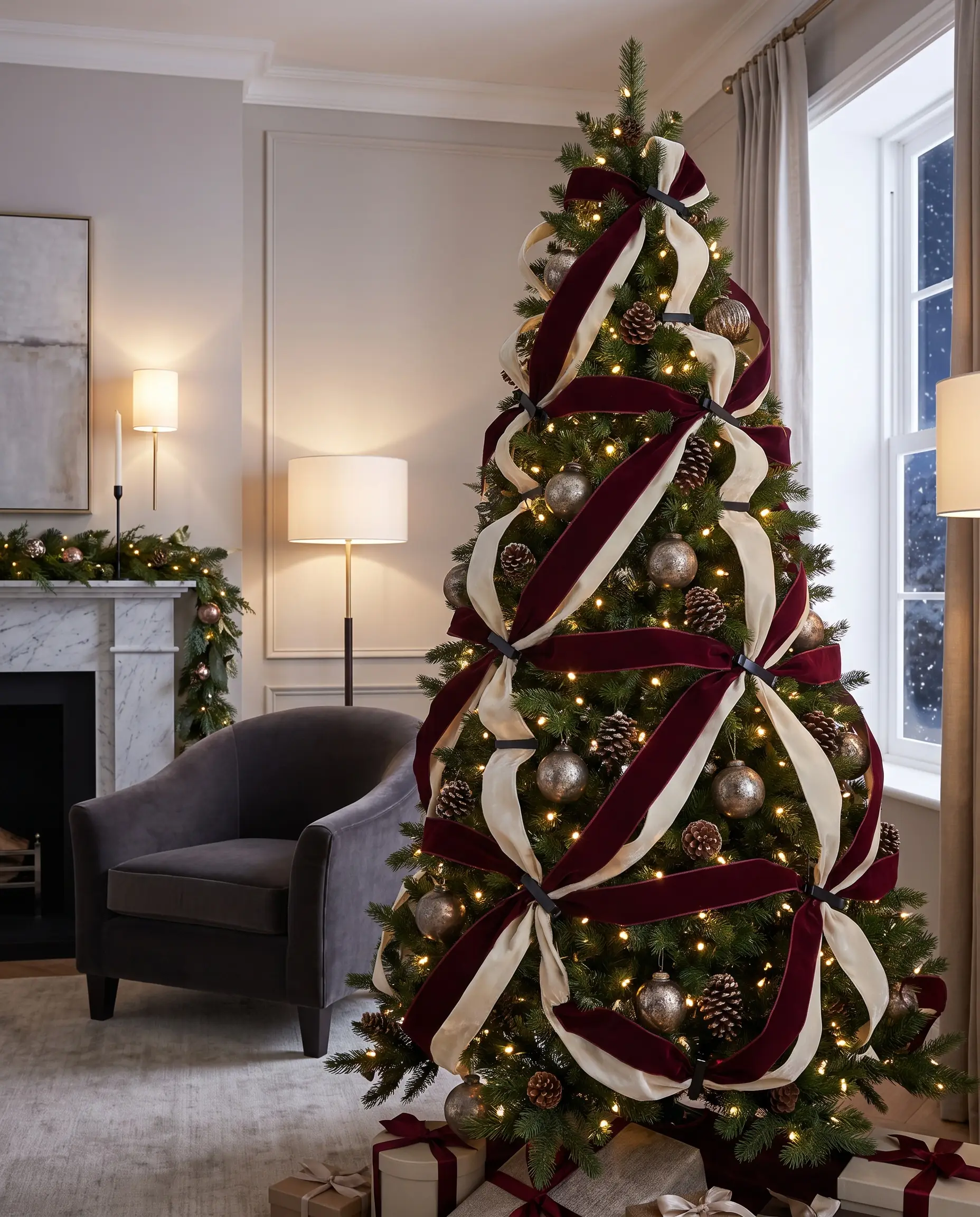
Avoid wrapping the tree horizontally, which traps the branches and flattens the profile. The professional method involves cutting ribbon into manageable sections and weaving them vertically and diagonally through the branches to create structural movement.
Cut your ribbon into 3-foot sections. Anchor one end deep near the trunk. Billow the ribbon out loosely over a branch. Pinch the fabric to create a pleat, and Tuck it back deep into the tree on a diagonal trajectory, creating a cascading Z-pattern.
Hackrea Styling Tip
- Vibe: Tailored / Professional
- Key Materials: Non-wired, heavy-drape fabrics
- Technique Focus: Deep anchoring to create billowing loops
- Styling Pro-Tip: Step back every three sections to ensure the diagonal lines are guiding the eye naturally downward.
12. Invest in Frayed-Edge Chiffon and Velvet
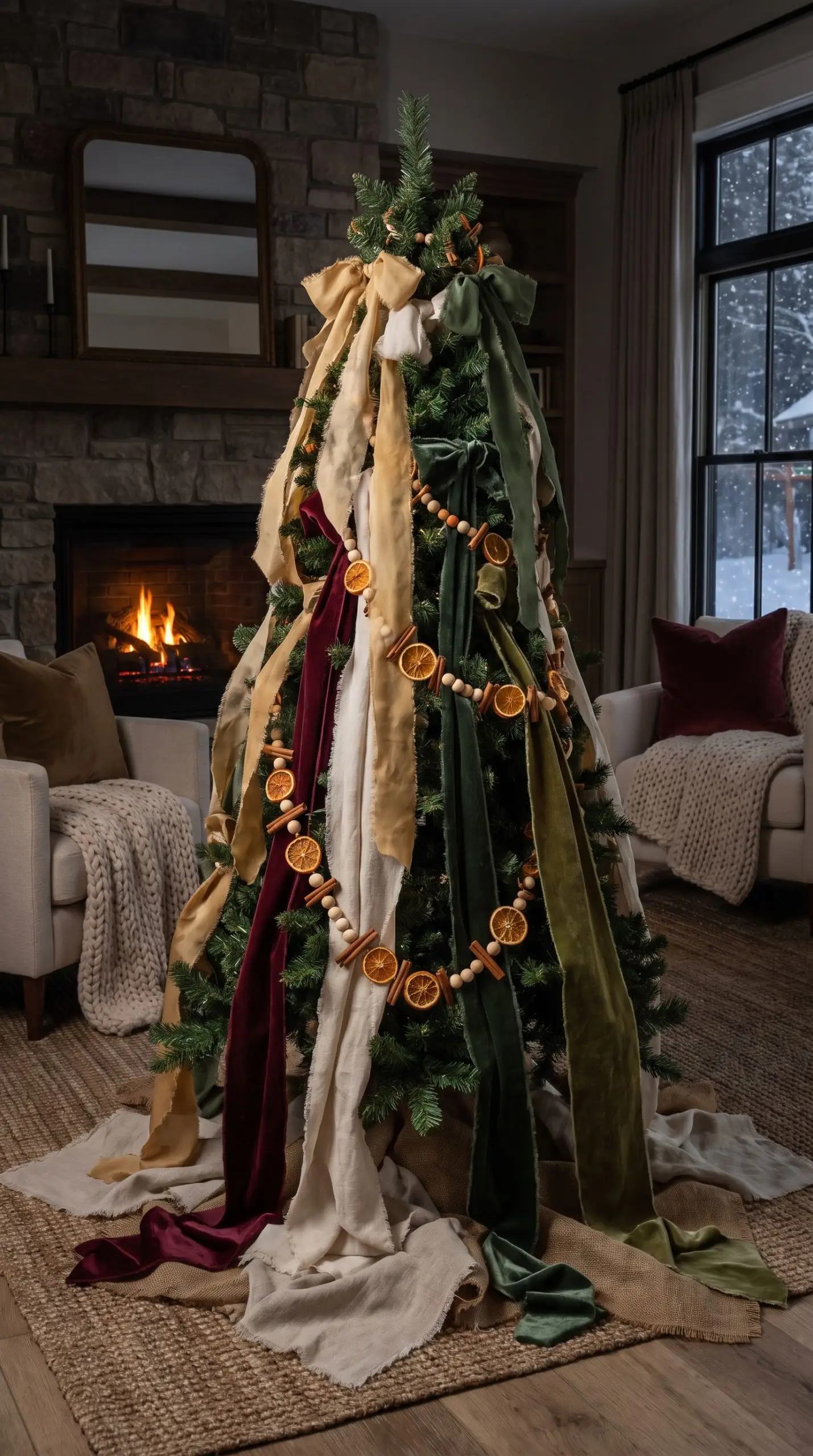
Stiff, cheap wire ribbon with perfectly rigid loops is out. The 2026 aesthetic favors luxurious, soft-draping materials like frayed silk chiffon or heavy cotton velvet that cascade organically down the branches, pooling slightly where they rest.
- Vibe: Organic Luxury
- Key Materials: Silk chiffon, heavy cotton velvet, raw-edge linen
- Visual Benefit: Softens the rigid needles of artificial trees
- Styling Pro-Tip: Let the ends of the ribbon hang loose and trail downward, rather than cutting them into stiff, perfect dovetails.
13. Cascade 1970s-Inspired Foil Tinsel
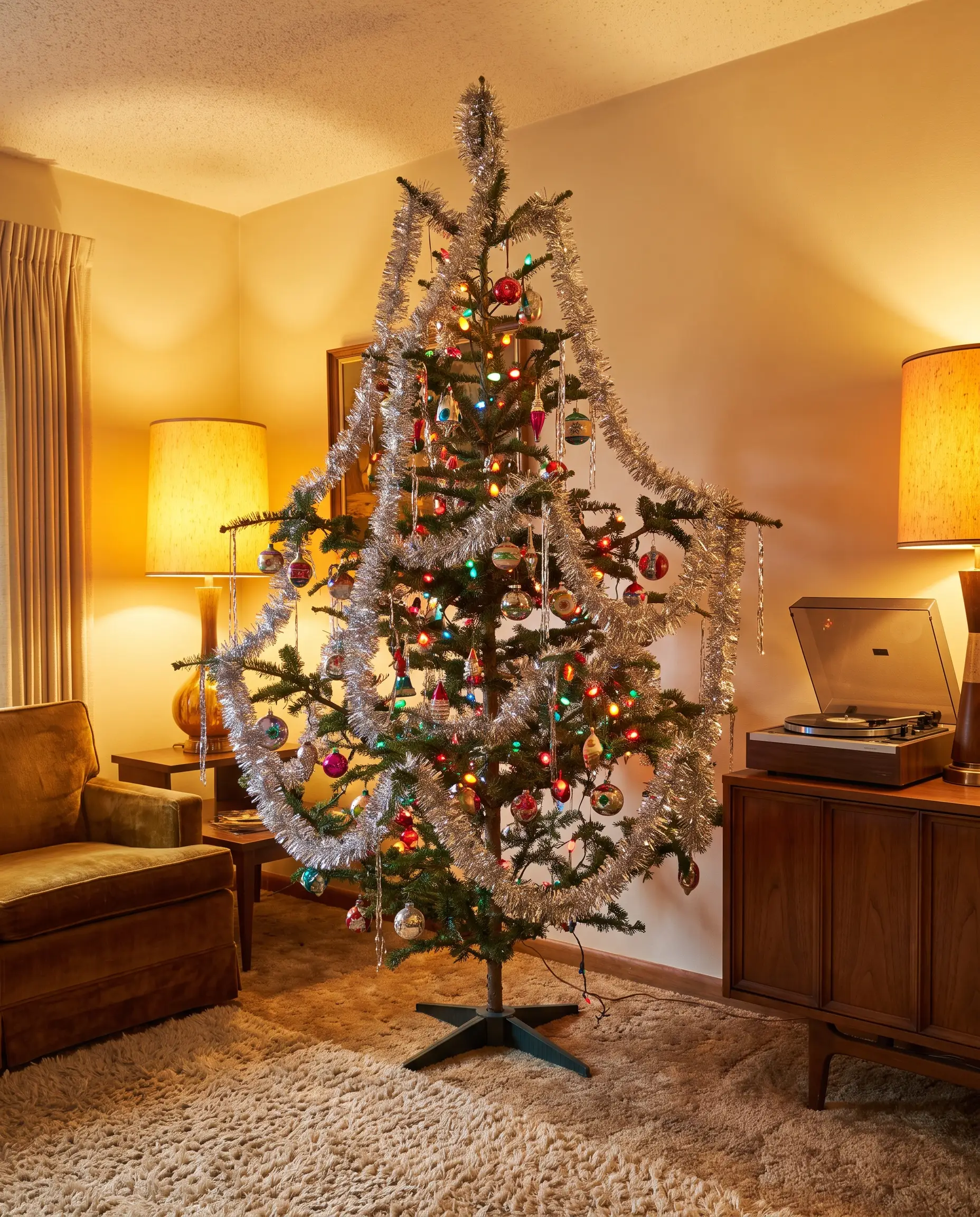
Tinsel “icicles” have returned in a massive way, but they must be applied with painstaking architectural precision, not thrown haphazardly by the handful. Draping individual strands on the very tips of the branches catches the ambient light and creates a stunning, shimmering veil.
Only use heavy foil tinsel on sparse, asymmetrical trees. If applied to a dense, heavily flocked, or heavily ornamented tree, it will immediately look chaotic and cluttered.
Pattern Allowance Warning
- Vibe: 1970s Retro Nostalgia
- Key Materials: Heavyweight metallic foil tinsel (lead-free)
- Technique Focus: Individual strand placement on outer tips only
- Styling Pro-Tip: Use silver tinsel against warm lights to create a highly dimensional, mixed-metal shimmer.
14. Layer Wooden Bead and Brass Bell Garlands
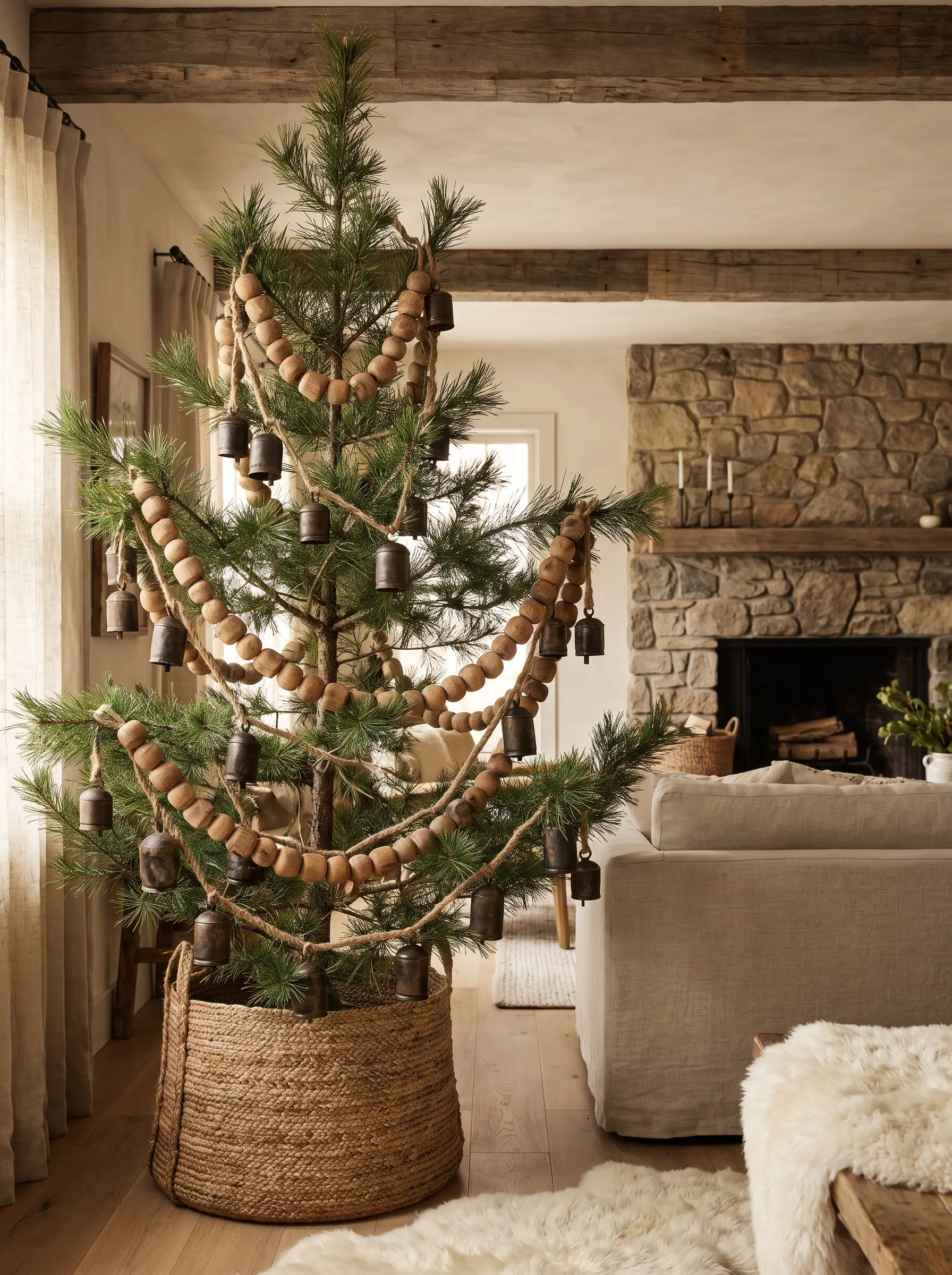
For a more grounded, organic look, bypass fabric ribbon entirely and drape heavy wooden beads interspersed with rustic brass bells. This introduces beautiful acoustic charm and heavy visual weight that anchors the lighter glass ornaments.
- Vibe: Organic Modern Foraged
- Key Materials: Raw oak beads, oxidized brass bells, thick jute cord
- Draping Method: Deep, swooping U-shapes from branch to branch
- Styling Pro-Tip: Ensure the garland swoops rest slightly behind the outermost tips of the branches to maintain depth.
Ornament Layering & Textural Contrast
A designer tree relies on a specific ratio of foundational “filler” baubles to highly detailed “feature” ornaments. Dressing a tree correctly means working from the inside out, establishing a reflective core before styling the delicate outer canopy.
15. Anchor the Trunk with Oversized Core Baubles
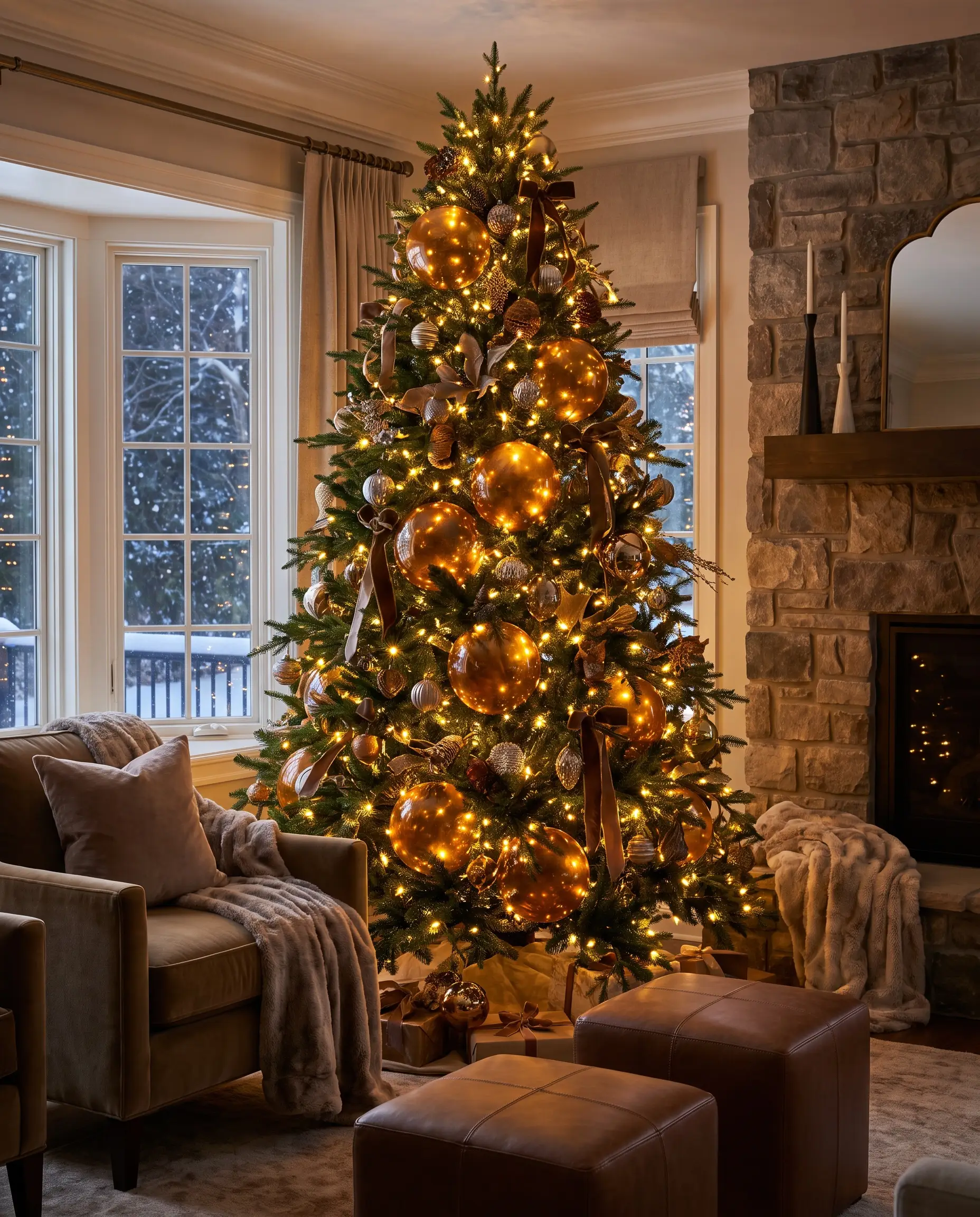
The most common mistake in amateur tree styling is placing all ornaments on the exterior tips, resulting in a flat, hollow-looking silhouette. Place your largest, most highly reflective ornaments deep inside the inner branch canopy, right against the trunk, to bounce light outward and hide the central pole.
- Vibe: Foundational Architecture
- Key Materials: Inexpensive, highly reflective shatterproof or glass spheres
- Size Requirement: 6 to 8 inches in diameter
- Styling Pro-Tip: Match these core baubles closely to the color of your tree’s lights (e.g., amber or gold) to amplify the glowing effect.
16. Implement the “Rule of Three Sizes”
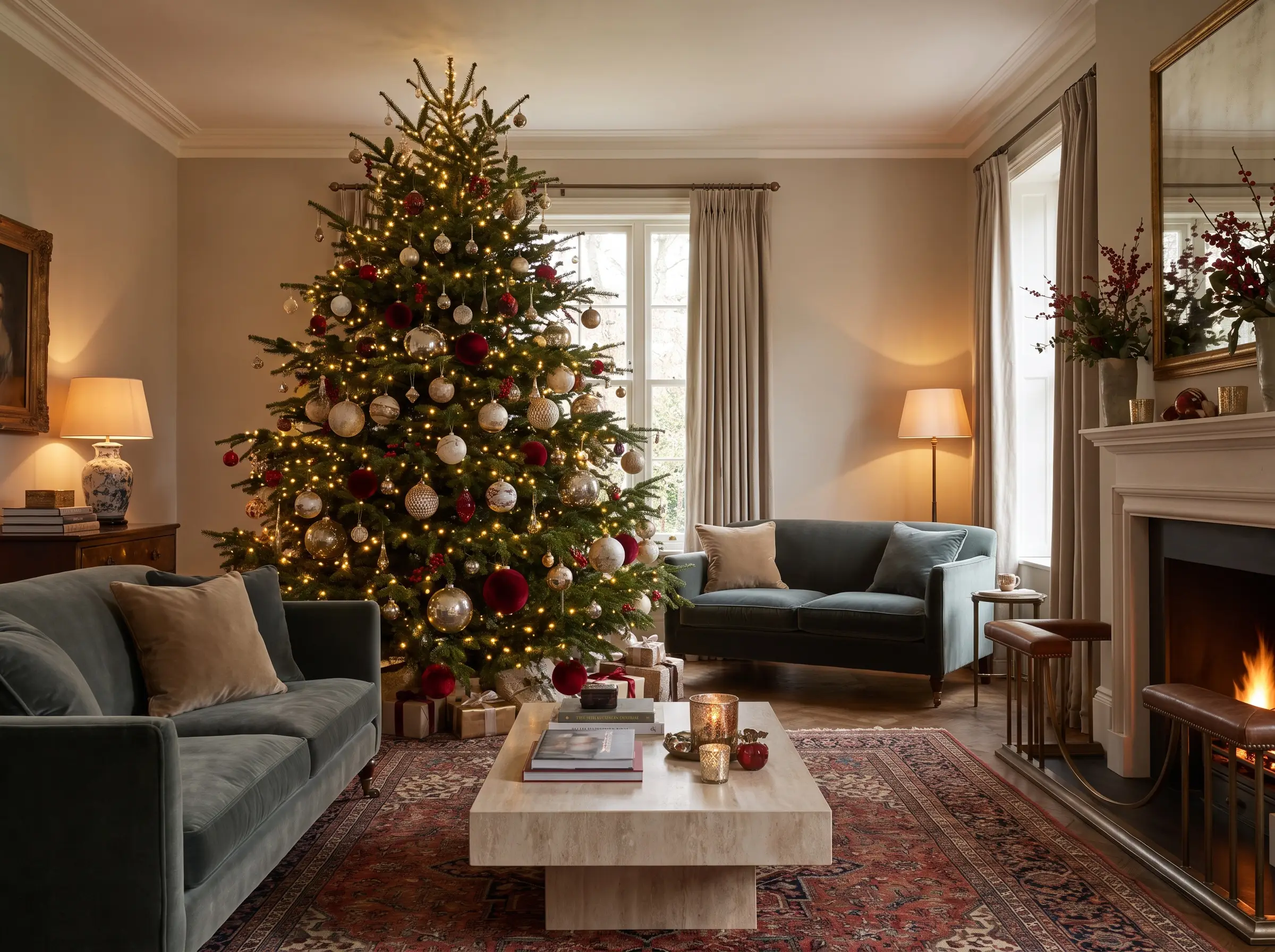
To achieve professional visual balance, you must mandate the use of three distinct ornament scales across the tree. Relying on a single box of uniformly sized ornaments creates a static, uninspired display that lacks spatial movement.
- Vibe: Bespoke / Curated
- Scale 1 (Depth): Extra-large (6″+) placed deep near the trunk.
- Scale 2 (Bulk): Medium (3-4″) used as the primary filler mid-branch.
- Scale 3 (Detail): Micro (1-2″) reserved for the delicate, outermost branch tips.
17. Hang Elongated Finials and Teardrops
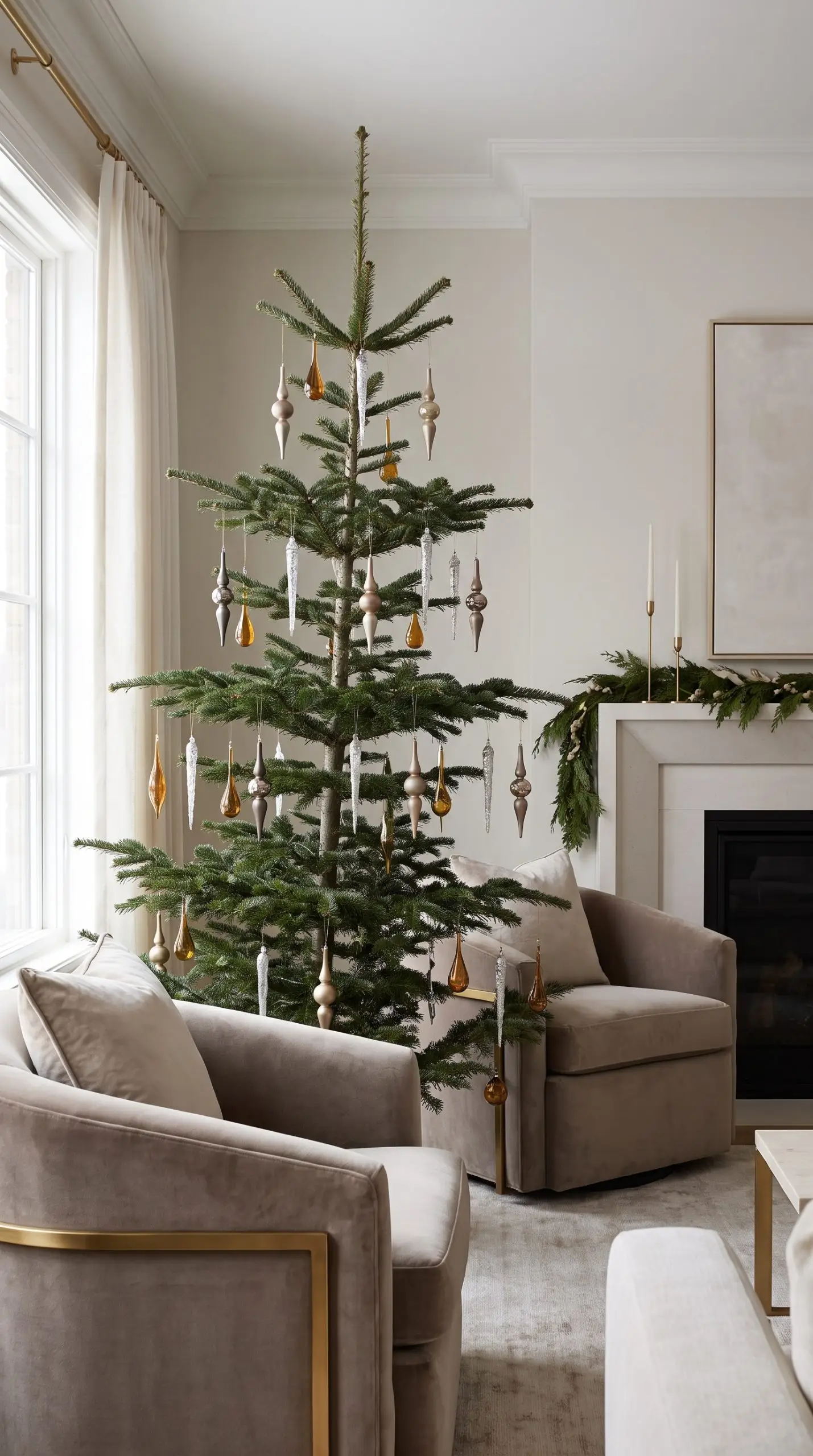
Break up the monotony of round spheres by integrating long finials, icicle shapes, and teardrops. These elongated forms draw the eye downward, introduce sharp verticality, and perfectly complement the negative space found in sparse branch gaps.
- Vibe: Transitional Elegance
- Key Materials: Blown glass, mercury glass, spun glass
- Placement Strategy: Suspend these directly in the center of branch gaps so they can spin freely.
- Styling Pro-Tip: Use finials that feature a contrasting matte and gloss finish to maximize light refraction.
18. Tie Ornaments with Velvet Ribbon Instead of Hooks
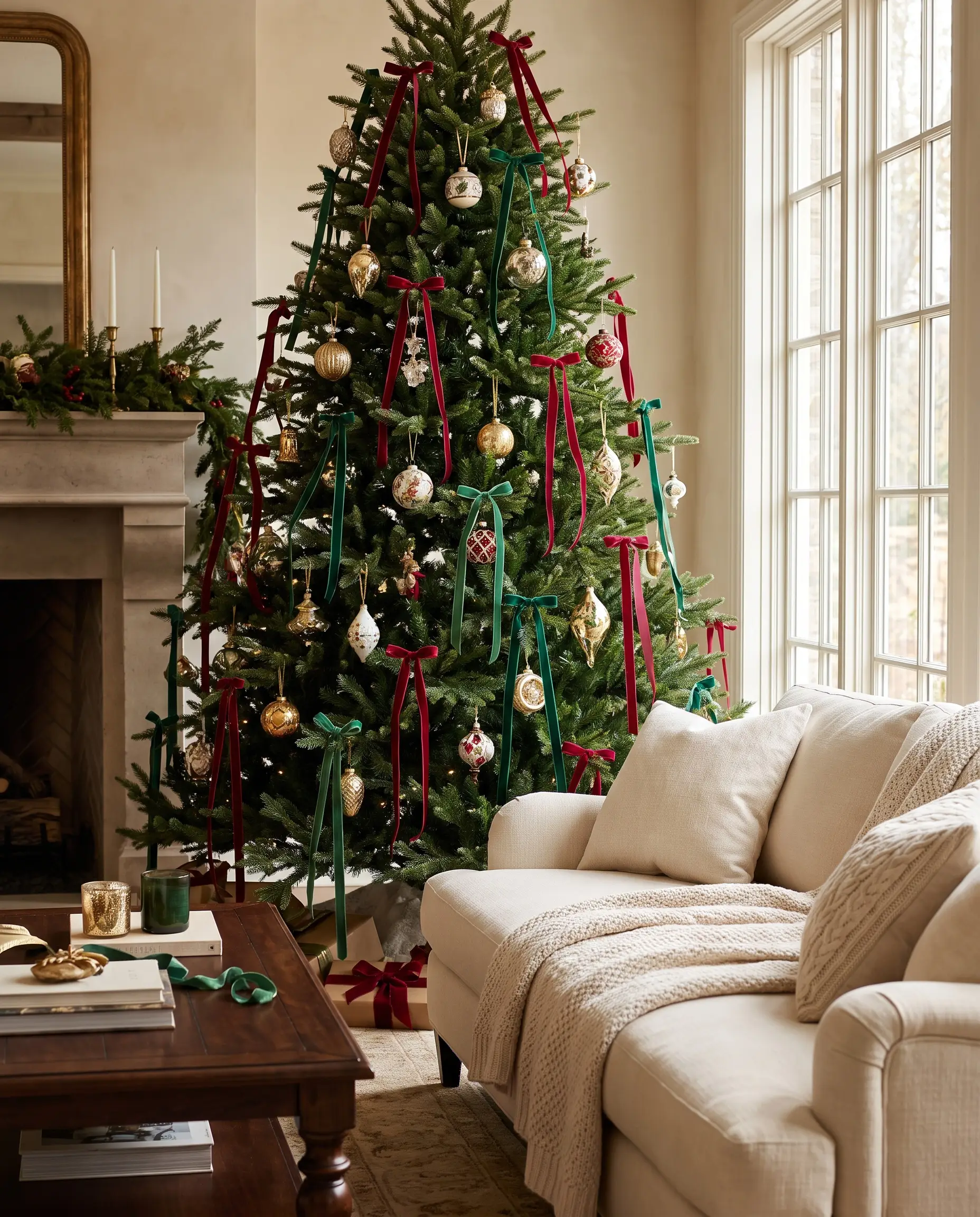
Ditch the standard green wire or cheap plastic hooks. Tying your highly detailed feature ornaments directly to the branches using thin, 1/4-inch velvet or silk ribbon instantly transforms the tree into a bespoke, tailored installation.
Pre-cut dozens of 8-inch lengths of thin velvet ribbon before you begin decorating. Thread them through the ornament caps and tie them to the branches using a simple, relaxed knot, letting the excess tails dangle.
Designer Secret
- Vibe: High-End Boutique
- Key Materials: 1/4-inch silk or cotton velvet ribbon
- Color Strategy: Match the ribbon tie to the overarching color palette, not the branch color.
- Visual Benefit: Adds micro-textures throughout the entire outer canopy.
19. Integrate Tactile Paper Mache and Felt
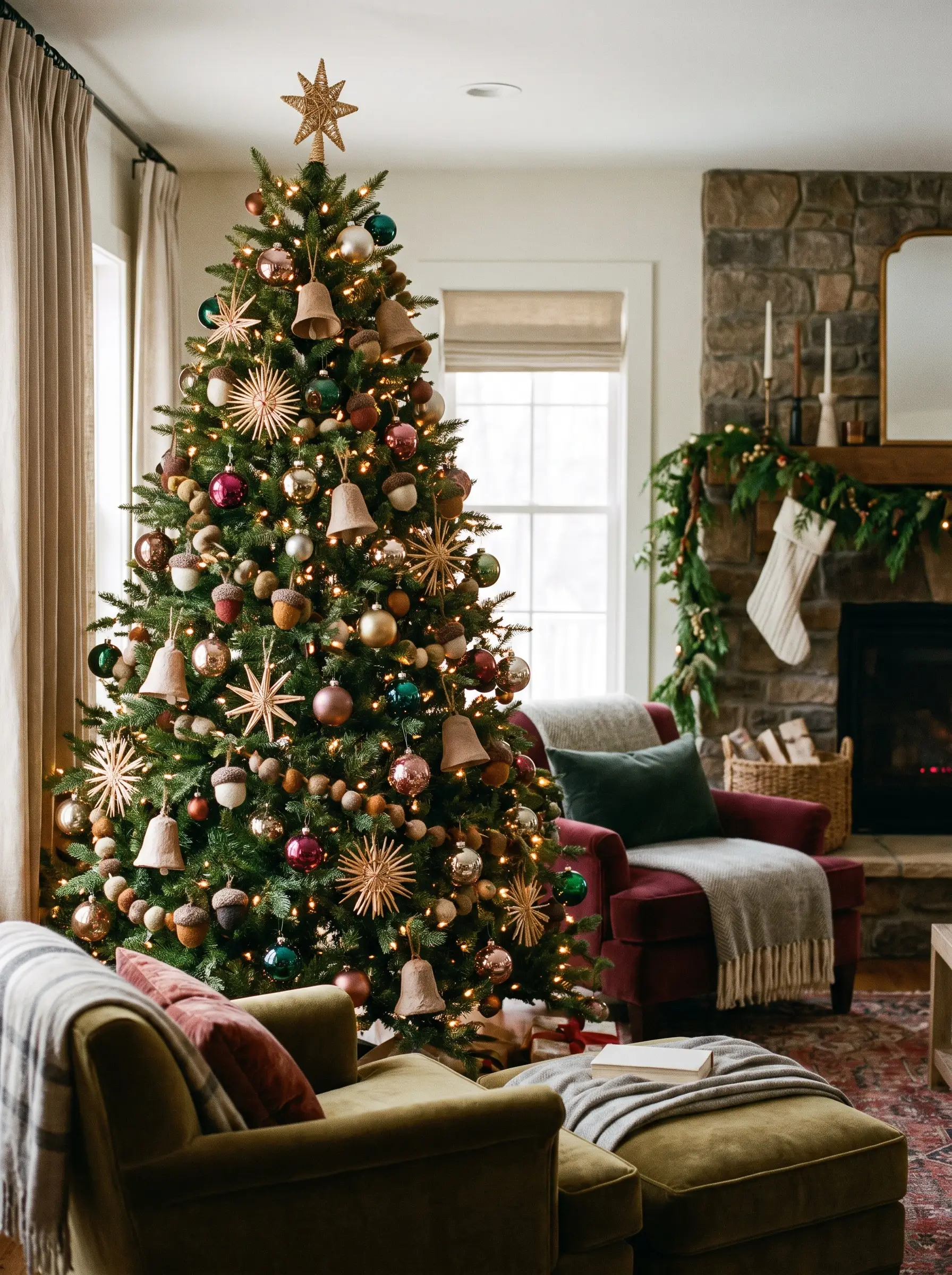
An overabundance of glass and metal can leave a tree looking cold and commercial. Warm up the visual temperature by layering in matte, artisanal textures like handcrafted paper mache bells, felted acorns, or woven straw stars.
- Vibe: Accessible Luxury / Artisanal
- Key Materials: Heavy paper mache, dense wool felt, woven straw
- Placement Strategy: Mix these directly next to highly polished glass to emphasize the textural contrast.
- Styling Pro-Tip: Source these pieces from independent artisans or high-end stockists to ensure the finish looks curated, rather than like a children’s craft project.
20. Cluster Small Baubles with Floral Wire
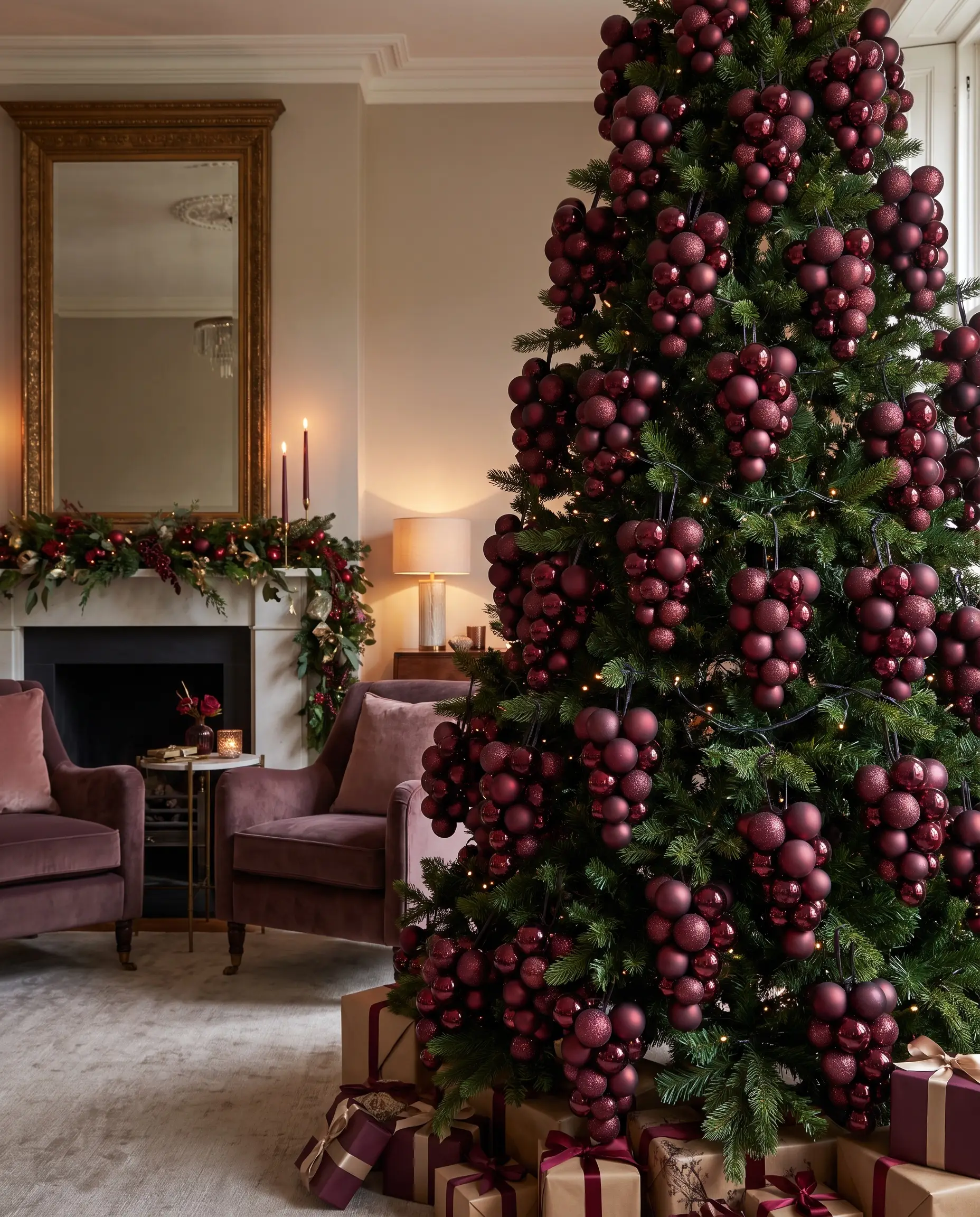
Instead of hanging micro-ornaments individually where they lose visual impact, group them into custom impact pieces. Thread three or four small, inexpensive ornaments tightly together with floral wire, and secure them as a single “grape bunch” directly onto a thick branch.
- Vibe: Maximalist / High-Impact
- Key Materials: 1-to-2-inch glass baubles, 22-gauge green floral wire
- Technique Focus: Twisting the wire tightly so the caps touch and hide each other
- Styling Pro-Tip: Mix matte, gloss, and glitter finishes of the exact same color within a single cluster for a sophisticated monochromatic pop.
The Finishing Touches: Toppers, Collars, and Skirts
The most stunning, meticulously styled tree can be ruined in seconds by a cheap metal stand showing at the bottom or an undersized topper leaning awkwardly at the peak. Proportion and scale at these top and bottom visual anchors are non-negotiable.
Collar vs. Skirt Pros & Cons
| Base Type | Best For (Aesthetic) | Pros | Cons |
| Architectural Collar | Modern, Clean, Organic | Hides hardware completely, easy to vacuum around, pet-proof. | Requires exact measurement of stand; bulky to store. |
| Textile Skirt/Rug | Maximalist, Eclectic, Vintage | Adds immense textural warmth, accommodates any stand size. | Collects dust/needles, requires constant readjustment. |
21. Anchor the Base with a Scalloped Wicker Collar
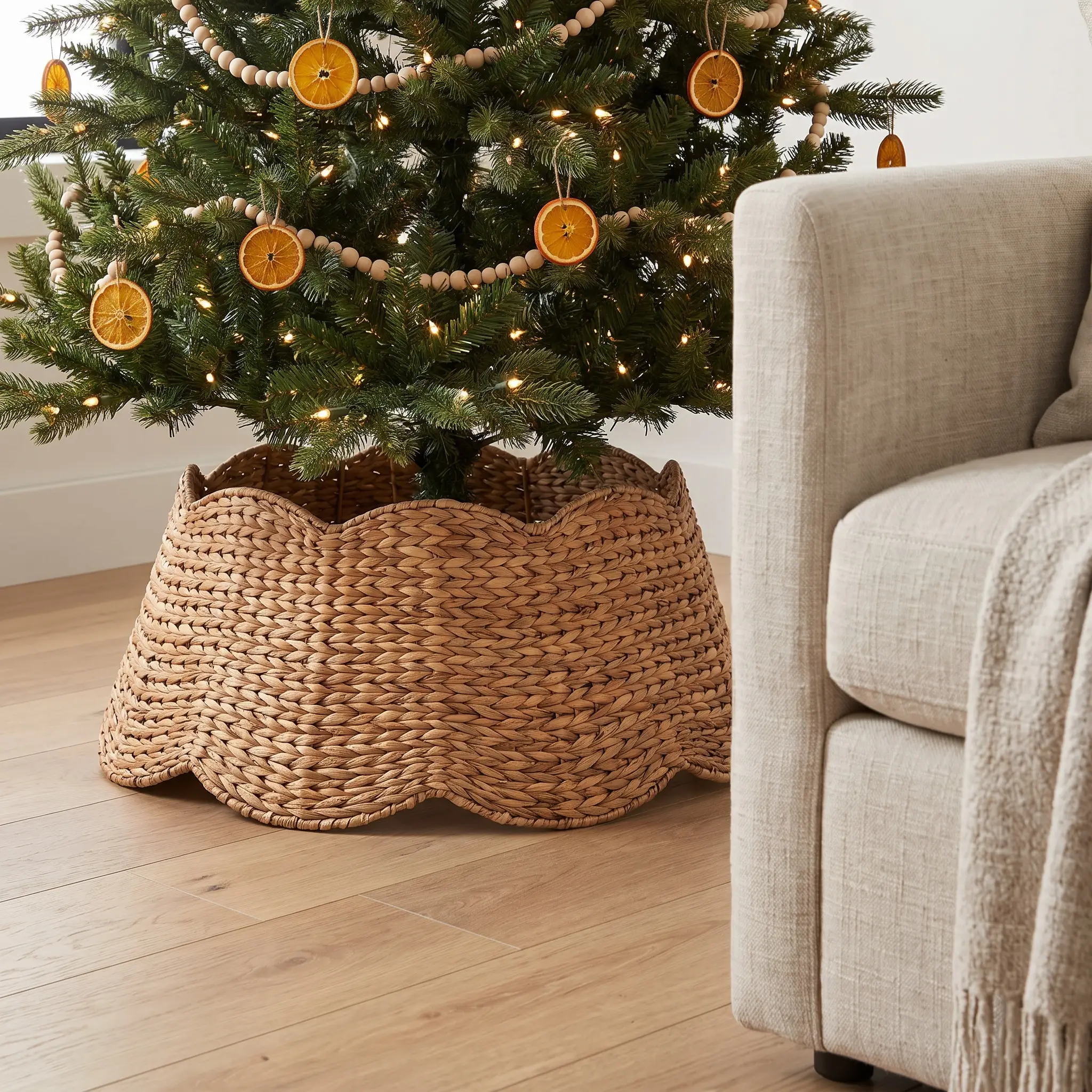
Standard fabric skirts often get messy, collect dust, and look untidy as presents are moved. The 2026 standard favors architectural tree collars—specifically scalloped rattan, woven hyacinth, or ribbed brass—which provide a clean, structured base that grounds the tree visually.
- Vibe: Organic Modern / Tailored
- Key Materials: Scalloped rattan, woven water hyacinth, ribbed brass
- Sourcing Warning: Always measure the maximum diameter of your metal tree stand before purchasing a collar to ensure it fits inside.
- Styling Pro-Tip: If you have a live tree, ensure the collar you select allows easy access to the water basin.
22. Layer a Vintage Rug as a Bohemian Skirt
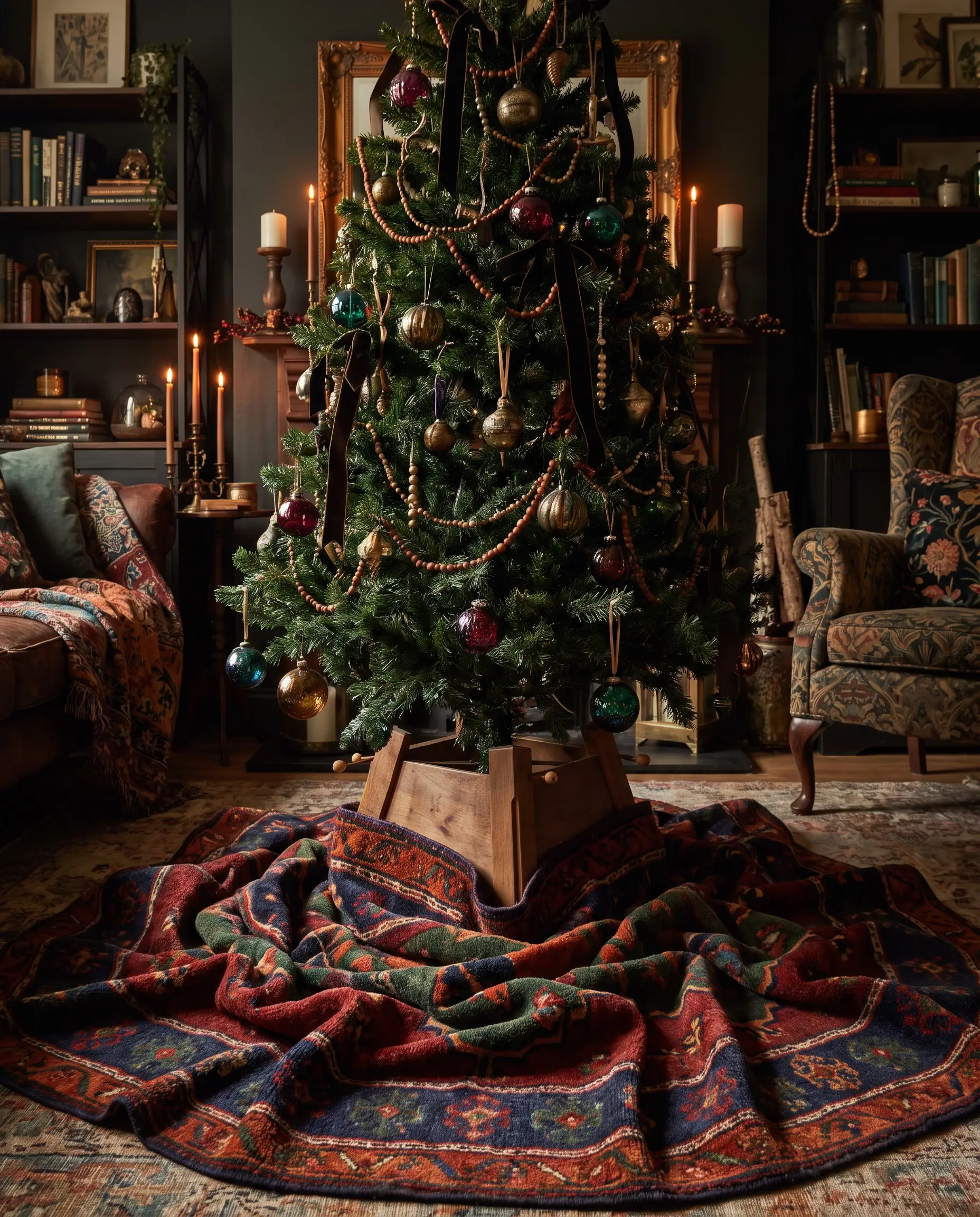
For Moody Maximalist or highly eclectic spaces, skip the traditional, perfectly round tree skirt entirely. Instead, softly rumple a small, authentic Turkish or Persian runner around the base to create a rich, effortless foundation.
- Vibe: Moody Maximalist / Eclectic
- Key Materials: Authentic wool Turkish or Persian runner (approx. 3×5 feet)
- Technique Focus: The “rumple”—do not lay it flat; create soft folds and peaks to build volume around the stand.
- Styling Pro-Tip: Pull the colors of your ornaments directly from the dominant hues woven into the vintage rug.
23. Crown with a Dramatic Capiz Shell Star
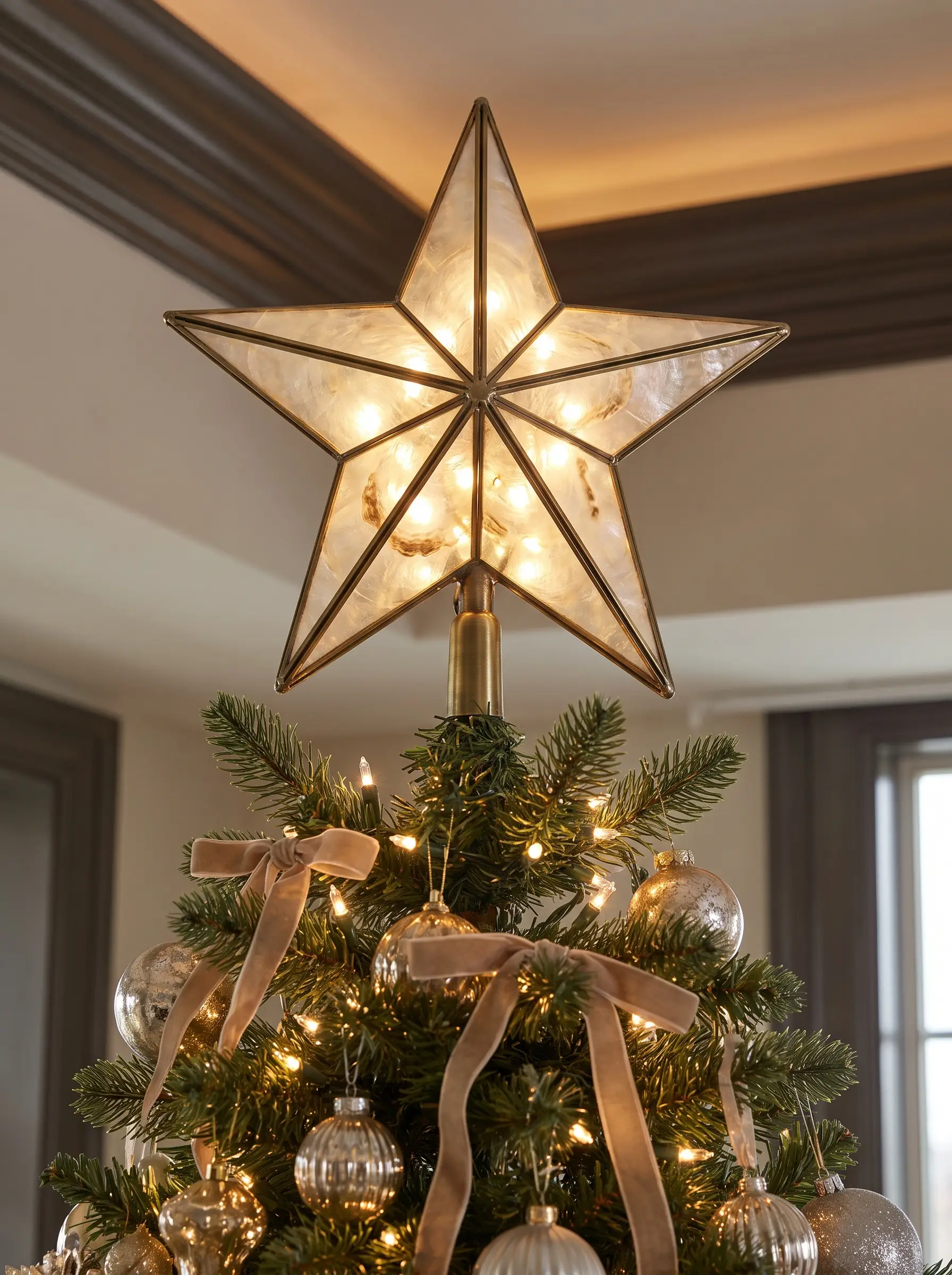
Move away from heavy, leaning plastic stars that force the top branch to bend awkwardly. Capiz shell offers a stunning, translucent glow when backlit by the highest canopy lights, remaining incredibly lightweight and architecturally beautiful.
Never rely on the flimsy top branch of an artificial tree to support your topper. Reinforce the central peak by zip-tying a green wooden dowel or heavy-gauge floral wire to the top stem, ensuring the star stands perfectly rigid and straight.
Hackrea Styling Tip
- Vibe: Transitional Elegance
- Key Materials: Authentic Capiz shell, brass framing
- Lighting Strategy: Ensure a cluster of warm white lights is positioned directly behind the shell to illuminate its natural veining.
- Styling Pro-Tip: Scale is critical; a 9-foot tree requires a star that is at least 10 to 12 inches tall to look proportionate.
24. Opt for a Subdued Long-Tail Ribbon Bow
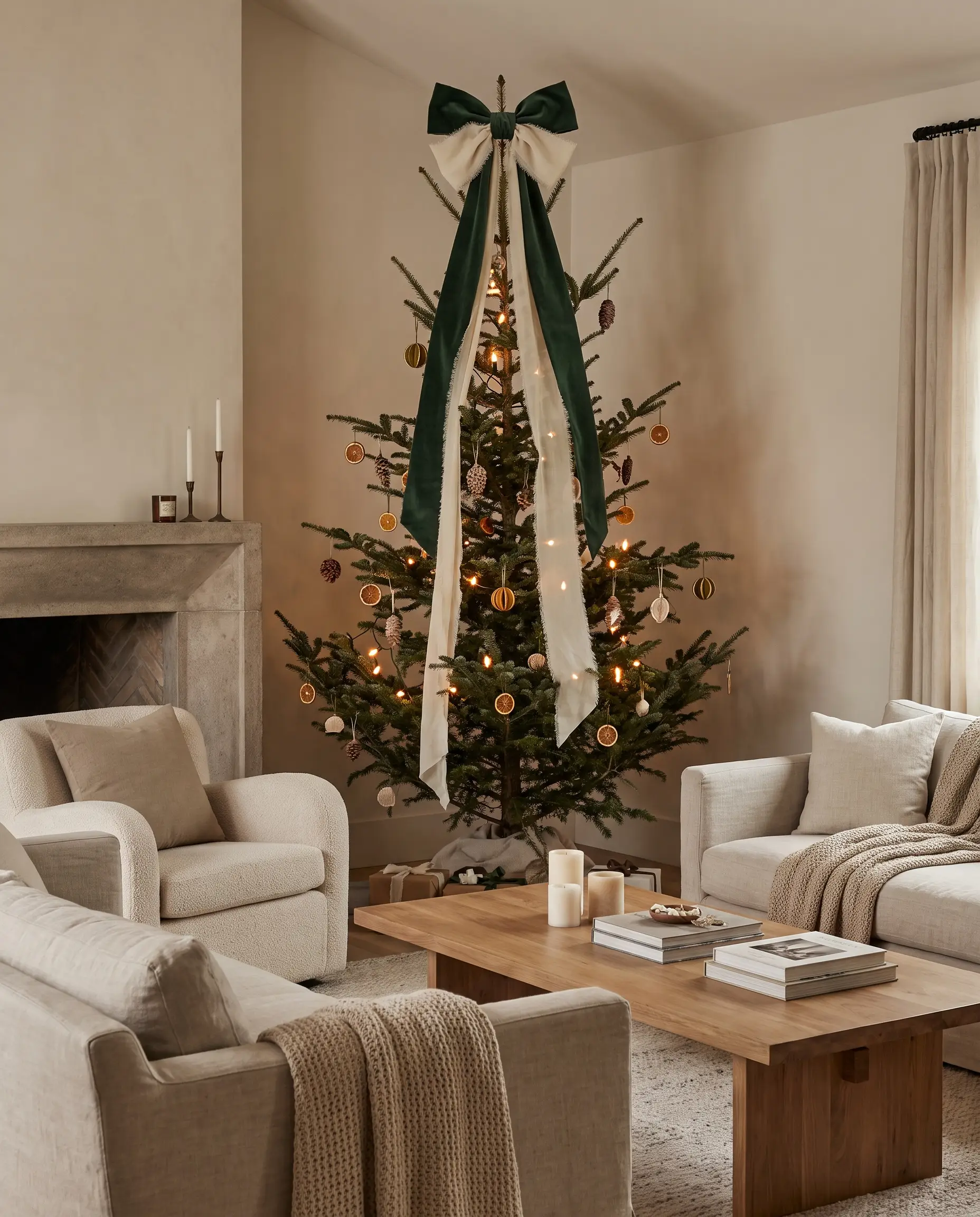
For a softer, more romantic finish that leans into the organic modern aesthetic, bypass structural toppers entirely. Tie a simple, oversized bow using wide velvet or frayed silk at the very peak, letting the tails trail halfway down the length of the tree.
- Vibe: Organic Luxury / Soft Minimalist
- Key Materials: 4-to-6-inch wide silk chiffon or heavy velvet
- Technique Focus: The bow must be relaxed and drooping, strictly avoiding stiff, overly perfect wired loops.
- Styling Pro-Tip: Cut the trailing tails at uneven lengths to enhance the organic, asymmetrical cascade.
Curating Your 2026 Holiday Centerpiece
The most magnificent holiday centerpieces are never bought in a single box; they are built through thoughtful layers, spatial discipline, and personal curation over time. You do not need to overhaul your entire collection to achieve a professional aesthetic this year. Pick one distinct color palette to thread through your existing pieces, experiment with the trunk-to-tip lighting method, or transition to a sparse Silvertip fir to instantly modernize your space.
Design is an ongoing practice of refinement. As you begin pulling your winter textiles and heirloom glass from storage, treat the tree not as a chore, but as an architectural canvas. If you are ready to continue refining your home’s seasonal transitions, subscribe to the Hackrea newsletter below for our weekly deep-dives into winter interior styling, spatial lighting guides, and bespoke sourcing lists.

The Hackrea Style Desk treats interior decoration as an exact visual science. Rather than focusing on demolition or floor plans, this desk masters the art of color theory, undertone matching, material pairings, and spatial proportion. From balancing the visual weight of mixed metals to finding the perfect bridging tone between disparate wood species, this desk provides the rigorous aesthetic rules needed to achieve high-end, editorial-quality harmony in any space.