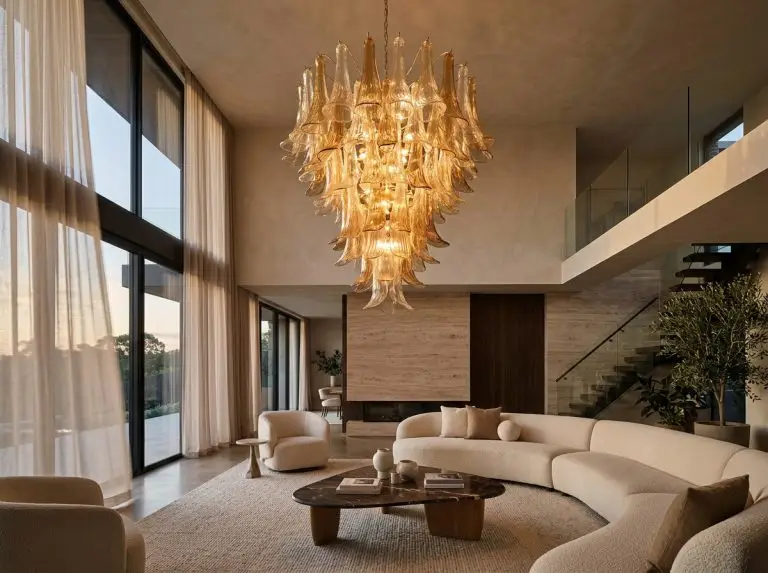
Murano blown glass chandeliers do more than illuminate a room: they introduce color, movement, craftsmanship, and a distinctive sense of history. Their sculptural forms can transform an otherwise practical ceiling fixture into the visual center of an interior, creating an atmosphere that changes subtly from daylight to evening.
Where Light Meets Venetian Craftsmanship
The character of a Venetian chandelier begins with glass shaped by hand rather than produced as a perfectly uniform industrial component. Skilled glassmakers work with heat, timing, and gravity to form curved arms, cups, leaves, flowers, pendants, and decorative flourishes. Slight variations may remain between individual elements, but these nuances are part of the object’s identity. They reveal the human process behind the finished piece and allow the chandelier to feel expressive instead of mechanically repetitive.
Light gives those crafted details a second life. Transparent glass creates crisp reflections and an airy appearance, while amber, ruby, blue, green, pink, or amethyst tones can spread gentle color throughout a room. Gold leaf adds warmth and ceremonial richness, especially when paired with traditional silhouettes. The result is not simply decorative glass surrounding a bulb, but a layered composition in which illumination passes through color, texture, and ornament before reaching the wider interior.
Choosing a Chandelier for the Room
Scale is the first practical consideration. A chandelier must relate to the room’s width, ceiling height, furnishings, and available space beneath it. Large multi-tiered designs can create an impressive focal point in entrance halls, stairwells, and formal living rooms. More compact models may be better suited to bedrooms, dining areas, or apartments where visual presence matters but excessive volume would feel intrusive. The number and arrangement of lights also influence whether the fixture appears delicate, balanced, or deliberately dramatic.
Color and frame finish determine how naturally the chandelier joins the surrounding design. A chrome frame can give traditional glasswork a cleaner, cooler edge, whereas a gold-toned structure reinforces its classical Venetian character. Homeowners and designers exploring Murano blown glass chandeliers can compare transparent, monochromatic, multicolored, and gold-leaf compositions alongside different light configurations. This range makes it possible to select a piece that complements the architecture without merely matching every existing color in the room.
A useful approach is to treat the chandelier as the beginning of a visual conversation. In a restrained interior, vivid glass can provide the single strong accent that prevents the space from appearing impersonal. In a room already rich in pattern and antique furniture, clear or softly tinted glass may add brilliance without increasing visual weight. The most convincing choice usually creates a relationship between old and new rather than forcing the fixture into one rigid decorative category.
Designing Around a Statement in Glass
Once installed, Murano blown glass chandeliers deserve enough surrounding space to be appreciated from several viewpoints. Tall furniture, oversized wall art, or competing ceiling fixtures can weaken their impact. A calmer arrangement allows the eye to follow the chandelier’s branching arms and repeated glass details. Mirrors can extend its reflections, while polished stone, dark wood, velvet, and understated metal surfaces provide contrasting textures that make the glass appear even more luminous.
Careful lighting choices are equally important. Warm illumination tends to emphasize amber, gold, ruby, and pink glass, creating a comfortable evening atmosphere. Cooler light can sharpen transparent or blue elements and produce a more contemporary impression. Dimmers add flexibility by allowing the same chandelier to support daily activities, quiet dinners, or formal gatherings. The goal is not always maximum brightness; controlled illumination often reveals the depth and contours of handmade glass more effectively.
Murano blown glass chandeliers remain compelling because they combine function with unmistakable artistic presence. They can enrich classical architecture, bring personality to modern rooms, and become lasting reference points around which an interior evolves. Chosen with attention to proportion, color, and light quality, a Venetian chandelier is not simply added to a space. It helps define how that space is seen, experienced, and remembered.