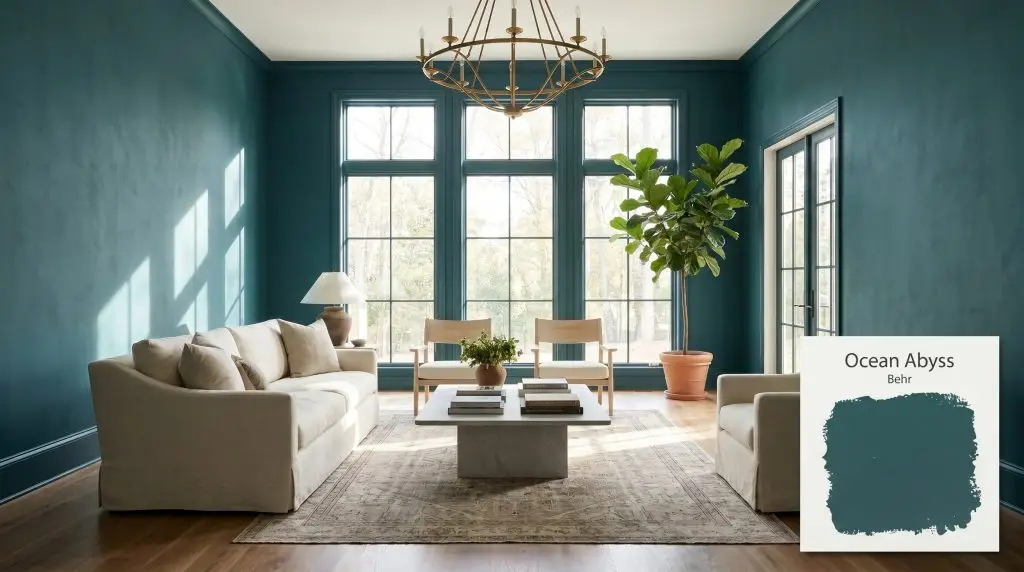
Behr Ocean Abyss (MQ6-01) is a deep, moody, and nautical dark teal with a cool gray cast. Boasting an LRV of 8, it brings immense drama and sophistication to a space, but requires ample natural or artificial light to prevent its rich blue-green tones from reading flat or muddy.
Will Ocean Abyss clash with your room?
Paint Technical Profile
| Color ID / SKU | MQ6-01 |
| HEX Code | #2a565b |
| Light Reflectance (LRV) | 8 |
| Temperature | Cool |
| Primary Undertone | Deep Blue-green |
| Hidden Undertones | Cool Gray Cast |
| Use | Interior, Exterior |
| Best Exposures | West-facing, South-facing |
| Best For | Moody bedroom walls, dramatic dining rooms, home office accent walls, painted bathroom cabinets, cozy basements (with ample artificial light) |
Ocean Abyss Digital Design Concept Boards
Moody bedroom walls
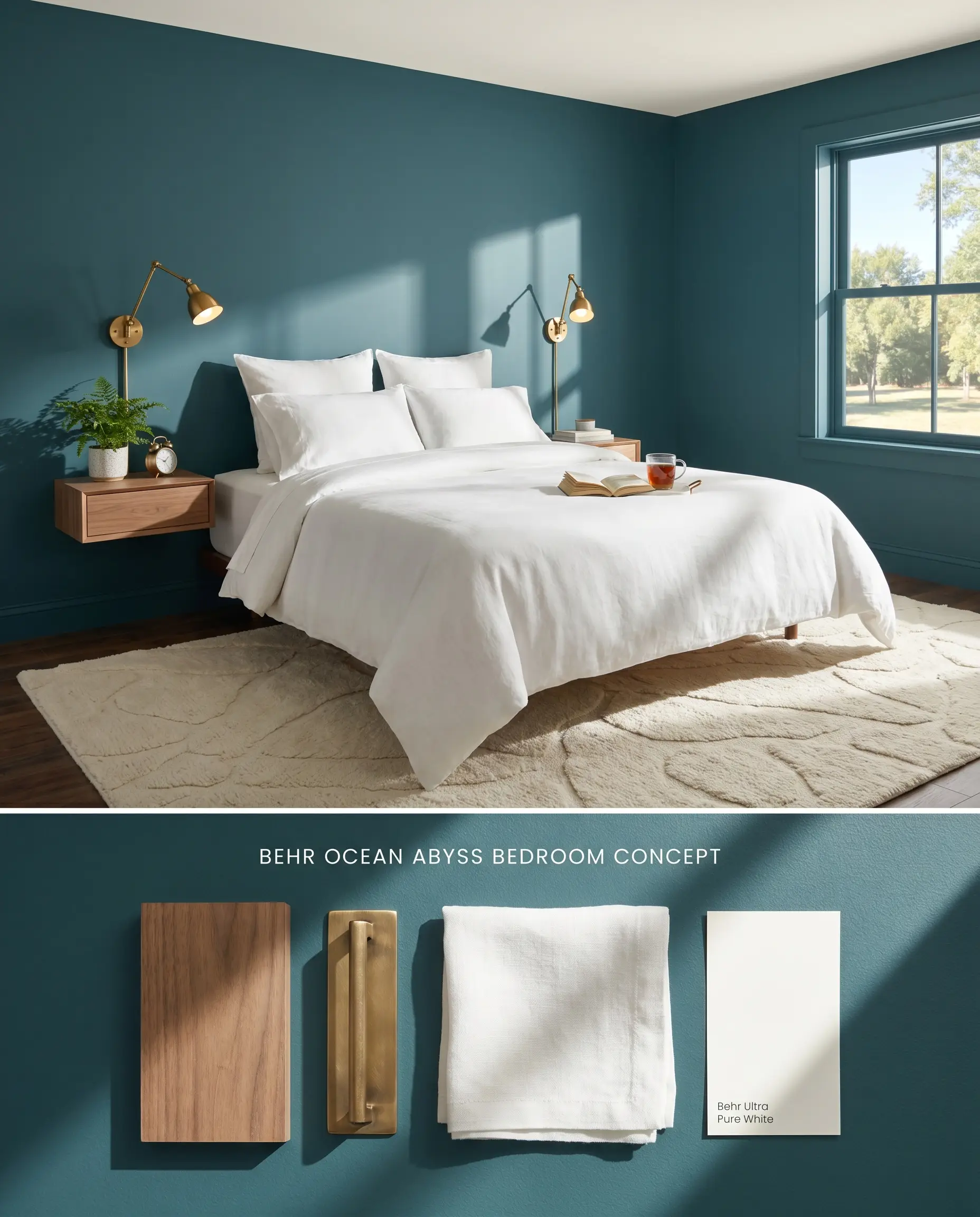
Color drenching the walls and trim in this jewel-toned hue collapses the visual boundaries of a sleeping space, creating an enveloping, restorative environment. The low light reflectance value of 8 absorbs ambient light, grounding the room and pushing the walls outward. Introducing light walnut furnishings prevents the deep teal from swallowing the room’s architectural footprint.
Dramatic dining rooms
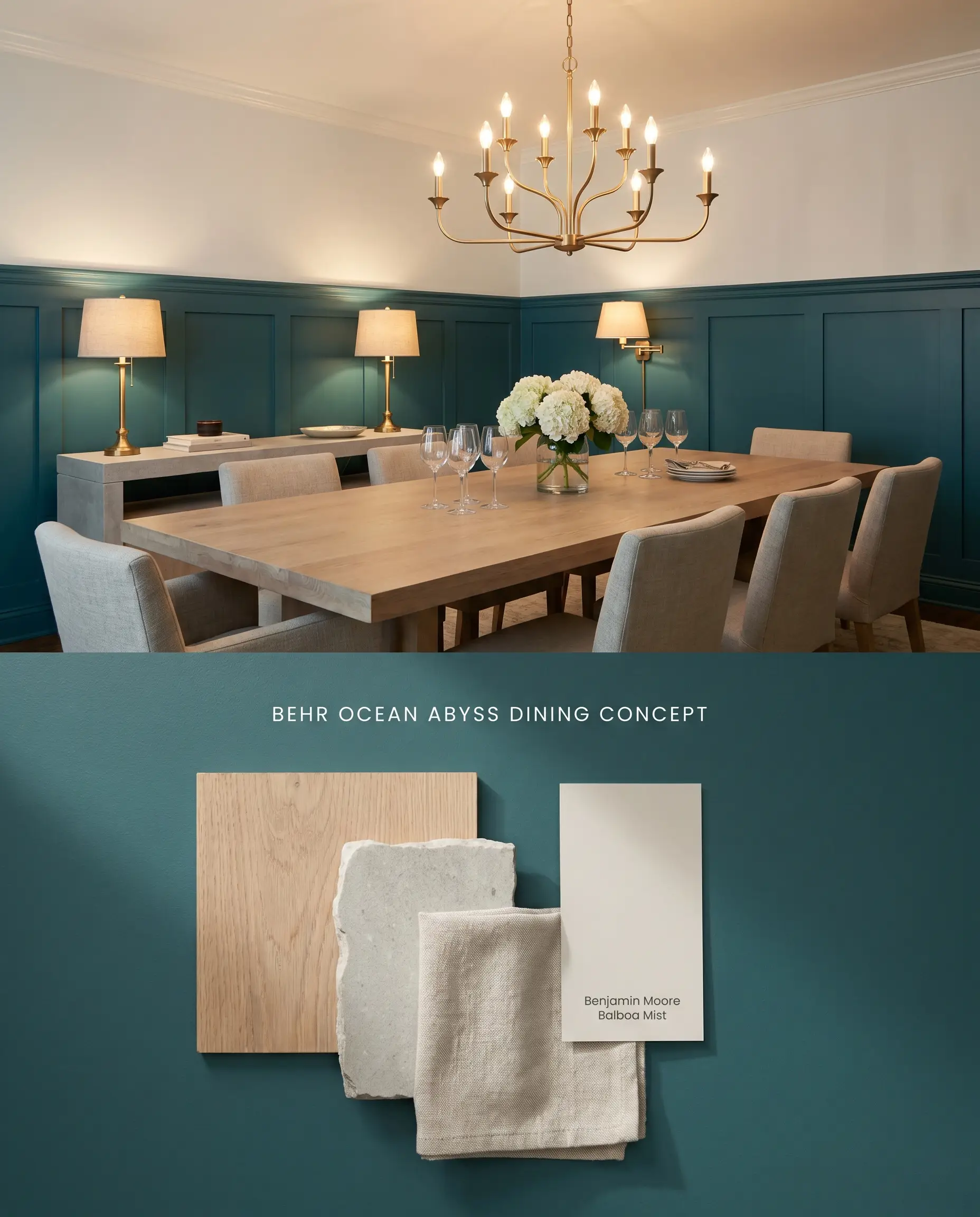
A formal dining space leverages the moody coastal energy of this teal, providing a high-contrast backdrop for reflective metals and glowing table lamps. The cool gray cast beneath the blue-green surface prevents the room from feeling overwhelmingly saturated. Pairing this deeply saturated wall color with a high-contrast trim establishes a crisp, tailored perimeter.
Home office accent walls
Will Ocean Abyss work with your specific lighting, floor, or furniture?
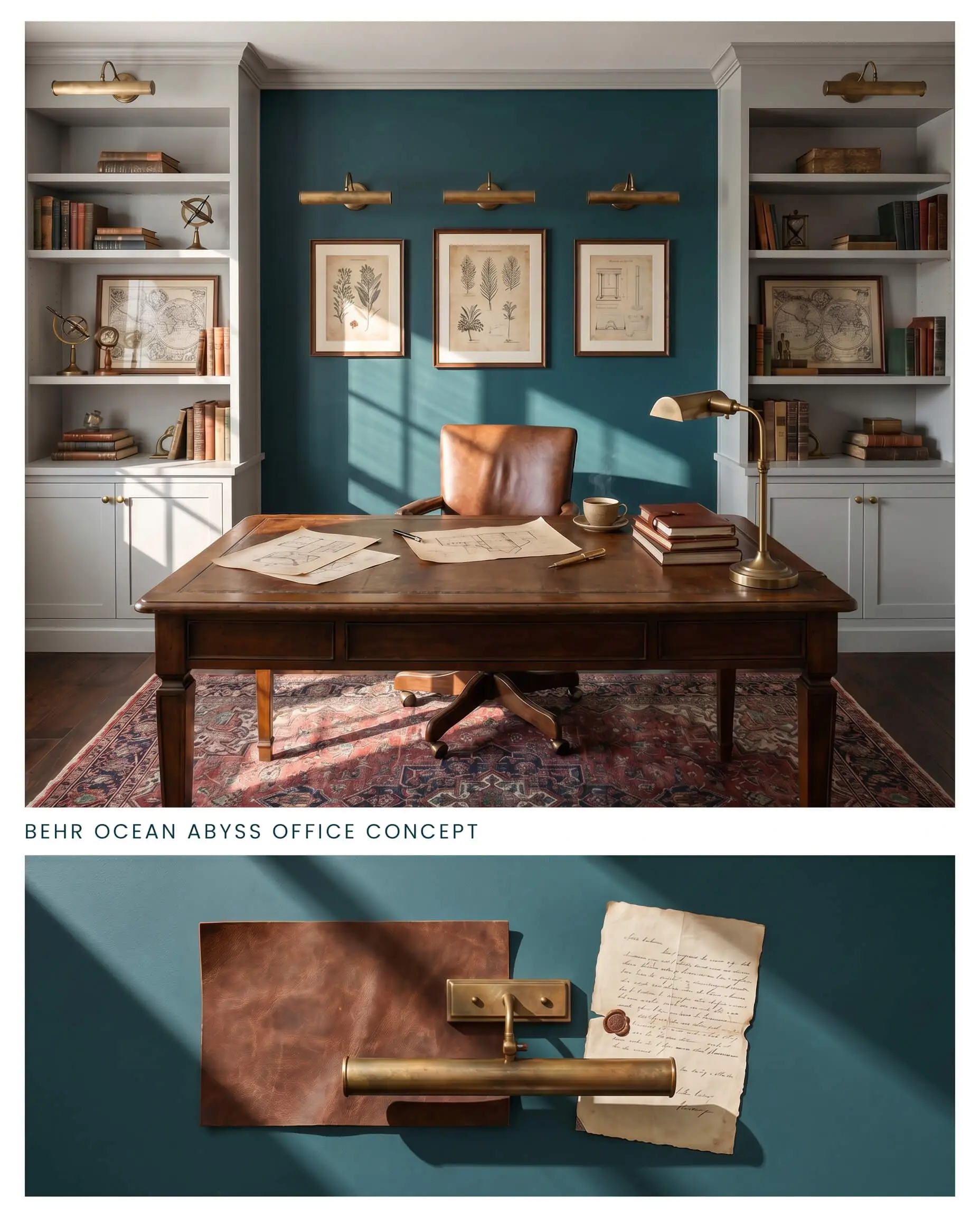
Confining this nautical teal to a single focal wall anchors a workspace without triggering a low light trap in a standard-sized room. The concentrated burst of color directly behind a desk reduces eye strain by absorbing harsh monitor glare. Flanking the wall with light grey built-ins pulls the blue-green forward while maintaining a professional, structured aesthetic.
Painted bathroom cabinets
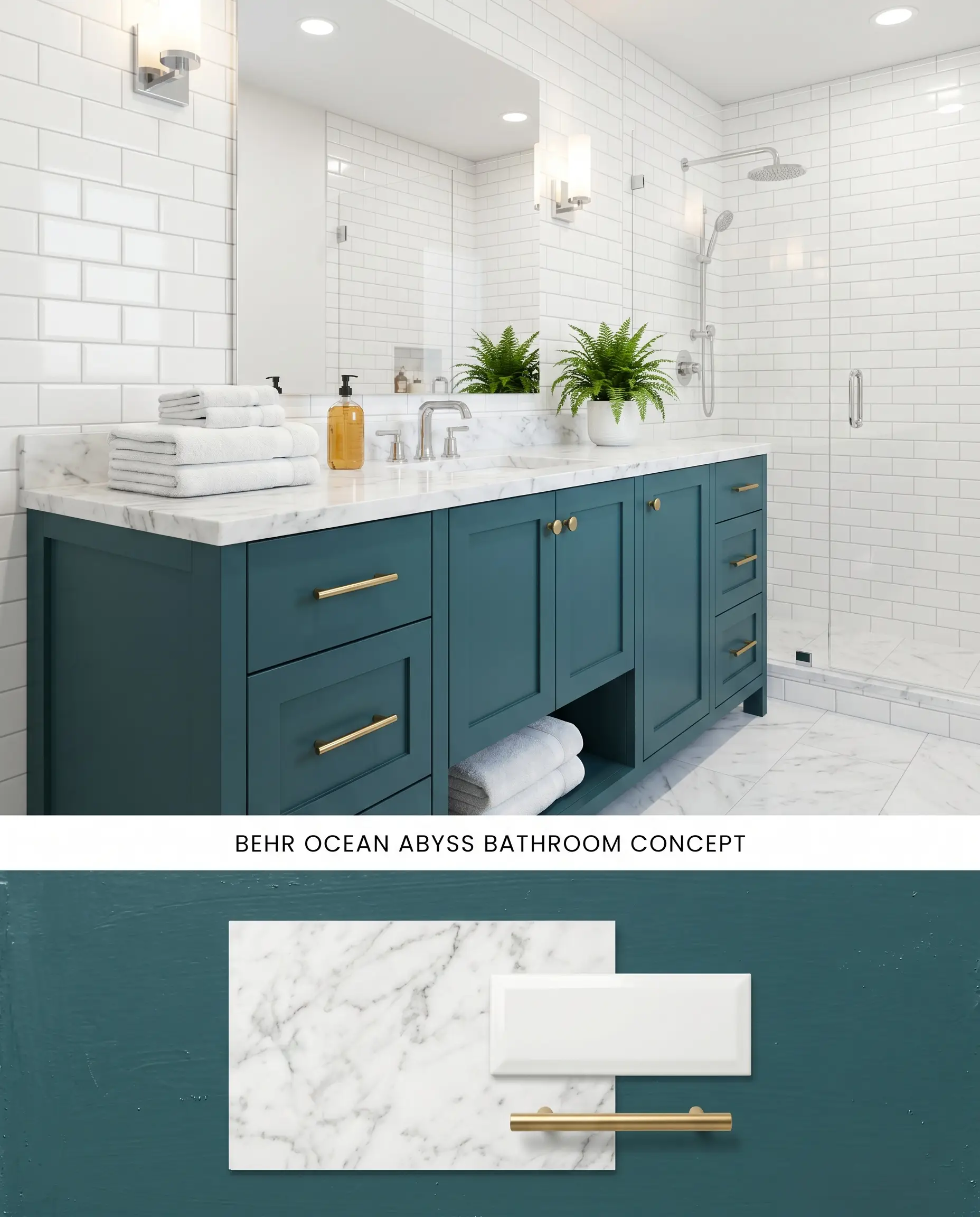
Applying this deep hue to vanity cabinetry anchors a stark, tiled bathroom with a solid block of color. The rich pigmentation interacts with glossy subway tiles and polished chrome fixtures, reflecting light back onto the dark wood to emphasize the teal base. Keeping the surrounding walls bright ensures the cabinetry remains a distinct architectural feature rather than blending into the shadows.
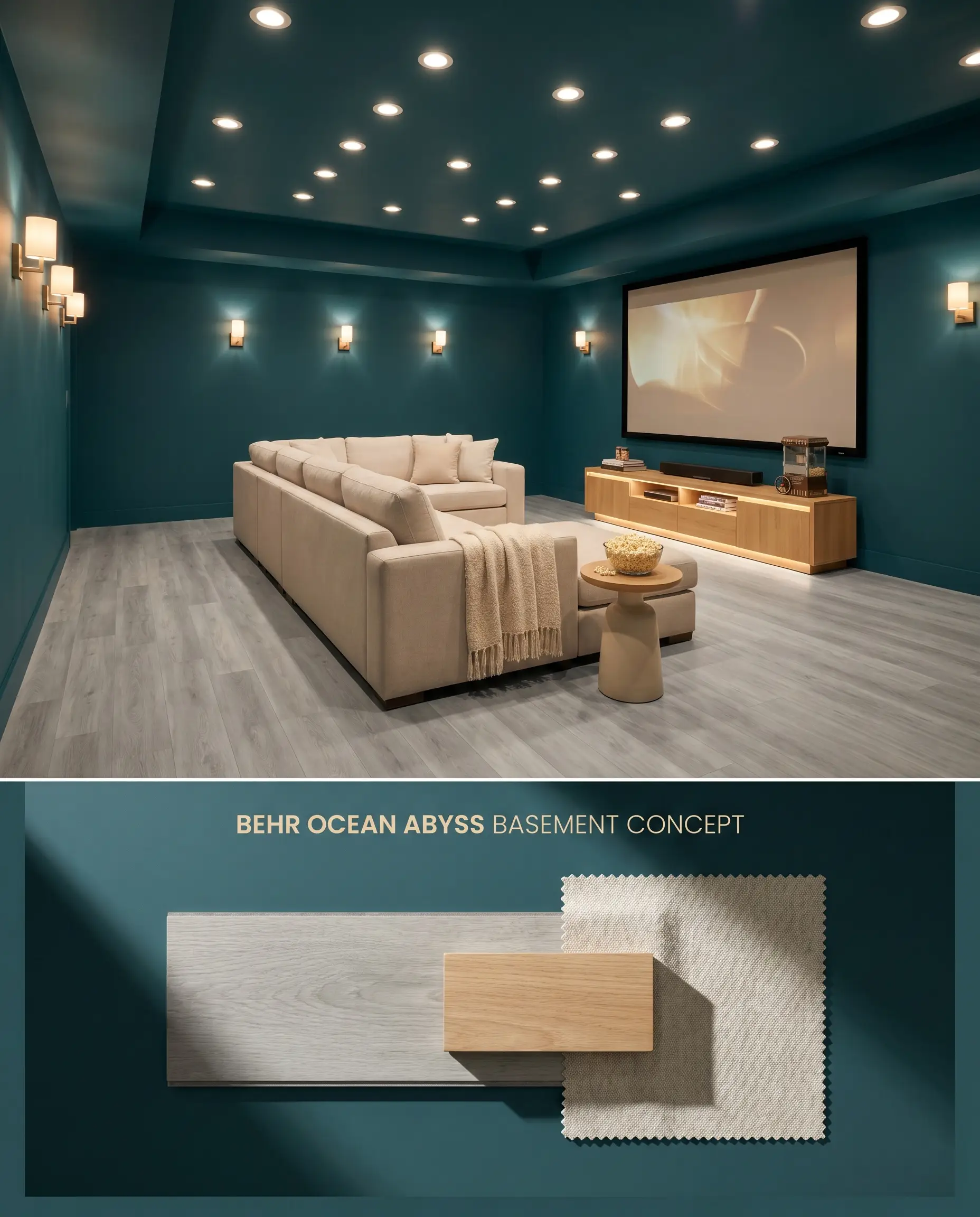
Cozy basements (with ample artificial light)
Will Ocean Abyss work with your specific lighting, floor, or furniture?
Transforming a subterranean footprint requires leaning into the dark paint profile rather than fighting it. Wrapping the walls in this hue creates a theater-like environment where the boundaries of the room blur and recede. Aggressive lighting strategies and light-reflecting textiles are mandatory to counteract the aggressive light absorption of the walls.
Comparing Blue-Green Architectural Finishes
Behr Ocean Abyss MQ6-01 vs. Sherwin-Williams Seaworthy SW 7620
Sherwin-Williams Seaworthy (SW 7620) carries an LRV of 7, making it marginally darker and noticeably more navy-dominant than Behr Ocean Abyss MQ6-01. While Ocean Abyss maintains a clear green undertone that reads as a nautical teal, Seaworthy pushes toward an indigo base, resulting in a cooler, stricter blue profile. Specify Seaworthy for rooms with warm Western light that need cooling down, but deploy Ocean Abyss when you want to emphasize a jewel-toned, green-leaning depth in a Southern-facing space.
Behr Ocean Abyss MQ6-01 vs. Benjamin Moore Dark Teal 2053-20
Will Ocean Abyss work with your specific lighting, floor, or furniture?
Benjamin Moore Dark Teal (2053-20) shares a nearly identical LRV (9.12) to Behr Ocean Abyss MQ6-01 but features a slightly higher saturation of pure green. Ocean Abyss relies on a cool gray cast to mute its vibrancy, giving it a more subdued, architectural feel on large wall expanses. Choose Dark Teal for a more vivid, high-energy accent wall in a brightly lit room, and reserve Ocean Abyss for full-room color drenching where a muted backdrop is required.
Behr Ocean Abyss MQ6-01 vs. Behr Tsunami S450-7
Behr Tsunami (S450-7) registers with a slightly higher LRV of 9 and leans much further into a vibrant, true blue-green without the graying agents found in Ocean Abyss MQ6-01. Tsunami will bounce more light and maintain its color identity even in moderately lit spaces, whereas Ocean Abyss aggressively absorbs light and risks turning black in shadows. Opt for Tsunami in North-facing rooms to inject missing warmth and color, but use Ocean Abyss in sun-drenched spaces where the intense light can fully penetrate its dense formulation.
Technical Specifications and Low Light Reflectance FAQs
Yes, its low LRV of 8 causes it to act as a low light trap, absorbing ambient light aggressively. Without substantial artificial lighting or natural sun, the teal quality vanishes, leaving a muddy, nearly black finish.
Dark wood furniture will completely blend in and vanish against this chromatic profile. To maintain visual separation, you must use lighter woods like bleached oak, light walnut, or pale greys.
A matte or flat finish minimizes surface imperfections, but glossier applications will make the blue-green base read deeper and richer. Higher sheens require meticulous surface prep as they highlight every drywall flaw.
In cool, North-facing light, the color’s gray cast dominates, making it read flat and dark. In warm, West-facing afternoon light, the green undertones are activated, revealing its true jewel-toned, nautical teal character.
Room Compatibility & Clashes Diagnoses
Hackrea's reports evaluating the compatibility of Ocean Abyss in real rooms.No compatibility tests for Ocean Abyss yet.
Be the first to see how this color reacts to your space. Run a free architectural diagnostic now.
Paint Aesthetic & Practical Analysis
| Profile | Analysis | |
|---|---|---|
| Aesthetic | Ocean Abyss is a showstopper for those wanting to embrace the dark academia or moody coastal aesthetic. It’s incredibly rich, but be warned—it demands excellent lighting. Without it, the stunning teal nuance gets lost in the shadows. | |
| The Coverage Catch | As a dark, low-LRV architectural finish, surface prep is critical. Scratches, dents, and sheen differences will show clearly. Uneven substrates may require extra attention, and glossier applications will make the blue-green base read deeper. | |
| The Lighting Shift | Without enough natural light, Ocean Abyss loses its vibrant teal quality and can look extremely dark, almost black or muddy. You won't get the rich, jewel-toned feel without a lot of sun or well-placed artificial lighting. | |
| The Clash Warning | Dark furniture tends to vanish against this chromatic profile. If you have black or very dark wood furniture, it may get 'eaten' by the walls. Opt for lighter woods, greys, or walnuts for contrast. | |
| The Low Light Trap | In windowless rooms or basements, the walls will absorb light aggressively. You will need significantly more artificial lighting than you might expect to keep the room from feeling like a cave. |