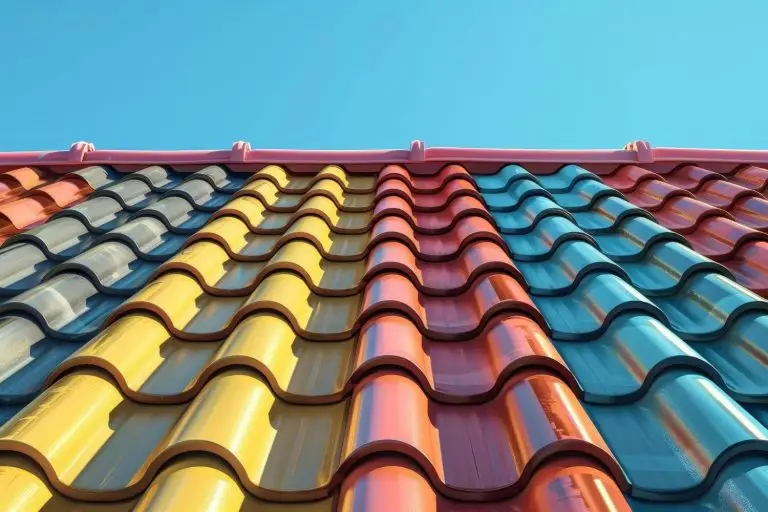
Most exterior color decisions are reversible. Front door: a weekend. Shutters: an afternoon. Body color: expensive, disruptive, but entirely doable, and plenty of people repaint a house twice in the time they own it.
The roof is not like that. It covers more visible surface than anything except the walls, it sets the value range the whole facade has to live inside, and you replace it roughly twice in a lifetime. Which makes it strange that it’s usually chosen last, fastest, and with the least information.
The Element You Choose Least Often
Think about how the decision actually happens. Something fails or a storm hits, you get quotes, and somewhere in a conversation that is mostly about money and scheduling, a sample board comes out. You pick from perhaps eight options in ninety seconds.
Compare that to how long you spent on a paint color for one bedroom. The imbalance isn’t laziness. It’s that roofing is sold as a repair and paint is sold as a choice, so we bring completely different attention to them.
Roofs Have Undertones, Same As Paint
Everything a designer knows about undertones applies here and almost nobody transfers the knowledge.
Architectural shingles are blends. What reads as “gray” from the curb is usually a mix of granules that includes blue-gray, brown-gray, and sometimes a genuinely warm tan, and the blend’s dominant temperature is what will fight or flatter your brick. The same applies to “black,” which is almost never neutral. Some blacks lean blue and some lean brown, and on a large surface that lean becomes the whole character of the house.
Ask for the blend name and look at what’s actually in it. A shingle called Weathered Wood and one called Driftwood can sit in completely different temperature families.
Start With the Fixed Elements, Not the Swatch
Here’s the ordering rule that solves most exterior palettes: identify what you cannot change, then choose everything else around it.
Brick is fixed. Stone is fixed. An existing roof with fifteen years left is fixed. The things you can adjust are body color, trim, door, shutters, and gutters. If you’re replacing the roof, it moves temporarily out of the fixed column and into the chosen column, which is exactly the moment to think hard.
And this is why roof color gets chosen badly so often. The decision happens under fluorescent light, from a sample the size of a postcard, at the end of a conversation about deductibles. Somebody working through a hail-season backlog, and Roofing The Woodlands TX will be one of many contractors in that position after a bad Gulf Coast summer, is not being paid to have a view on how the blend sits against your brick. That part is yours, and nobody will raise it if you don’t.
The Brick Problem
Brick is where exterior palettes go wrong, because brick is never one color and it never gets replaced.
A red brick with orange undertones will make a cool gray roof look blue and slightly sour. A brown-toned brick and a blue-black roof produce a combination that reads as accidental, because it is. Meanwhile a warm gray-brown shingle over the same brick looks considered without anyone being able to say why.
If your house has brick or stone on any elevation, that material is the palette’s parent. Pull three colors out of it, hold shingle samples against it outdoors, and eliminate anything that makes the brick look dirty.
Why Gray Roofs Went Everywhere
There’s a reason so much recent housing stock has a gray roof, and it isn’t purely fashion.
Gray blends are the most forgiving option against the widest range of body colors, which makes them the safe specification for a builder producing two hundred houses with six exterior schemes. Safe is not the same as right, though, and on a house with a strong existing material, a warmer or darker choice will often do considerably more.
Dark Roofs Cost More Than They Look
The aesthetic argument for a very dark roof is real. It grounds a facade, it makes trim pop, and it photographs beautifully.
The thermal argument runs the other way, and it’s larger than most people assume. Solar reflectance measures the fraction of sunlight a surface bounces back rather than absorbing as heat, and the Department of Energy’s guidance on cool roofs puts most dark roofing materials at somewhere between 5 and 20 percent reflectance, against 55 to 90 percent for light-colored materials. That is not a marginal difference. It’s most of the sunlight hitting the largest surface of your house either coming in or going back out.
In a cold climate the tradeoff is genuinely arguable. In a hot one it isn’t, particularly on a house with an underinsulated attic. If you want the dark look in a hot region, the compromise worth asking about is a darker blend with a higher reflectance rating rather than the darkest option on the board.
Sample Boards Lie At Roof Scale
Two distortions to correct for.
Scale: a granule blend that reads as a rich mottled texture on a postcard reads as a single flat color from sixty feet away, and the flat color is usually darker and less interesting than the sample suggested. Light: a roof is seen mostly in daylight from below and at an angle, never flat under a showroom fixture.
The fix costs nothing. Get the largest samples the supplier has, take them outside, and prop them against the house at roof height while somebody stands at the curb.
Trim Is the Adjustment Knob
Once the roof is set, trim is where you buy back flexibility. A warm white against a cool roof will pull the whole scheme toward neutral. A trim that matches the roof’s undertone will make the composition read as deliberate.
This is the cheapest lever in the entire exterior palette and the one people reach for last, usually after deciding the roof was a mistake.
Choose the Roof Once, Then Build Outward
The practical sequence is simple and almost nobody follows it. Look at what can’t change. Pick the roof against that, outdoors, at scale. Then choose body, trim and door in that order, each one responding to what came before.
Do it backwards, starting from a body color you loved on a paint chip, and you’ll spend the next two decades adjusting everything around a roof that was never going to cooperate.