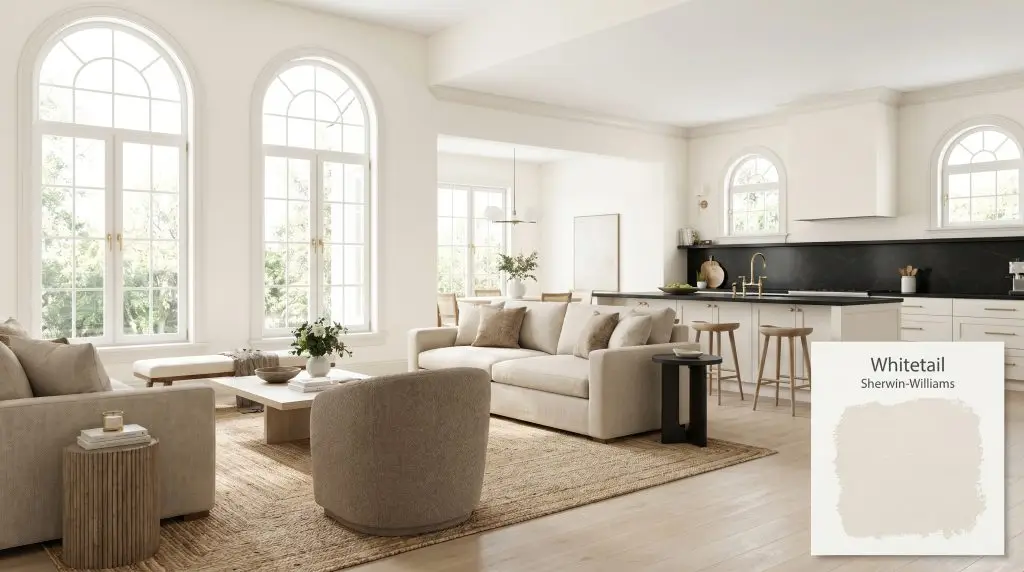
Sherwin-Williams Whitetail (SW 7103) is a bright, creamy warm white with an LRV of 86. Known for its soft yellow undertones, it adds a cozy, inviting glow to interiors without feeling overly stark or sterile, making it ideal for cabinets and living spaces.
Will Whitetail clash with your room?
Paint Technical Profile
| Color ID / SKU | SW 7103 |
| HEX Code | #F4EFE4 |
| Light Reflectance (LRV) | 86 |
| Temperature | Warm |
| Primary Undertone | Yellow |
| Hidden Undertones | Cream, Faint Beige |
| Use | Interior, Exterior |
| Best Exposures | North-facing or East-facing |
| Best For | Kitchen cabinets, living room walls, bedroom walls, trim and molding, bathroom vanities |
Whitetail Digital Design Concept Boards
Kitchen Cabinets
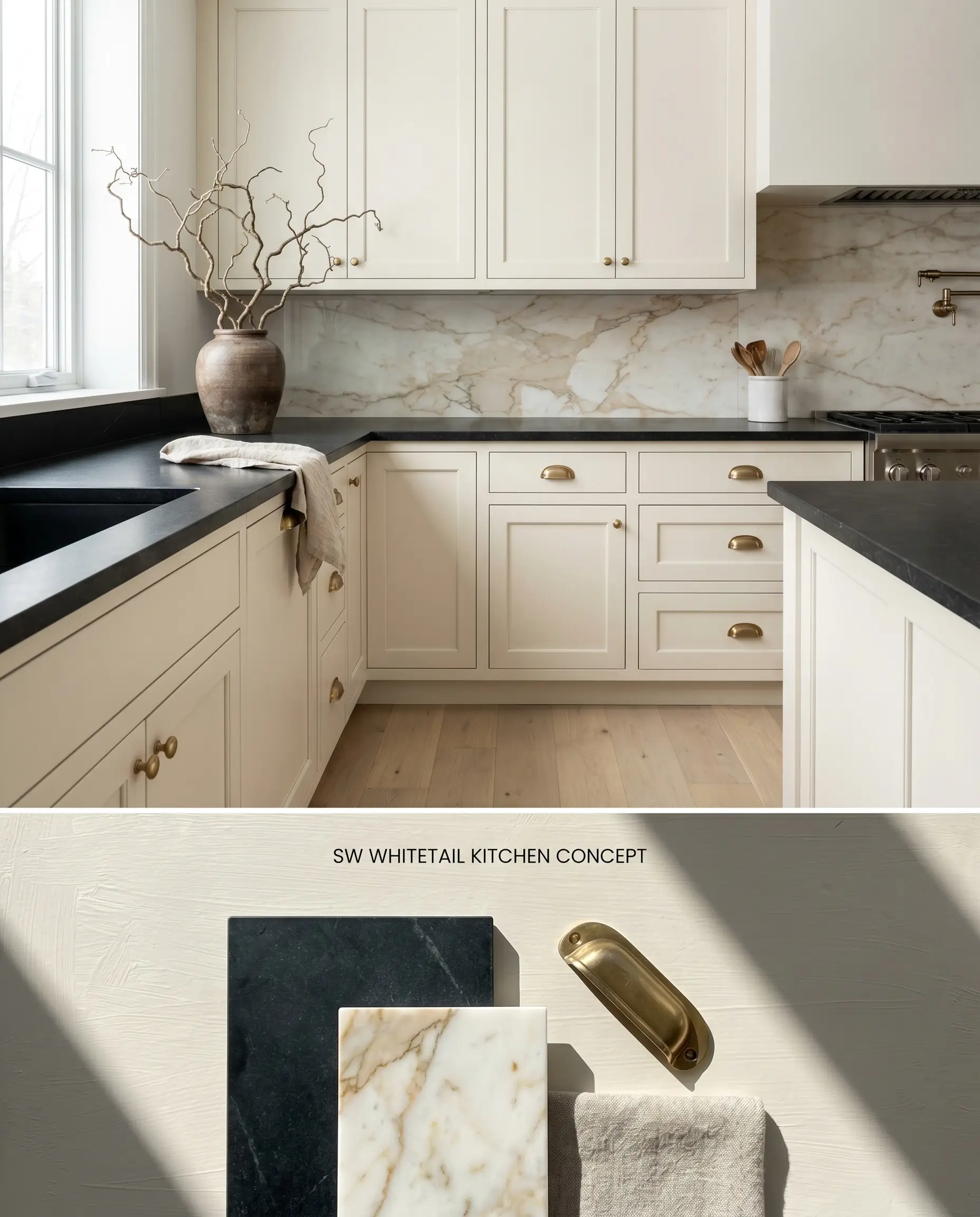
Whitetail reads as a creamy off-white on upper and lower cabinetry when grounded by the dense, matte visual weight of honed absolute black granite. Because it clashes with cool grays, the surrounding hard surfaces must share its warm chromatic profile to prevent the cabinet paint from appearing dingy. Utilizing unlacquered brass hardware pulls the underlying warmth forward while adding a reflective metallic contrast against the soft doors.
Living Room Walls

With a light reflectance value of 86, this warm white expands living spaces provided there is ample natural light to prevent the corners from looking muddy. Reddish-brown floors will physically bounce light onto the walls and intensify the color cast, so pairing this hue with pale white oak flooring finished in a matte, clear sealer controls the overall color temperature.
Bedroom Walls
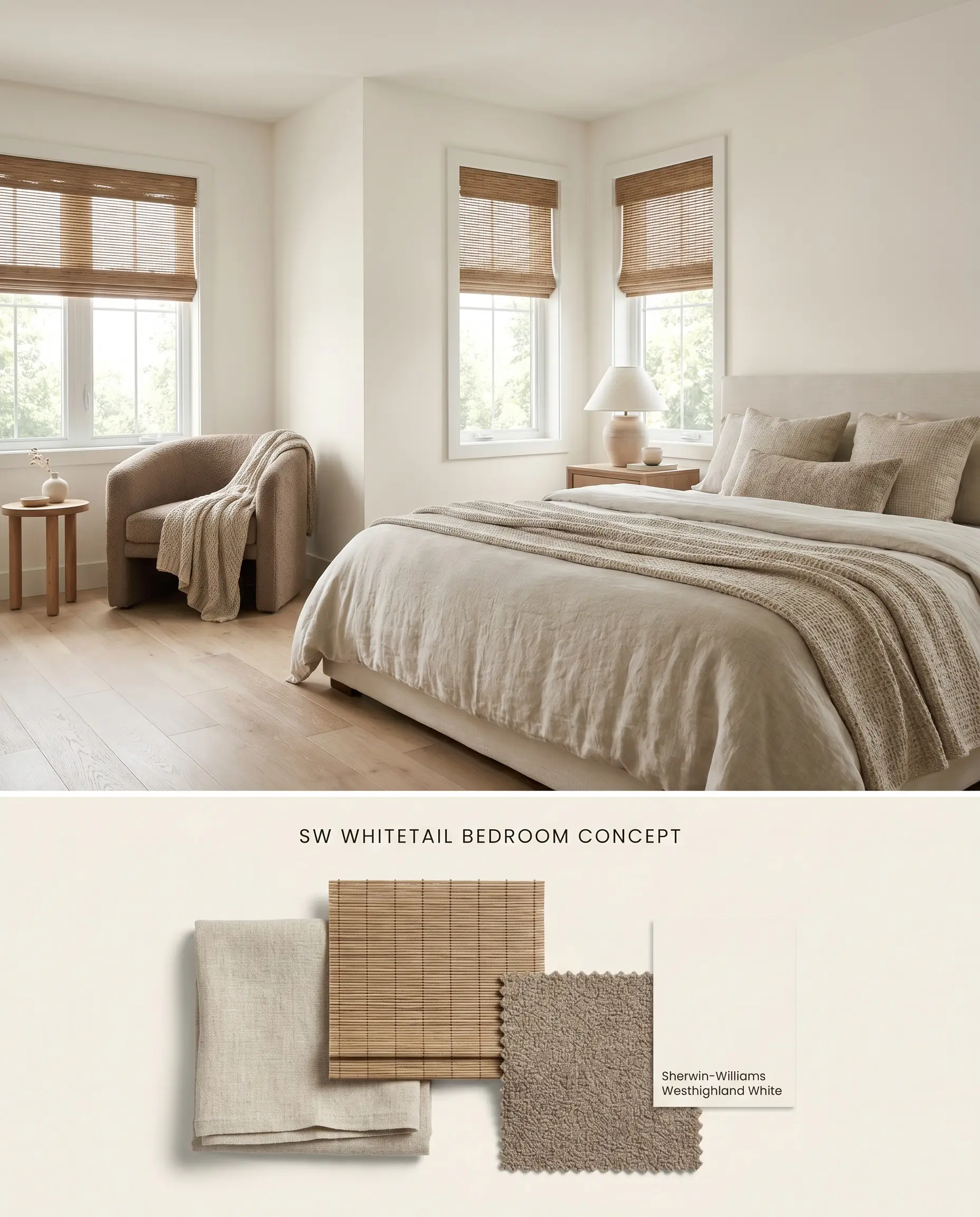
This creamy off-white wraps a bedroom in a soft, ambient glow when natural light reflects off textured linen and woven wood shades. Because this high-LRV paint suffers from a coverage catch, applying a high-quality tinted primer is mandatory when painting over darker, saturated colors to prevent the old hue from bleeding through.
Trim and Molding
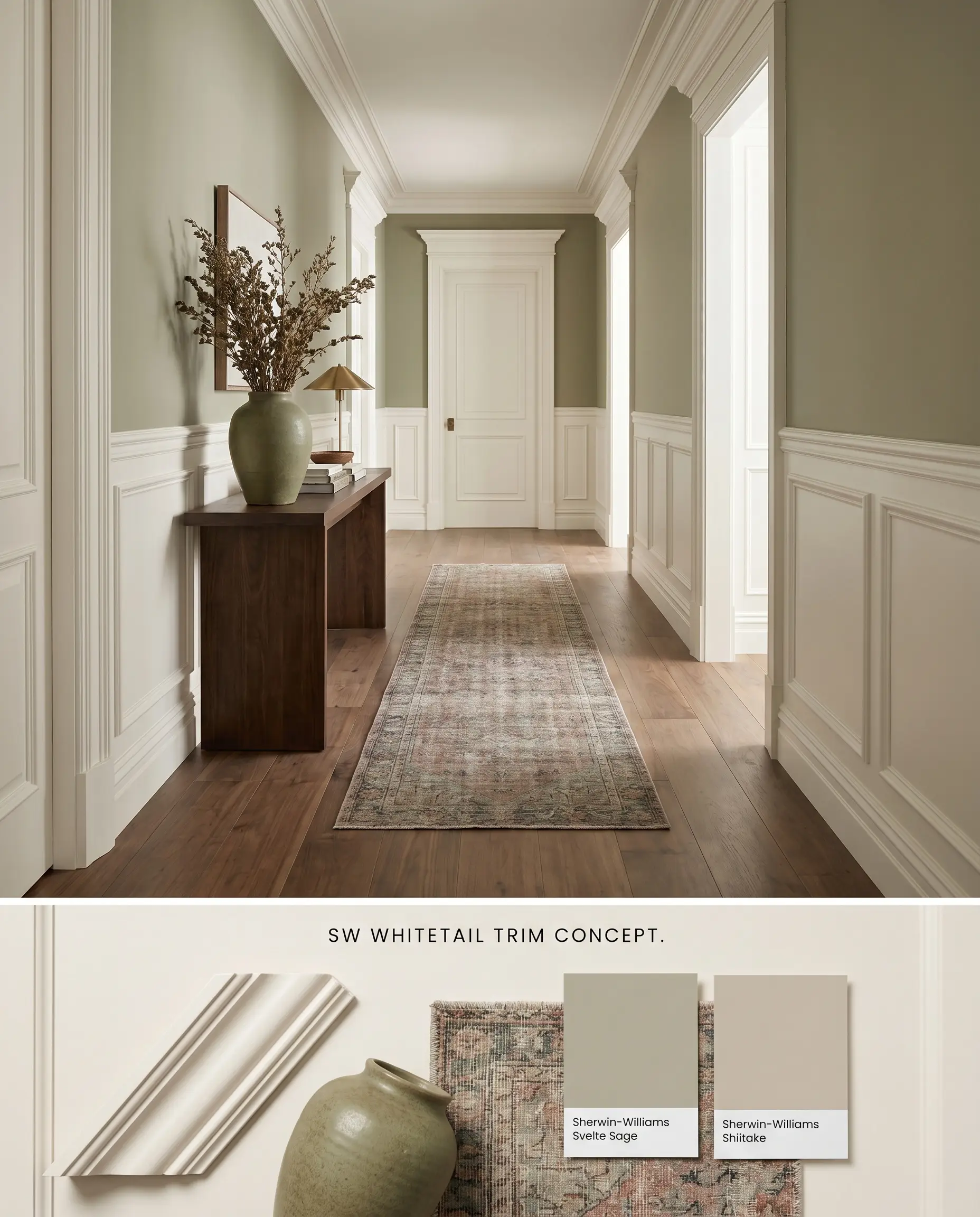
Using this hue as a trim color requires strict adherence to warm-toned wall pairings, as crisp stark whites or blue-toned finishes will immediately make the millwork appear aged and dirty. It bridges seamlessly with earthy greens or warm tans to create a cohesive, organic architectural finish.
Bathroom Vanities
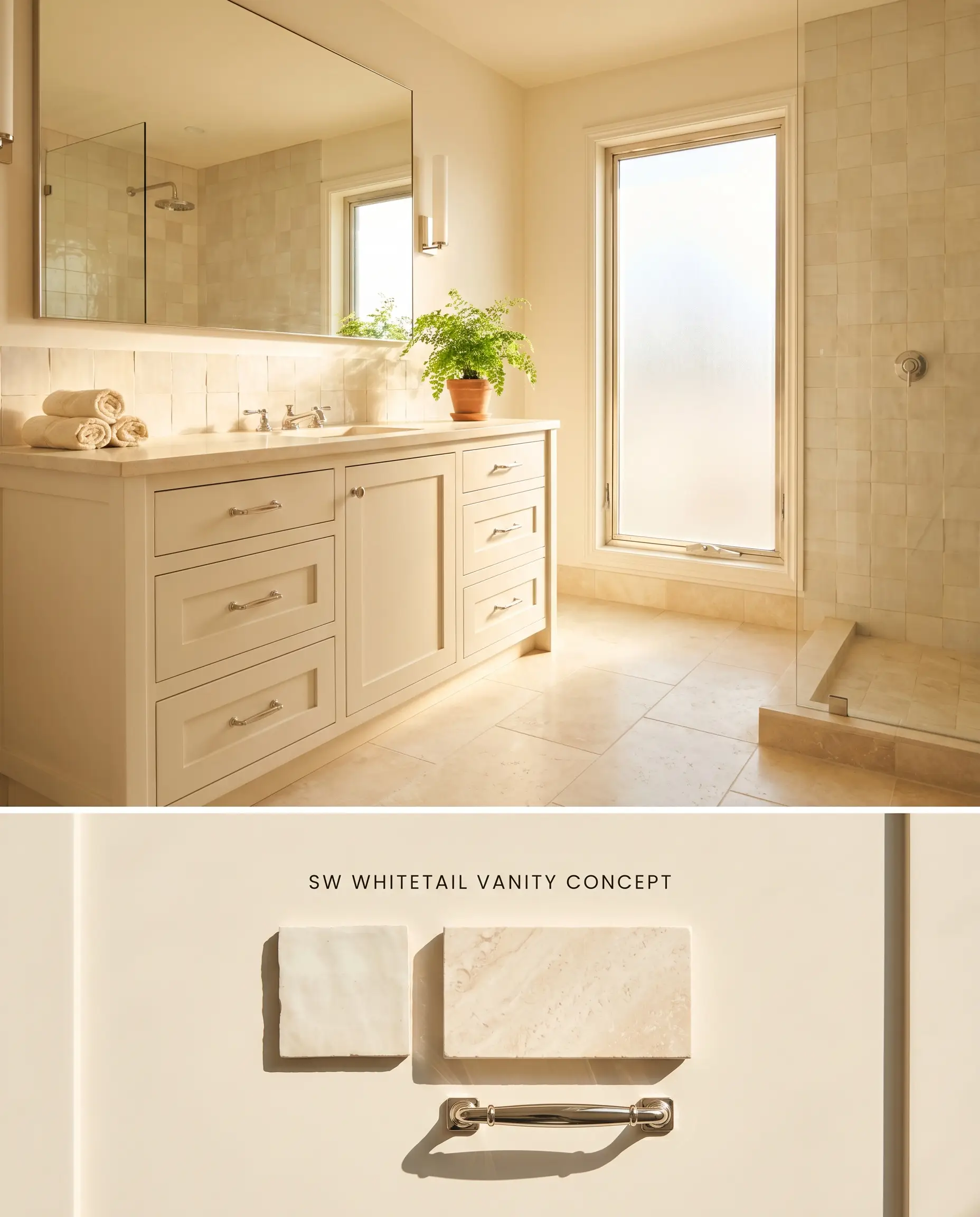
A vanity painted in this warm white anchors a bathroom beautifully, provided the space features a window, as poor artificial lighting causes the color to lose its brightness and turn muddy. You must strictly avoid cool gray bathroom tiles, opting instead for warm travertine or creamy zellige tile to harmonize with the strong yellow undertone.
Chromatic Profile & Head-to-Head Comparisons
Sherwin-Williams Whitetail SW 7103 vs. Sherwin-Williams Alabaster SW 7008
Alabaster has an LRV of 82 and features a more neutral beige-gray undertone compared to the distinct yellow undertone of Whitetail (LRV 86). If your room has south-facing light, Alabaster will hold its shape as a soft white, whereas Whitetail will amplify into a prominent cream. Specify Whitetail in cool, north-facing rooms to inject missing warmth, and reserve Alabaster for spaces where you need a more subdued, less reactive off-white.
Sherwin-Williams Whitetail SW 7103 vs. Sherwin-Williams Dover White SW 6385
Dover White sits at an LRV of 83 and carries an even stronger, almost peachy-yellow color cast compared to Whitetail. Whitetail is slightly lighter and cleaner, making it the better choice for coordinating with warm beige walls in modern transitional spaces. Dover White should be reserved for traditional, heavily layered rooms where a distinctly aged, vintage cream is the specific architectural goal.
Sherwin-Williams Whitetail SW 7103 vs. Benjamin Moore White Dove OC-17
White Dove (LRV 85.38) utilizes a greige shadow to neutralize its warmth, making it highly versatile across varying lighting conditions. Whitetail lacks this graying agent, meaning it will clash aggressively with cool-toned finishes where White Dove might succeed. Specify White Dove if your hard surfaces include Carrera marble, but select Whitetail when coordinating with warm soapstone or earthy terracotta floors.
Technical FAQs
Yes, the warm afternoon light of a southern exposure actively amplifies its yellow undertone, causing the paint to read significantly creamier. To mitigate this, restrict its use to north-facing rooms where the cool light physically balances the warmth.
It will clash aggressively with both, as the stark contrast highlights the yellow cast and makes the paint appear dingy or aged. Always pair this color with warm, creamy whites and earthy, warm-toned stones like travertine.
Whitetail provides a brighter, more distinctly yellow-cream finish (LRV 86), while Alabaster (LRV 82) offers a slightly deeper, more neutral beige base. Choose Whitetail for a sunlit, traditional aesthetic, but opt for Alabaster if you need to bridge the gap between warm and slightly cooler hard finishes.
It pairs beautifully with warm countertops, but highly reflective, reddish-brown wood floors will bounce warm light back onto the walls, intensifying the yellow cast. Use a matte finish on the floors to reduce this bounce effect and stabilize the wall color.
Room Compatibility & Clashes Diagnoses
Hackrea's reports evaluating the compatibility of Whitetail in real rooms.No compatibility tests for Whitetail yet.
Be the first to see how this color reacts to your space. Run a free architectural diagnostic now.
Paint Aesthetic & Practical Analysis
| Profile | Analysis | |
|---|---|---|
| Aesthetic | Whitetail is an under-the-radar gem for those seeking a genuinely warm white. It avoids the starkness of pure whites but demands careful pairing to prevent its creamy yellow base from clashing with cool-toned finishes. | |
| The Coverage Catch | As a high-LRV white, it may require a high-quality tinted primer or a third coat when painting over darker, saturated colors. | |
| The Lighting Shift | In south-facing or warm afternoon light, the yellow undertone amplifies, making it read significantly creamier. In cool, north-facing light, it provides a balanced, soft warmth. | |
| The Clash Warning | Can clash aggressively with cool grays, crisp stark whites, or blue-toned finishes, which can make Whitetail look dingy or overly yellow by comparison. | |
| The Bounce Effect | Reflects the tones of its surroundings; warm wood floors or reddish-brown furniture can bounce light onto the walls, intensifying its creamy yellow cast. | |
| The Low Light Trap | In windowless rooms or spaces with poor artificial lighting, it can lose its brightness and take on a slightly muddy or aged appearance. | |
| The Touch Up | Highly stable for touch-ups, though exact sheen matching is critical for seamless repairs on broad walls. |
Closest Cross-Brand Equivalents
The absolute closest scientific color matches for Whitetail across top paint brands.