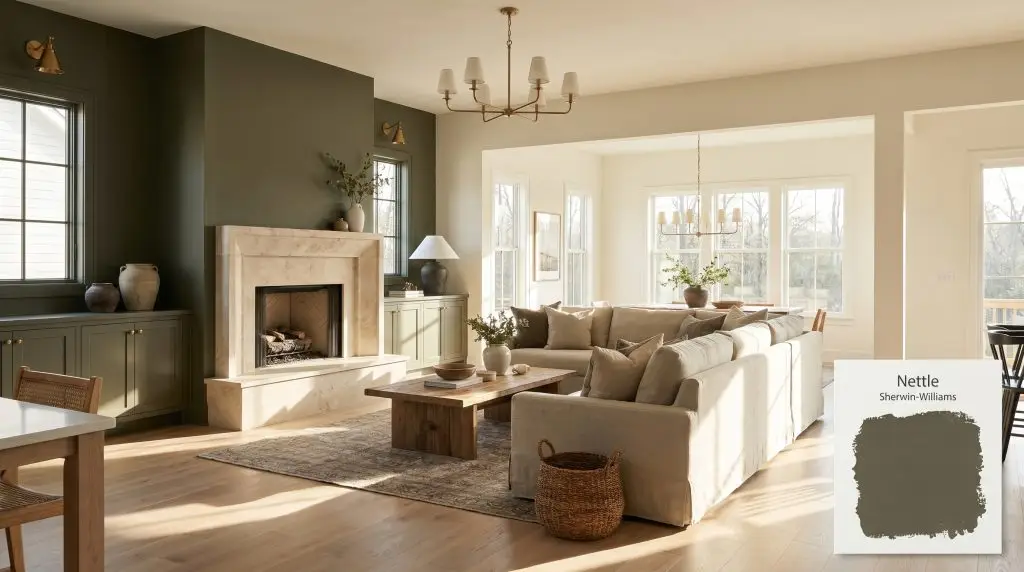
Sherwin-Williams Nettle (SW 9535) is a deep, moody olive-brown with strong warm undertones. Boasting an LRV of 11, this rich earthy shade excels in well-lit rooms, bringing a grounded, sophisticated bronze-green presence to cabinets, exteriors, and dramatic accent walls.
Will Nettle clash with your room?
Paint Technical Profile
| Color ID / SKU | SW 9535 |
| HEX Code | #665B44 |
| Light Reflectance (LRV) | 11 |
| Temperature | Warm |
| Primary Undertone | Olive Green |
| Hidden Undertones | Yellow, Bronze |
| Use | Interior, Exterior |
| Best Exposures | South-facing, West-facing |
| Best For | Living Room Accent Walls, Kitchen Cabinets, Exterior Trim, Home Libraries, Moody Bedrooms |
Nettle Digital Design Concept Boards
Living Room Accent Walls
Will Nettle work with your specific lighting, floor, or furniture?
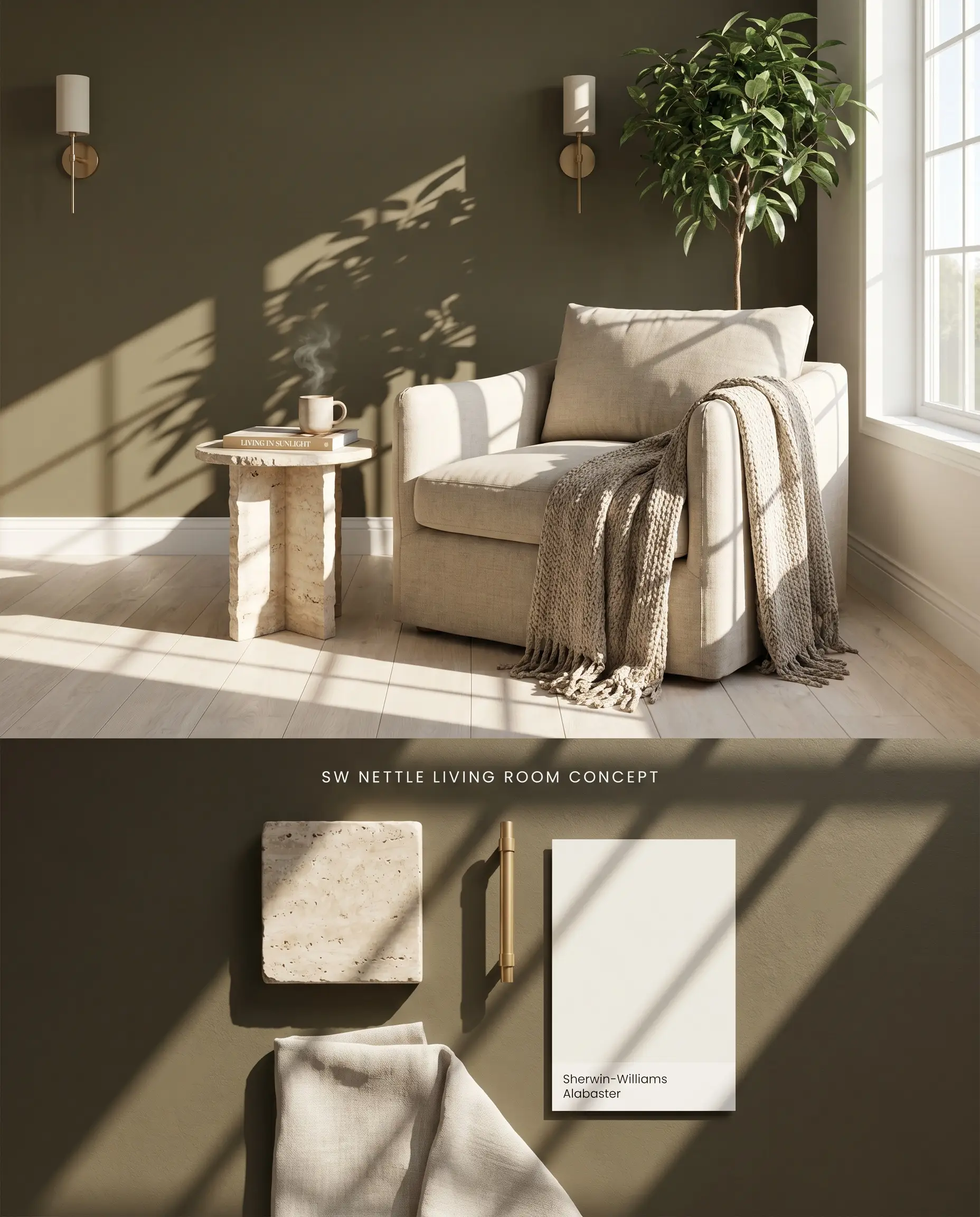
A single focal wall in Sherwin-Williams Nettle anchors sprawling, open-concept living spaces by absorbing excess ambient light without reading as a stark black. The earthy chromatic profile requires adjacent warm-toned natural stone or light, bleached white oak flooring to prevent the room from feeling restrictive.
Kitchen Cabinets & Islands
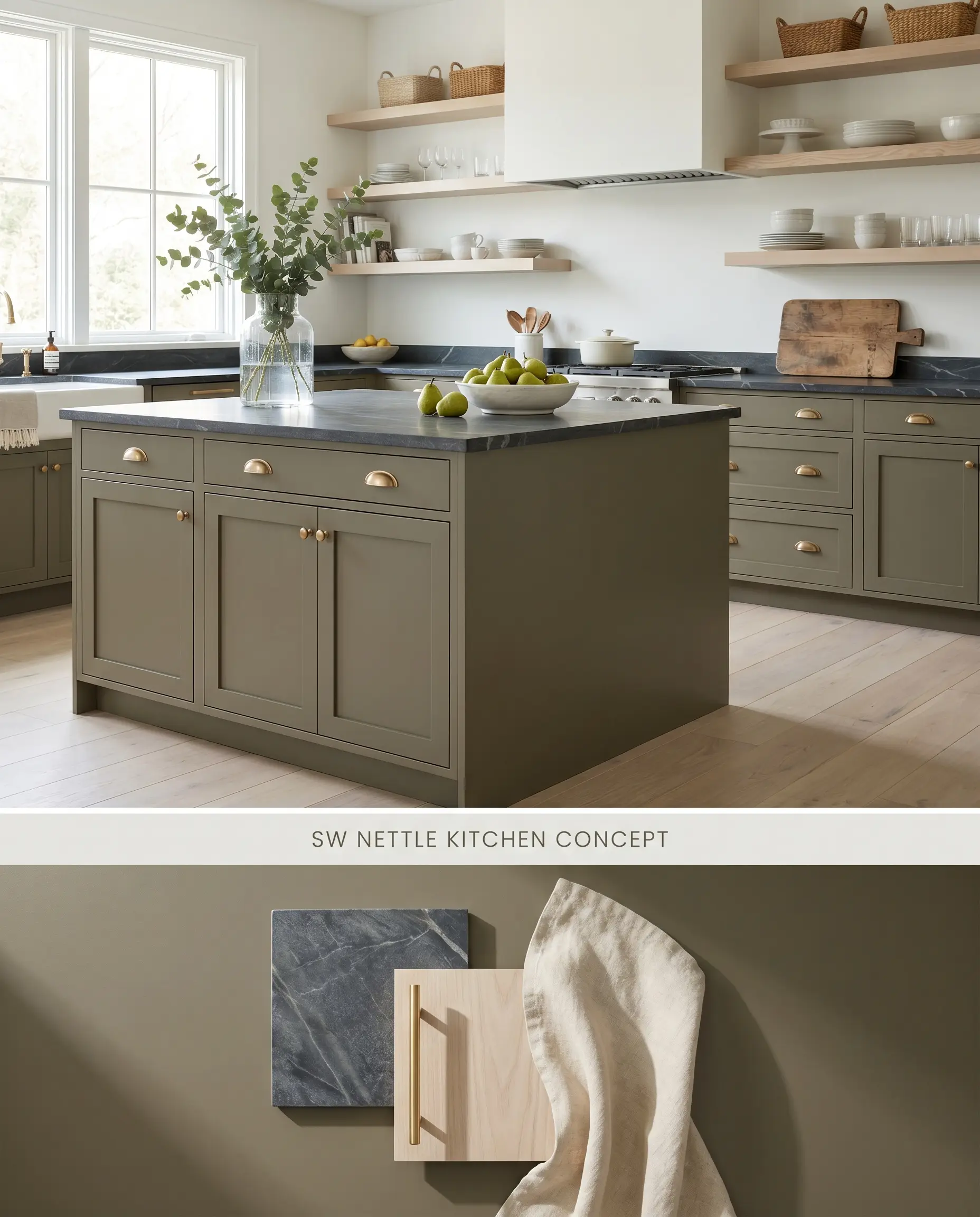
Deploying this bronze cast on lower cabinetry or a central island grounds a bright kitchen while offering a sophisticated alternative to standard navy or forest green. To avoid aggressive visual clashing, pair this cabinetry paint strictly with pale, ash-toned woods or natural soapstone counters, completely eliminating any prominently red-toned cherry or mahogany elements from the sightline.
Exterior Siding & Trim
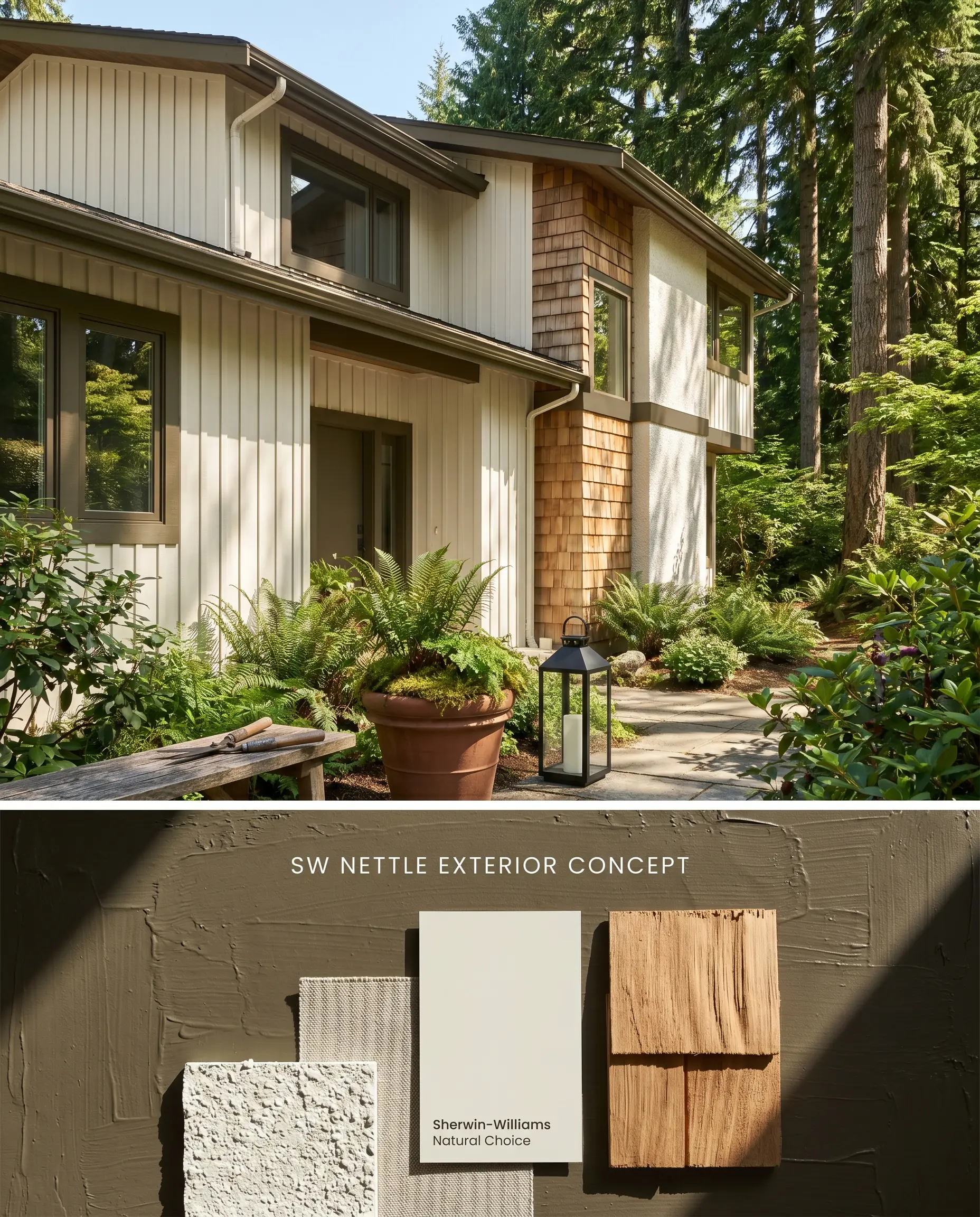
As an exterior trim shade, Sherwin-Williams Nettle blends architecture into wooded or densely landscaped lots by mimicking organic foliage and soil tones. The low LRV 11 absorbs harsh, direct sunlight, preventing the facade from glaring while highlighting the textural depth of cedar shingles or coarse stucco.
Home Libraries / Studies
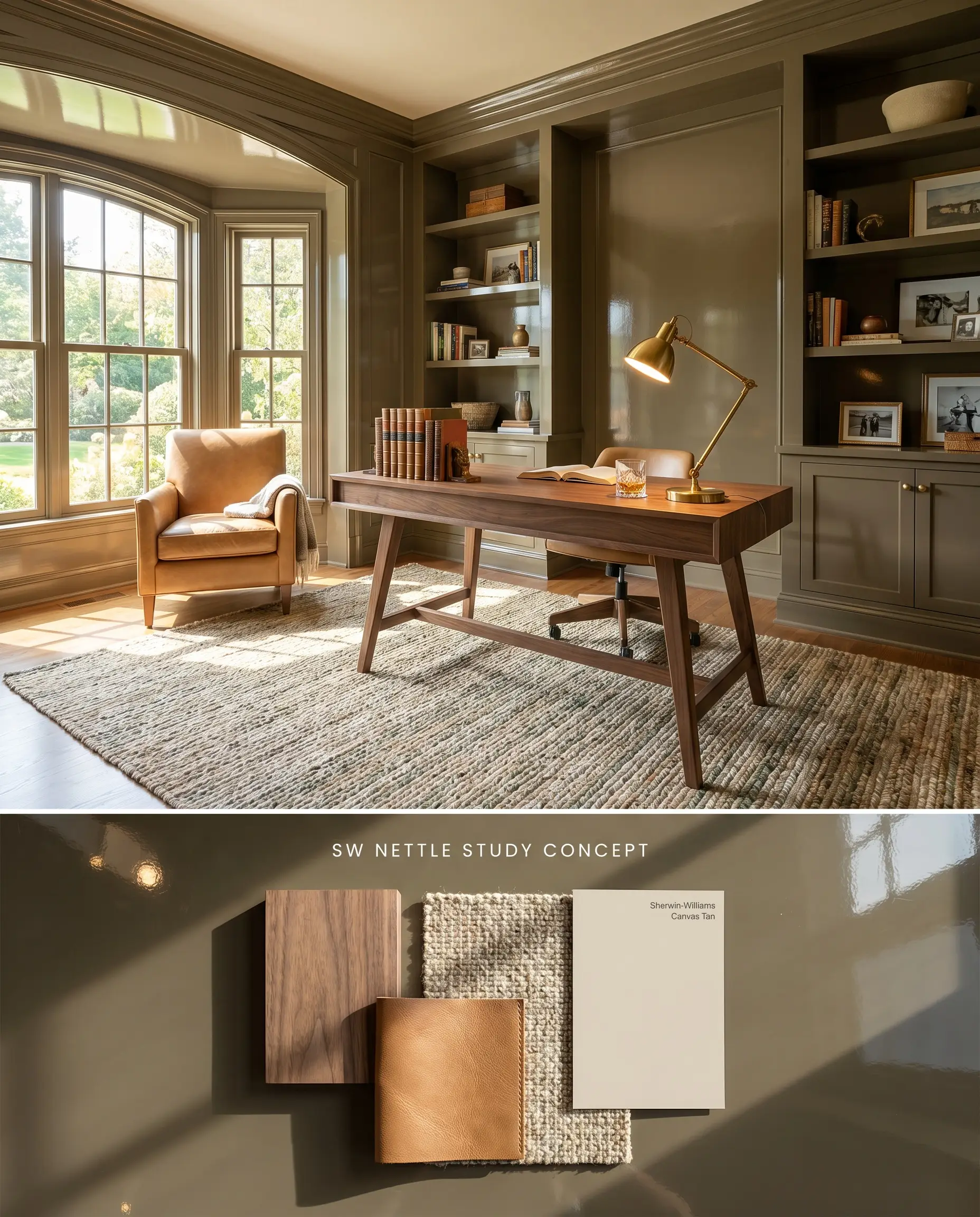
Wrapping a study in this moody architectural finish creates an enveloping, focused environment, provided the space features expansive windows to counteract the low light reflectance. The rich, olive-brown structure pairs exceptionally well with built-in shelving, provided the surrounding woods lean toward cool walnut or pale birch rather than warm, reddish stains.
Bedroom Accent Walls
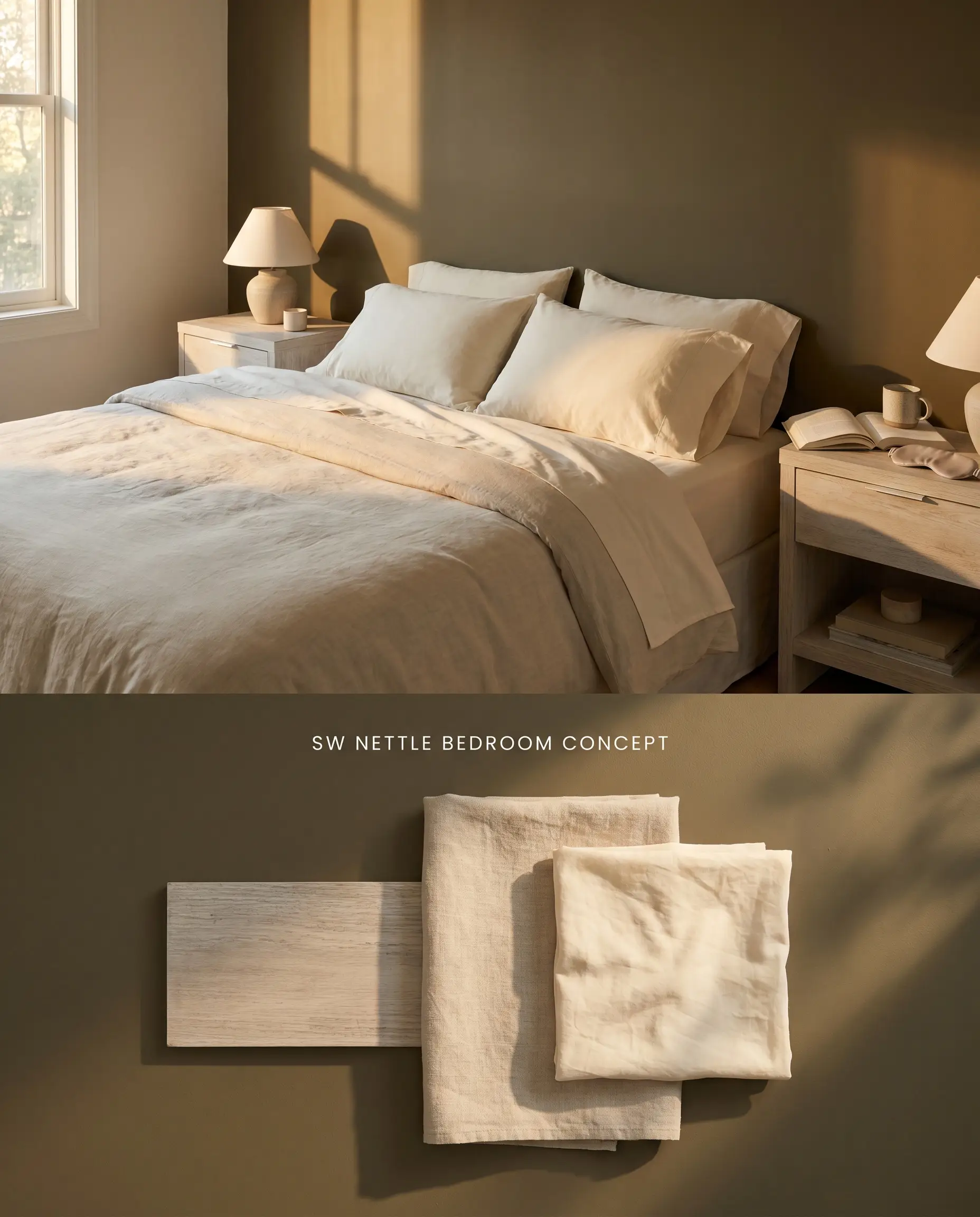
Will Nettle work with your specific lighting, floor, or furniture?
Anchoring a headboard against Sherwin-Williams Nettle establishes a grounded, earthy backdrop that minimizes visual noise for a restful environment. The deep olive-brown hue requires flanking the wall with pale, textural elements to prevent the dark pigment from absorbing all available light.
Head-to-Head Architectural Color Comparisons
Sherwin-Williams Nettle vs. Sherwin-Williams Oak Leaf Brown SW 7054
Oak Leaf Brown possesses a more straightforward, warmer yellow-brown base compared to the distinct yellow-green olive undertone of Sherwin-Williams Nettle. In a South-facing room, Oak Leaf Brown reads as a traditional, earthy brown, whereas Nettle shifts toward a botanical bronze. Select Oak Leaf Brown when working alongside warmer, traditional wood tones, and reserve Nettle for spaces featuring cool, ash-toned woods or stark white marbles where the green can act as a grounding neutral.
Sherwin-Williams Nettle vs. Farrow & Ball Broccoli Brown W108
Broccoli Brown carries a noticeable red-gray undertone that gives it a softer, more muted mushroom quality, contrasting sharply with Nettle’s aggressive golden-olive base. Because Broccoli Brown has a slightly higher light reflectance, it performs better in moderately lit rooms without feeling restrictive. Nettle requires significantly more natural sunlight to activate its complex earthy chromatic profile, making it the superior choice for sun-drenched, high-contrast architectural features.
Sherwin-Williams Nettle vs. Behr Moss Stone PPU7-01
Will Nettle work with your specific lighting, floor, or furniture?
Moss Stone leans much further into a literal green chromatic profile, presenting as a true muted olive, while Nettle retains a dominant brown core. Under cool, North-facing light, Moss Stone maintains its green identity, whereas Nettle’s green recedes entirely, leaving a flat brown finish. Specify Moss Stone if a consistent green aesthetic is required across all lighting conditions, but utilize Nettle when seeking a dynamic, shifting color that transitions between bronze and olive depending on the sun’s angle.
Technical FAQs
Yes, in cool, North-facing light, the golden-olive undertones are stripped away, causing Nettle to read as a flat, dull brown. To experience the intended botanical warmth, this color strictly requires Southern or Western exposure.
Nettle features a strong yellow-green base that will aggressively clash with any prominently red-toned woods like cherry, mahogany, or red oak. It must be paired with pale, ash-toned woods, white oak, or cool walnut to maintain visual harmony.
Warm artificial lighting, such as 2700K to 3000K LED bulbs, amplifies the golden-olive undertones, pushing the color toward a rich bronze. Cooler artificial lighting will suppress the green, emphasizing the dark brown base.
Yes, due to its deep color structure and low light reflectance, Nettle requires a dark tinted primer, specifically a P5 or P6 gray base. Skipping this step will result in patchiness and require more than two coats to achieve uniform coverage.
Room Compatibility & Clashes Diagnoses
Hackrea's reports evaluating the compatibility of Nettle in real rooms.No compatibility tests for Nettle yet.
Be the first to see how this color reacts to your space. Run a free architectural diagnostic now.
Paint Aesthetic & Practical Analysis
| Profile | Analysis | |
|---|---|---|
| Aesthetic | Nettle is an incredibly sophisticated, earthy anchor color. It bridges the gap between deep brown and olive green perfectly, though it demands ample natural light to prevent it from reading flat or muddy. It is a designer favorite for moody studies and dramatic cabinetry. | |
| The Coverage Catch | Due to its deep color structure, Nettle often requires a dark tinted primer (like a P5 or P6 gray base) to ensure uniform coverage and prevent patchiness in just two coats. | |
| The Lighting Shift | In cool, North-facing light, the green recedes and it reads as a heavy, flat brown. In South or West-facing light, the golden-olive undertones illuminate, making it appear much warmer and more botanical. | |
| The Clash Warning | Nettle's strong yellow-green base clashes aggressively with pink-toned beiges, cool stark grays, and heavily red-toned woods like cherry or mahogany. | |
| The Bounce Effect | Because of its low LRV, it absorbs light rather than bouncing it. Painting an entire room in Nettle without adequate lighting will create a cavernous, shrinking effect. | |
| The Low Light Trap | In windowless rooms or hallways, the nuanced olive tones disappear, leaving a flat, muddy brown that can feel oppressive. | |
| The Touch Up | As a dark shade, Nettle is highly prone to burnishing and flashing. Touch-ups will likely show a sheen difference, especially in matte or eggshell finishes. |