Painting Over a Water Stain? Find the Leak First

Key takeaways
- A stain or bubbling paint next to a bathroom or kitchen often points to a plumbing leak.
- Some leaks only show up while water is running, so a wall that looks dry at noon doesn’t prove much.
- Repaint once the wall has stayed dry through a normal week of use, and seal the stain with a stain-blocking primer first.
You can paint over a water stain, but only after the water has stopped. Paint applied over a damp wall often doesn’t last: Benjamin Moore lists moisture as one of the main reasons paint loses its grip and blisters. A water stain can also bleed back through a fresh topcoat.
If the mark sits next to a bathroom or the kitchen, a plumber is usually the right first call, not a painter. Before you call, it helps to look closely at the wall.
1. Read the wall
Different marks hint at different stages. A yellow or brown ring usually forms where water soaked into the drywall and then dried. Bubbles or blisters in the paint suggest moisture behind the paint film. Peeling paint just above the baseboard, or a seam that has swollen, often means the water has been there for some time.
Bubbles aren’t always caused by a leak, though. Benjamin Moore also links blistering to painting over a dirty or hot surface, and to latex paint getting wet before it has fully cured. If the bubbles appeared soon after a paint job and haven’t changed since, prep is a likely suspect. If they keep growing near a fixture or pipe, a leak is the more likely one.
2. Where the water may be coming from
The location of a stain is a useful clue, nothing more.
| Where the stain is | Possible source | When it tends to show |
| Wall behind the toilet, or the floor at its base | Supply line, tank, or the seal under the toilet | Constantly, or after flushing |
| Wall on the other side of the shower | Shower valve, grout or caulk | During or after showers |
| Wall under the sink | Supply line or drain trap | Constantly, or when the sink drains |
| Next to the washer or dishwasher | Hose or drain connection | During a cycle |
| Ceiling below a bathroom | Drain line, tub overflow or toilet seal | After the bathroom is used |
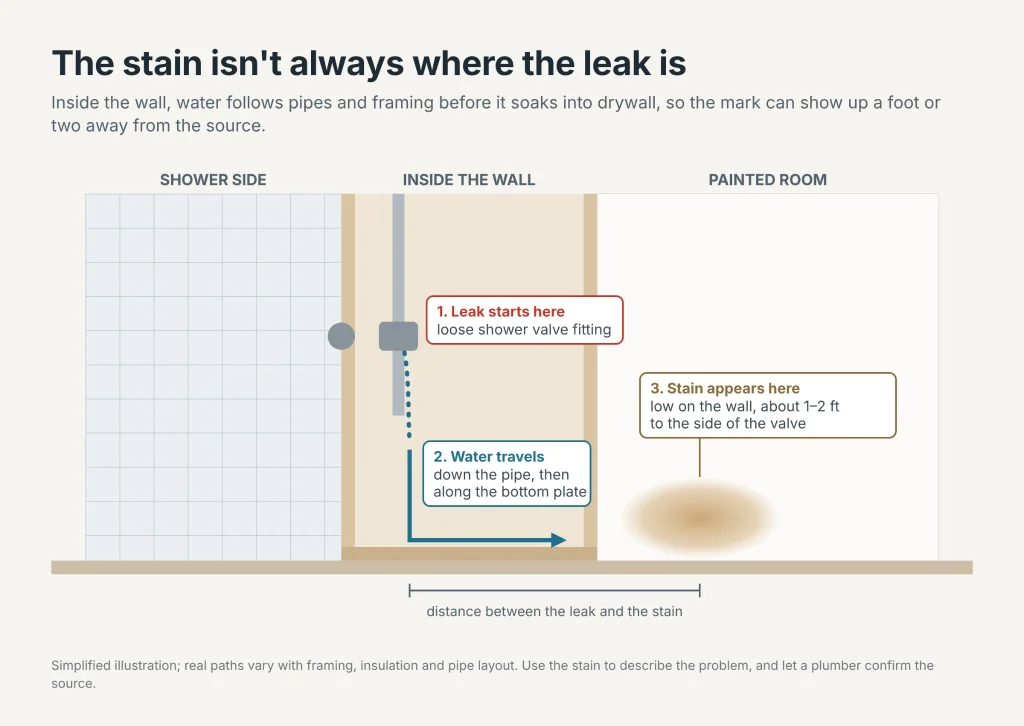
Water can travel along a pipe or a stud before it shows, so the stain may sit a foot or two from the actual leak. A plumber can confirm the source; the table just helps you describe what you’re seeing. Some plumbing companies take calls after business hours, a few of them through an answering service for plumbers, so it may be possible to describe the problem the same day you spot it.
The table also has limits. A stain on an outside wall, under a window or high up near the ceiling that only appears after rain probably isn’t plumbing at all. In that case a window frame or the roof is the likelier suspect, and a plumber isn’t the right first call.
3. Is it still wet?
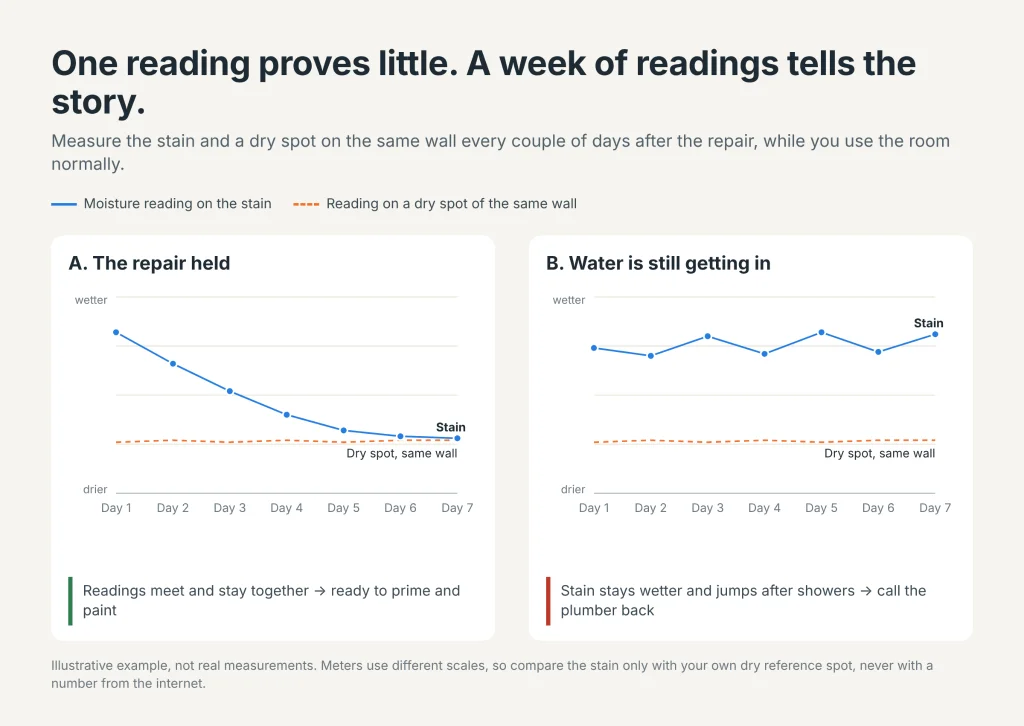
A moisture meter helps here. Take a reading on the stain, then on a dry part of the same wall a few feet away. Meters use different scales, so the absolute number matters less than the difference between the two spots.
Then use the nearby fixture as you normally would, for example a regular shower, and measure both spots again a little while later. If the stain reads noticeably wetter than before while the reference spot doesn’t change, water is probably still reaching the wall. Write the readings down (a photo of the meter screen works too); a plumber will find them useful.
For supply-line leaks, the EPA describes a simple check: read your water meter, use no water for two hours, and read it again. If the number changed, there’s probably a leak somewhere in the pipes. It won’t tell you where, and a toilet that runs on its own can move the meter too, so treat it as one more clue.
4. Dry it out, then make sure the repair worked
Start drying as soon as the leak is repaired. The EPA advises drying water-damaged materials within 24 to 48 hours to help prevent mold, so run a fan or a dehumidifier in the room right away.
After that, it’s tempting to paint as soon as the wall looks dry. Waiting a little longer is cheaper than painting twice. A practical rule of thumb is to live normally for about a week, using the bathroom or kitchen as usual, and to compare the stain with the reference spot every couple of days. If the readings come together and stay together, that’s a good sign the repair held and the wall has dried. If the stain stays wetter, call the plumber back before you paint.
5. Repair, prime and repaint
Firm, dry drywall with a stain on it usually needs only primer and paint. Drywall that has gone soft or started to bow is a job for a professional, and so is any sign of mold. The EPA advises against painting or caulking over moldy surfaces.
For a sound wall, start with a stain-blocking primer. Ordinary paint often lets water stains show through, and a primer made for stains is designed to seal them in. Let it dry fully before the topcoat.
Painting the whole wall from corner to corner, rather than only the patch, usually gives a more even result, because fresh paint over primer can look slightly different from the older paint around it.
If the leak came through a shower wall, the repair is also a chance to think about how that wall is protected. Painted drywall around a shower takes steam and splashes every day, while tile holds up to water far better, though its grout still needs looking after. This comparison of half-tiled and fully tiled bathroom walls covers the trade-offs, including where paint is still a reasonable choice.
FAQ
Can I paint over bubbled paint? Not directly. Benjamin Moore’s advice is to find and remove the source of moisture first if the blisters go all the way down to the wall, then scrape away the loose paint, sand the edges smooth and prime before repainting. Paint applied over bubbles tends to bubble again.
Does bubbling paint mean there’s mold behind the wall? Not necessarily. Bubbles mean moisture or a prep problem, not mold by themselves. Moisture that isn’t dried out can lead to mold, though, which is why the EPA’s 24 to 48 hour drying window matters. If you can see mold or smell a musty odor near the stain, have a professional look at it rather than painting over it.
Will a water stain fade on its own once the wall dries? Usually not. The brown or yellow ring is what the water leaves behind as it dries, so drying won’t remove it. A stain-blocking primer is the usual way to cover it.
I rent. Can I just paint over it? Tell your landlord or property manager first, preferably in writing, and let them arrange the plumbing repair. Painting over a stain can hide a problem they need to know about, and your lease may limit what changes you can make.