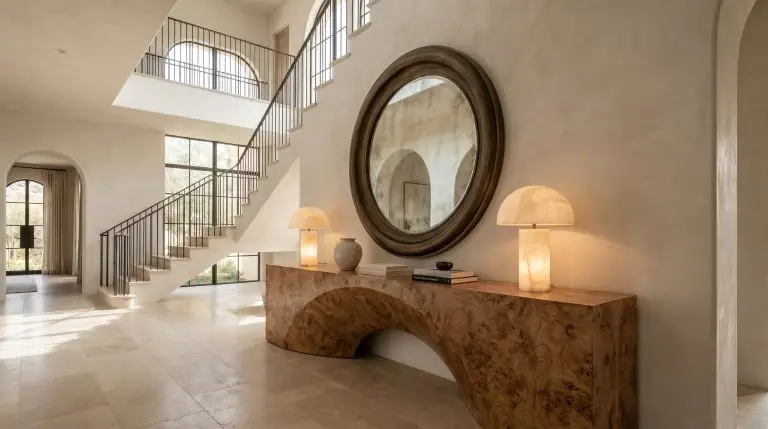
The entryway establishes the architectural tone for the entire home, setting an immediate precedent for the interior volume and material quality that follows. Introducing burl wood into this space is an uncompromising, highly deliberate design choice. The material demands attention, presenting a complex, swirling grain that acts less like furniture and more like a commissioned sculpture.
Sourcing burl wood console tables for luxury entryways requires a masterful eye for spatial proportion and restraint. Because the veneer is so visually hyper-active, the secret to ensuring the foyer looks effortlessly expensive—rather than dated or cluttered—lies entirely in the surrounding material contrast.
True high-end styling relies on balancing the chaotic beauty of the wood with serene, monolithic elements that allow the grain to breathe.
Foundational Rules for High-End Burl Styling
Burl wood acts as the primary art installation within the room’s architectural envelope. Because the heavily patterned grain is so aggressively active, the surrounding elements must provide a deliberate visual resting place. Mastering this balance is the absolute baseline for high-end foyer curation.
Balance the Active Grain with Monolithic Textures
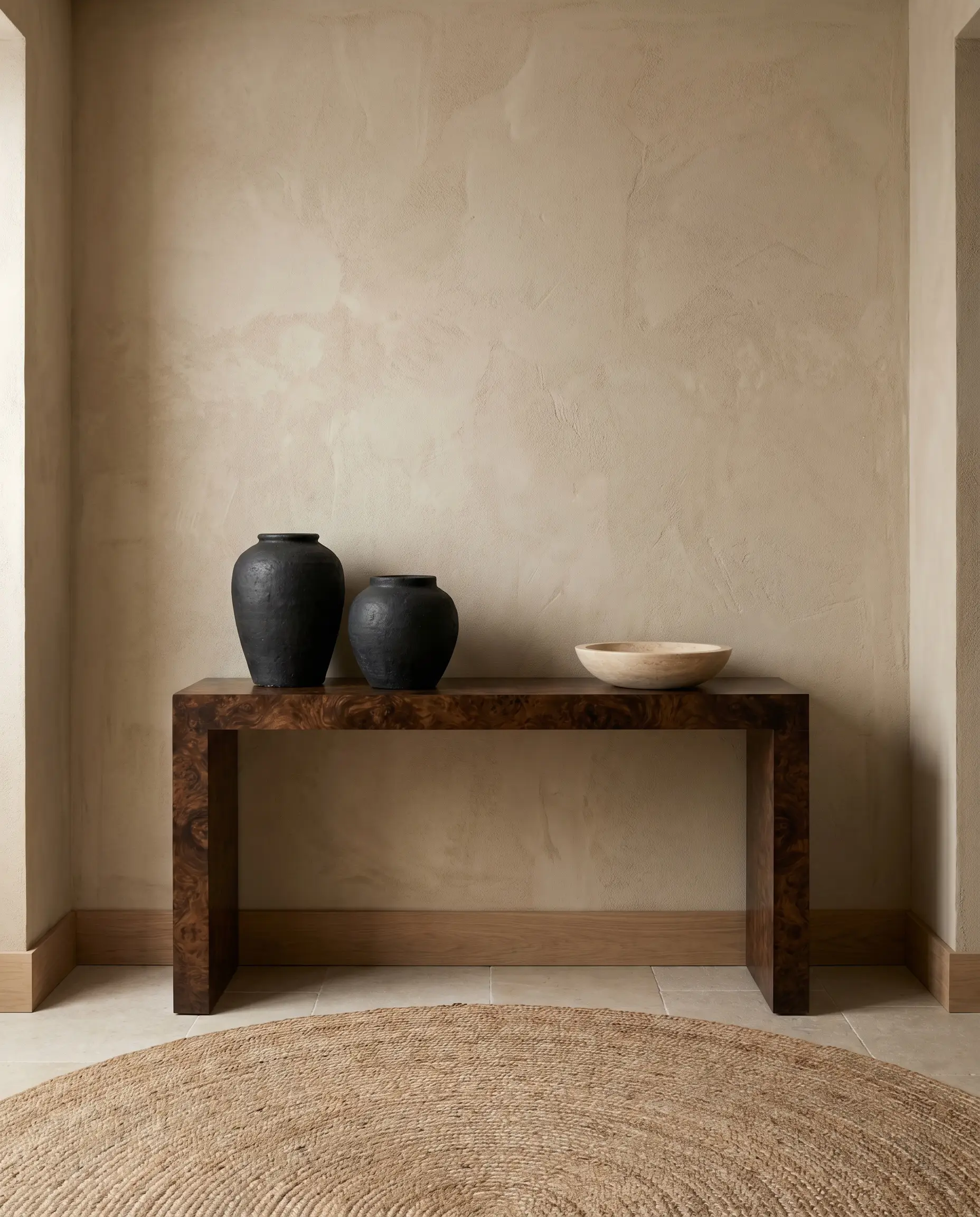
Pairing burl with other heavy patterns creates immediate visual fatigue and diminishes the luxury status of the table. The console must be anchored by solid, monolithic materials like thick travertine, honed marble, or matte ceramics that absorb rather than reflect the room’s energy.
Never place a highly figured burl console against heavily patterned floral or geometric wallpaper. The conflicting motifs will violently compete for the eye, instantly downgrading the entryway from bespoke to chaotic.
Hackrea Designer Secret
- Styling Vibe: Restrained Monolithic Luxury
- Key Materials: Honed Travertine, Matte Ceramics, Raw Plaster
- Visual Tension: High-activity grain versus absolute solid surfaces
Master the Scale of Oversized Foyer Dimensions
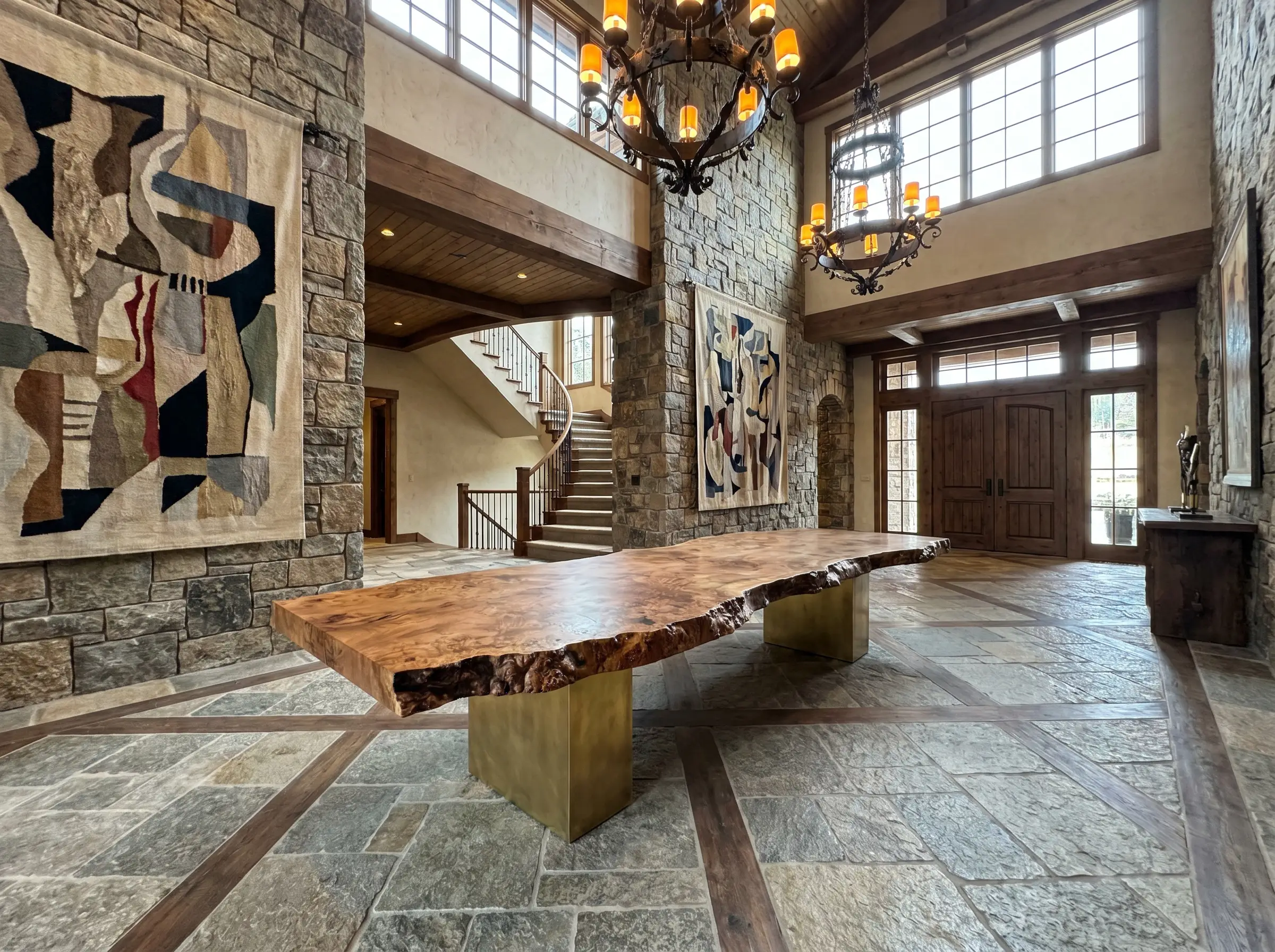
High-end entryways frequently feature double-height ceilings or vast, sweeping floor plans that will swallow a delicate, spindly console. To anchor a grand room, the architecture requires heavy plinth bases or thick, three-inch tabletop profiles that assert physical dominance in the space.
- Styling Vibe: Architectural Weight
- Key Materials: Heavy timber cores, solid brass plinths
Dimension Guide:
- Grand Foyers: Minimum 60-inch to 72-inch console length to hold the wall.
- Tabletop Thickness: Look for 2.5 to 3-inch edge profiles for a monumental presence.
- Depth Allowance: Maintain a minimum of 15 to 18 inches of depth to support heavy lighting and styling artifacts.
Choose Between High-Gloss Polish and Matte Organic Finishes
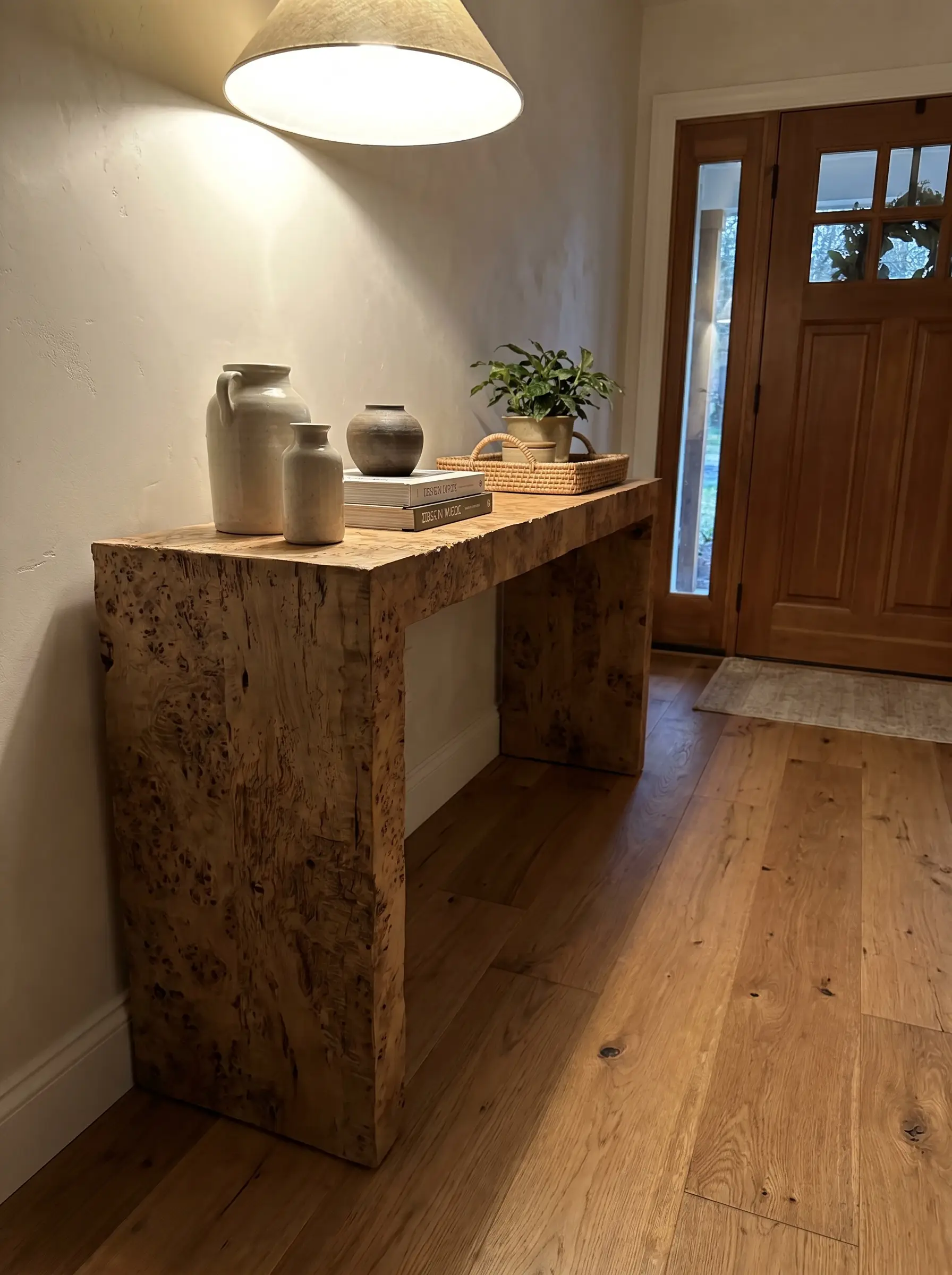
The finish applied to the veneer entirely dictates the era and mood of the foyer. A high-gloss lacquer leans heavily into 1970s glamour and reflects ambient light, whereas a matte, open-pore finish strips away the shine to reveal a raw, organic modern aesthetic that absorbs light.
- Styling Vibe: 70s Glamour vs. Organic Modernism
- Key Materials: Polished resin lacquers, matte wax sealants
- Lighting Pairing: Pair high-gloss with soft, diffused lighting to avoid harsh glare; pair matte finishes with directional spotlights to highlight the wood’s tactile ridges.
Sculptural Shapes and Console Silhouettes
The physical silhouette of the console establishes the specific design era and dictates how the wood interacts with the surrounding negative space.
The Postmodern Chunky Cylinder Base
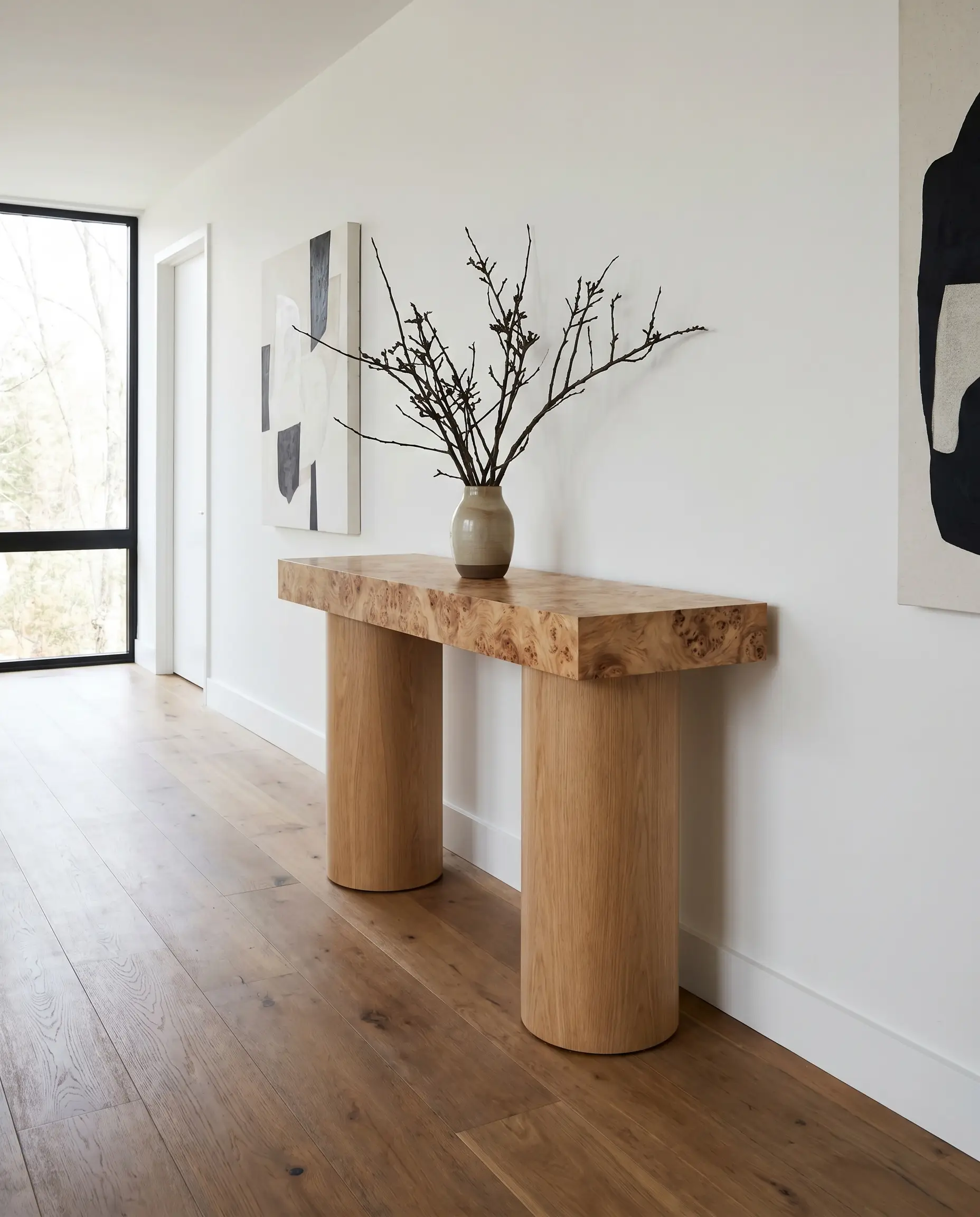
Consoles featuring dual oversized cylinder legs supporting a flat burl top are dominating current high-end interiors. This geometric, chunky postmodern silhouette visually grounds the piece, allowing the stark circular forms to contrast beautifully against the organic chaos of the wood grain.
- Styling Vibe: Contemporary Postmodern
- Key Materials: Mappa burl, solid wood cylindrical armatures
- Proportion Rule: The cylinder bases should be at least 12 inches in diameter to provide adequate visual weight.
The Seamless 1970s-Inspired Waterfall Edge
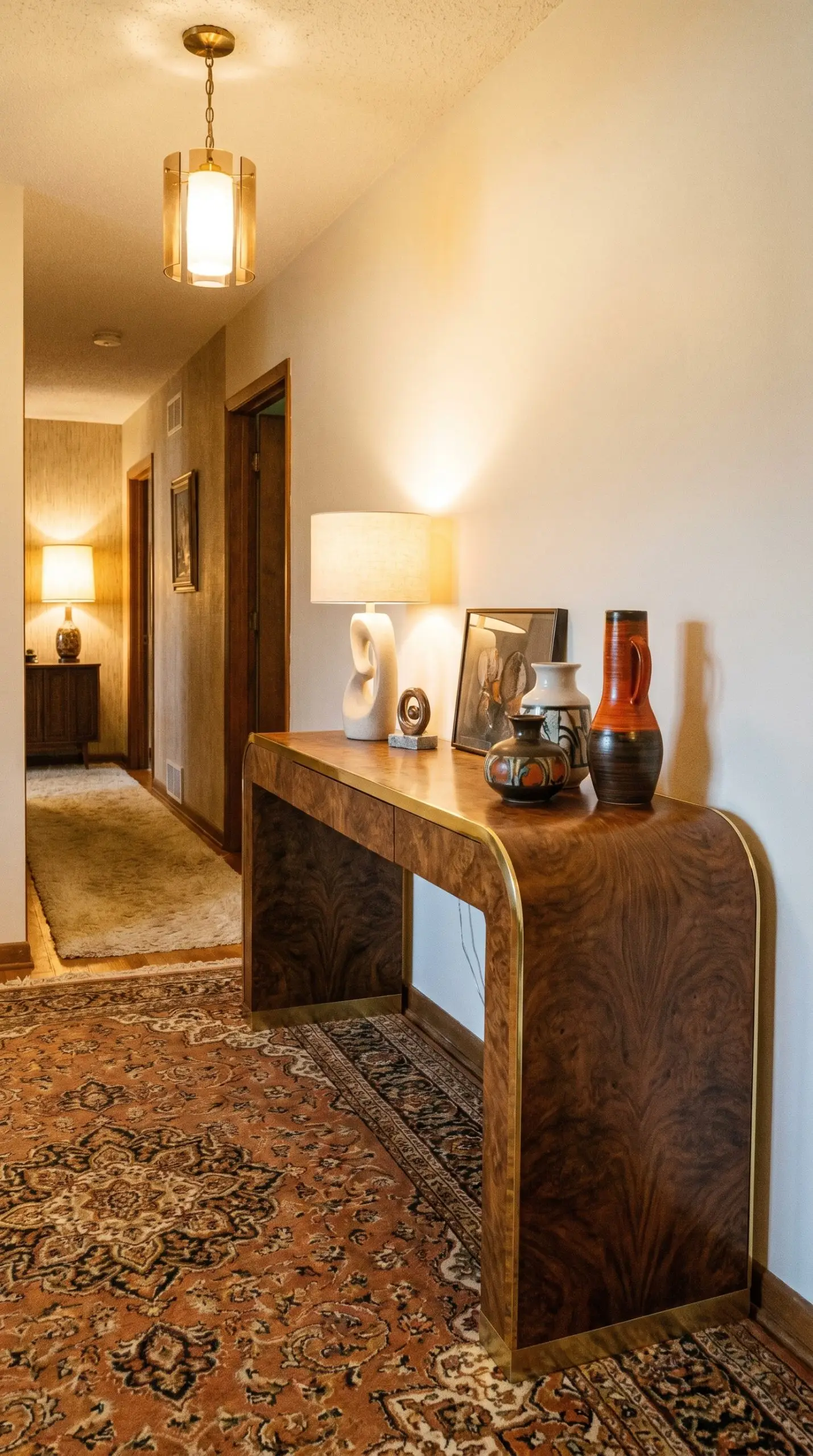
The continuous, uninterrupted grain flow of a waterfall edge remains the most iconic and highly sought-after burl silhouette. For a true luxury execution reminiscent of vintage Milo Baughman designs, the veneer must be flawlessly matched exactly at the cascading curve to create the illusion of a single, bent slab of solid wood.
- Styling Vibe: Authentic 1970s Revival
- Key Materials: Burled walnut, polished brass edging
- Sourcing Marker: Inspect the curved drop-off; a disjointed grain pattern at the joint indicates inferior mass-market manufacturing.
Floating Wall-Mounted Burl Ledges for Narrow Hallways
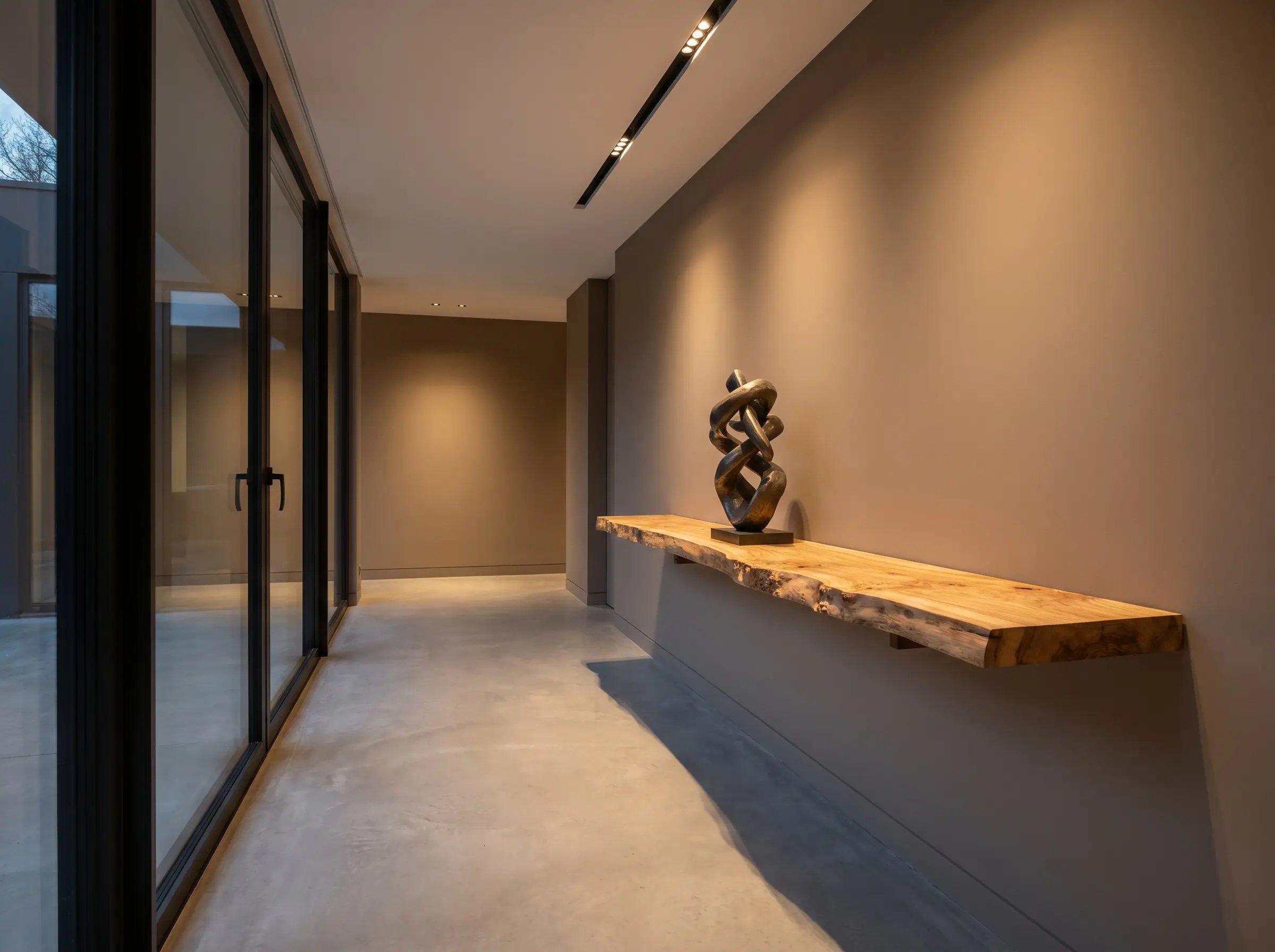
For long, narrow luxury corridors where floor space is limited, a cantilevered, thick burl floating shelf acts as a monumental architectural console without crowding the walkway. This creates a gallery-like pedestal, perfect for displaying a single, highly curated sculptural artifact.
- Styling Vibe: Minimalist Gallery
- Key Materials: Olive Ash Burl, concealed heavy-duty steel brackets
- Installation Pro-Tip: The shelf must be mounted directly into wall studs using steel rods to support the weight of heavy stone or bronze styling objects.
Traditional Demilune Profiles with Burled Inlays
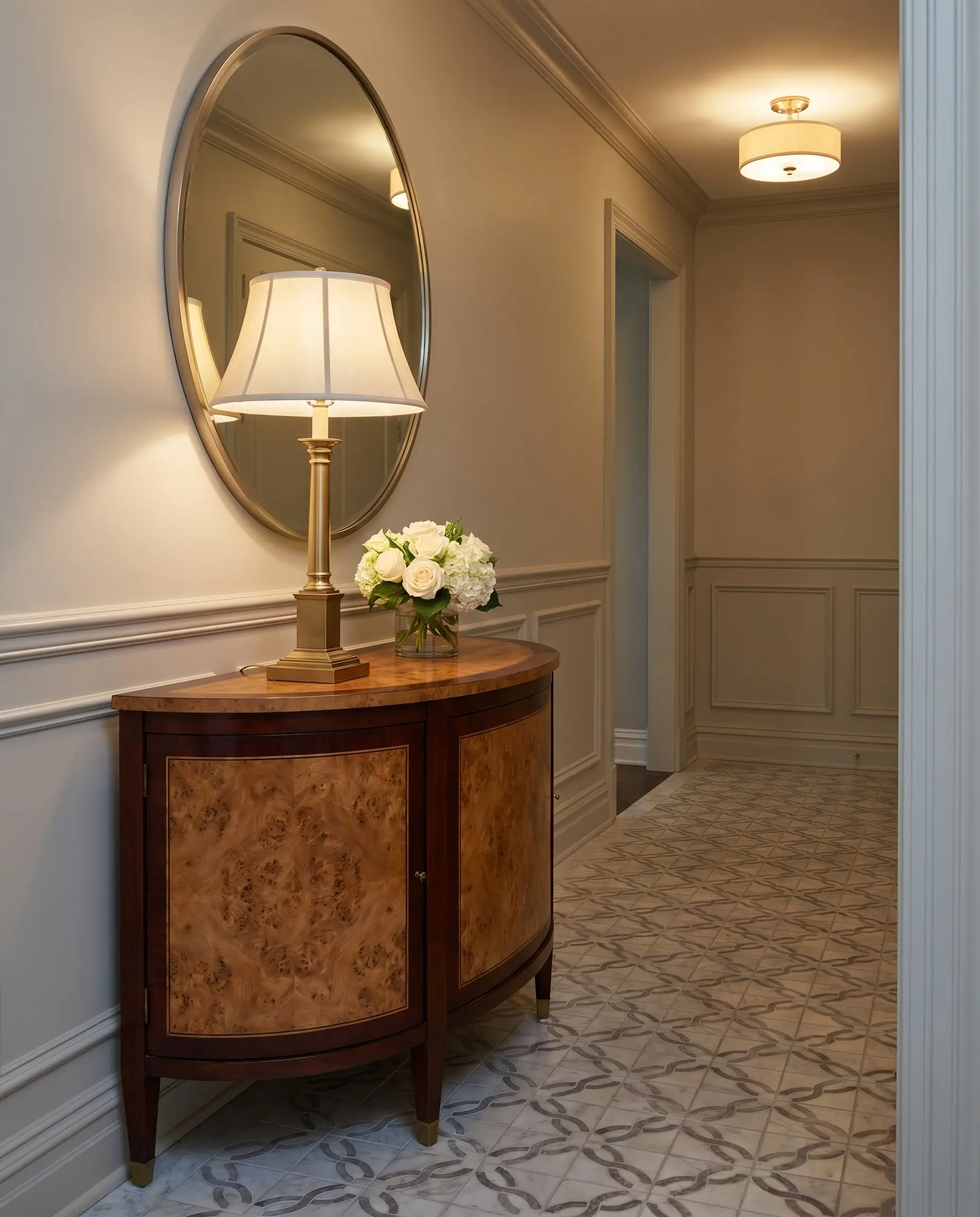
A half-moon demilune shape softens rigid, linear architecture and caters seamlessly to transitional luxury homes. Instead of a solid burl piece, these traditional profiles utilize the active grain strictly as a top inlay, framed by a darker, quiet mahogany or walnut border for a highly tailored aesthetic.
- Styling Vibe: Tailored Transitional
- Key Materials: Mahogany framing, contrasting burl inlays
- Spatial Advantage: The curved edges prevent harsh hip-checks in tighter entryways while maintaining formal elegance.
Brutalist Block Consoles in Dark Walnut Burl
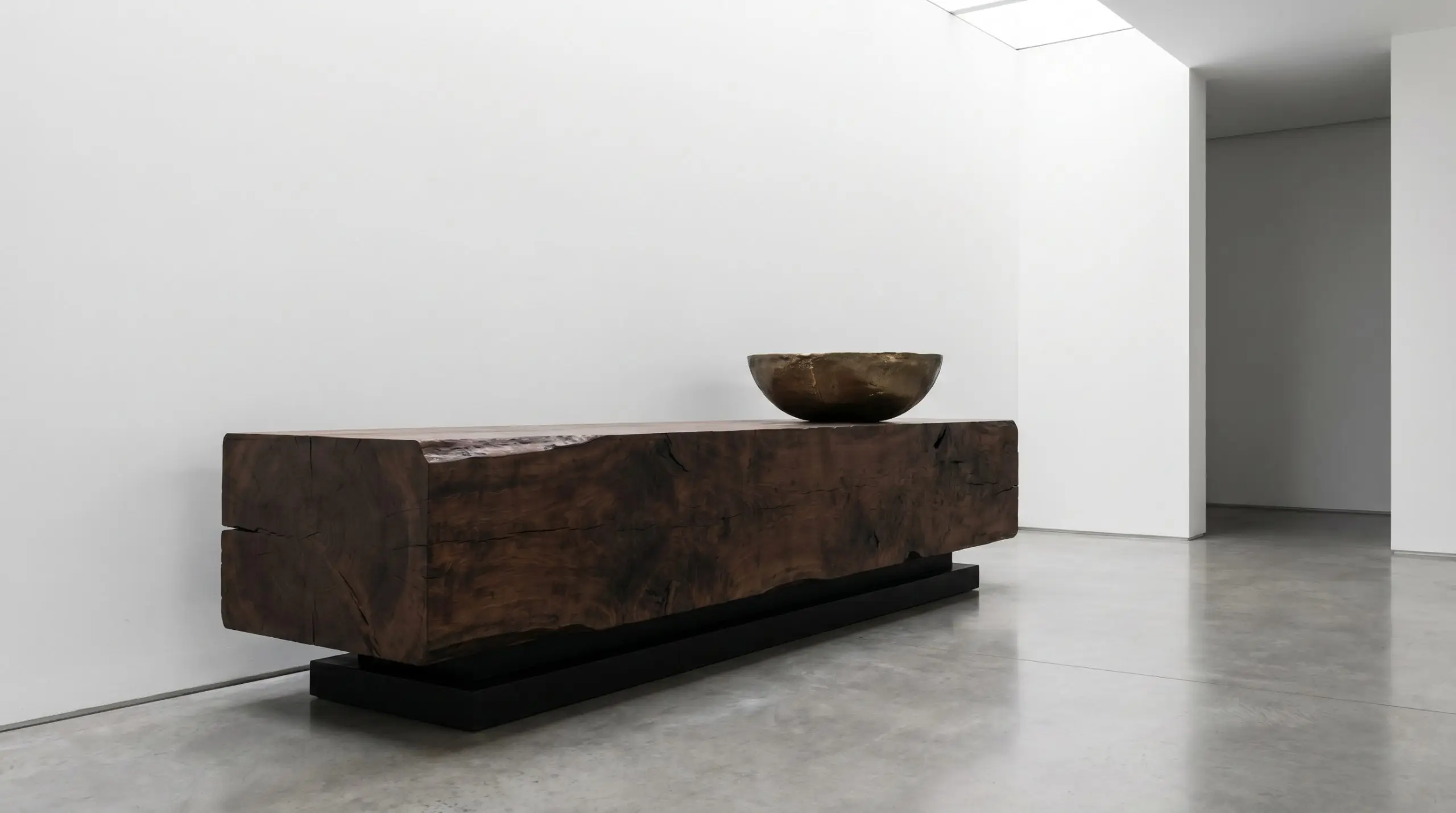
Heavy, squared-off block designs utilizing dark, brooding walnut burl introduce a severe, monumental presence into a minimalist entryway. The brutalist approach relies on the sheer, uncompromising mass of the dark wood to anchor the visual field against stark white gallery walls.
- Styling Vibe: Moody Brutalism
- Key Materials: Dark Walnut Burl, ebonized plinth bases
- Styling Pro-Tip: Keep styling incredibly sparse—a single structural branch or an oversized bronze bowl—to let the heavy geometry speak for itself.
Curating the Vignette: Above and Around the Console
A luxury console cannot sit empty, nor can it serve as a catch-all for everyday mail; it requires a deliberate, meticulously curated vignette to finish the space. The following spatial styling rules are mandatory for achieving a bespoke, lived-in aesthetic.
Anchor the Arrangement with an Antiqued Mirror
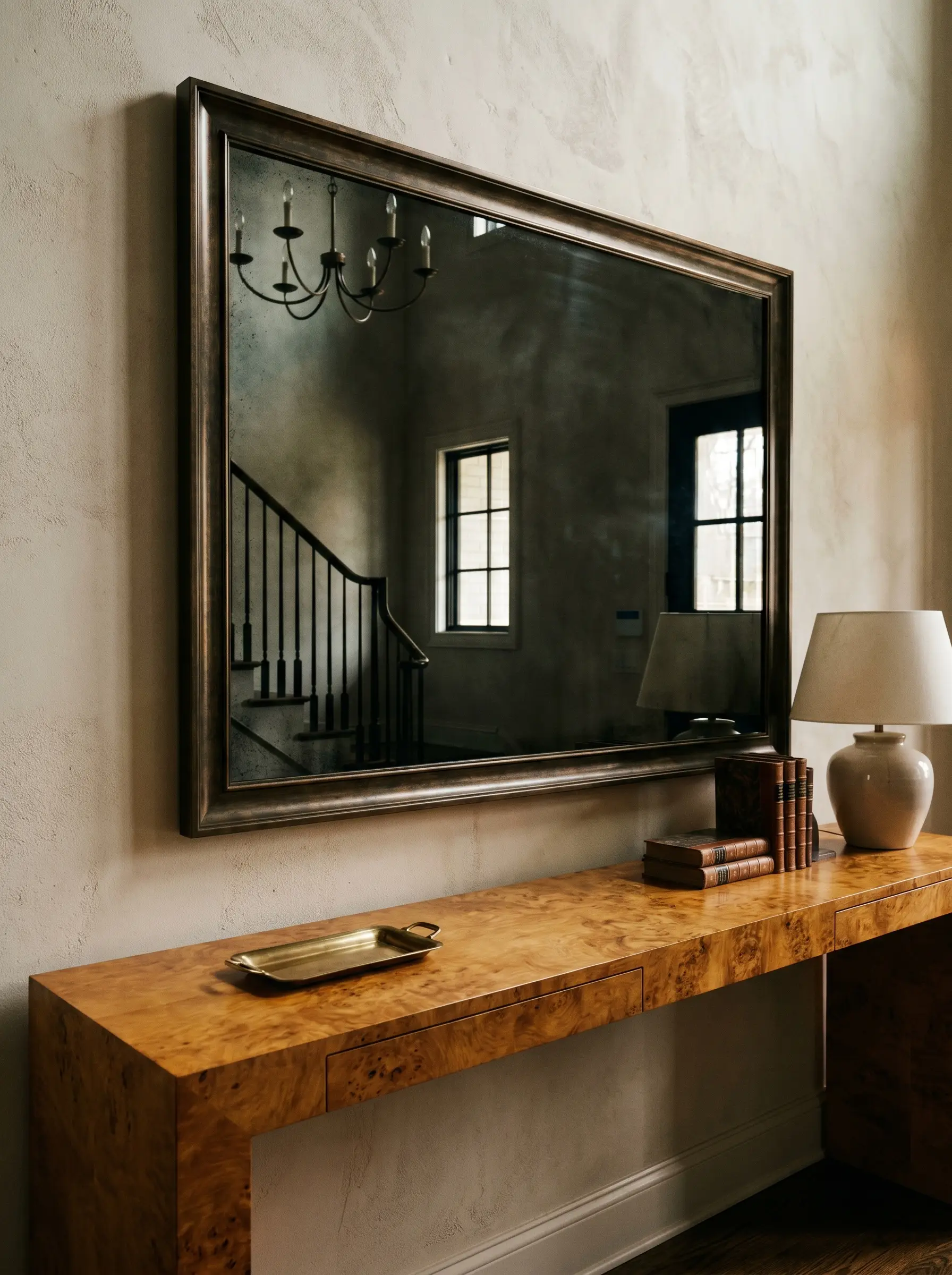
While a mirror expands the foyer’s footprint, a standard clear mirror often reads as cold and clinical against heavily figured wood. Heavy antiqued or smoked glass complements the deep amber and honey warmth of the burl, creating a moody, atmospheric reflection.
- Styling Vibe: Atmospheric Depth
- Key Materials: Antiqued mirror glass, smoked bronze framing
- Spatial Ratio: Ensure the mirror spans roughly 2/3 the width of the console to maintain proper visual proportion.
Contrast the Wood with Alabaster Table Lamps
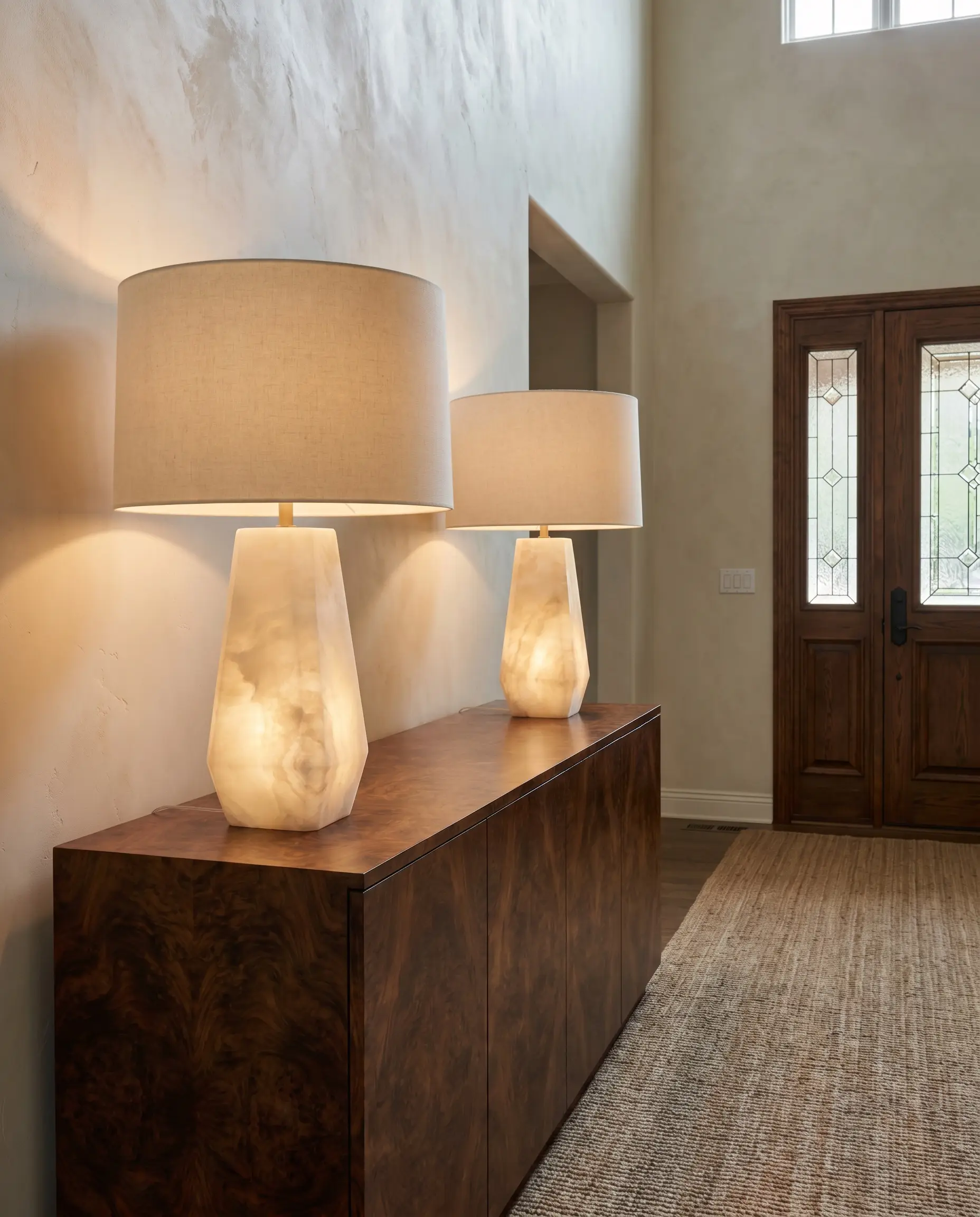
Alabaster provides a heavy, milky, translucent contrast to the dark, swirling intensity of the console. Oversized, solid alabaster geometric lamps possess the necessary visual weight and opacity to hold their own against the heavy wood grain, emitting a soft, diffused glow that highlights the veneer.
Our curatorial team explicitly advises against styling cheap, spindly metal lamps on a burl console. The thin lines of the metal will look entirely out of proportion and visually weak next to the heavy mass of the wood.
Hackrea Styling Tip
- Styling Vibe: Translucent Luxury
- Key Materials: Solid carved alabaster, linen drum shades
- Lighting Temperature: Use 2700K LED bulbs to enhance the natural warmth of both the stone and the wood.
Introduce Asymmetry with Oversized Branch Florals
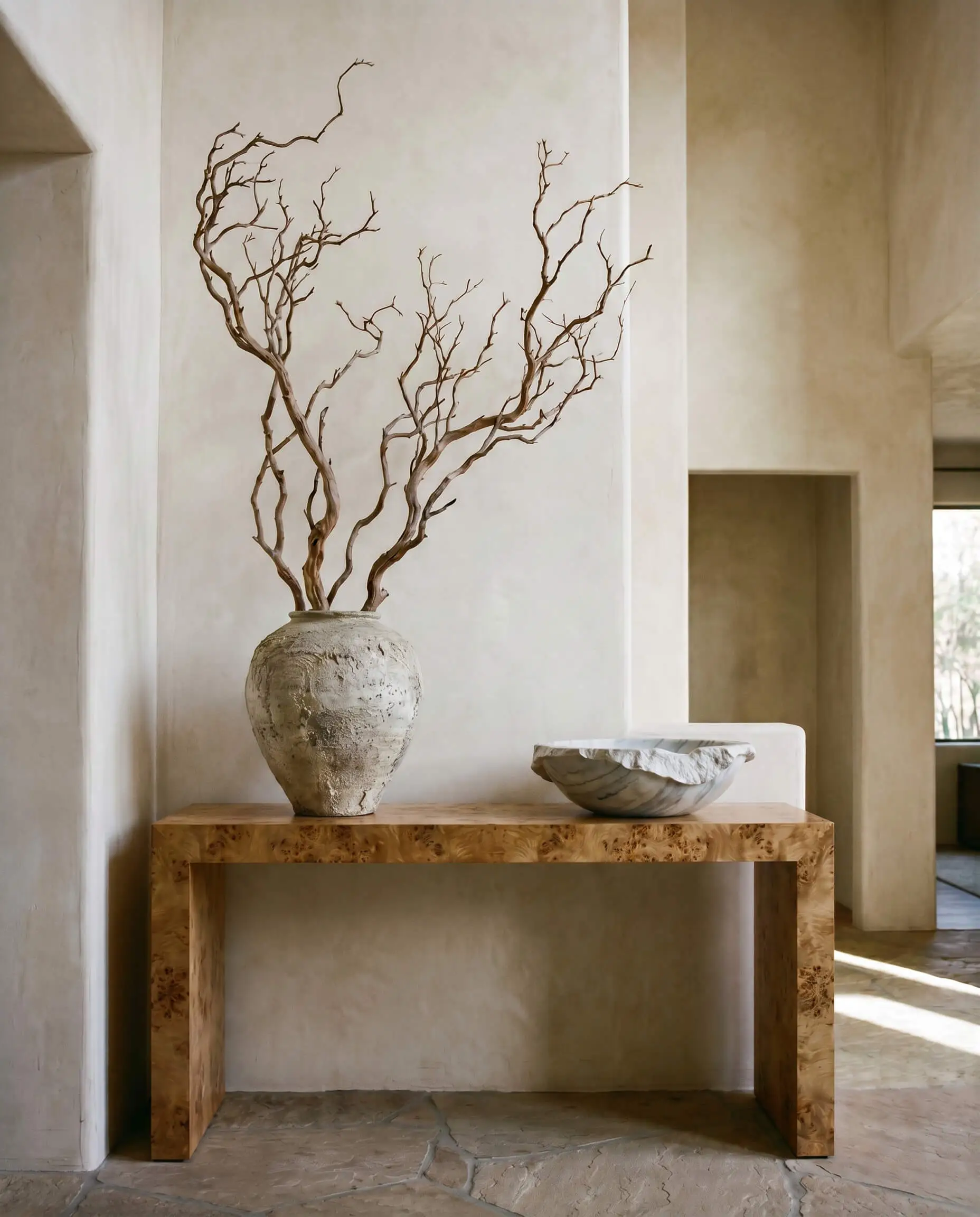
To soften the heavy wood and draw the eye upward toward high foyer ceilings, place a large, heavily textured ceramic vessel on one side of the table. Fill it with tall, structural branches—like quince, olive, or dried manzanita—to break the rigid geometry of the furniture.
- Styling Vibe: Organic Sculptural
- Key Materials: Wabi-sabi ceramic vessels, natural branches
- Styling Pro-Tip: Maintain strict asymmetry. Offset the tall branches on the left with a low, heavy marble bowl on the right to create dynamic visual tension.
Ground the Space with Hand-Knotted Silk Rugs
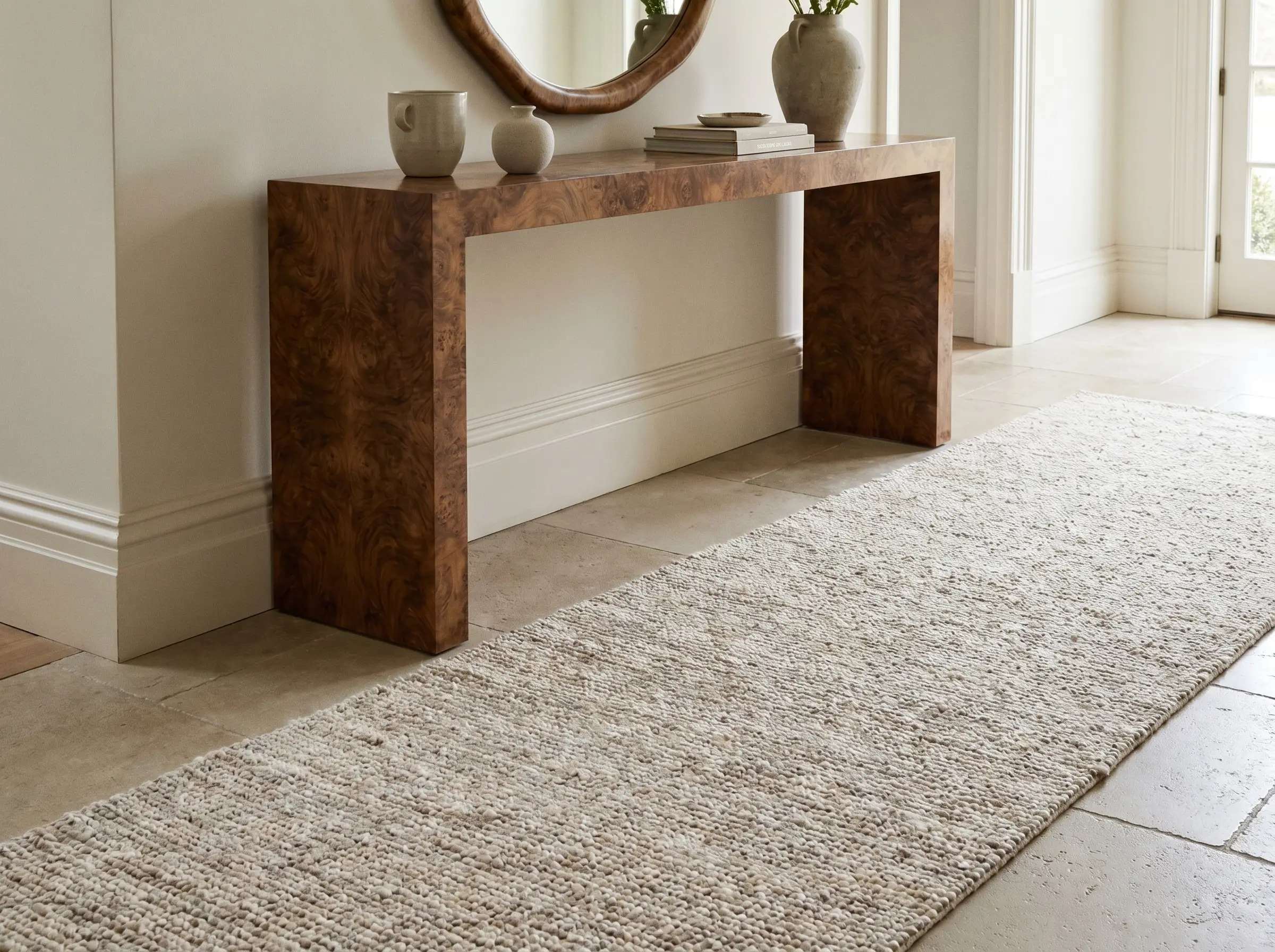
Burl wood aggressively fights with heavily patterned Persian or Oushak rugs, creating a visually chaotic floor plane. To solve this competitive gap, place a solid, highly textural hand-knotted silk or sheared wool runner underneath the console, allowing the subtle sheen of the silk to quietly reflect the table’s finish.
- Styling Vibe: Quiet Textural Grounding
- Key Materials: Hand-knotted silk, sheared New Zealand wool
Do/Don’t Box:
- Do: Source solid, highly textural rugs with a subtle sheen that provide a quiet base.
- Don’t: Pair burl with high-contrast geometric prints or busy traditional motifs that compete with the wood grain.
Flank the Console with Upholstered Boucle Stools
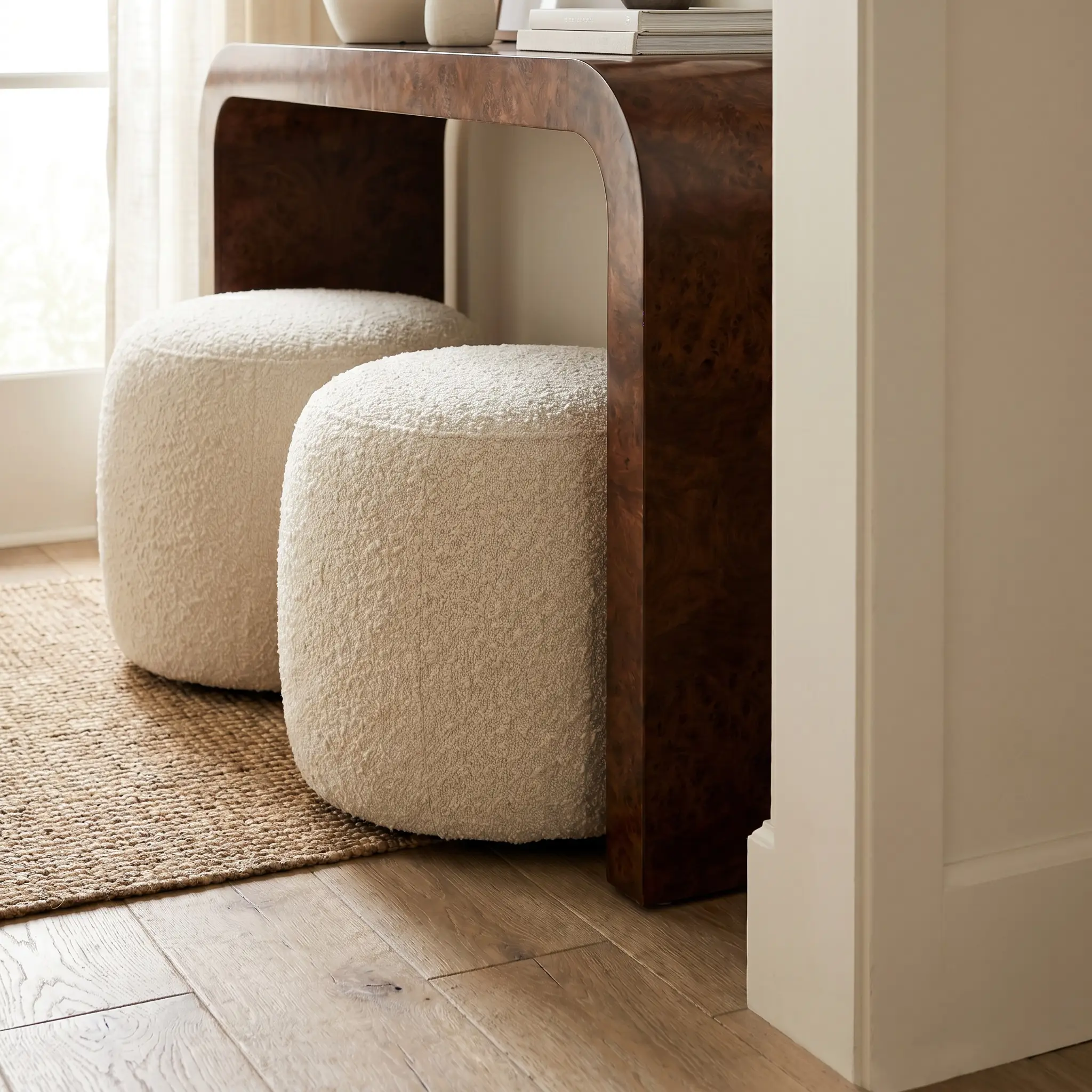
Tucking two small, rounded boucle or shearling ottomans beneath a tall waterfall console adds immediate textural softness and functional seating for removing shoes. The matte, nubby texture of the fabric acts as a brilliant counterpoint to the smooth, hard surface of the wood.
- Styling Vibe: Soft Tailored Function
- Key Materials: Heavyweight boucle, natural shearling
- Color Recommendation: The upholstery must be a soft, matte cream or ivory to create a sharp, high-end pop against the dark brown wood.
Wall Treatments and Architectural Pairings
High-end interior design considers the background architectural envelope just as rigorously as the foreground object. The wall treatment directly behind the table dictates how the wood is perceived.
Set Against Roman Clay or Venetian Plaster
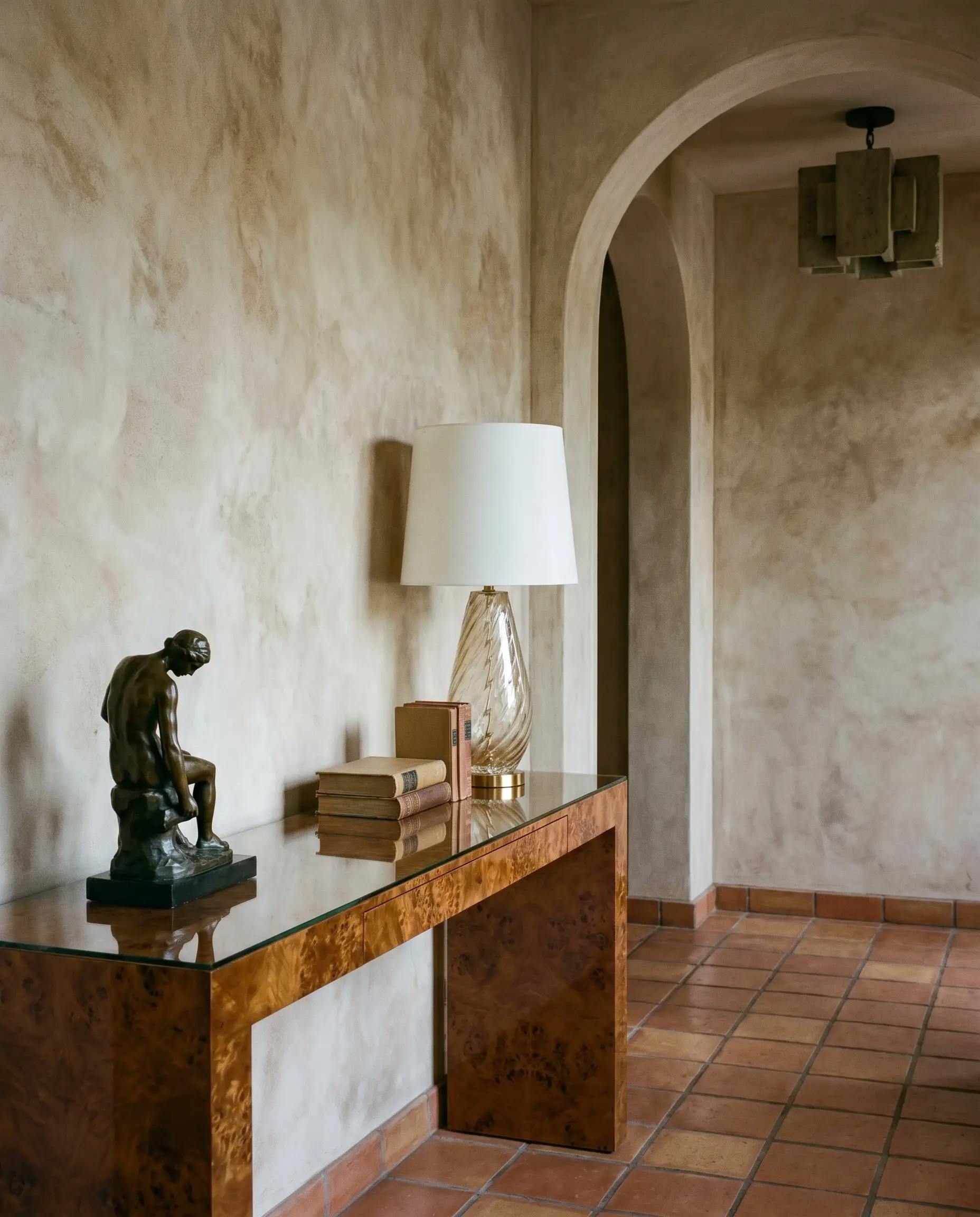
The subtle, mottled texture of matte plaster walls provides the absolute perfect backdrop for a high-gloss burl console. This pairing creates a masterclass in visual tension, contrasting the glassy, reflective surface of the wood against the dry, chalky depth of Roman clay and Venetian plaster entryway walls.
- Styling Vibe: Old World meets 70s Glamour
- Key Materials: Venetian plaster, Roman clay
- Visual Tension: High-gloss polished veneer against dry, matte architectural walls.
Pair with Deep Moody Paint Tones for Drama
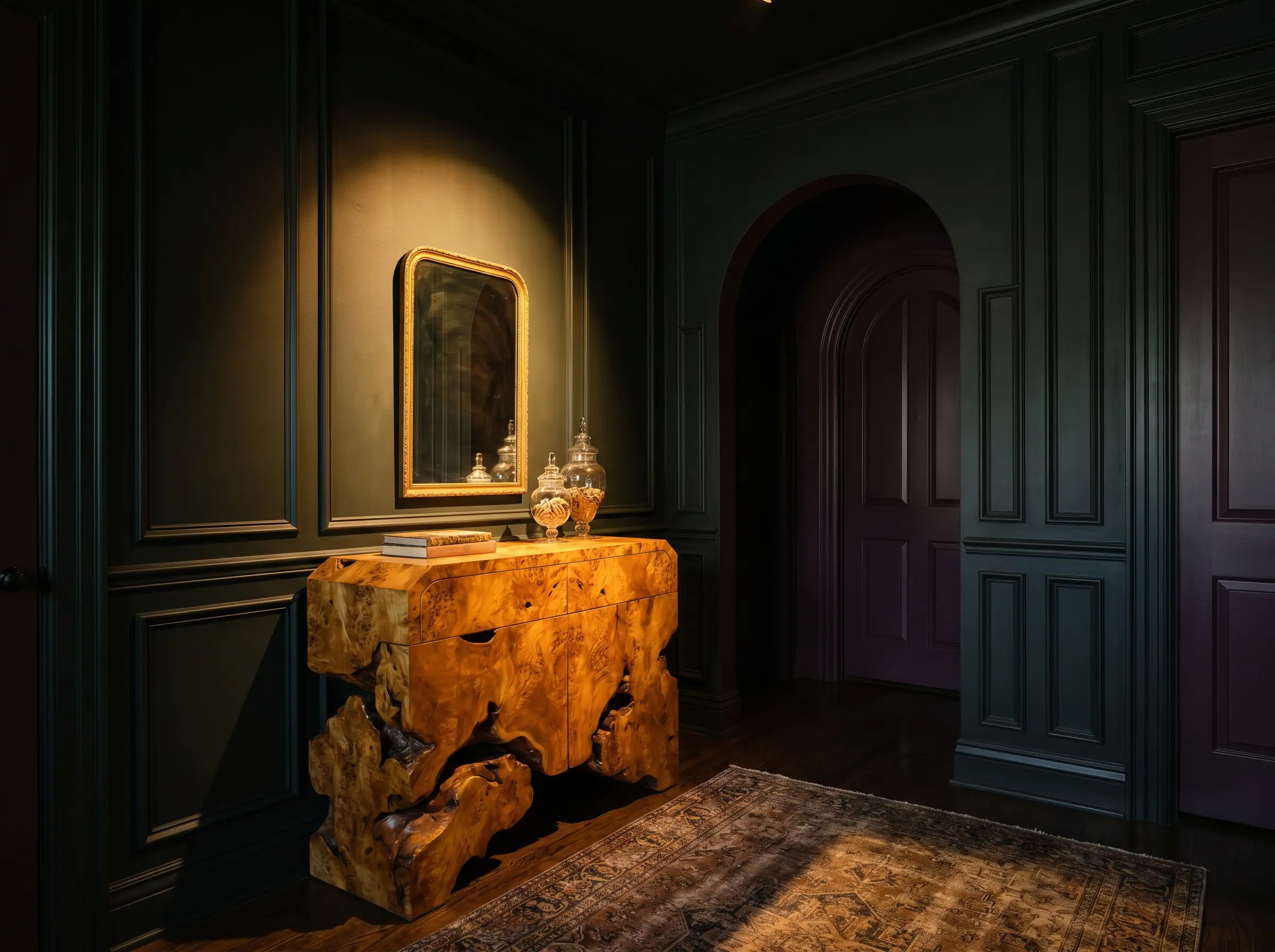
Instead of defaulting to stark gallery white, painting the entryway walls in deep aubergine, blackened green, or rich charcoal forces the amber and honey tones of the burl wood to glow aggressively. This high-contrast, moody aesthetic turns the foyer into an intimate, jewel-box experience.
- Styling Vibe: Jewel-Box Drama
- Key Materials: Ultra-matte estate emulsion paints
- Paint Recommendation: Farrow & Ball Studio Green, Farrow & Ball Brinjal
Accentuate with Brass or Aged Bronze Wall Sconces
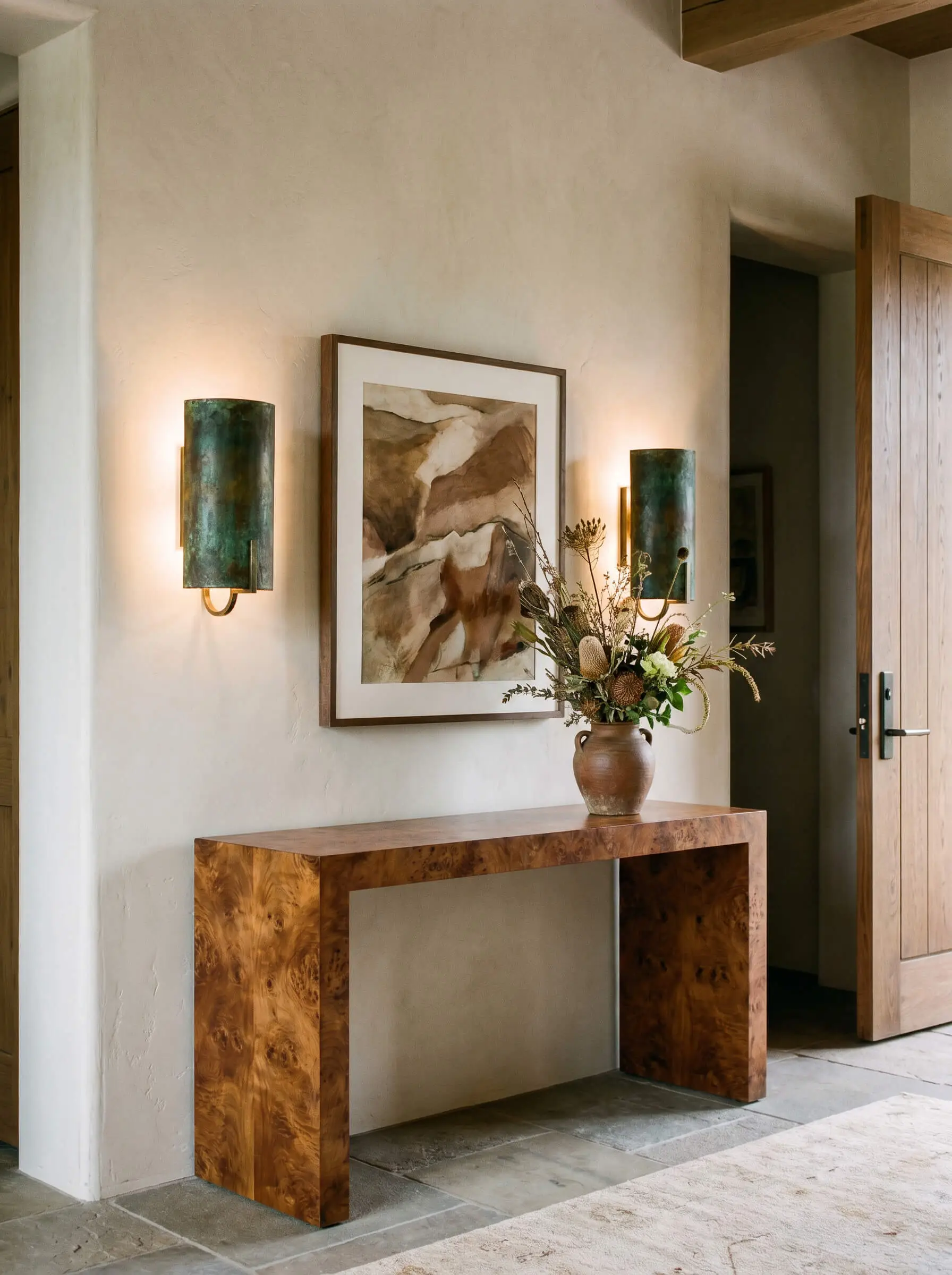
Flanking the mirror or artwork above the console with heavy, unlacquered brass or aged bronze hardwired sconces anchors the vignette into the architecture. These warm, living metals naturally patina over time, harmonizing flawlessly with the warm, organic undertones of the wood.
- Styling Vibe: Architectural Permanence
- Key Materials: Unlacquered brass, aged bronze
- Installation Pro-Tip: The sconce placement must be rigorously symmetrical to balance the asymmetrical floral arrangements placed on the console below.
Position Beneath Double-Height Foyer Staircases
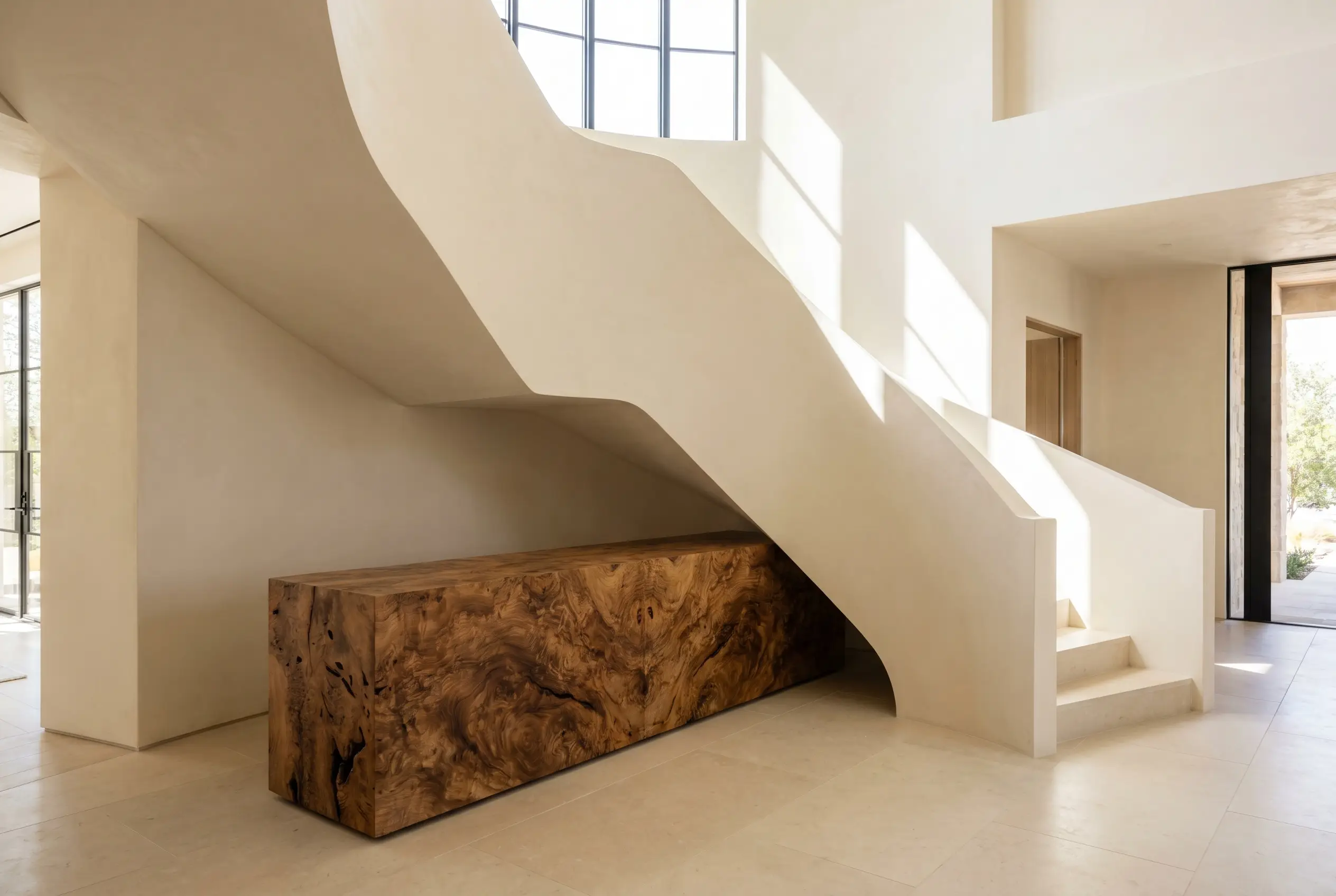
In luxury floor plans featuring a sweeping grand staircase, the negative space beneath the curve often feels vast and empty. Housing a heavy, brutalist burl console directly in this alcove anchors the floating architecture of the stairs, grounding the sweeping curves with a solid block of highly figured wood.
- Styling Vibe: Spatial Anchoring
- Key Materials: Monumental burl blocks, curved plaster staircases
- Spatial Planning: Ensure the console is deep enough (at least 18 inches) so it doesn’t look dwarfed by the massive overhead architectural volume.
Sourcing and Executing the Final Details
Transitioning from aesthetic theory to procurement requires a strict understanding of material quality. Knowing exactly what to specify separates a genuinely curated home from a superficial catalog replica.
Identifying Authentic Book-Matched Olive Ash
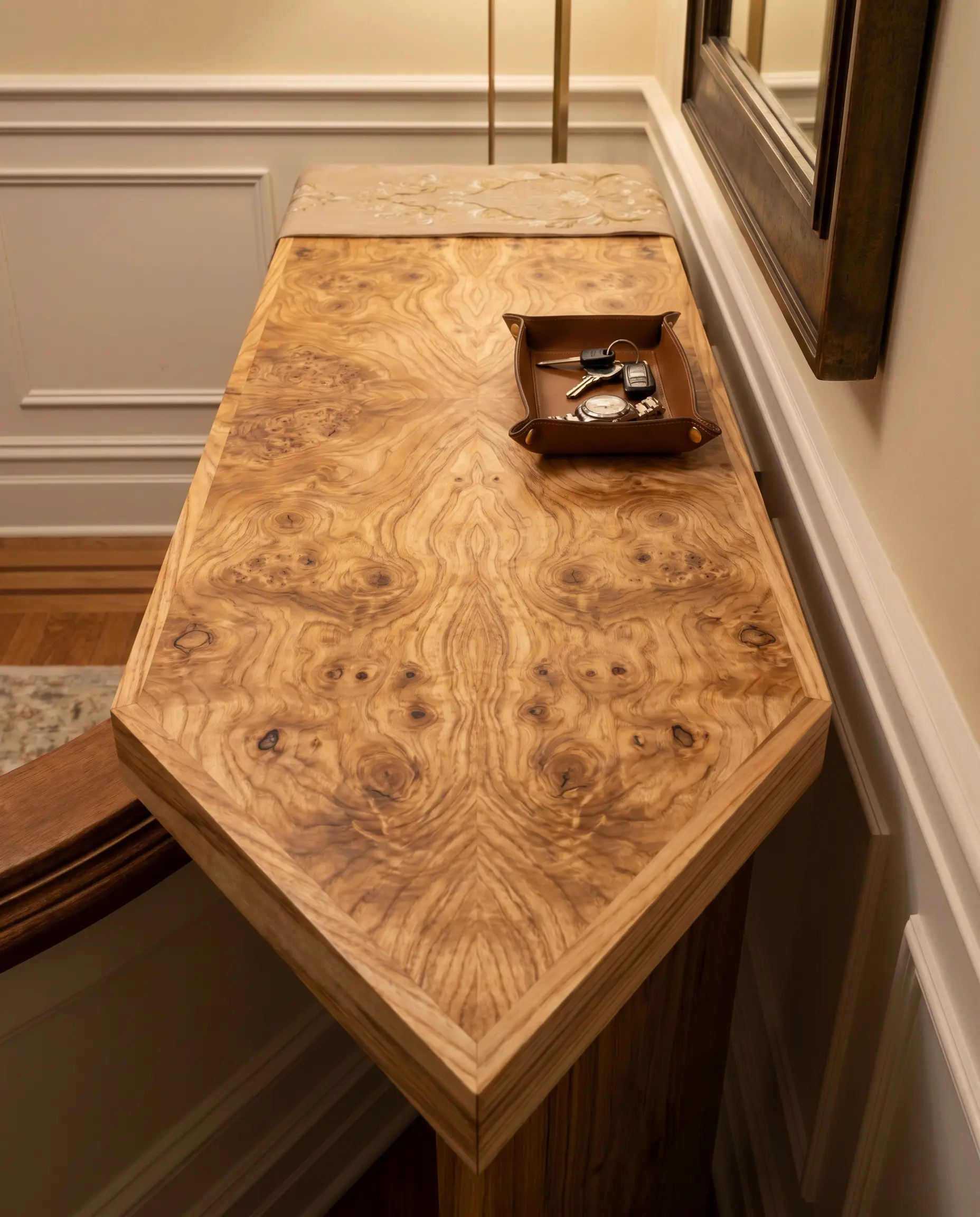
Because solid burl grows in chaotic knots, it is structurally unstable; therefore, luxury burl is almost always applied as a premium veneer over a solid hardwood core. The absolute hallmark of expensive craftsmanship is book-matching—the meticulous process of slicing and mirroring two adjacent sheets of veneer so the grain creates a perfectly symmetrical, kaleidoscopic pattern.
- Styling Vibe: Bespoke Craftsmanship
- Key Materials: Olive Ash Burl, premium core substrates
- Quality Check: Run your hand along the edges; high-end pieces will have thick veneer banding, not cheap painted edges.
Sourcing Vintage Milo Baughman vs. Contemporary Bespoke
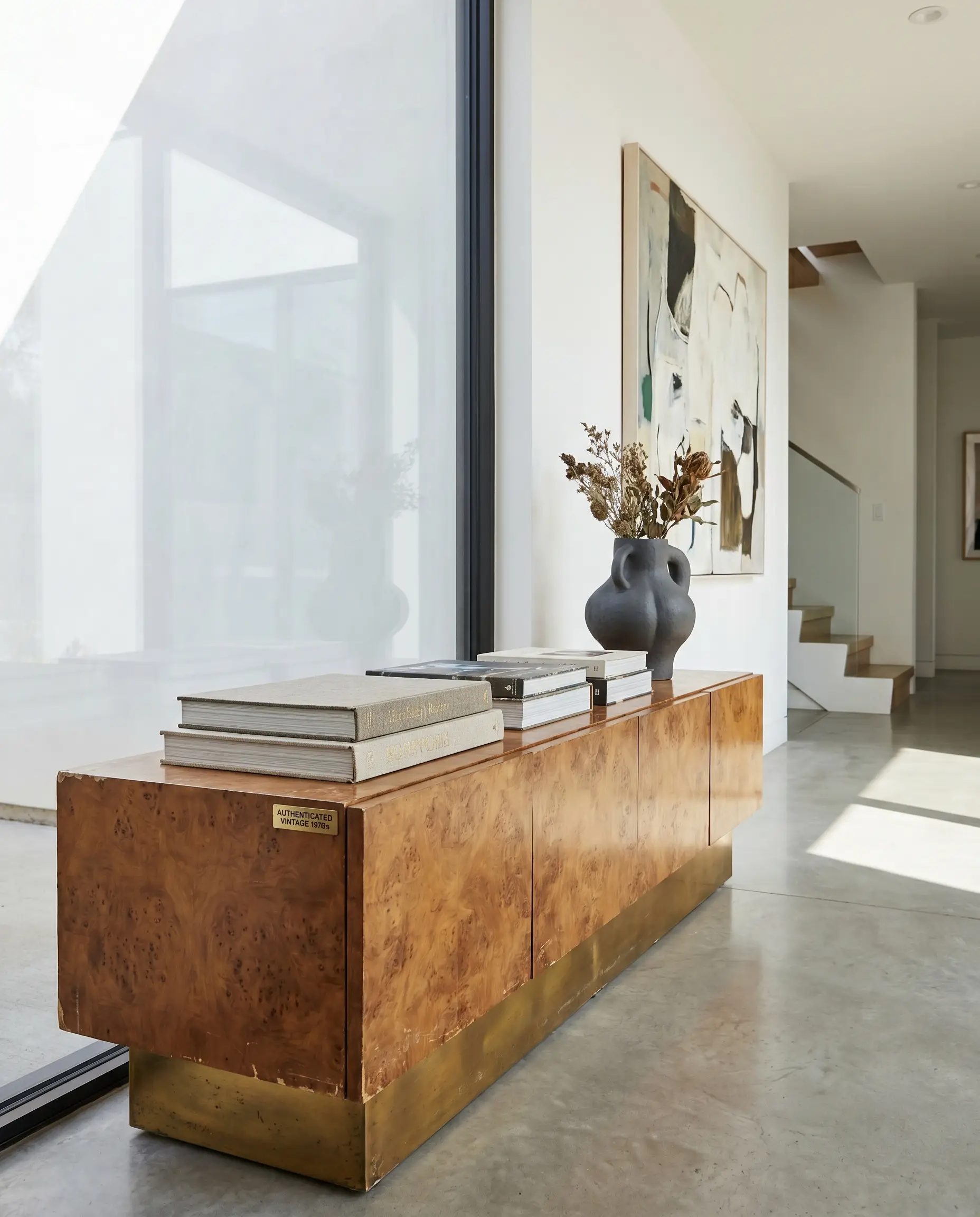
Acquiring the perfect piece often comes down to hunting for authenticated 1970s vintage designs—such as iconic works by Milo Baughman for Thayer Coggin—versus commissioning a local millworker to fabricate a custom postmodern cylinder console. Both avenues offer distinct luxury advantages depending on your project timeline and required dimensions.
- Styling Vibe: Authenticated Curation
- Key Materials: Vintage authenticated pieces, custom millwork
Sourcing:
- Vintage Milo Baughman: Pros: Immediate investment value, authentic patina. Cons: Fixed dimensions, potential restoration costs. Lead Time: Immediate (if sourced via galleries).
- Contemporary Custom Build: Pros: Exact spatial dimensions, choice of specific burl species (Mappa vs. Walnut). Cons: Zero historical provenance. Lead Time: 12 to 16 weeks.
The Importance of UV-Resistant Finishes Near Foyer Doors
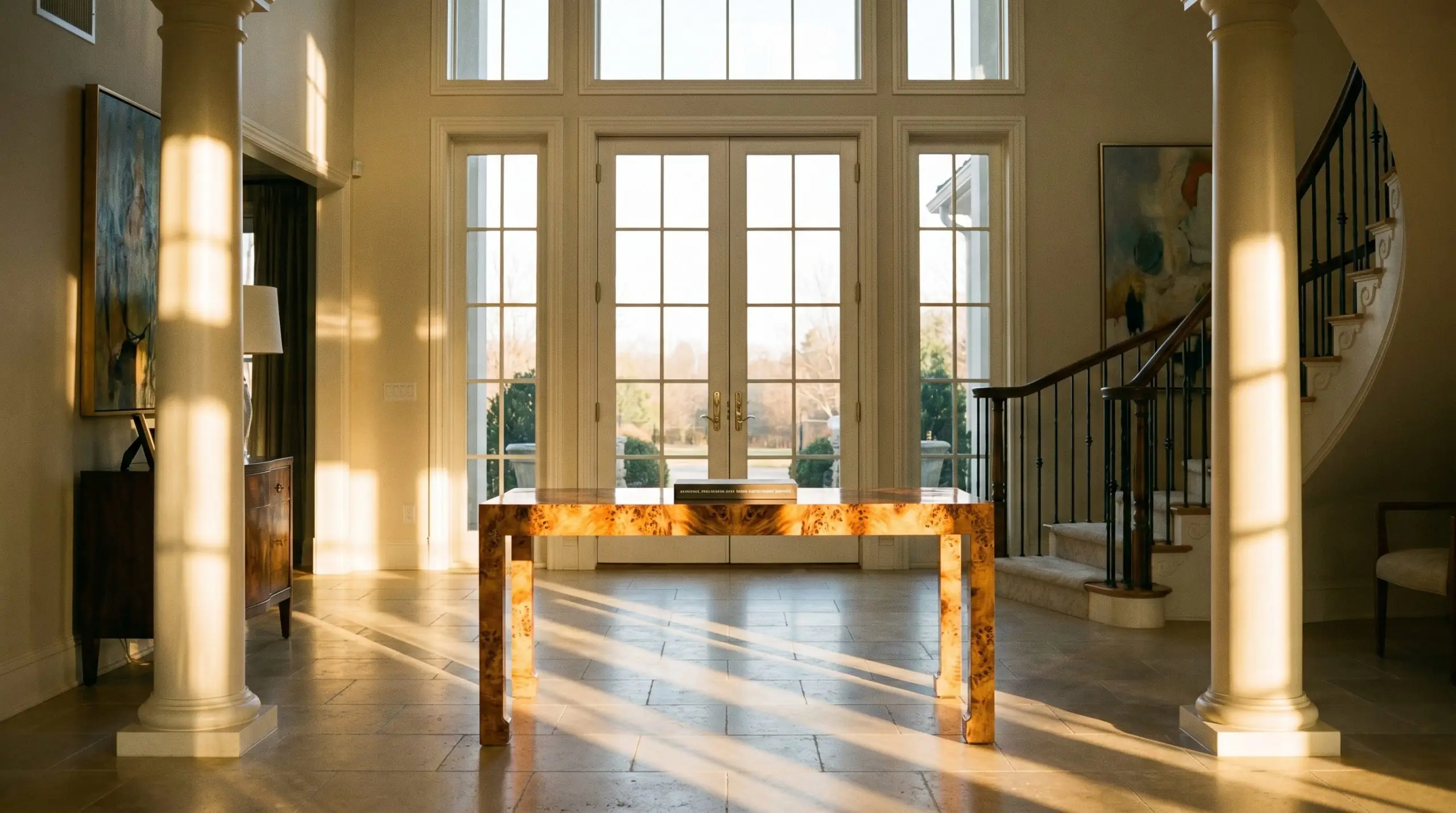
Grand entryways frequently feature large glass double doors or floor-to-ceiling sidelights that flood the space with natural light. Burl wood is exceptionally susceptible to sun fading, which will rapidly bleach the wood and destroy the high-contrast grain that makes the piece valuable.
If your console sits in direct path of afternoon sunlight, you must specify a museum-grade UV-resistant lacquer from your fabricator, or apply UV-blocking window films to your foyer doors. Failure to do so will ruin the veneer within a year.
Hackrea Architectural Warning
- Styling Vibe: Archival Preservation
- Key Materials: UV-resistant marine-grade lacquers, architectural window films
- Maintenance Pro-Tip: Rotate styling objects (like books or trays) monthly to prevent distinct shadow lines from burning into the wood’s finish.
Curating the Perfect First Impression
Bringing a high-end burl wood console into the foyer is a bold, sophisticated choice that signals an immediate appreciation for complex materials and architectural history. It is not a piece of furniture that allows for lazy styling. It requires strict curation of ambient lighting, tactile rugs, and contrasting wall finishes to ensure the grain remains the undisputed focal point of the space.
The result of this meticulous restraint is an undeniably bespoke entrance that feels heavy, permanent, and incredibly deliberate. Before you commission a custom build or source a vintage masterpiece, evaluate your current entryway lighting and floor coverings. Ensure your architectural envelope is ready to support the chaotic, beautiful weight of the wood, and let the console define the luxury standard for the rest of your home.

The Hackrea Style Desk treats interior decoration as an exact visual science. Rather than focusing on demolition or floor plans, this desk masters the art of color theory, undertone matching, material pairings, and spatial proportion. From balancing the visual weight of mixed metals to finding the perfect bridging tone between disparate wood species, this desk provides the rigorous aesthetic rules needed to achieve high-end, editorial-quality harmony in any space.